
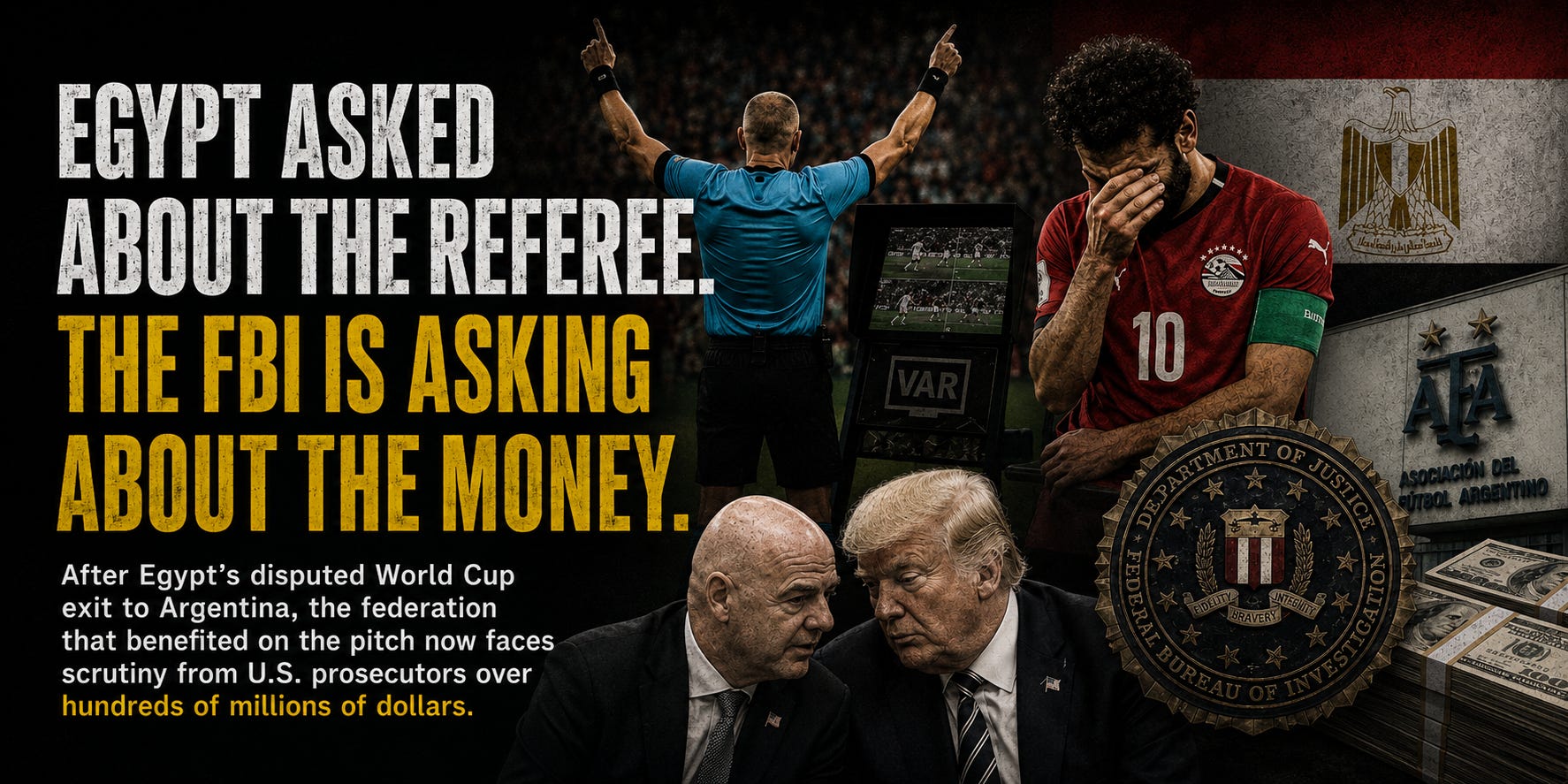
Egypt did what losing teams are usually punished for doing: it asked questions.
After surrendering a 2–0 lead in a 3–2 World Cup exit to Argentina, Egypt’s federation filed a furious complaint over the officiating, the VAR decisions, a disallowed goal, and a penalty it says should have been given. Reuters reported that Egypt said it would not remain silent over what it described as the improper use of VAR, pointing to decisions it argued directly shaped the outcome of the match.
In football, the losing side is rarely allowed to demand accountability without being accused of bitterness. The powerful called it passion when Egypt complained. But then came the more revealing story:
Argentine media now report that FBI agents and U.S. federal prosecutors are taking testimony over the Argentine Football Association’s financial operations in the United States. According to AS, investigators are looking at AFA-linked business through TourProdEnter LLC and trying to understand how more than $300 million was allegedly channeled through the U.S. financial system, and whether any of it could amount to money laundering or bank fraud under American jurisdiction.
The allegations are not about football’s usual theater of corruption: the soft penalty, the convenient whistle, the mysticism of VAR, the referee who somehow sees everything except the thing everyone else saw. It’s about the bank accounts, commercial contracts and the millions that move quietly while the world watches the ball.
While we should not pretend an investigation is a conviction, we also must not pretend the timing is meaningless either.
What happened to Egypt cannot be separated from what Egypt became in this tournament. Their national team became a source of joy for people who need joy and a stage where something more honest slips through the corporate choreography.
That is what happened when Hossam Hassan carried the Palestinian flag after Egypt’s win over Australia and dedicated the victory to the Egyptian people and the Palestinian people. He asked God to have mercy on Palestine’s martyrs. He spoke about Gaza. He said his heart and soul were with Palestinians.
For a moment, the World Cup’s sanitized nationalism cracked open. A football coach said what so many institutions spend their lives avoiding, naming the people and the grief, underlining that a victory could belong to more than the players who won it, it could belong to humanity … it could be their hope.
Days later, before facing Argentina, Hassan went further. Asked about Palestine, he said anyone who does not feel for the Palestinian people is “not human,” and tied football’s own language of respect to the right of people to live. That is why Egypt’s run mattered beyond football because it carried a contradiction every Egyptian knows.
The people’s Egypt and the state’s Egypt are not the same country. One chants for Palestine from the stands. The other manages Palestine through security coordination, border politics, diplomacy, and American money. One sees Gaza as family. The other sees Gaza as a file. One wants the border to become a lifeline. The other lives inside the architecture of Camp David, U.S. aid, and a regional order built to keep rage contained.
Egypt’s president can say there will be no popular normalization with Israel until the occupation ends and a Palestinian state is established. The statement lands because it reflects a real public truth: popular normalization has never looked like state normalization. But it also lands inside a state system that has maintained the peace treaty, preserved extensive security ties, and continued to receive roughly $1.3 billion in annual U.S. military aid.
So when Hassan lifted the Palestinian flag, he was exposing a gap between what people feel and what states permit. The gap between the official language of “stability” and the public language of dignity. The gap between a regime that polices dissent and a population that still finds ways to say Palestine out loud.
Human Rights Watch has reported that Egypt continues to detain and prosecute critics and activists, including people connected to Palestine solidarity demonstrations. Amnesty International has also described a broader human rights crisis marked by unfair trials, repression, and impunity.
That is part of why the World Cup moment hit so hard for so many. Because the stadium briefly allowed what the street often cannot. A people could recognize themselves in a team that, for once, did not seem to be asking them to forget who they were. And then, Egypt met Argentina in a match that should have been remembered as one of the great Egyptian performances, but instead became something else entirely: a collapse wrapped in controversy, a comeback shadowed by questions, a team that led the champions and then left feeling robbed of even the right to understand how it happened.
Egypt had already been carrying more than football. It was carrying Palestine’s joy for a few hours. It was carrying the anger of people who have watched the world turn massacres into abstractions.
It was carrying the pride of a public used to being humiliated by power at home and lectured by power abroad. It was carrying the hope that, even in a tournament built by money, spectacle, and state branding, something human could still break through.
Then it was told to accept the result.
Power always begins with a rulebook. It asks you to trust the process, then punishes you for reading the fine print and you suddenly become the problem.
Too emotional. Too political. Too suspicious. Too Arab. Too African. Too unwilling to accept that justice, like everything else, is apparently subject to interpretation when power is on the other side of the pitch.
Egypt did not accept the script. It questioned a match and was told to move on. Argentina’s federation is now facing questions from prosecutors, and that is the part football does not want to confront.
After Egypt filed an official complaint over the biased refereeing in its 3–2 collapse against Argentina — including a disallowed Egyptian goal and a late penalty appeal that was not given — FIFA has now reportedly appointed an all-Argentine officiating crew for France–Morocco.
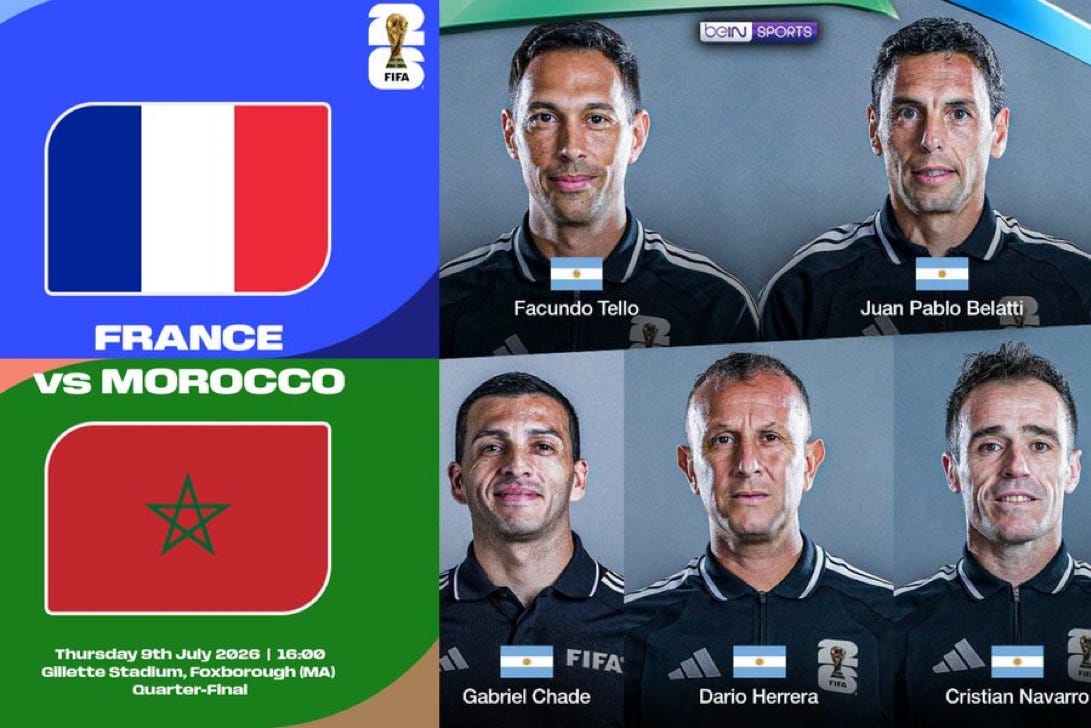
The referee: Facundo Tello. His assistants: Juan Pablo Belatti and Gabriel Chade. Fourth official: Darío Herrera. Reserve assistant: Cristian Navarro.
The sport loves the mythology of fairness.
Football is played inside systems. Some teams arrive with global brands, friendly broadcasters, protected legends, commercial empires, and federations woven into the business of the game. Others arrive with grief, pressure, and the knowledge that one mistake will confirm every prejudice against them.
Egypt was allowed to inspire, as long as it did not accuse. It was allowed to make the tournament beautiful, as long as it did not make the tournament uncomfortable.
It was allowed to carry Palestine, as long as that solidarity remained a moment of emotion rather than a demand for accountability.
But the problem with dignity is that once people feel it, they rarely agree to return quietly to their assigned place. Egypt’s World Cup was never clean. It was always full of contradictions. A national team embraced by people who distrust the state. A coach with his own complicated history suddenly saying something morally clear. A regime trying to harvest patriotic pride while fearing the politics that patriotism can unleash.
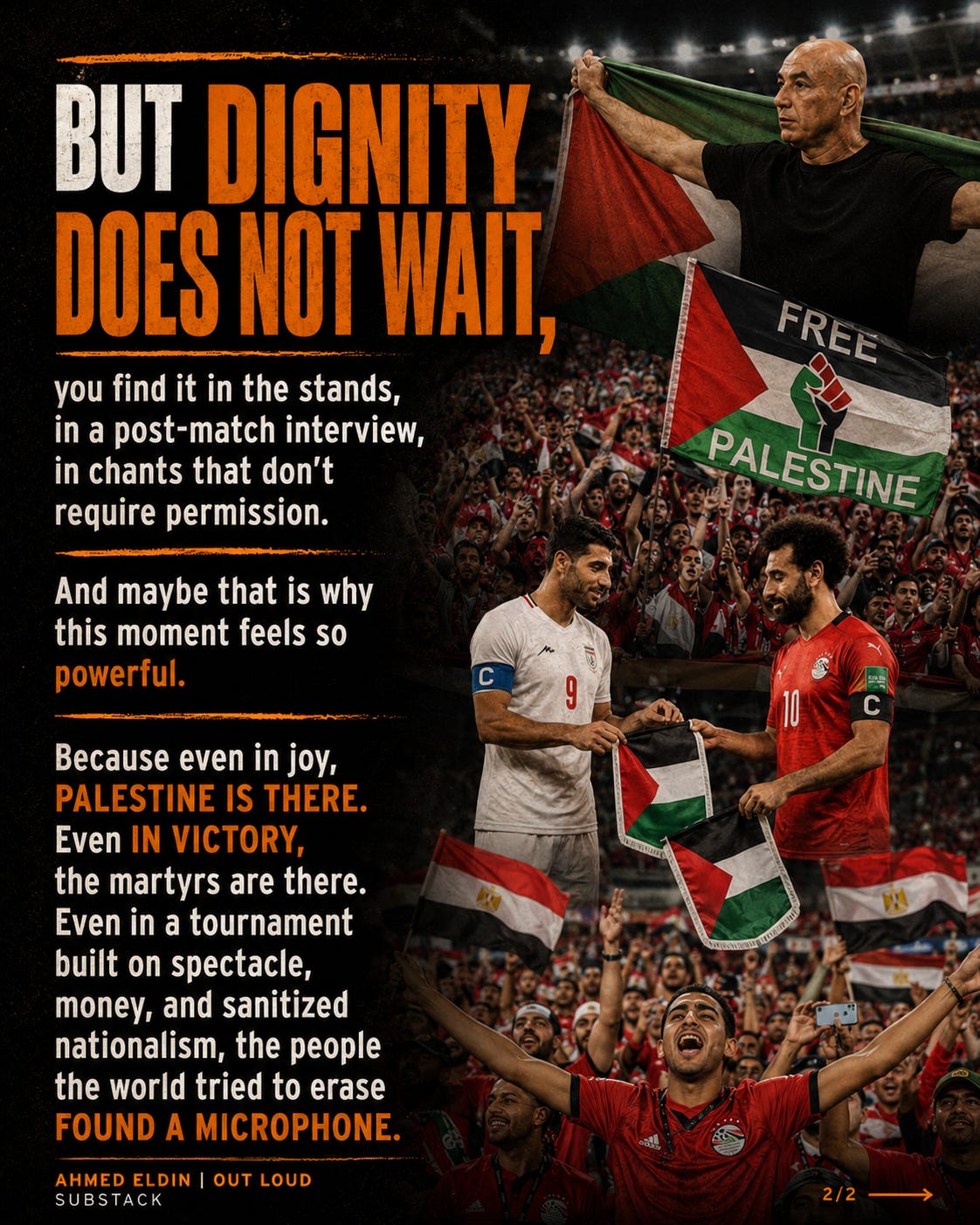
A team that gave Gaza a reason to cheer and then left the tournament asking whether the game itself had been honest.
And across from all of that stood Argentina: champions, icons, protected spectacle.
Now there are transfers, bank accounts, commercial vehicles, prosecutors, testimony, and the possibility that the clean image of football’s royalty may depend on systems far dirtier than anything that happened in the penalty area.
This proves something damning: the institutions that tell losing teams to stop asking questions are themselves surrounded by questions they cannot control.
On the field, Egypt was denied answers.
Off the field, Argentina may now be forced to provide them.
Comments
Nothing yet. Say the first thing.
Sign in to join the conversation.