
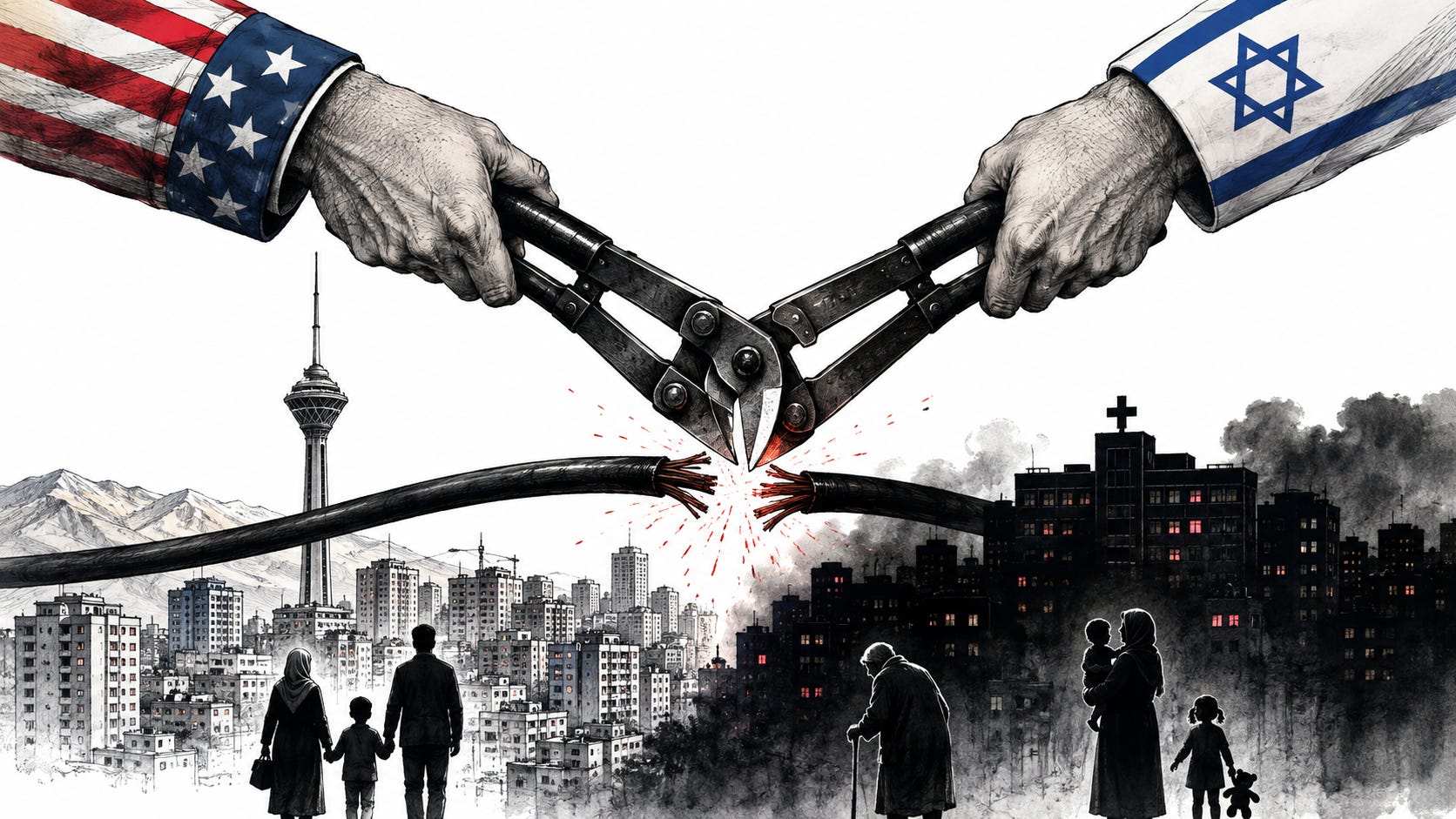
On Friday, senior U.S. officials sat down at Camp David and talked through a specific idea: cutting electricity to Tehran, a city of roughly ten million people. CBS News reported that no final decision had been made as of Friday afternoon, but the plan around it had already hardened into something close to policy: a joint U.S.-Israeli bombing campaign against Iran’s energy infrastructure, power plants and refineries included, with strikes possibly starting this weekend. One source said there was pressure inside the White House to wrap it up before markets open Monday, which tells you all you need to know about whose costs get weighed in these conversations and whose don’t.
Asked about it in front of reporters, Trump didn’t reach for euphemisms. “We’ll be hitting them very hard,” he said. A former U.S. military official told CBS the real value of hitting energy infrastructure was crippling Iran’s ability to govern and deliver basic services: hospitals, water pumps, traffic systems, refrigeration, the very machinery that keeps a population alive day to day.
Let’s call this what it is: collective punishment.
The strikes have been chewing up the grid for weeks now. Al Jazeera reported that Iran’s national electricity company logged a 4,200-megawatt drop in grid capacity and damage at more than 2,000 points on the network, on top of a brutal summer heat wave.
Tehran’s city council chairman was asked why blackouts kept hitting without warning. He told a reporter to go count how many electrical facilities had just been bombed and then ask that question again. University final exams have been pushed back because the servers went down mid-test. A vendor lost 400 pounds of ice cream to a blackout and became a minor viral folk hero for his fury about it, the kind of small, absurd detail that tells you a population is being worn down by something entirely out of its hands. What’s being discussed now is a deliberate plan to finish what the strikes started.
Article 33 of the Fourth Geneva Convention bans collective penalties against a civilian population, full stop. Article 54 of Additional Protocol I goes further, specifically protecting “objects indispensable to the survival of the civilian population” and naming water and power installations by name. Yusra Suedi, an international law professor at the University of Manchester, called an earlier version of this same threat “clearly an act of collective punishment.” Genocide Watch laid out the case back in April: more than 100 international law scholars, from Harvard, Yale, Stanford, several former JAG officers among them, had already warned in an open letter that strikes on Iran’s civilian infrastructure raised serious war crimes concerns. Amnesty International’s own analysis of the threat called it disproportionate and unlawful on its face. Kenneth Roth, the former Human Rights Watch director, put it bluntly: he saw no real difference between this and what the ICC charged Russian commanders with in Ukraine, where judges found reasonable grounds to believe deliberate strikes on power stations amounted to a war crime.
Courts and treaty bodies have long settled these questions. What’s happening now is a test of whether anyone intends to honor them.
Israel cut electricity to Gaza after October 7, 2023, and its energy minister announced the move himself, framing it openly as leverage. Human rights groups and even allied governments pushed back in terms that should sound familiar by now. Then–UN Secretary-General Ban Ki-moon said has clearly said that cutting power to an entire population to pressure its government violates international humanitarian law. It wasn’t even the first time: Amnesty International called the 2006 bombing of Gaza’s only power station a war crime under the Fourth Geneva Convention, nearly two decades before the current war began. A UN Commission of Inquiry has since concluded that Israel’s conduct in Gaza amounted to genocide. South Africa’s genocide case against Israel is still in its written pleadings phase at the ICJ, with no final ruling expected for years. While the legal process moves ever so slowly, the blackouts, the darkened hospitals, the spoiled insulin and failed dialysis machines don’t wait for it.
The pattern is simple, and it keeps repeating: a power grid gets treated as a lever instead of the thing keeping people alive, and the people on the other end of the switch are civilians.
The Pentagon won’t confirm targets before Trump signs off, and press secretary Karoline Leavitt has said only that U.S. forces operate within the law. When officials do choose to make an argument, it usually is based on this: Iran runs one unified grid for military and civilian users alike, so the whole system counts as fair game, the same “dual-use” logic the U.S. has already leaned on for the bridges it’s bombed in this war.
Legally, that reasoning doesn’t erase the rule that civilian harm can’t be excessive relative to whatever military gain is on the table. And it’s worth saying plainly: as of this writing, nothing has actually been struck. This is still a plan being argued over at Camp David, not something carried out. Maybe that distinction will end up mattering. But the switch doesn’t have to be flipped for the intent behind it to be clear, and the people pushing to do it are the same ones who spent two years calling the lights going out over Gaza regrettable, and somebody else’s problem.
Sooner or later, I hope we realize this is all of our problem. This keeps happening, and every time it does without consequence, it gets a little more normal.
It’s not just a moral cost, either. Genocide Watch’s analysis points out that Kuwait, Saudi Arabia, Oman, and the UAE all rely on desalination plants for most of their drinking water, and those plants run on electricity tied to gas drawn from the same Persian Gulf infrastructure now in the crosshairs. A blackout ordered from Camp David doesn’t stay inside Iran’s borders. It can reach taps and hospitals in countries that had no say in any of this either.
Every blackout begins as someone else’s.
The wire doesn’t stop at the border.
Eventually, it reaches our own switch.
Comments
Nothing yet. Say the first thing.
Sign in to join the conversation.