
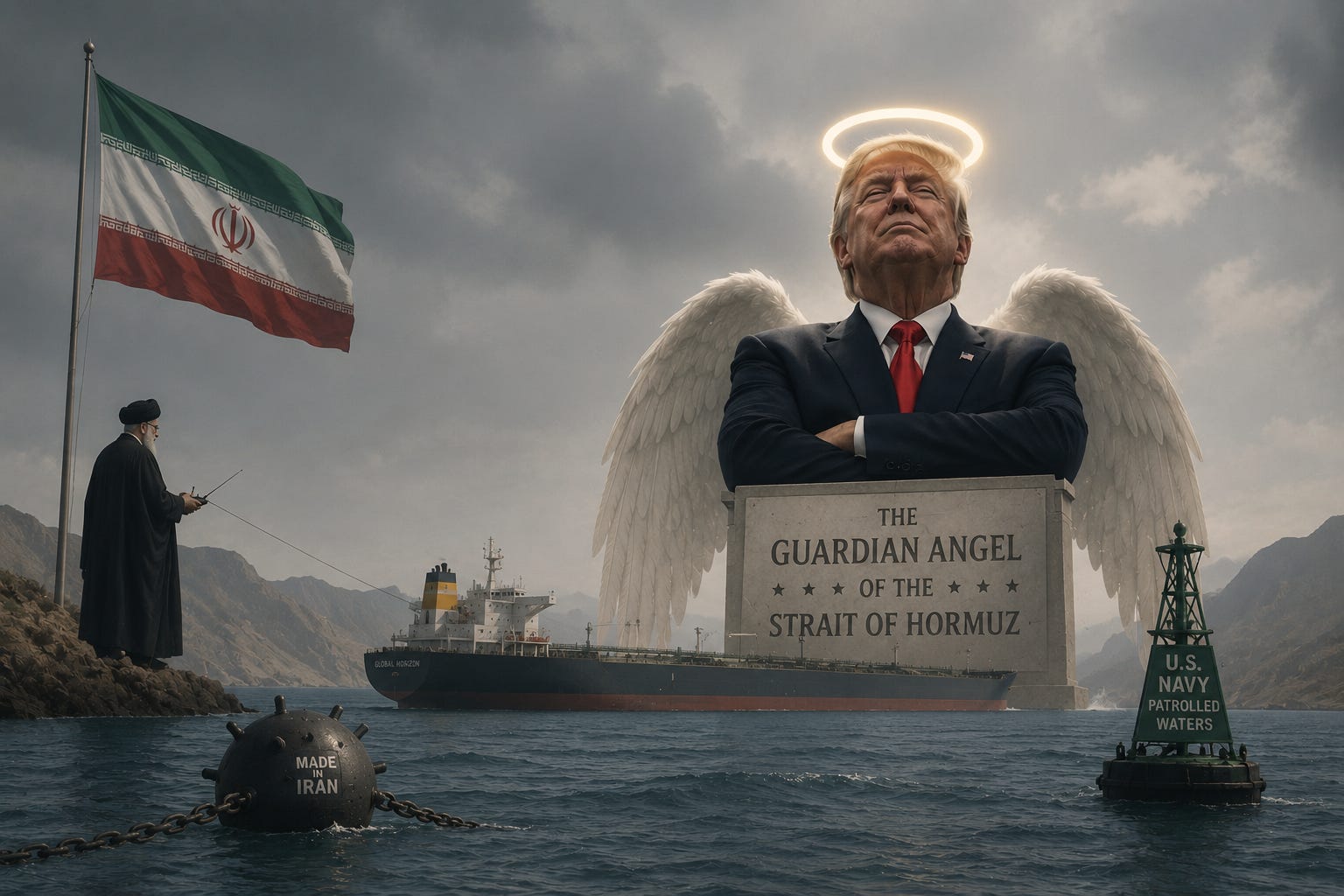
Five months ago, on February 27th, the Strait of Hormuz was open. A fifth of the world’s oil moved through it every day, no questions asked. Today it’s closed, not on paper, but in the way that actually counts. War-risk insurance is running at eight times normal. The biggest shipping lines on the planet are routing around the entire continent of Africa rather than risk it. That’s the smallest cost of this war. The rest is still coming.
Gas was $2.98 a gallon before the first missile flew. It’s over four dollars now, and it touched $4.56 at one point in May. Every American filling up a tank is paying a war tax nobody voted for, funding a war nobody in this administration can explain the end state of.
I wrote about this likelihood on February 27th, the day before the first missile flew.
Twenty percent of global oil trade. Twenty percent of global LNG. A twenty-one-mile-wide chokepoint that Iran had spent decades building the exact naval capability to hold hostage the moment it had nothing left to lose. None of that was classified information. It was sitting in open shipping data, in the record of how this regime uses leverage, and in plain geography. You didn’t need a source inside Tehran to see it coming. You needed to read a map.
A few days after that piece went up, I spent fifty-two days in a Kuwaiti cell. Interrogators sat across from me circling the same questions: who inside Iran’s government leaked me the Hormuz plan. I gave them the same answer every time. Nobody leaked me anything. There was no source, no back channel, no mole. There was a laptop, public shipping data, and twenty years of watching how this regime negotiates. It was easier to invent a spy than to accept that Iran’s next move was obvious to anyone willing to actually study the region.
On the very first morning of this war, a Tomahawk missile, American-made and American-fired, hit a girls’ elementary school in a town called Minab. The AP spent months reconstructing what happened because the Pentagon wouldn’t. Iran puts the toll at more than 150 dead, over 100 of them children. Five months later, there’s still no American accountability or investigation of that morning. The president even floated, with a straight face, that maybe it was someone else’s Tomahawk.
We were told this war would end Iran’s nuclear ambitions. Instead we killed the one man in Tehran who U.S. intelligence itself believed genuinely didn’t want the bomb. His son runs the country now, and our own intelligence agencies are telling the New York Times that Mojtaba Khamenei wants nuclear weapons more than his father ever did. The assassination of Mojtaba’s father, Ayatollah Ali Khamenei, essentially handed the program to someone worse and called it progress.
Then there is the current state of the U.S. military. THAAD interceptors, Patriot missiles, Tomahawks — burned through at a rate that’s got defense analysts warning the U.S. isn’t positioned for anything else right now; not Taiwan, not Korea, nothing. The U.S. strategic petroleum reserve is at its lowest point since 1983, drained trying to blunt a gas price crisis this war created in the first place. Eighteen American service members dead. Hundreds more wounded, with the Pentagon’s own count creeping upward every few weeks like it’s still catching up to its own war.
Not long ago, Trump was telling reporters the U.S. would take control of the strait outright, that it would become the “Guardian Angel of the Strait,” implying that shippers should pay Washington a toll for the privilege. In June he signed a memorandum in Versailles declaring the strait would reopen and calling it a major win. During the NATO summit in July, he was the one announcing that same memorandum dead. Friday, after thirteen straight days of fresh strikes, Trump told the military to stand down, then told a room of reporters the same line he’s been repeating for months: Iran would “love to make a deal.” Meanwhile it’s Oman and Iran doing the actual negotiating over how to reopen the strait — not Washington and Tehran. The self-declared Guardian Angel isn’t even in the room.
Today, while his own administration was telling reporters that those talks were making real progress, an oil tanker exploded after striking an Iranian naval mine — a mine that turned up the moment a ship strayed from the shipping corridor Iran unilaterally decided is the only safe one, according to its own Tasnim news agency.
Men in a Kuwaiti interrogation room spent fifty-two days refusing to believe a journalist could predict this inevitability without a leak. The only person who genuinely didn't seem to see where this war would take us — and still, this week, doesn't seem to realize it — is the man who gave the order to start the war in the first place.
Comments
Nothing yet. Say the first thing.
Sign in to join the conversation.