
In 1983, one year before I was born, one of Italy’s biggest bands wrote a song called “Palestina.”
Matia Bazar planned to perform it at Sanremo, the country’s most-watched music festival, but the festival rejected it. Not because of profanity or incitement, just the title itself was the problem. So, the band played something else instead: “Vacanze Romane,” which became one of the biggest hits in Italian pop history.
The song itself never says anything direct. It’s built from postcard imagery, kangaroos in Australia, the Great Wall, Big Ben, a sphinx that can’t answer a tourist looking for a motel. Every other place in the song gets flattened into a tourist snapshot. “Palestina” is the one word the song repeats and never explains.
“Palestina” got buried on the album Tango, a b-side nobody was going to remember.
Except it wasn't quite buried. A few weeks after Sanremo turned it away, Matia Bazar performed "Palestina" anyway, on Attenti a noi due, prime-time on Canale 5, Silvio Berlusconi's commercial network, riding the exact fame "Vacanze Romane" had just won them at the festival that wouldn't let its sister song in the building. Sanremo was the stage that mattered, so RAI said no. By the time Canale 5 aired it, "Vacanze Romane" had already made the band famous so saying yes didn't cost anyone anything anymore.
Italy has never spoken with one voice on Palestine. No country does. But there has always been a second Italy running underneath the first one: the Italy that treats Palestinians as people rather than as a subject to be managed, a live wire under the floorboards of the official one.
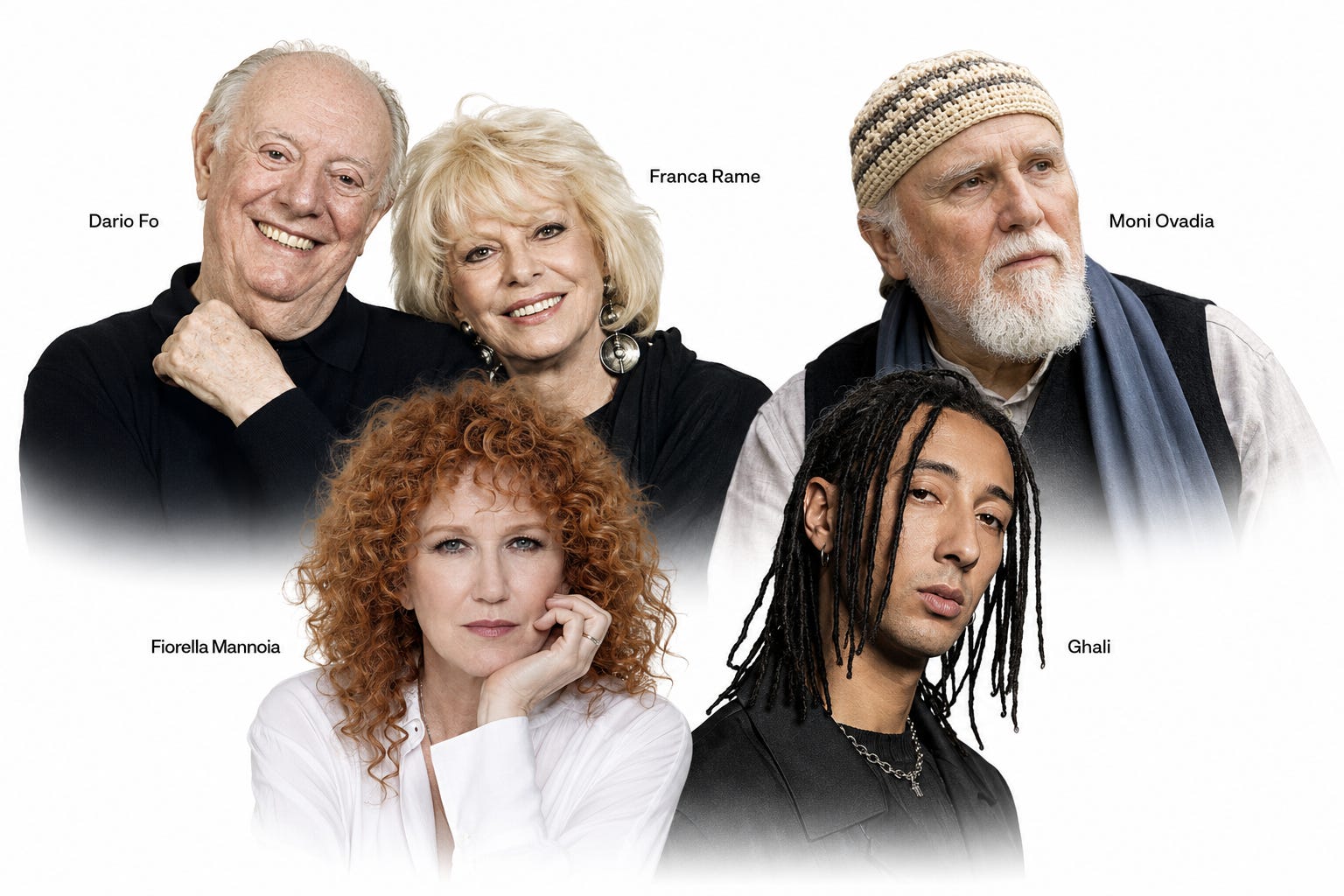
Italy has produced some of the clearest and most consistent artistic voices on Palestinian freedom anywhere in Europe — Dario Fo and Franca Rame, Moni Ovadia, more recently Fiorella Mannoia and Ghali. Today, journalists keep reporting on Palestine despite attempts at censorship and cities still fly the Palestinian flag over municipal buildings, unbothered by who it annoys.
Officially, Italy is still behind. Spain, Ireland, and Norway recognized the State of Palestine back in 2024. By the fall of 2025, Britain, France, Canada, Australia, Portugal, and half a dozen smaller European states had joined them, andthree-quarters of the UN now recognizes a Palestinian state. Italy still hasn’t. Neither has Germany. Both governments have signalled they aren’t planning to anytime soon. Meloni told the UN last September that Israel had crossed a line. The words may keep sharpening, but the policy still hasn’t caught up to them.
The people didn’t wait for it to. After Israeli forces intercepted the Global Sumud Flotilla in international waters, more than two million people walked out of work and school across more than a hundred Italian cities in a single day, one of the largest strikes this country has seen in decades, and recognizing the State of Palestine outright was one of its stated demands. In Genoa, dockworkers blocked a ship loaded with weapons bound for Israel, then linked up with dockers in Spain, France, Greece, and Cyprus so it wouldn’t be a one-time gesture. And while officials kept debating language, Italian hospitals had already taken in hundreds of children evacuated from Gaza for treatment nobody else could give them — doctors and nurses doing, quietly, what their government still won’t say outright.
I live in Italy now. I teach here. I walk streets that still carry this history, whether anyone around me is thinking about it or not. And what’s struck me, living inside it rather than watching from outside, is how old this actually is, and how much of it is still being written.
Francesca Albanese has spent the last several years standing in front of the UN and the world saying the plainest, most necessary things about Gaza, in a register that international bodies aren’t built to receive or reward. Journalists like Lorenzo D’Agostino, detained by Israeli forces and expelled after sailing with the Global Sumud Flotilla, have kept covering what a lot of outlets decided was over. None of this is new momentum. It’s the same current that was already running in 1983; it just has more names attached to it now, and more people willing to say them out loud.
Support for Palestine here in Italy is not a trend, and like Israel’s genocide, it didn’t start on October 7th. It has been threaded through Italian labor movements, cinema, journalism, and local politics for generations — long before it was something you could post about.
Italy is hardly innocent when it comes to complicity in Israel’s genocide, but the solidarity we feel now when we are in Italy has deep roots, and the roots are older than the genocidal war currently still sometimes making headlines.
Undercurrents keep moving beneath whatever’s on the surface, gathering whoever’s willing to be pulled along, until one day the ground can’t hold what’s underneath it anymore. Maybe that’s what this is, not a tidal wave yet, but the water rising toward one.
Maybe that’s why a rejected song from 1983 still matters. Because forty years later, people still remember the name it refused to say, and more of them are saying it out loud now than ever did before.
Italy still hasn’t recognized the State of Palestine. Its people already have.
(Thank you to Raphaël Neal for sharing this song with me)
Out Loud stays independent because readers fund it directly. A paid subscription from you helps make it possible.
Comments
Nothing yet. Say the first thing.
Sign in to join the conversation.