
A week ago, Egypt’s World Cup run already felt bigger than football.
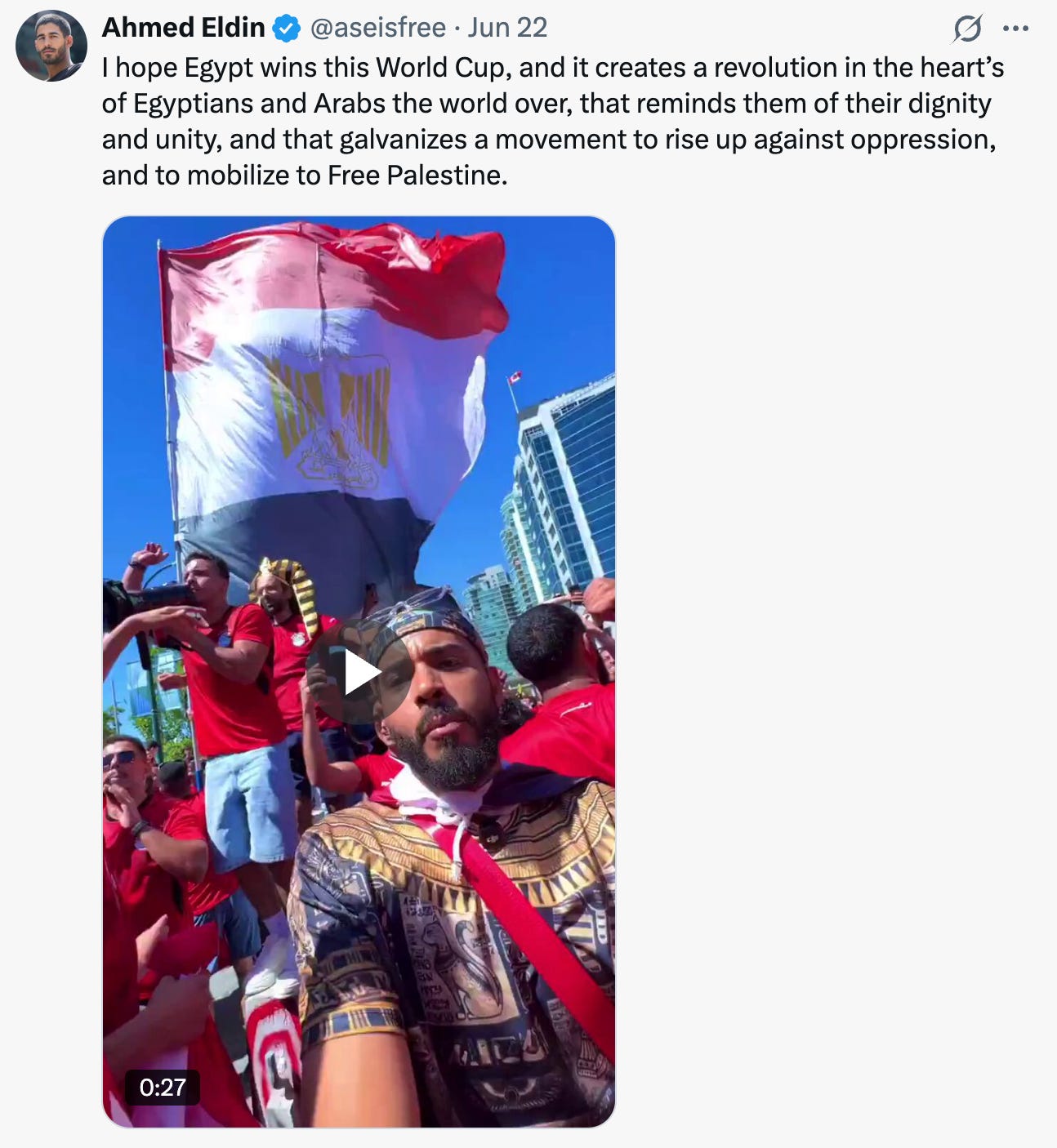
Eight years after their last World Cup match ended in heartbreak, the Pharaohs beat New Zealand 3–1 in Vancouver, claiming their first-ever World Cup win and moving to the top of Group G.
Egyptian fans, thousands of miles from Cairo, were chanting: “We love you Palestine.”
This may look like a slogan looking for a camera. What it is, is actually older, deeper, and more difficult to contain: the voice of a people who know that Palestine is not an issue to be managed, a tragedy to be filed away, or a cause to be dusted off when convenient.
Egypt is reminding us: Palestine is the wound. It is the mirror. And it is the measure.
And now, after Egypt defeated Australia on penalties to win a World Cup knockout tie for the first time, head coach Hossam Hassan gave that feeling a name.
“My heart and soul are with the Palestinian people,” Hassan said after the match. “I thank them and dedicate this victory to them.” He said Egypt had made Arab people proud. He said he wanted to win for “the good people.” And in that moment, a football victory became something else entirely.
Sport usually knows how to keep things safe: wave the flags, thank the sponsors, talk about pride, move on. Hassan could have given the usual answer. Discipline. The nation. The players. The fans. The dream. All of that would have been true enough.
Instead, he redirected a historic Egyptian victory toward Palestine, Gaza, grief, and the Arab world’s unfinished responsibility. He didn’t allow joy to become an alibi for forgetting.
For nearly three years, Palestinians in Gaza have been forced to endure not only bombs, starvation, displacement, and mass death, but the obscenity of being narrated out of their own suffering. The world has tried to turn genocide into a debate, occupation into context, resistance into criminality, and Palestinian grief into a public relations problem.
The dead are counted, disputed, doubted, revised, erased. The living are starved, besieged, filmed, pitied, abandoned. Most of Gaza’s 2.1 million people remain displaced, lacking sufficient access to the essentials of life. And every institution seems to have developed its own language for looking away.
This is what sport can still do at its best. It can gather people across borders, languages, and histories, then remind them of something their governments have spent decades trying to discipline out of them: Dignity is not neutral and memory is not harmless.
A football victory cannot stop a genocide or break open a border, or bring back a single child buried under rubble. But it can reveal what is still alive in people. It can expose the distance between rulers and the ruled. It can show, for one unguarded moment, that the Arab street has not forgotten what Arab capitals have learned to negotiate around.
That is why I hope Egypt keeps winning. Football will not liberate anyone. No national team can compensate for the cowardice of governments, the paralysis of institutions, or the cruelty of a world that has learned to watch Palestinians die in high definition and still call itself civilized.
But the players are dignified people, and the people watching them are carrying something no regime has managed to kill: the knowledge that Palestine is theirs too.
In the Arab world, mass emotion for Palestine is treated as a security problem. Trust me, I have the receipts from prison.
It must be contained before it becomes courage, softened before it becomes demand, and celebrated only when it remains symbolic.
But people have not forgotten, they have only been forced to live under systems that punish memory and crush resistance.
So I hope Egypt keeps winning because perhaps each victory widens the crack, until what begins as a roar in a stadium becomes something no authority can safely ignore.
What happens when millions of people are watching the same team, shouting the same chants, sharing the same clips, feeling the same rush of pride and Palestine keeps entering the conversation? What happens when every Egyptian win carries Gaza and Palestine with it? What happens when joy refuses to be separated from grief?
That is the dangerous possibility inside Egypt’s thrilling run. Not simply that a team wins matches, but that the people watching remember themselves. That a region trained to mourn quietly begins to hear its own voice again. That Palestine, after everything done to bury it, keeps appearing at the center of the celebration.
The Arab people have not forgotten Palestine. They have been forced to live under governments that act like forgetting is policy.
They have watched normalization dressed up as pragmatism, watched summits produce statements while Gaza produces graves, and watched borders remain sealed, trade continue, ambassadors return, and leaders speak of stability while children are slaughtered in real time.
So when Egyptian fans chant for Palestine in Vancouver, and then Egypt’s coach dedicates a historic victory to Palestine’s martyrs, it doesn’t feel like symbolism to me. It feels like a crack in the official script … finally.
The people already know. They know Palestine is not separate from Egypt, from Lebanon, from Jordan, from Syria, from Iraq, from Yemen, from Morocco, from every Arab home where the news from Gaza enters like a wound that will not close.
They know the humiliation of Palestine is meant to teach the entire region obedience. They know the siege is not only on Gaza. It is also on imagination, courage, and the belief that Arab lives can still move history.
Egypt is not just playing for Egypt now, whether it wants that burden or not. It is carrying the grief of people who have had very little to celebrate. It is carrying the anger of people who have been told that rage is irrational, that solidarity is dangerous, that dignity must wait for a better diplomatic moment.
But dignity does not wait, you find it in the stands, in a post-match interview, in chants that don’t require permission.
And maybe that is why this moment feels so powerful. Because even in joy, Palestine is there. Even in victory, the martyrs are there. Even in a tournament built on spectacle, money, and sanitized nationalism, the people the world tried to erase found a microphone.
I hope Egypt keeps winning because maybe every match will widen the crack.
Maybe every victory will force the question more urgently: what would happen if the love, grief, and rage that fill Arab stadiums finally moved off the pitch and into the world?
What would happen if Arab people demanded from their rulers even a fraction of the courage they demand from their players?
What would happen if Palestine was not only remembered in moments of symbolic beauty, but defended with passion and force? I do not know.
But I know this: when Hossam Hassan dedicated Egypt’s victory to Palestine and its martyrs, he did more than honor the dead. He reminded the living that they are still responsible to them.
May Egypt’s run awaken something far beyond football. In Egypt. Across the Arab world. And everywhere people are still refusing to look away from Palestine.
Comments
Nothing yet. Say the first thing.
Sign in to join the conversation.