
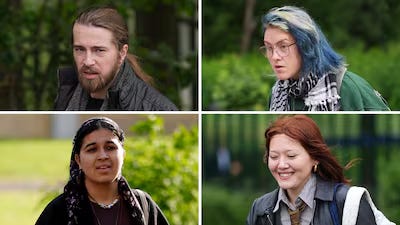
Four Palestine Action activists were sentenced in Britain to more than 22 years in prison after a judge attached a “terrorism connection” to their action against an Israeli weapons factory.
The case began with a raid on Elbit Systems UK’s Filton facility near Bristol in August 2024. Prosecutors said the group used a prison van as a battering ram, sprayed red paint from fire extinguishers, and damaged drones, computers, and military equipment belonging to Israel’s largest arms manufacturer.
The jury convicted them of criminal damage.
The terrorism finding came later, at sentencing.
Justice Jeremy Johnson ruled that the action caused serious damage and was intended to influence the government, intimidate a section of the public, and force Elbit to shut down. That decision means they must serve at least two-thirds of their terms before parole eligibility and face 15 years of terrorism-related notification requirements after release.
These sentences are as devastating as they are dangerous.
Charlotte Head, 30, received five years.
Leona Kamio, 30, received five years.
Fatema Rajwani, 21, received four years and eight months.
Samuel Corner, 23, received seven years and eight months, including a conviction for GBH without intent.
With additional licence periods, the total sentence package rises to 26 years and four months. Then, outside Woolwich Crown Court, the state gave the public a preview of what this new dangerous reality looks like.
More than 100 people were arrested for allegedly supporting Palestine Action, now a proscribed organization. Some were elderly. Some were reportedly in their 80s and 90s. Some stood silently holding placards.
A High Court ruling found the proscription unlawful earlier this year, but the ban remains in force while the government appeals.
One passerby pleaded with police as officers detained an elderly woman.
“She’s frail ... can you let her go? ... just from holding up a placard!”
The Metropolitan Police attempted to defend the arrests by saying they must enforce the law “as it is at the time, not as it might be at a future date.”
That sentence should chill anyone who understands how repression actually works.
Repression rarely introduces itself as repression. It arrives as procedure. As public order. As national security. As a judge’s ruling, a police statement, a sentencing enhancement, and the insistence that everyone is simply doing their job.
But history is full of laws that were enforced before they were condemned.
Amnesty International UK warned that criminal damage had never before been treated as terrorism within the UK justice system. Its chief executive, Kerry Moscogiuri, called it “a new low” in the crackdown on protest.
The question is not whether one agrees with every tactic used by Palestine Action. The question is why Britain is now using the architecture of terrorism to punish political action directed at the infrastructure of Israel’s war machine.
This is part of a much larger global pattern.
The vocabulary changes by country. In Britain, it is terrorism. In the United States, extremism, immigration enforcement, campus discipline, and national security. In Israel, incitement. In Kuwait and across the Gulf, false news, public order, national unity, and harming state interests. In Iran, national security, espionage, and war.
But the same logic keeps emerging, regardless of where we are in the world. Whether we are inside a prison cell, or outside of it: turn dissent into danger, turn solidarity into suspicion, turn protest into criminality, and make the punishment so visible that everyone else learns the cost of speaking.
I know this because I lived through a version of it. I spent 52 days wrongfully detained in Kuwait over a tweet.
I know what it feels like when the state decides your words are not merely words, but a threat. I know what it does to your family. I know what it does to your community. I know what it means when people begin to whisper because they understand the walls are listening.
And for every case that becomes public, there are many more that never do. People all over the world are suffering in silence. Families absorb the fear. Communities internalize the warning. People learn to lower their voices. The charge becomes the punishment. The process becomes the weapon. And the detention becomes the message.
That is why what happened in Britain today matters far beyond Britain.
This is not about four activists, it is about the shrinking space for people who stand with the occupied, the displaced, the surveilled, the besieged, and the brutalized. It is about the growing willingness of states to protect the machinery of violence while criminalizing those who try to expose or disrupt it.
The world needs to wake up before it is too late. Because once governments learn they can call solidarity a threat, protest a security risk, journalism a destabilizing act, and speech a crime, no one is safe.
What worries me most is that by the time people realize the line has moved, they may already be standing on the wrong side of it, facing a charge they never imagined, a detention they never expected, and a system that insists it is only enforcing the law.
Comments
Nothing yet. Say the first thing.
Sign in to join the conversation.