
Dementia is the most feared and perhaps the least understood condition in medicine. Over the past few months, the Aging Almanac has met with more than a dozen people living with the early stages of dementia, and no two present alike. Among them were a retired schoolteacher in her nineties who can recount the morning of the September 11 terrorist attacks in minute-to-minute detail, yet can’t recall what she had for breakfast; a man in his eighties losing his words a year after a stroke; a woman of 78 with Parkinson’s Disease experiencing vivid hallucinations; and an accountant in her fifties, thirty years into the job, suddenly baffled by routine tasks at her desk.
People consistently rank dementia ahead of cancer and heart disease as the condition of old age that they dread the most, (1) a fear rooted in the threat it poses to identity and independence, and the caregiving burden it places on families. At the same time, two-thirds of people still believe that dementia is a normal part of aging — it’s not — thus overestimating the odds of developing it and misunderstanding the different symptoms it may produce. (2)
The fear is not unreasonable, but the numbers are often misread: at any given time about one in ten Americans over 65 is living with dementia, currently more than six million people, and another fifth have the milder cognitive impairment that can precede it. (3) However, the risk climbs with age: roughly doubling after 80, meaning that most people in their late sixties and seventies do not have dementia, and about a third of those over 85 do. (4) While dementia is not a normal part of aging, it is a common part of growing old.
“I took a long time to accept that I needed to see a doctor — it took my children to push me forward, and thank God they did, because it came just at the right time in my life.”
Fear and confusion breed stigma and avoidance: when people are afraid of the label and what it might say about them, they put off seeing a doctor that could rule out a treatable cause, or miss the window when treatment and/or lifestyle changes could do the most good. Hillary Raskin, a photojournalist by trade, experienced about five years of symptoms before she was diagnosed: “I took a long time to accept that I needed to see a doctor — it took my children to push me forward, and thank God they did, because it came just at the right time in my life.”
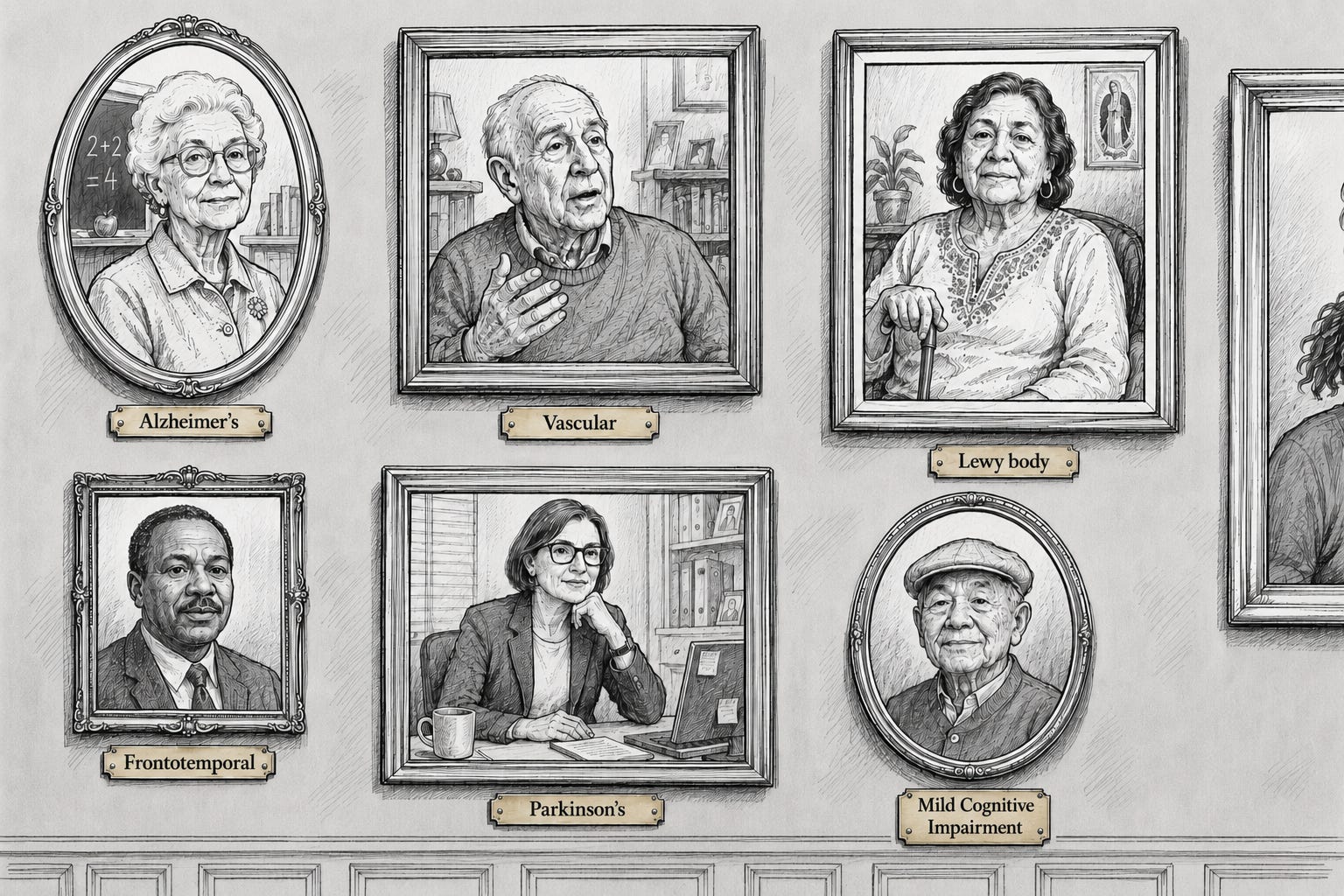
Dementia is not in fact a “diagnosis” because it is not a single disease, it’s a syndrome — a collection of symptoms that consistently appear together. The word “dementia” is an umbrella term that describes a decline in memory, thinking, language or judgment that is severe enough to interfere with daily life, caused by physical changes in the brain. Those physical changes can be caused by a great range of progressive diseases, and they can manifest a variety of different symptoms. The four most common conditions account for the large majority of dementia cases in the United States, but more than a 100 conditions can cause it. (5)
“Dementia is a category. It’s not one diagnosis,” explains Dr Jason Cohen, neurologist at Montefiore Medical Center in New York. “It’s a very helpful shorthand. But then the next question is always, what type?”
The four most common types of dementia are Alzheimer’s Disease, vascular dementia, Lewy body dementia, and fronto-temporal dementia.
1. Alzheimer’s Disease is the most common form of dementia, responsible for an estimated 60 to 80 per cent of cases. It is characterized by the presence of two abnormal proteins in the brain, amyloid plaques and tau tangles, and it often first presents as short-term memory loss, the inability to retain memories of recent experiences or information.
2. Vascular dementia, about 10 per cent of cases, is caused by strokes or reduced blood flow to the brain, and tends to emerge in the form of slowed thinking and trouble with planning and judgement, rather than through declining memory.
3. Lewy body dementia, caused by deposits of a protein called alpha-synuclein, can bring visual hallucinations, changes in movement, and sharp swings in alertness. The same protein drives the dementia that often develops later in Parkinson’s disease; the two are distinguished mainly by whether thinking or movement fails first.
4. Fronto-temporal dementia, caused by other proteins collecting in the frontal and temporal lobes of the brain, tends to strike younger patients in the fifties and sixties, and alters personality, behaviour or language before it affects memory. It is often initially misdiagnosed as a psychiatric illness.
“If it’s not one or the other, often it’s one and the other.”
Many older patients have more than one of these conditions at once, most often Alzheimer’s and vascular disease together, and this can make an accurate diagnosis more difficult. One study found individual patients carrying as many as six different pathologies. (6). “If it’s not one or the other, often it’s one and the other,” says Dr Cohen.
At the same time, some of what looks like dementia is not, or is not permanent: a thyroid disorder, a vitamin B12 deficiency, a drug interaction, or even depression can each produce the same fog, and each can be treated. When the cause is one of the diseases that can’t be reversed, knowing which one or which combination, and knowing it early, can help patients and their families implement lifestyle changes, assess any treatment options, and prepare for the future.
Everyone’s memory lapses and thinking slows with age, so some of the early changes of dementia can be the hardest to spot. One useful question is what you or your loved one are forgetting, and how often. Mislaying your keys and retracing your steps to find them is ordinary; picking them up and not knowing what they are for is not. Blanking on a name and recovering it an hour later is normal; repeatedly losing your way home on a familiar route is not.
The Alzheimer’s Association lists several early signs of dementia, and memory is only one. Other signs include trouble following a recipe or keeping up with the bills, consistently losing the thread of a conversation or searching for words, confusion about the date or the season, and putting things in odd places. You may also notice poor judgement with money or safety, withdrawal from work and social settings, shifts in mood or personality, and problems with vision and spatial sense, such as misjudging a kerb or a doorway. (7) Any one of these, now and then, is not concerning, but if you are experiencing several together, or one that keeps worsening, it is a reason to see a doctor.
Only an estimated 8 per cent of people with the mild cognitive impairment that precedes dementia are ever formally diagnosed.
Naming the signs is easier than acting on them, of course. Only an estimated 8 per cent of people with the mild cognitive impairment that precedes dementia are ever formally diagnosed. (8) People often wait because they don’t want to recognize or admit to the symptoms, but also out of fear of receiving a diagnosis, and a stigma attached to those living with cognitive changes. As one person living with dementia put it to me: “I know it’s called dementia, but I don’t like that term, because I’m not demented. My mind is not demented.”
But there is a strong and practical case for seeing a neurologist at the earliest juncture: a doctor can rule out the treatable causes, and in addition to the opportunity to make supportive lifestyle changes, the newest Alzheimer’s drugs work only in early-stage disease, so timing can decide what options are still on the table. Research has now established that the onset of dementia symptoms begins around 15-20 years after the beginning of physical changes in the brain, meaning that early detection could be life-changing if it can slow the progress of the disease. (9)
Diagnosis starts with a detailed medical history. Doctors want an account from both the patient and someone close to them, because, as Dr Cohen puts it, “the person with a memory problem might not remember all the parts of it.” The timeline is as important as the symptoms: a slow slide over four years suggests something different to a change that seemed to begin one bad Thanksgiving. From there the standard workup includes: tests of memory and thinking, a neurological exam, blood tests to rule out the reversible causes, and at least one scan of the brain, usually an MRI.
Confirming Alzheimer’s Disease also typically requires an amyloid PET scan or a spinal tap to sample the fluid around the brain, both of which are accurate, but they are costly or invasive. A newer option is a blood test that was FDA-approved in May 2025. The blood test measures a ratio of two proteins that tracks the amyloid build-up in the brain, a biomarker that can help confirm the presence of Alzheimer’s Disease. The blood test is very accurate: it matches PET scans and spinal-fluid results about 92 per cent of the time for positive cases and 97 per cent for negative ones, so in theory, many patients could now skip the scan. The test is cleared only for people who already have symptoms, not as a screen for the worried well, and a specialist still confirms the diagnosis before treatment. (10).
“The science is advancing more rapidly than the insurance coverage, which is still quite spotty.”
Advances in blood testing and biomarkers for Alzheimer’s Disease are “game changers,” says Dr Tobe Banc, Medical Director of the Northwell Aging Institute in New York. However, the tests are not yet readily available outside of large research institutions or academic medical centers, while many clinicians are still learning how to use them and relying on PET scans as the fall back. Dr Banc warns that at the same time, “the science is advancing more rapidly than the insurance coverage, which is still quite spotty.” She is hopeful that the progress of disease-modifying drugs will fuel better coverage of diagnostic tests in the near future.
Further tests are being developed for the other types of dementia. The biggest recent shift is in testing for Lewy body dementia and Parkinson’s dementia, both caused by a protein called alpha-synuclein. A test known as a “seed-amplification assay” can now accurately detect abnormal forms of the protein in spinal fluid and increasingly in a small skin biopsy, allowing for earlier detection of the diseases. (11) Reliable blood tests for fronto-temporal dementia, and for the specific proteins related to it, are still mostly confined to research. If there is a family history of front-temporal dementia, genetic testing can help to establish a diagnosis, with between 10 and 30 per cent of cases linked to specific gene mutations.
The standard tests can still miss early disease, however, with many patients like Raskin waiting years to get a confirmed diagnosis: “When I first went to a memory specialist, he told me nothing appeared concerning. The message was: you’re fine, eat well and come back in a year. I waited too long, and now I feel I’ve lost some important years.”
A diagnosis is a starting point, not an end point, and the sooner it comes the more options are on the table. Those options — the treatments, their trade-offs, and the daily changes that can help maintain function — are where next week’s Aging Almanac will pick up.
Comments
Nothing yet. Say the first thing.
Sign in to join the conversation.