
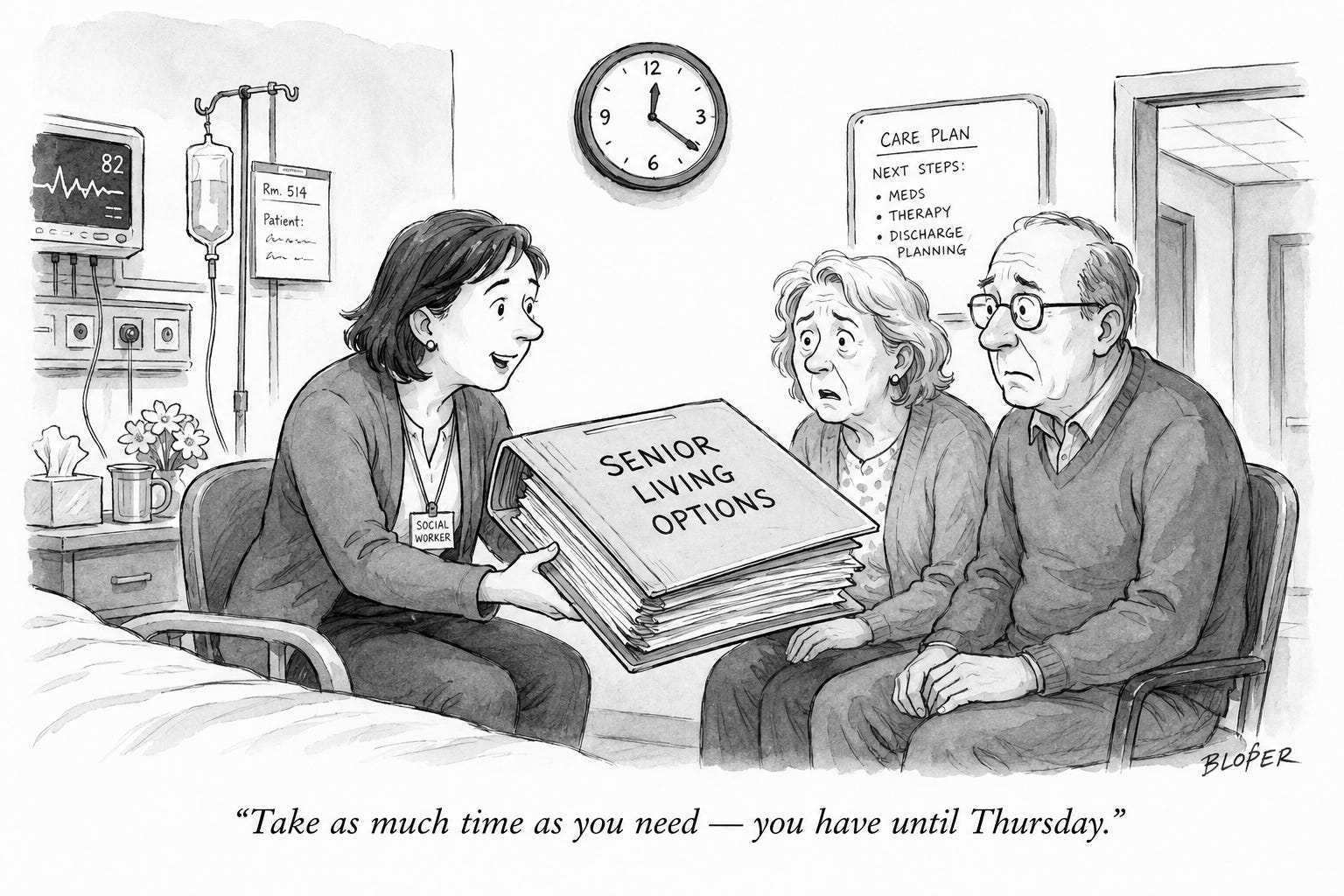
Many senior living decisions are made in a hurry. A family member receives an urgent phone call from a hospital social worker who reports that their loved one must be discharged by the end of the week. The search begins for a long-term care placement that may last for years and cost more than their house, but the time pressure means that the months of needed research and planning are compressed into a few frantic days. Our family was in exactly this situation. After his stroke, my father-in-law ran out of Medicare coverage days for his acute inpatient rehabilitation stay and we were given three days to find a bed for sub-acute rehab in a skilled nursing facility which could later become a long-term care placement. So many words! It took much of that time to simply understand the terminology and the insurance rules, let alone find him a bed.
In the absence of an acute health event, many families struggle with knowing if and when it is time to look for a senior living arrangement, especially when their loved one may be resistant to the idea. Some of the warning signs worth attending to are repeated falls, new or worsening confusion about time, place, or familiar people; missed medications or stockpiling; difficulty preparing food or maintaining nutrition; repeated incidents with the stove; getting lost on familiar routes; declining hygiene that suggests bathing has become difficult or is being avoided. Caregiver burnout is also a valid reason to make a change: if the caregiver is having difficulty functioning — not sleeping, not working, withdrawing from their own health — the situation has already passed the threshold for re-evaluation. Doctors, social workers, and geriatric care managers can help assess readiness and the level of care that your loved one may need to be safe.
The Aging Almanac has developed this guide to the maze of senior living options to support both families with the time to plan, and families who do not have that luxury.
Senior living terminology is inconsistent and frequently used in ways that can obscure real differences in care. Below are the primary long-term care settings, organized roughly from least to most intensive.
Independent living is for older adults who can manage their own daily care: dressing, bathing, medications, meals and so on, but who want a community environment with options for shared dining, social programming and transportation. Independent living facilities are not licensed for any medical or personal care, so if a resident develops the need for care, they must hire private help, move out, or transition to a higher level of care if the campus offers one. Costs are entirely out-of-pocket; Medicare and Medicaid do not cover them.
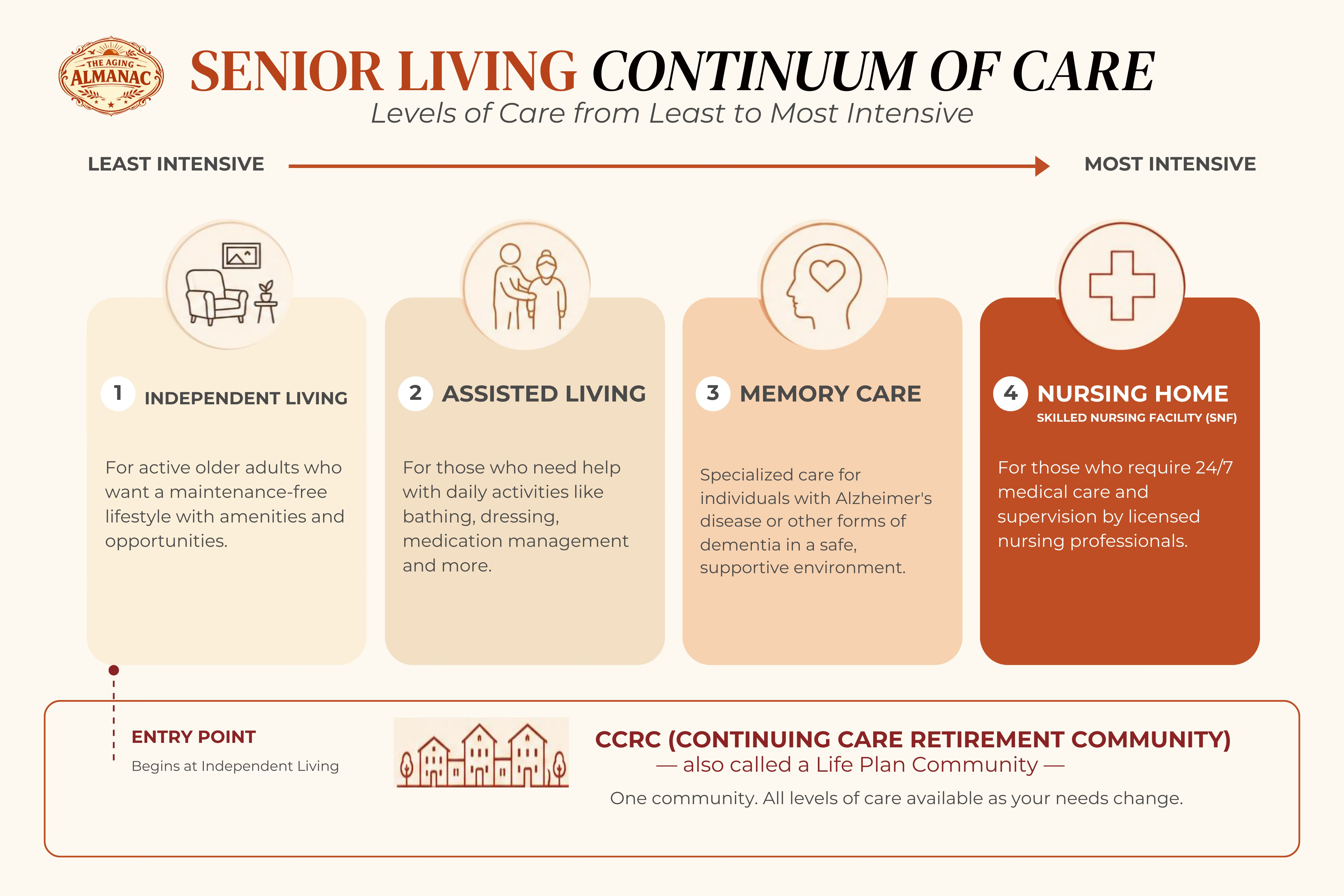
CCRCs (also called Life Plan Communities) offer multiple levels of care in one location. They typically offer independent living, assisted living, memory care, and skilled nursing on the same campus. The premise is that older adults can enter at the independent living level, but also plan for higher levels of care without relocating to a new facilities. Most CCRCs require entrants to be functionally independent at admission.
CCRCs require a significant entrance fee, ranging from tens of thousands to well over $500,000 depending on contract type and market, plus monthly fees. Three contract structures are common:
Type A (Life Care): highest entrance fee; future care included at little or no additional cost. Effectively long-term care insurance bundled into the contract.
Type B (Modified): lower entrance fee; future care at a discounted rate.
Type C (Fee-for-Service): lowest entrance fee; future care at market rates as needed.
Before signing, retain an elder law attorney to review the contract and examine the facility’s financial statements. CCRC insolvencies are rare but they happen, and entrance fees are at risk.
Assisted Living Facilities are for older adults who need help with one or more activities of daily living such as bathing, dressing, toileting, transferring, eating or managing medications, but who do not require continuous skilled nursing care. Most facilities cannot accommodate two-person transfers, complex medical care, or significant behavioral symptoms of dementia. Substantial decline in mobility, continence, or cognition typically forces a move to a higher level of care. Most residents pay privately, and/or via a long-term care insurance policy. Medicaid coverage for assisted living exists in most states but is limited, and facilities vary widely in whether they accept it.
Memory care is a specialized form of assisted living for adults living with dementia and who are at risk of wandering, have behavioral symptoms, or who cannot safely live in standard assisted living. Memory care has secured units, higher staffing, and dementia-specific programming. It is generally more expensive than standard assisted living — typically by $1,500 to $2,000 per month or more. Most memory care units accept residents who can still walk and feed themselves, while those with substantial physical care needs may require nursing home care.
Nursing homes are for adults requiring 24-hour skilled nursing care: significant medical needs (wound care, IV medications, complex chronic conditions), severe physical limitations (bed-bound, two-person transfers), or advanced dementia combined with physical decline. Nursing homes are federally regulated and inspected. “Skilled Nursing Facility” (SNF, an acronym often used by health workers and pronounced “sniff”) is the formal Medicare and Medicaid term and is used interchangeably with “nursing home” in practice.
Some care settings resemble long-term facilities but serve a distinct purpose: short-term, Medicare-covered rehabilitation following an acute health event. They are frequently the route by which families end up choosing a long-term placement under time pressure.
These units are for patients who require intensive interdisciplinary rehabilitation and can tolerate three or more hours of therapy a day. “Tolerate” in this context is somewhat subjective and will be in the judgement of the facility, but it means the patient must be medically stable enough to engage in therapy and have the potential to make improvements. Patients are typically transferred directly from an acute hospital. Care is short-term only and is covered under Medicare Part A hospital benefit period rules. Admission requires physician certification.
Subacute rehabilitation is for patients who need rehabilitation but cannot “tolerate” the intensity of acute rehab. This takes place in a Skilled Nursing Facility (SNF) and it is the most common post-hospitalization setting for older adults. Medicare covers up to 100 days per benefit period: it pays in full for the first 20 days, then with daily coinsurance ($217/day in 2026) for days 21–100. Coverage can end before 100 days if the patient stops making measurable progress. This is a common occurrence that families rarely anticipate. Written notice is required before coverage ends.
BEWARE: If your loved one has been hospitalized, confirm whether they have been admitted as an ‘inpatient’ or ‘under observation’: Medicare’s SNF benefit requires a qualifying 3-day inpatient hospital stay. Patients held ‘under observation’ are classified as outpatients, even if they sleep in a hospital bed for several nights, and this can eliminate SNF coverage entirely. Ask explicitly on admission: ‘Is this person admitted as an inpatient or under observation?’ The hospital must notify patients in writing about this (the Medicare Outpatient Observation Notice), but families routinely miss it. If the classification is wrong, the patient’s physician can request reclassification..
A planned move into senior living typically takes between four and twelve weeks: research and shortlisting, tours, application and financial review, contract review, and move-in scheduling. Communities with waitlists, particularly memory care units in dense urban markets, can extend this further, sometimes by months.
In a crisis, the timeline collapses and there are typically two paths:
If skilled nursing care is appropriate: the hospital can usually arrange a direct transfer to a SNF, sometimes the same day. Medicare’s SNF benefit then provides 20 to 100 days during which a longer-term plan can be developed. This is the most common bridge to permanent placement.
If assisted living is the appropriate level of care: the path is harder. Few assisted living communities accept move-ins within 72 hours. Workable options may include a short-term respite stay (most facilities offer these for 30 to 90 days at a higher daily rate but without a long-term commitment), or in-home care during the search for a placement.
Hospital discharge planners and social workers are the first call in any urgent placement. They have current information on local availability and can sometimes facilitate same-day admissions. Geriatric care managers can also help with emergency placements on a fee basis. One good rule of thumb: do not sign a long-term contract in the context of an emergency placement. A short-term arrangement that can be undone is almost always preferable to a permanent placement that is difficult and expensive to unwind.
Senior living pricing is unreasonably complicated and it’s important to understand all the components: the sticker price is rarely the full price.
Community fee: This is a one-time, upfront charge of $2,000 to $10,000, sometimes more for high-end facilities, and it is often framed as non-refundable. You can negotiate this fee; some facilities reduce or waive it during slow periods.
Base monthly rate: This covers room, board, and a defined set of services. What’s included varies enormously between facilities, so ask for the itemized list.
Care levels: Facilities assess residents at intake and assign a level of care (often 1–5). In assisted living, each level adds $300 to $800 per month to the base rate. Expect higher pricing in nursing homes due to higher staffing costs for nurses and physicians. Levels are reassessed periodically and tend to rise over time.
Medication management: This is almost always billed separately, typically $200–600/month.
Ancillary services: Laundry, transportation, personal supplies, beauty services, and guest meals are often billed individually. Read the contract.
Annual rate increases in assisted living have averaged 4–8 per cent in recent years and some facilities raised rates more aggressively post-pandemic. It’s wise to run the numbers at 5 per cent annual increases over three to five years and see whether a facility is within the budget. Care needs are also likely to increase: a resident entering at care Level 2 may be at Level 4 within two years.
Some facilities will require families to hire a full-time private aide if a resident’s needs exceed standard staffing — an additional $4,000 to $10,000 or more per month. Ask about this policy before signing. To understand baseline pricing for your local market, Genworth’s Cost of Care Survey breaks down median costs by state and care type.
What happens if the resident is unhappy, declines faster than expected, or the facility decides it can no longer meet their needs? These terms vary widely by facilities and it’s important to understand them before signing: ask whether the community fee is refundable and under what conditions; what notice is required from the resident and from the facility; what recourse exists if the facility initiates an involuntary discharge; and for CCRCs with large entrance fees, what the refund structure is under each contract type. Residents in licensed facilities have legal rights around involuntary discharge. If a discharge appears improper, your state’s long-term care ombudsman (ltcombudsman.org) can advise.
Nursing homes that are Medicaid-certified: (roughly 80–90 per cent of nursing homes) are required to admit and retain eligible residents, but facilities control the number of designated “Medicaid beds.” Private-pay residents are financially preferred as Medicaid reimburses at roughly 30 per cent less than private rates, and Medicaid reimbursement often does not cover the full cost of a resident’s care. So be warned that a facility can technically accept Medicaid and still have no available Medicaid beds.
Assisted living has no Medicaid obligation: Facilities may accept, limit, or refuse Medicaid at their discretion. Most higher-end facilities do not accept it at all.
Private-pay minimums: Many facilities require a 2–3 year private-pay period before accepting Medicaid. They are legally allowed to do so, but it’s important to keep this in mind when reading the contract if you expect your loved one to need Medicaid in the near future.
Medicaid Pending: Some facilities admit residents with Medicaid applications under review; others will not. If a spend-down is underway, ask explicitly.
Medicaid eligibility involves strict income and asset limits that vary by state and update annually. An elder law attorney can advise on planning. Free counseling is available through the State Health Insurance Assistance Program (shiphelp.org); do not rely on facility admissions staff for this guidance.
Referral Companies: There are a handful of large senior care referral companies that consistently appear in the first search results families encounter online, including A Place for Mom, Caring.com and SeniorAdvisor. These companies present themselves as providing free advisory services, but families should note that they are not neutral. They receive commissions from the facilities when families move in - typically the equivalent of one month’s rent per referral. This creates some perverse incentives: a 2024 Washington Post investigation into A Place for Mom found that more than a third of facilities on the company’s “Best of Senior Living” lists had been cited for serious regulatory violations, prompting the Senate Special Committee on Aging to open a formal inquiry that year. The inquiry found that facilities that do not pay referral fees are not listed; Medicaid-accepting facilities are largely excluded; and Senate investigators found that a majority of families who used the service ended up spending more than they had planned.
Ownership: Roughly 5 per cent of nursing homes are owned by private equity firms; a larger share are owned or partly owned by related financial structures. (1) Research has linked private equity ownership to higher resident mortality, lower staffing, increased use of antipsychotics, and higher Medicare costs. (2) Changes of ownership more broadly — not just private equity — are associated with declines in quality ratings, driven by lower staffing and inspection scores. Ask directly: who owns the facility, and has it changed hands in the past three years?
Call directly: identify facilities in your target area and call them yourself. Ask about availability, current rates, and Medicaid policy. Then tour in person at a mealtime - ideally you can tour without an appointment, though facilities often won’t accommodate this.
Tour now, not later: the most useful thing a family can do is visit facilities before anyone needs a placement. Most welcome prospective tours; it costs nothing and gives a personal sense of the place that no website conveys. For memory care in particular, tour early: waitlists at preferred facilities can be as long as 6–18 months in some markets. After the tour, ask to speak with one or two current residents or family members without staff present. Ask what they wish they had known before moving in. Below is a guide to the questions to ask.
Medicare’s Care Compare: medicare.gov/care-compare provides inspection reports, staffing data, and star ratings for nursing homes.
Long-term care ombudsman: every state has one. The ombudsman’s office handles complaints about nursing homes and assisted living facilities and can identify facilities with open complaints or poor inspection histories (ltcombudsman.org).
Geriatric care managers: Aging Life Care Professionals, also known as geriatric care managers, provide independent, fee-based placement guidance with no referral fees from facilities. In a complex situation, this is often money well spent.
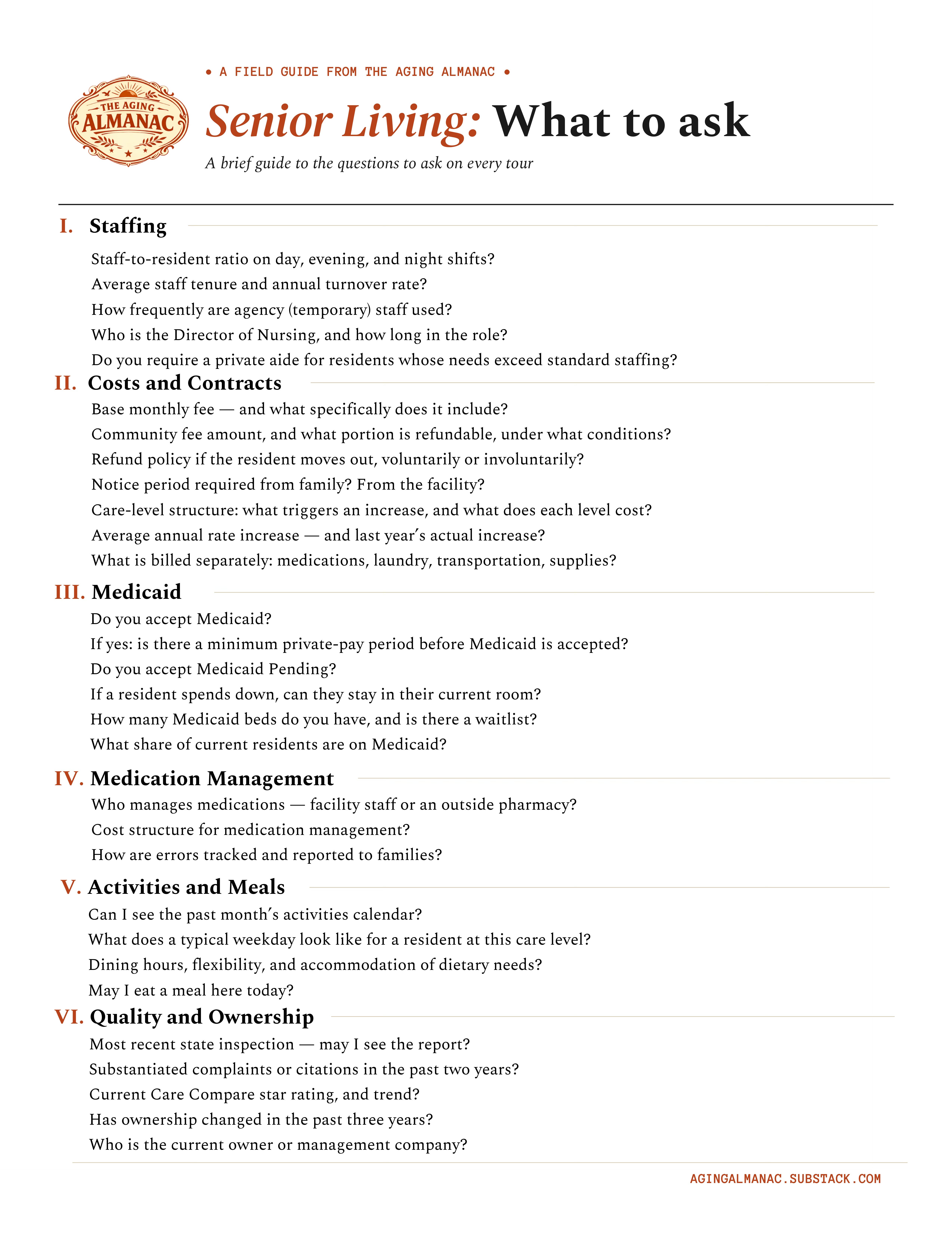
To download a printable version of this guide, click the button below.
Printable Senior Living Questions
In next week’s Aging Almanac, we’ll talk about one of the biggest buzzwords in the aging field: “longevity.” What does it really mean, how do we attain it, and how do we tell fact from fiction in an industry riddled with influencers and disinformation?
Comments
Nothing yet. Say the first thing.
Sign in to join the conversation.