
David skis ninety days a year and teaches on most of them. His students are experienced skiers working on technique, and he meets them on the hard runs: demonstrating the turn one more time, correcting their stance, picking the line down a steep face, and like all good ski instructors, making conversation on the chairlift. His handshake is firm, his gaze steady, and at eighty years of age, he is not even the oldest instructor on the mountain.
David and his fellow octogenarian ski instructors are of course outliers when it comes to healthy aging. Most people in their eighties are not on skis, any more than they are running marathons or hiking the Inca Trail. But if your goal is to keep up with your grandchildren, travel with friends and family, or continue playing an active role in your community, there is still plenty to learn from David. Genetics play a role — a recent Weizmann Institute study found that genetics may account for over 50 per cent of lifespan differences -- but healthy behaviors still account for roughly the other half. (1) People who reach their eighties healthy and active have, almost without exception, invested in their bodies consistently over time.
Geriatricians say the prescription is unfashionably plain: eat reasonably well, move your body, sleep enough, and keep your mind engaged with learning and social connection. There is no need to take up an extreme sport, train for a marathon, or set your sights on Machu Picchu. The research shows that you don’t need to do everything to gain something: most of the benefit comes from the first changes, not the last optimization.
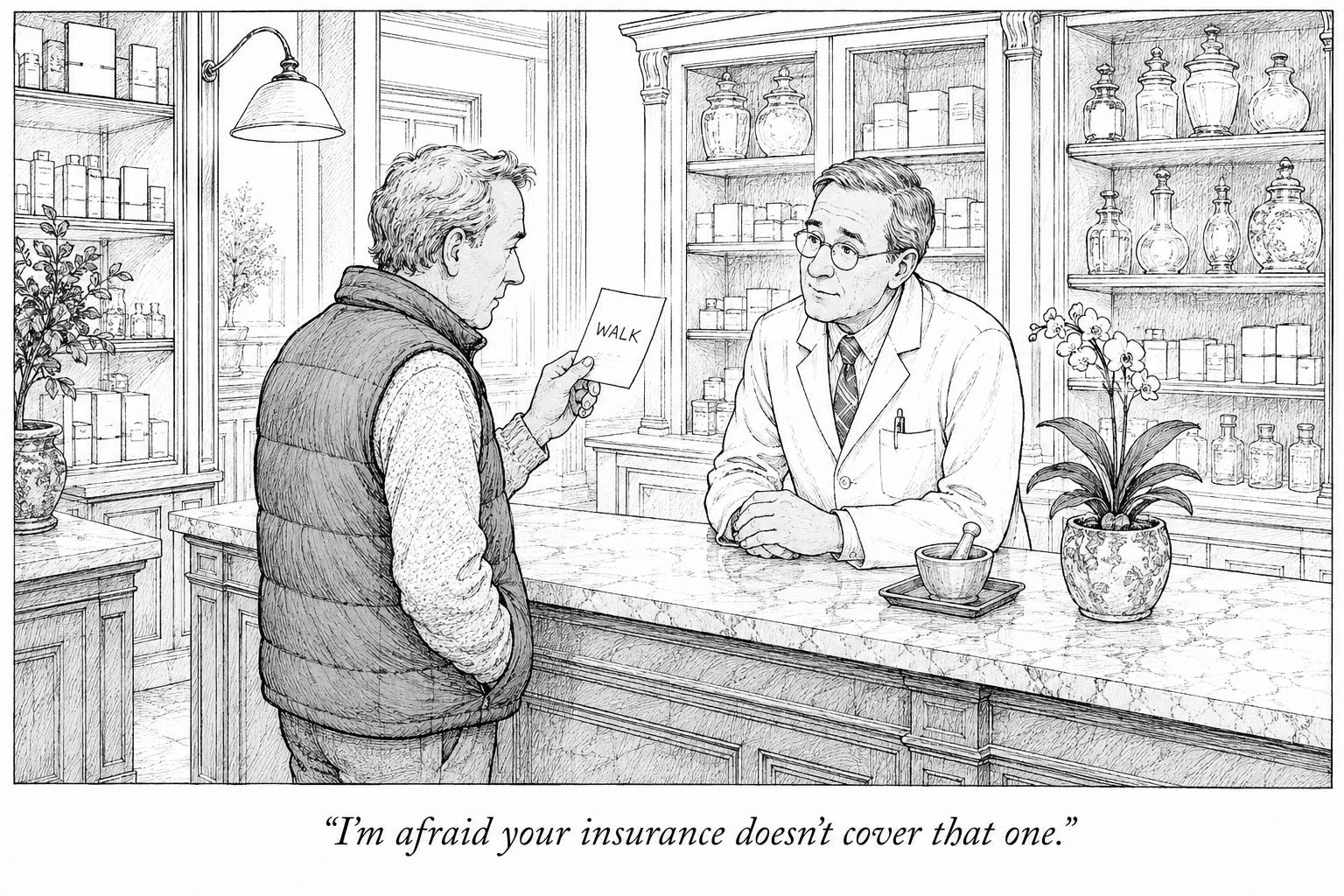
Ask your doctor, a physical therapist or a personal trainer where to begin with an exercise program, and the advice is the same: start small, build slowly, and above all, be consistent. Exercise still conjures something competitive and physically demanding for many older adults, but the evidence shows that “little and often” pays enormous health dividends - so much so that physicians often express the wish to prescribe it.
Louise Aronson, a geriatrician at UCSF and the Pulitzer-nominated author of Elderhood, said: “If we know exercise is the best medicine, or more effective than many medicines for high blood pressure, diabetes, depression, insomnia, heart disease, then why is it that we cannot prescribe exercise that is covered by insurance?” Speaking at a Healthy Aging conference hosted by Stanford University, she noted that the effect size of regular exercise exceeds almost any medication she could prescribe.
A healthy minimum: 20-40 minutes of walking a day and lifting something heavy twice a week.
A healthy adult should be targeting a minimum of 150 to 300 minutes of moderate aerobic activity a week (or 75 to 150 minutes of vigorous activity), plus muscle-strengthening work on two or more days, according to World Health Organization guidelines. (2) That’s equivalent to just 20-40 minutes of walking a day and lifting something heavy twice a week. You can do more than that of course, but the increased benefit after 300 minutes a week is marginal.
For those who prefer to count their steps, researchers found that the meaningful threshold for adults over 60 sits between 6,000 and 8,000 daily steps, with the steepest health gains at the bottom of the range. (3) The commonly quoted 10,000-step target turns out to be marketing, traceable to a 1960s Japanese pedometer campaign rather than a clinical threshold.
Bodyweight work, resistance bands and weighted household objects are all good ways to train for strength.
The evidence for strength training is equally encouraging for those just getting off the couch and feeling intimidated by the gym. A 2022 study found that doing any resistance training at all was associated with a 15 per cent reduction in all-cause mortality and a 19 per cent reduction in cardiovascular mortality. The peak benefit came at around 60 minutes a week. Bodyweight work, resistance bands and weighted household objects all count. (4)
One of the most important outcomes of strength training for anyone past 60 is maintaining function: rising from a low chair without using your hands, and catching yourself when you stumble are critical skills. Older adults are particularly vulnerable to falls for reasons that accumulate with age: muscle mass declines, balance and reaction time deteriorate, proprioception becomes less reliable and blood pressure drops become more common. The result is that falls are the leading cause of fatal and non-fatal injuries among Americans aged 65 and older. (5)
Balance and functional training can cut fall rates by about a quarter, according to a 2019 review of 108 randomised trials. (6) Tai chi has the most consistent record: a 2018 study found six months of Tai Chi reduced falls by 58 per cent, compared with stretching in adults already at high risk. (7) Walking alone doesn’t reduce fall risk.
Rehab is exercise too: older adults performing the demands of independent living are doing athletic work and deserve to be trained accordingly.
Rehabilitation is an integral part of this picture, although it is often treated as recovery from illness rather than exercise in its own right. Amy Pastva, a rehabilitation scientist at Duke University, works with older adults after heart failure, stroke and brain injury. Pastva’s research has documented consistent functional gains in patients assumed to be past significant benefit, when they receive a comprehensive three-phased program of inpatient therapy, followed by 12-weeks of outpatient physical therapy and 3 months of home-based maintenance exercises - a timeline consistent with producing real behaviour change. The program addresses four domains: strength, balance, mobility and endurance, calibrated to wherever the patient starts, and becoming progressively more challenging. Her argument is that older adults performing the demands of independent living are doing athletic work and deserve to be trained accordingly. Pastva is currently the lead investigator on a phase 3 trial of the program. (8)
The behaviour-change research supports starting from wherever you are. Stacy Sims, an exercise physiologist, says: “It is never too late to start. The body is very adaptable. If you give it a challenge, the body is like, ‘Whoa, okay, let’s see how I can overcome that.’”
Good is getting off the chair. Walk. Take the stairs. A gentle daily walk of 15 to 20 minutes meaningfully lowers the risk of cardiac events, vascular disease, dementia and depression.
Better is the WHO-recommended minimum: 150 minutes of walking, (or whatever exercise you enjoy) per week, and two days of working your muscles, whatever that looks like. If you’re recovering from illness, surgery or a significant period of inactivity, supervised rehabilitation counts as exercise, because it is exercise.
Best, for anyone over 60, is the WHO-recommended upper range plus deliberate balance and lower-body strength work: tai chi, single-leg stands, sit-to-stand reps, slow squats. Cardiovascular fitness keeps you alive. Balance and leg strength keep you upright, off the floor, and out of the hospital.
Good dietary advice is often crowded out with hype about the latest approach to eating for longevity, but with every book deal or celebrity diet, the best evidence continues to point back to the Mediterranean diet. The most-tested diet in the world, the Mediterranean diet consists of vegetables, fruit, beans, whole grains, fish, olive oil, and less red and processed meat. The landmark study is PREDIMED: 7,447 Spanish adults at high cardiovascular risk, tracked over about five years. Those assigned to a Mediterranean diet — extra olive oil or extra nuts — had around 30 per cent fewer heart attacks, strokes and cardiovascular deaths than a control group told simply to eat less fat. (9)
For cognitive health specifically, researchers at Rush University developed the MIND diet, which weights the Mediterranean diet toward the foods most consistently linked to brain health: green leafy vegetables, berries, nuts, fish, olive oil, and a sharp limit on butter, cheese, pastries and fried food. Researchers tracking 923 older adults in an observational study found that those who followed the diet most closely had a 53 per cent lower rate of Alzheimer’s over four and a half years. Even moderate adherence cut the risk by 35 per cent. (10)
A 2024 study found convincing links between higher ultra-processed food consumption and all-cause and cardiovascular mortality, type 2 diabetes, depression and several other outcomes.
There’s also mounting evidence that ultra-processed foods are bad for your health and longevity. These are the packaged baked goods, breakfast cereals, sugary drinks, reconstituted meats and artificially-flavored snacks that your grandmother wouldn’t recognise. A 2024 study found convincing links between higher ultra-processed food consumption and all-cause and cardiovascular mortality, type 2 diabetes, depression and several other outcomes. Published in the British Medical Journal, the study pulled together 45 meta-analyses involving nearly ten million people. It found that each 10 per cent increase in ultra-processed food intake was associated with a 10 per cent higher risk of dying from any cause. (11)
None of this is new and interesting enough to sell, which is why the diet industry keeps looking for something better. Take for example, time-restricted eating — eating within a set daily window, typically eight hours. The diet has been heavily marketed in recent years, particularly to middle-aged women, as a tool for weight loss and metabolic reset. However, the case for time-restricted eating as a longevity strategy is thin: a randomised trial in the New England Journal of Medicine found that the practice produced no additional benefit over standard calorie reduction when calories were controlled, suggesting the window itself isn’t the active ingredient. (12) As one dietician put it to the Aging Almanac: “The reason that it helps you lose weight is not that you’re restricting your feeding to a certain window, it’s because you’re skipping breakfast.” The diet also works against getting the most out of exercise: skipping breakfast consistently leaves people under-fuelled for morning training, which is where much of the longevity benefit comes from.
Good is cutting back on ultra-processed food. You don’t need to eliminate them entirely. The dose-response is roughly linear, so any reduction helps.
Better is the broad outline of the Mediterranean diet: vegetables, fruit, legumes, whole grains, fish, olive oil, less red and processed meat.
Best, if cognition is your particular worry, is the MIND specification: green leafy vegetables most days, berries twice a week, nuts daily, fish weekly, olive oil as the main cooking fat, and a sharp cut in butter, cheese, pastries and fried food.
Sleep is when most of the body’s repair work happens. While you’re unconscious, the brain runs what scientists call the glymphatic system, an overnight rinse cycle that clears out the waste proteins that build up during the day, including the amyloid fragments implicated in Alzheimer’s. The same hours are when the brain consolidates the day’s experiences into long-term memory, deciding what to keep and what to discard.
Deep sleep is also when the pituitary gland releases most of the day’s growth hormone, which repairs muscle, bone and soft tissue. And blood pressure drops by ten to twenty per cent overnight, giving the cardiovascular system a recovery window it doesn’t otherwise get. When sleep is short or broken night after night for years, those processes fall behind and the consequences arrive in the form of higher rates of heart disease, dementia, depression and type 2 diabetes.
Dr Tommy Wood, neuroscientist and author of newly-released The Stimulated Mind, argues that if sleep wasn’t essential, evolution would have eliminated it at some point. “Not only is spending a third of your day completely unconscious (and defenseless) risky from a survival standpoint, but that’s also a lot of time that could be spent doing other things related to survival, like finding food and procreating.” Wood explains that quantity, quality and regularity of sleep all play an important role.
The sweet spot seems to be between 7-9 hours. Pooling 16 studies involving more than a million people, an analysis by Francesco Cappuccio found that short sleep (under seven hours) is linked to roughly a 12 to 15 per cent higher risk of dying from any cause; long sleep (over nine) carries a larger increase, though that figure is partly confounded by undiagnosed illness driving people back to bed. (13) The same pattern is visible in hospital claims: irregular sleepers are more likely to end up in the hospital, says Adrian Gore, the developer of Vitality, a behavioral insurance model that incentivizes policyholders to adopt healthier behaviors.
The cognitive evidence is also striking. In a study of almost 8,000 British civil servants followed for 25 years — known as the Whitehall II study — people who slept six hours or less at age 50 had a 30 per cent higher rate of dementia than those who slept seven, after adjustment for the usual confounders. The effect held at age 60 and 70. The strongest predictor was persistent short sleep across midlife, not any one bad year. (14)
To improve your sleep environment, Wood’s suggestions include: (a) lower the lights as you approach bedtime, and keep your bedroom dark; (b) a warm bath before bed and/or a cool bedroom can produce the temperature drop the body needs to trigger sleep; (c) the timing of food and drink before bed depends on your specific needs, but avoid a large meal too close to bedtime; (d) have your last dose of caffeine about 9 hours before bed; (e) practice relaxation techniques; (f) build a routine around your bedtime.
Sleeping pills aren’t a long-term answer; the goal should be to improve natural sleep function.
If insomnia is in the way, get help. Unfortunately, the prescription drugs that dominate the insomnia market (zolpidem and its relatives) come with real downsides: falls, daytime cognitive impairment, and a tendency to lose effect over time. The evidence points to cognitive behavioral therapy for chronic insomnia, now available through apps, online courses and a growing number of clinics. Sleeping pills aren’t a long-term answer; the goal should be to improve natural sleep function.
Good is to sleep enough to function: protect a seven-hour window.
Better is regular sleep: seven hours during the same window, most nights. Variability in timing has its own emerging evidence base, separate from duration, and the pattern is the same. The more variable your bedtime, the worse outcomes.
Best is sleep that is both adequate in duration/timing and good in quality, held across decades rather than weeks.
The same habits that protect your heart protect your brain. Researchers in Finland gave 1,260 older adults at risk of dementia either the usual health advice or a two-year program of nutritional counseling, more exercise, brain training and vascular monitoring. Two years on, the intervention group scored 25 per cent better on cognitive tests, with the biggest gains in planning and quick thinking. (15) This study was the first trial to show that a coordinated lifestyle program could measurably protect cognition in people at risk.
On the question of whether brain training works, the some of the best evidence comes from the ACTIVE trial, funded by the US National Institutes of Health. ACTIVE randomised 2,832 older adults to one of three cognitive programmes (memory, reasoning, or speed-of-processing training) or a control group. Ten-year follow-up data in 2014 showed that reasoning and speed training preserved cognitive gains a decade later. More recent follow-ups, now past the 20-year mark, suggest reduced dementia incidence in the trained groups. The effects are stubbornly domain-specific: speed training improves speed; reasoning training improves reasoning with little spillover effects. (16)
Crosswords — a common recommendation for older adults — aren’t enough to keep your brain sharp. A team at the University of Texas had one group of older adults take up something genuinely new and demanding (digital photography, quilting), another was given a low-challenge social activity, another was given an activity to do alone. Participants pursued their activity for 15 hours a week, over three months. Only the new learners’ memories improved, and only their brain scans showed it. What matters is the difficulty, not the time spent: the active ingredient looks like effortful, unfamiliar cognitive work, not the comfortable repetition of a familiar puzzle. (17)
Good is mental engagement of any kind that pushes you slightly past comfort: a new route, a new recipe, a book outside your usual fare.
Better is sustained learning of something entirely new: an instrument, a language, a craft.
Best is to combine attention to your diet, exercise, and cognitive challenge with careful management of blood pressure and other vascular risks.
None of this is what the longevity industry sells. There is no proprietary blend in it, no subscription, and no $5,000 diagnostic. The basics are free, they work, the dose-response is forgiving, and the first step is worth more than the last. Next week in the Aging Almanac, we’ll look at the effects of loneliness and the evidence that social connection is another critical pillar of our well-being.
Comments
Nothing yet. Say the first thing.
Sign in to join the conversation.