
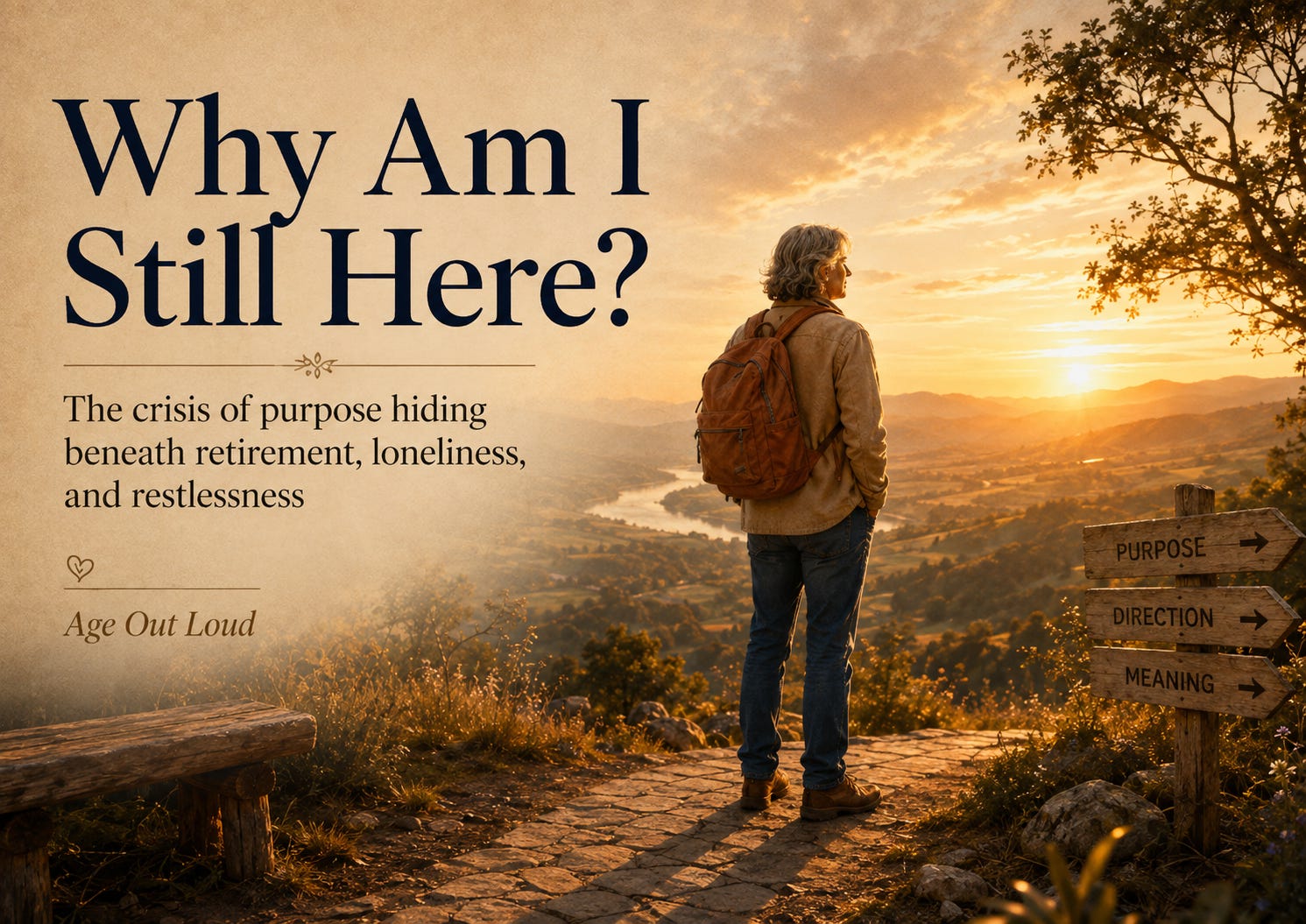
Yesterday, we asked a difficult identity question: Who am I when the labels come off? Today, we go one layer deeper and ask the question that gives identity direction: Why am I still here?
For much of adulthood, we do not have to spend much time thinking about purpose because life supplies it for us. There are children to raise, bills to pay, customers to serve, employees to lead, meals to prepare, repairs to make, and people depending on us. We wake up knowing what needs to be done because responsibility is waiting for us before our feet hit the floor.
Then life changes. The children grow up. The career ends. The business is sold. The caregiving season closes. The calendar opens, and for the first time in decades, no one is telling us where we need to be or what we need to accomplish before the end of the day.
At first, that freedom can feel like a well-earned reward. After years of alarm clocks, deadlines, long days, and endless responsibility, the idea of finally resting sounds wonderful. Rest is good, and there are seasons when we desperately need it. But rest was never meant to become the permanent destination of a human life.
After the vacations are over, the house projects are finished, and every show worth watching has been watched, a quiet restlessness can begin to surface. A person may not know exactly what is wrong. They may describe themselves as bored, tired, lonely, or unmotivated. Beneath those feelings, however, there is often a much deeper question: Does my life still have a meaningful direction?
In Age Out Loud, I wrote about people who spend decades anticipating retirement as a magical time when they will finally rest. Many enjoy that freedom for a while, but then begin experiencing a gnawing emptiness, restlessness, and listlessness they cannot explain. Human beings need a sense of purpose to live, not simply exist.
That drift is one of the quietest and most dangerous forms of resignation. It does not always look like despair. Sometimes it looks like comfort. It looks like sleeping a little later, watching a little more television, declining another invitation, and saying, “Maybe next time.” The days may be pleasant enough, but they become increasingly interchangeable. Nothing is terribly wrong, yet nothing feels deeply alive either.
A person can have money in the bank, a comfortable home, a loving family, and plenty of free time, yet still feel an emptiness that none of those things can fill. The problem is not necessarily a lack of activity. Many people stay remarkably busy after retirement. The deeper problem is that busyness and purpose are not the same thing. You can fill every square on a calendar and still feel directionless. You can belong to three clubs and still feel disconnected. You can spend your days helping other people and still wonder whether your own life has a clear assignment.
Purpose is not merely having something to do. Purpose is knowing why what you do matters.
I believe human beings are designed to create, connect, and contribute. We need to make something, whether that is a business, a garden, a meal, a piece of art, a relationship, a solution, or a better future. We need meaningful connection with God and with other people. We need to know that something is different because we were here. When those three currents stop flowing, we become like a ship without a rudder.
This is why the loss of purpose can be so devastating in later life. A person may still possess energy, wisdom, ability, experience, and resources, but without a reason to apply them, those assets remain dormant. Over time, they may begin to doubt their usefulness, not because they have nothing to offer, but because they can no longer see where what they offer belongs.
Our culture often makes the problem worse. We have created a model of later life centered on comfort, safety, leisure, and care. Those things have value, but they are not enough to sustain a human soul. People do not thrive simply because their needs are being met. They thrive when they know they are needed.
There is a profound difference between being cared for and being counted on. There is a difference between being entertained and being engaged. There is a difference between being included in an activity and knowing your presence changes the outcome.
Older adults are too often treated as though their central task is to stay safe, remain comfortable, and avoid becoming a burden. That is not a compelling vision for the future. It is a strategy for managing decline. Age Out Loud offers a radically different view. Older adults are not burdens to be managed. They are assets to be activated. The later years can become the years of greatest wisdom, impact, usefulness, joy, courage, and contribution. Aging is not merely the slow loss of life. It can be the deepening of life.
That deeper life requires purpose. Purpose gives vitality a reason. It gives us a reason to strengthen our bodies, challenge our minds, nurture our relationships, and get out of bed in the morning. In the book, I describe purpose as the essential ingredient. Without it, we have little reason to do the work required to stay strong, engaged, connected, and alive. Purpose becomes the North Star that gives direction to everything else.
We often imagine purpose as something grand. We think it must involve starting a foundation, writing a bestselling book, traveling the world, or leading a movement. Those may be meaningful callings for some people, but purpose is not measured by scale. It may mean mentoring one young person who needs someone to believe in them. It may mean teaching a grandchild a skill that would otherwise disappear, sitting with someone who is grieving, repairing a strained relationship, volunteering in a community, creating a place where people feel welcome, or offering hard-earned wisdom to someone walking through a challenge you have already survived.
Purpose is not always loud, but it is always consequential.
One of the greatest mistakes we make is assuming that purpose must remain the same throughout life. The assignment that drove you at 35 may no longer fit you at 65. The way you served people through a career may not be the way you are called to serve them now. Your purpose may remain constant at its core while changing completely in its expression.
A teacher may no longer stand in a classroom, but the call to help people understand may still be very much alive. A contractor may no longer swing a hammer every day, but the instinct to build, solve problems, and create places where people can thrive may still shape everything he does. A parent may no longer be raising children, but the ability to nurture, encourage, and create belonging may now be needed by a wider circle. A caregiver may no longer be managing appointments and medications, but the compassion forged through that season may become a source of healing for someone else.
The role changes. The assignment evolves. The purpose continues.
That is why asking, “Why am I still here?” is not a morbid question. It is one of the most life-giving questions we can ask. I believe the fact that we are still here means we still have work to do. Each of us has an assignment that no one else can fulfill in precisely the same way because no one else has our exact combination of experiences, relationships, gifts, wounds, wisdom, and opportunities.
There are people you can reach because you understand something they are living through. There are doors that may open to you because of who you know, what you have survived, and the trust you have earned. There are problems you can help solve because you have spent a lifetime learning lessons that cannot be downloaded, purchased, or taught in a classroom.
God is not careless with human life. If you are still here, I do not believe you are here by accident.
That does not mean purpose will always arrive as a dramatic revelation. Sometimes we wait for a lightning bolt while the next assignment is sitting quietly across the table from us. Purpose is often discovered through attention. It appears when we notice the need in front of us, the person we are uniquely equipped to help, the problem that will not leave us alone, or the dream that keeps returning no matter how many times we try to dismiss it.
We also have to be honest about what happens when purpose is absent. Without a compelling reason to move forward, people begin shrinking their lives. They avoid challenges because the effort no longer seems worthwhile. They withdraw from relationships because initiating connection requires energy. They stop caring for their bodies because they cannot see what they are preparing themselves to do. Little by little, expectation disappears, and with it goes momentum.
This is how resignation takes root. It is not always that people believe life is terrible. It is that they no longer believe anything meaningful is waiting for them.
That is why the question cannot simply be, “What would I enjoy doing?” Enjoyment matters, but purpose goes deeper. A better question is, “Where do my gifts, my experience, and the needs around me intersect?”
Think about what you have lived through that could help someone else. Consider what people naturally come to you for, what kind of problem you are still drawn to solve, what injustice still bothers you, what beauty you want to create, and what wisdom you refuse to let die with you. Then ask yourself who could be strengthened because you decided to become fully engaged again.
These questions are not meant to create pressure. They are invitations. Purpose should not become another burden placed on your shoulders. It should become a source of energy. The right assignment will not always be easy, but it will feel worthy of your life.
Purpose does not require you to relive the past or recreate a younger version of yourself. It asks you to bring everything you have become into the present. Your scars, victories, mistakes, faith, relationships, skills, and perspective all become raw material for the next chapter.
The later years are not empty space after the meaningful part of life. They may be the season when everything you have learned finally comes together.
Today, I want you to sit with two questions. First, who or what is better because you are still here? Then ask the more challenging question: Who or what could be better if you became fully engaged again?
Do not look for the biggest answer. Look for the truest one. You may not discover your entire purpose today, but you can begin paying attention. Notice what moves you, what need draws your concern, what people ask of you, and what idea continues to return. Purpose often whispers before it speaks clearly.
Share your answer in the comments, even if all you can say is, “I am still trying to figure it out.” That honesty is not failure. It is the beginning of direction.
Tomorrow, we will confront the question that often stands between us and the life still calling us forward: What must I overcome?
No posts
Comments
Nothing yet. Say the first thing.
Sign in to join the conversation.