
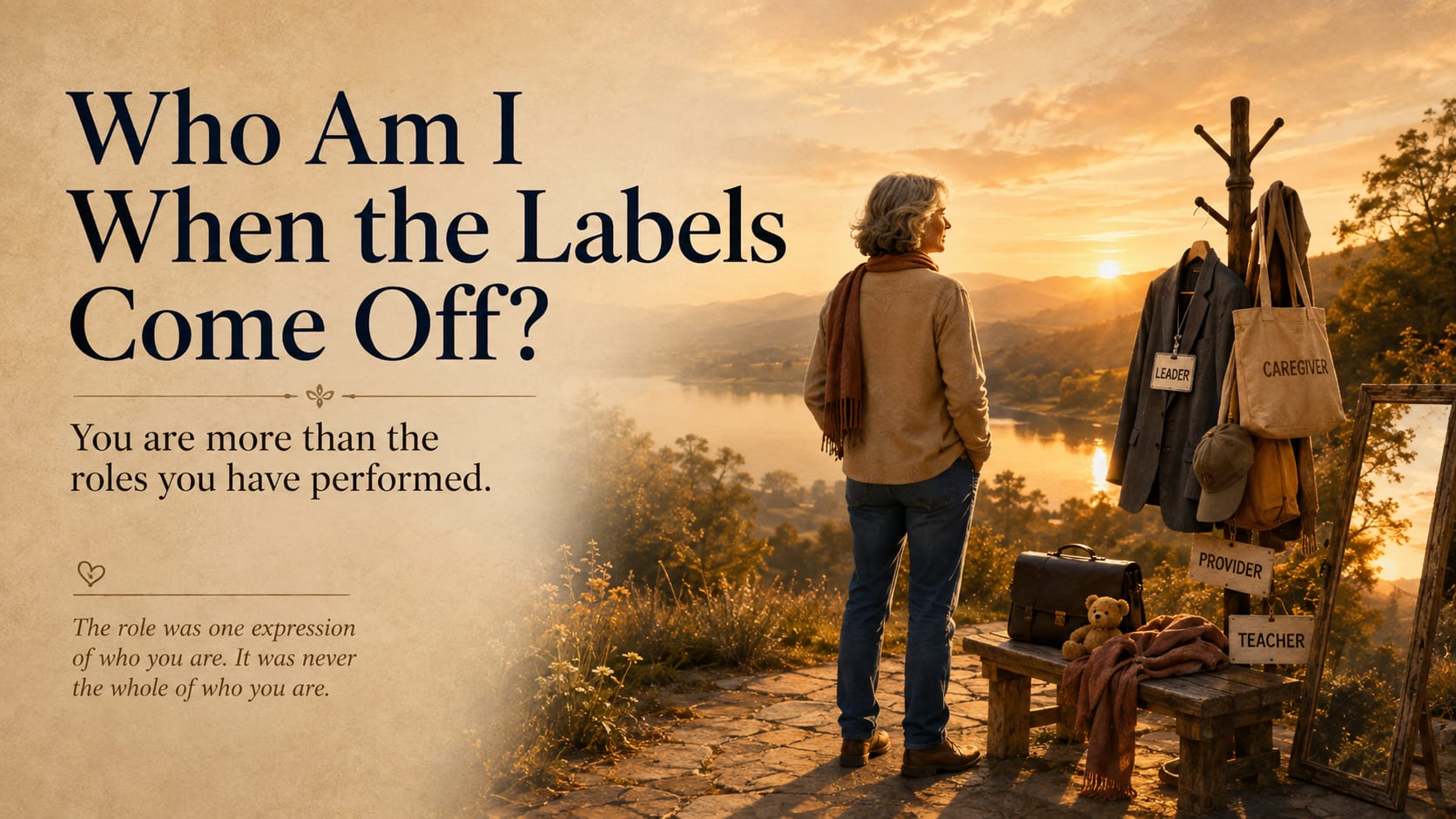
Yesterday, we looked at the question people ask almost automatically when they meet someone: “What do you do for a living?” We also considered a better question: “What are you doing with your life?” That shift sounds small, but it takes us into much deeper territory. It forces us to look beneath job titles, responsibilities, achievements, and roles. It raises a more personal question, one that becomes increasingly important as we grow older: Who am I when the labels come off?
For most of our lives, identity gets wrapped around the roles we carry. We are husbands, wives, mothers, fathers, business owners, teachers, contractors, nurses, pastors, caregivers, leaders, volunteers, providers, problem-solvers, and friends. Those roles matter. They shape our schedules, our relationships, our sense of responsibility, and the way other people see us. The problem begins when we confuse a role we perform with the person we are.
Roles are real, but they are temporary. They change with the seasons of life. Children grow up and leave home. Careers end. Businesses are sold. Health changes. A spouse dies. Caregiving responsibilities come to an end. One day, the role that defined your life for years may no longer exist, and when that happens, identity can begin to unravel.
I experienced this after my wife Barbara died. For 33 years, I had been a husband. During the final months of her life, I had also become a caregiver. Then, suddenly, I was neither. My children were grown, the rhythms of daily life had changed, and the roles that had organized much of my life had disappeared almost overnight. I remember asking myself, “Who am I now?”
There was a new label attached to me: widower. But that label did not feel like an identity. A farmer is someone who farms. A builder is someone who builds. What does a widower do? The word described something that had happened to me, but it did not tell me who I was supposed to become next. That is one of the hardest parts of any major transition. It is not only that life changes. It is that the version of ourselves we understood no longer fits the life we are living.
Retirement can create the same kind of disorientation. For decades, someone may have been the person who made decisions, solved problems, led a team, taught students, served customers, or kept an organization running. Then one day, the title is gone. The office is gone. The phone rings less often. The questions stop coming. The work may be over, but the need to matter is not.
The same is true when children leave home. A parent who poured years of energy into raising a family may suddenly feel unneeded. The children still love them, but the relationship has changed. No one needs lunch packed, rides arranged, homework checked, or problems solved in the same way. A caregiver may spend years organizing life around the needs of a spouse or parent, and when that season ends through recovery, relocation, or death, the caregiver can be left with an aching emptiness. They may have been so focused on someone else’s needs that they no longer know what they need, what they enjoy, or what direction their own life should take.
These moments expose a problem that was there all along. We often build our identity on things that can be taken away. A title can be taken away. A position can end. A relationship can change. A body can lose an ability. An income can shrink. A reputation can fade. A role can be completed. When our identity is built entirely around those things, their loss can feel like the loss of the self.
This is where many people begin slipping into resignation. They may not say, “I have lost my identity.” Instead, they say things like, “Nobody needs me anymore,” “I don’t know what to do with myself,” or “My best years are behind me.” Those statements are not merely observations about circumstances. They are conclusions about personal worth, and that is the danger.
There is a difference between saying, “My role has changed,” and saying, “I no longer matter.” There is a difference between saying, “I cannot do that the way I used to,” and saying, “I have nothing left to contribute.” There is a difference between saying, “That chapter has ended,” and saying, “My story is over.” One recognizes reality. The other surrenders identity.
In Age Out Loud, I make the case that human beings are designed to create, connect, and contribute. Those three needs do not disappear when a career ends or a role changes. In fact, they may become even more important because we can no longer rely on a job or a family responsibility to fulfill them automatically.
This is why older adults can feel lonely even when they are not physically alone. They may be surrounded by family, attend church, participate in activities, and still feel invisible. The problem is not always a lack of people. Sometimes it is a lack of meaningful contribution. Being cared for is not the same as being needed. Being included is not the same as being known. Being present is not the same as having purpose.
Older adults are often treated as recipients rather than contributors. People make decisions for them, organize activities for them, and offer help to them. Some of that help may be needed and deeply appreciated. But when nobody asks what they know, what they think, what they want to build, or how they might serve, a person can begin to feel as though their value has been reduced to their needs.
That is one of the great failures of our culture. We talk a great deal about caring for older adults, but we do not talk nearly enough about activating them. We ask what they need, but we do not always ask what they have to give. We focus on safety, comfort, and care, and those things matter, but a meaningful life also requires agency, contribution, challenge, growth, and the dignity of being useful. Older adults are not a burden to be managed. They are an asset to be activated.
The wisdom of age is not theoretical. It comes from lived experience. It comes from making decisions when the outcome was uncertain, surviving losses that once seemed unbearable, rebuilding after failure, raising families, managing conflict, creating businesses, serving communities, and discovering that many things we once worried about were never as important as we thought. That wisdom does not expire when a job ends.
Experience is not an old uniform hanging in the closet. It is a resource. It is perspective. It is resilience. It is the ability to see patterns, anticipate consequences, recognize what matters, and help someone else avoid mistakes you had to learn the hard way. But wisdom cannot serve anyone if it remains locked inside a person who believes they are finished.
That is why the identity question matters so much. Who are you beneath the labels? You may be a retired teacher, but perhaps you are fundamentally someone who helps people understand. You may be a former contractor, but perhaps you are someone who sees possibilities and builds solutions. You may have spent years raising children, but perhaps you are someone who nurtures growth, creates belonging, and helps people become who they were meant to be. You may no longer be a caregiver in the formal sense, but perhaps you are someone whose compassion was deepened through suffering and who now understands how to sit with another person in pain.
The role was one expression of who you are. It was never the whole of who you are, and that distinction creates freedom. When we think identity is the role, we panic when the role disappears. When we understand that the role was an expression of deeper gifts, values, and character, we can begin finding new ways to express those same qualities.
A teacher can still teach without a classroom. A leader can still lead without a title. A builder can still build without a construction site. A parent can still nurture without raising young children. A caregiver can still bring healing without managing medications or appointments. A business owner can still create value without running a company. The expression changes, but the essence remains.
This does not mean transitions are easy. Loss is still loss. Retirement can be disorienting. Empty nesting can hurt. The death of a spouse can shatter the world you knew. A health challenge can force you to grieve abilities you once took for granted. We should never minimize that pain or rush people past it, but neither should we mistake pain for finality.
A changed life does not mean a meaningless life. A completed role does not mean a completed assignment. A closed chapter does not mean the book is finished. The deeper question is not merely, “What role did I lose?” The deeper question is, “What remains in me that still needs to be expressed?”
Perhaps your patience remains. Perhaps your ability to encourage remains. Perhaps your curiosity remains. Perhaps your faith remains. Perhaps your creativity remains. Perhaps your ability to solve problems remains. Perhaps your capacity to listen, mentor, teach, comfort, build, organize, write, speak, serve, or connect remains. Perhaps those gifts are stronger now than they have ever been because they have been tested by life.
The Age Out Loud message is not that we should pretend nothing has changed. It is that change does not erase identity. Aging can strip away some of the roles we once depended on, but it can also reveal what was underneath them all along.
In the fall, the green chlorophyll in a leaf begins to fade, and the colors hidden beneath it are finally revealed. The gold, orange, and yellow were there all along. They were simply covered by the activity of another season. The same can be true of us.
For years, the busyness of work, parenting, caregiving, and responsibility may have covered parts of us that never had room to emerge. When those roles begin to fade, we may initially see only what has been lost. But beneath the loss, something may be waiting to be revealed: a new voice, a deeper compassion, a long-delayed dream, a gift you never had time to develop, or a calling that required all the years behind you to prepare you for it.
The loss of a label can feel like an ending. It can also become an invitation. It can invite you to stop defining yourself by what you produced and begin understanding yourself by what you carry. It can invite you to look beyond your résumé and examine your character. It can invite you to ask not merely what you used to do, but what qualities made you effective, trusted, valuable, and alive while you were doing it.
You are not only the position you held. You are the wisdom you gained, the courage you developed, the relationships you built, the difficulties you overcame, the love you gave, and the person you became along the way. Your title may change, but your value does not. Your role may end, but your capacity to influence does not. Your assignment may shift, but your life still matters.
So here is today’s challenge. Complete this sentence without using your occupation, age, family role, income, accomplishments, possessions, or health: “I am someone who…”
Do not rush the answer. Sit with it. You might write, “I am someone who creates order out of confusion.” You might say, “I am someone who helps people feel seen.” Perhaps you are someone who brings courage into difficult rooms, sees potential others overlook, makes people laugh, protects what matters, builds community, or refuses to abandon people when life gets hard.
That answer will tell you more about your identity than any business card ever could. Share your sentence in the comments. You may be surprised by what becomes visible when the labels come off.
Tomorrow, we will move from identity to the question that gives identity direction: Why am I here?
No posts
Comments
Nothing yet. Say the first thing.
Sign in to join the conversation.