
Over the last three days, we have been asking increasingly personal questions. We began by challenging the way we define ourselves through work. Then we asked who we are when the labels come off. Yesterday, we explored why we are still here and what gives our lives direction.
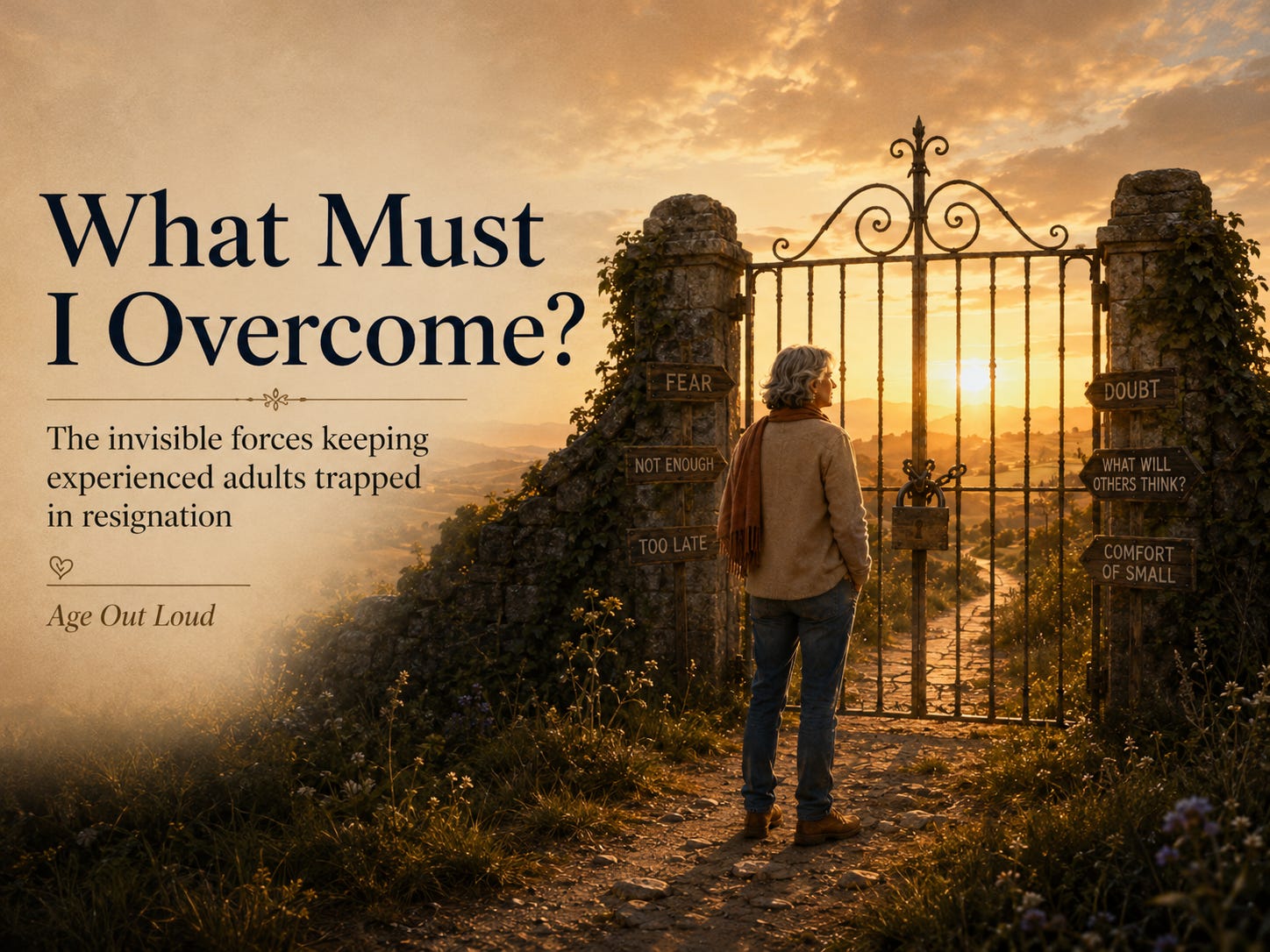
Today, we face the question that often stands between insight and action: What must I overcome?
That question matters because clarity alone does not create change. A person can know they still have value, sense that they still have purpose, and even feel the pull of a new chapter, yet remain stuck in the same place. They can see the trail ahead and still never take the first step.
Why?
Because something inside them has learned to resist movement.
Most people assume their greatest obstacles are external. They point to age, health, money, technology, family obligations, limited opportunity, or the fact that the world has changed. Some of those challenges are real. We should never pretend otherwise. Bodies change. Loss leaves scars. Resources may be limited. Responsibilities do not disappear simply because we are ready for something new.
But the obstacle in front of us is not always the obstacle holding us back.
Often, the deeper barrier is the meaning we have attached to our circumstances. It is the story we have accepted about what our age, losses, mistakes, or limitations say about who we are and what is still possible.
Two people can face nearly identical circumstances and experience them in completely different ways. One sees a brick wall and concludes the road has ended. The other sees a locked door and begins looking for the key. The facts may be the same, but the frame around those facts determines what each person believes, expects, and does next. That principle runs throughout Age Out Loud: our perspective becomes the lens through which we interpret obstacles, and that interpretation can create either faith and movement or doubt and paralysis.
This is where internalized ageism becomes so destructive. Ageism is not limited to discrimination from employers, advertising, entertainment, or younger people. Its most damaging form occurs when we begin applying the culture’s assumptions to ourselves.
We hear the messages for years. Older people are out of touch. Learning belongs to the young. New beginnings become less realistic with time. Adventure is for people with stronger bodies and fewer responsibilities. Creativity has a window, and that window is closing. The best thing an older person can do is be sensible, remain comfortable, and avoid becoming a burden.
Eventually, those messages no longer sound like something society is saying. They begin to sound like our own voice.
That is how the prison is built.
The bars are not always physical limitations. Often, they are sentences we repeat without questioning them: “I am too old to start over.” “Nobody wants what I know.” “I would look foolish trying that now.” “I missed my opportunity.” “I cannot keep up.” “I am not the person I used to be.” “I should be satisfied with what I have.”
One of the most dangerous phrases in later life is, “Be realistic.”
There is nothing wrong with reality. I believe in telling the truth. But what people call realism is often fear wearing work clothes. It sounds mature, practical, and responsible, but underneath it may be a decision to expect less from life so we will not have to risk disappointment.
That is how resignation disguises itself.
We convince ourselves we are content when we have actually stopped hoping. We call it peace when it may be withdrawal. We say we have nothing to prove, when the truth is that we are afraid to try something we might not do well. We tell ourselves we are being wise, when we are really protecting ourselves from embarrassment.
As we grow older, the fear of looking foolish can become more powerful than the desire to grow. By this point in life, we may have built a reputation. People know us as competent, capable, experienced, and dependable. Starting something new means becoming a beginner again. It means asking questions, making mistakes, and admitting that we do not know what we are doing.
That can feel threatening.
A person who spent decades being the expert may avoid learning a new skill because they do not want anyone to see them struggle. Someone who has always been independent may resist joining a new group because they fear not fitting in. A retired leader may have a valuable idea but never share it because they assume nobody is interested anymore.
We would rather remain competent in a shrinking world than become clumsy in an expanding one.
That is a terrible trade.
Every meaningful new chapter requires us to tolerate some discomfort. The first time we do anything, we are unlikely to do it gracefully. We forget this because we compare our beginning to someone else’s mastery. We see the finished result but not the awkward first attempt, the failed experiment, the unanswered invitation, or the long season of learning.
The truth is that growth has always required humility. That did not change because we turned 60, 70, or 80. The difference is that now we may have more pride to lay down.
Fear of failure is another powerful barrier. Many experienced adults carry disappointments they have never fully processed. A business failed. A marriage ended. A dream was delayed until it quietly disappeared. An opportunity was lost. A relationship never became what they hoped it would become. They may have moved on outwardly, but inwardly they built a conclusion around the pain: I tried once. It did not work. I will not put myself through that again.
That response is understandable. Pain teaches caution.
But it can also teach the wrong lesson.
A failure may prove that a particular approach did not work, that the timing was wrong, that we lacked preparation, or that we trusted the wrong people. It does not prove that we are incapable of succeeding in the future. Yet when we turn an event into an identity, we stop saying, “That failed,” and begin saying, “I am a failure.”
Those are not the same statement.
In Age Out Loud, I describe the importance of catching, checking, and changing the thoughts that shape us. We have to notice the automatic conclusions running through our minds, examine whether they are true, useful, and kind, and then replace them with something more balanced and constructive. The goal is not shallow positive thinking. It is refusing to allow an unexamined thought to become a life sentence.
Grief can also become an invisible barrier. Loss changes us, and it should. We should never minimize the death of a spouse, the loss of health, the end of a career, the estrangement of a child, or the collapse of a dream. There are losses we do not simply “get over.” We carry them differently over time.
But there is a distinction between honoring our grief and allowing grief to become our identity.
After Barbara died, my life was shattered. I had been a husband for 33 years and a caregiver during the final season of her life. Then both roles were gone. I had to learn who I was in a world I had never planned to inhabit. There were no shortcuts. I had to receive the pain, resolve to heal, reset my expectations, renew my mind, reimagine my purpose, and slowly move forward.
What I had to overcome was not my love for Barbara. I would never want to overcome that. I had to overcome the belief that continuing to live fully would somehow dishonor what we had shared.
Many people carry a similar conflict. They feel guilty when they laugh again, travel again, love again, dream again, or enjoy a day without thinking constantly about the person they lost. They confuse continued suffering with continued loyalty.
But refusing to live does not honor the dead. Living forward carries their influence into the future.
Loss may explain why we stopped. It does not have to decide whether we start again.
Another barrier is the comfort of familiar routines. We often talk about comfort as though it were always a good thing, but comfort can quietly become captivity. The familiar asks very little of us. We know where everything is, what everyone expects, and how the day will unfold. There is little risk, but there is also little surprise.
The longer we live inside a small, predictable world, the more intimidating the outside becomes. A new group feels exhausting. A new technology feels unnecessary. A different routine feels disruptive. Even something we once wanted can begin to feel like too much trouble.
We do not wake up one morning and decide to shrink our lives. It happens by inches. We decline one invitation, then another. We stop calling because we assume people are busy. We avoid driving at night, then avoid going out altogether. We tell ourselves we will try something when the timing is better.
Eventually, the boundaries of our comfort zone become the boundaries of our life.
That is when comfort stops serving us.
The habit of waiting for permission can be just as limiting. Many people have spent their entire lives meeting expectations. They did what parents, employers, spouses, children, churches, and communities needed them to do. They became responsible, reliable, and useful. Those qualities are admirable.
But after decades of living according to obligation, some people no longer know what they want. They may have dreams, but they immediately filter them through what others might think. Would my children approve? Would my friends understand? Would people think I have lost my mind? Am I allowed to make a choice simply because it calls me forward?
At some point, we have to stop waiting for a committee to approve our lives.
This does not mean abandoning responsibility or disregarding people we love. It means recognizing that a meaningful future will require our participation. Nobody else can identify our assignment, confront our fear, or take our next step for us.
The Age Out Loud journey is not about becoming selfish. It is about becoming fully available. When we live from fear, regret, obligation, or resignation, we have less to offer everyone around us. When we become more alive, more engaged, and more purposeful, our families and communities benefit.
Sometimes the thing we must overcome is not weakness but a false definition of strength.
We may believe strong people do not ask for help, admit loneliness, need community, or change direction. We think resilience means carrying everything alone. That may look impressive from a distance, but isolation is not strength.
Real strength is knowing when the load is too heavy to carry alone. It is entering a room where you do not know anyone. It is telling someone, “I am struggling.” It is allowing yourself to learn from people younger than you. It is receiving support without believing that support diminishes your dignity.
We are designed to create, connect, and contribute. None of those happen fully in isolation.
The final obstacle may be the hardest to admit: we have stopped expecting good things from the future.
Expectation is one of the most powerful forces in human behavior. When we expect failure, embarrassment, rejection, or decline, our actions begin aligning with that expectation. We procrastinate, avoid, and protect ourselves. When we expect possibility, we prepare, engage, and move.
Desire alone is not enough. You may desire better health, deeper relationships, a meaningful project, or a new adventure. But if your expectation says, “That will never happen for someone like me,” expectation will always win. The book describes this movement from the frame in our head, to the feeling in our heart, to the function in our hands. Doubt creates anxious apprehension and paralysis. Faith creates joyful anticipation and action.
This is why overcoming resignation is not simply a matter of trying harder. We have to challenge the belief system producing the resignation.
We must ask whether the story we are living is actually true.
Are you really too old, or have you simply never seen enough examples of people your age doing what you want to do?
Is the opportunity gone, or has its form changed?
Do you truly have nothing to contribute, or have you stopped looking for places where your contribution is needed?
Are you incapable, or are you unwilling to be a beginner?
Are you content, or have you lowered your expectations to avoid disappointment?
Is your world small because it must be, or because familiarity has become more important than possibility?
These are not comfortable questions, but comfort is not the goal. Freedom is.
I believe every challenge has the potential to become either a brick wall or a locked door. A brick wall ends the journey. A locked door invites us to search for the key. The key may be a new perspective, a difficult conversation, a healthier boundary, a request for help, a decision to forgive, a new skill, a small act of courage, or the willingness to try again.
Some doors will take time to open. Some wounds require patient healing. Some circumstances will not change simply because we want them to. Age Out Loud is not denial, and it is not pretending that every obstacle disappears when we think positively.
It is the refusal to surrender our entire future to one obstacle.
It is the determination to ask, “Given what is true, what is still possible?”
That question restores agency. It brings us back to what we can control: our attitude, our effort, our response, and our next step. We may not be able to change the past, recover everything we lost, or remove every limitation. But we can decide what those facts will mean going forward.
Today, I want you to identify one belief about yourself, your age, or your future that has become a locked door in your life. Write it down as honestly as you can. Then ask what remaining behind that door has already cost you. Has it cost you connection, adventure, health, contribution, confidence, joy, or time with people you love?
Finally, ask one more question: What would become possible if that belief no longer controlled me?
Do not try to solve everything today. Find the first key. Make the phone call. Join the group. Ask the question. Take the walk. Open the document. Sign up for the class. Tell someone about the dream you have kept hidden.
Courage is rarely one dramatic act. More often, it is one honest step taken while fear is still present.
Share in the comments what you believe you must overcome. You may discover that naming the barrier weakens its power, and someone else may recognize that they are not the only person standing in front of the same locked door.
Tomorrow, we will bring this week together and examine the quiet prison these beliefs can create: the prison of resignation. We will also prepare to explore what it means to finally step out of that prison and begin the journey toward liberation.
No posts
Comments
Nothing yet. Say the first thing.
Sign in to join the conversation.