
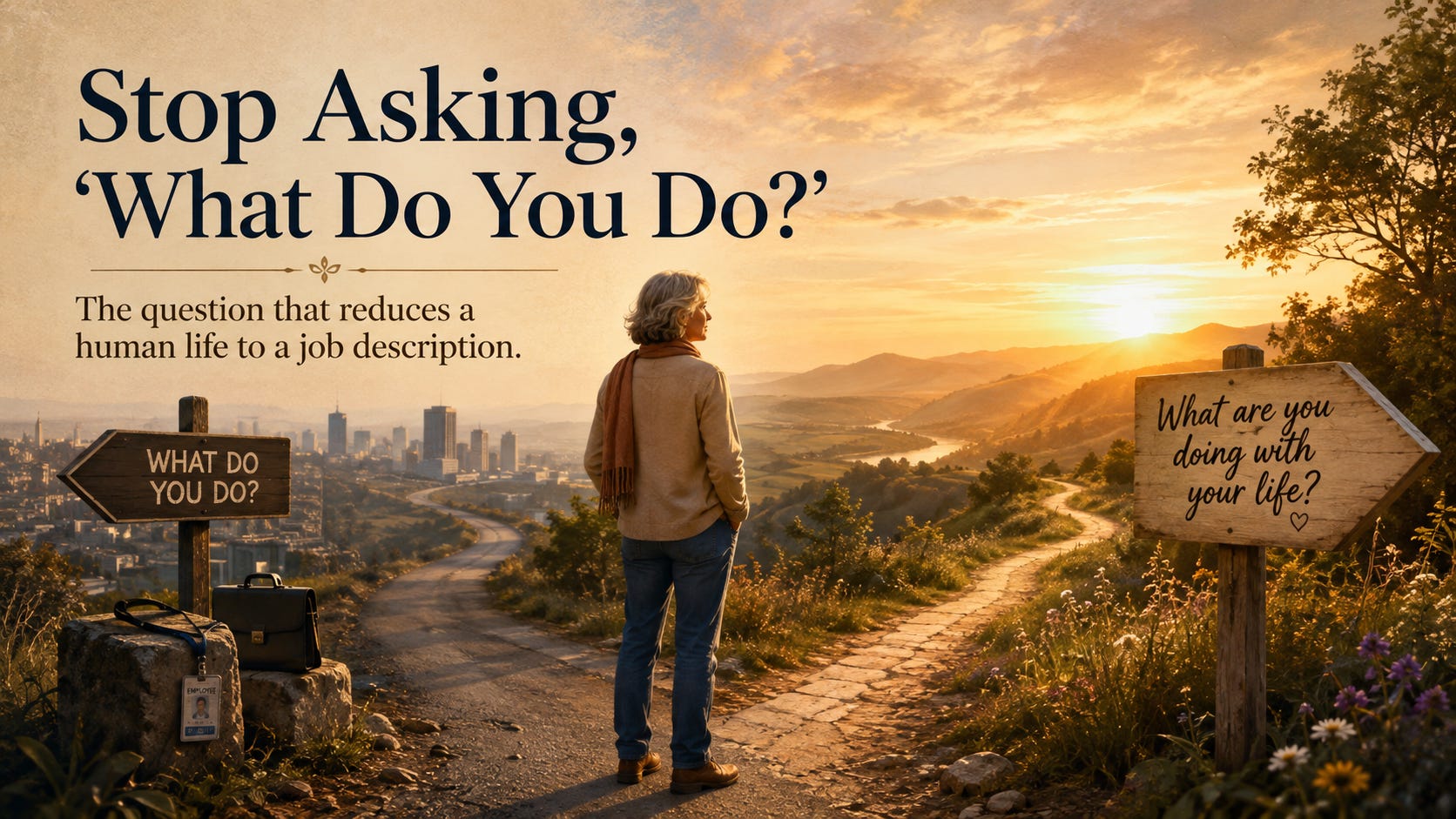
One of the first questions we ask when we meet someone is, “What do you do for a living?” It seems innocent enough. It gives us a place to begin a conversation and helps us understand something about the person standing in front of us. But the more I think about it, the more I wonder whether that question reveals more about our culture than it does about the person.
We rarely ask someone, “What are you learning?” We do not usually ask, “Who are you becoming?” We almost never ask, “What are you doing with your life?” Instead, we ask how they earn money, where they fit into the economy, and what function they perform. Before we realize it, we have begun measuring the value of a human being by a job description.
People answer by saying, “I am a contractor,” “I am a nurse,” “I am a teacher,” or “I am a business owner.” There is nothing wrong with taking pride in our work. Meaningful work gives us opportunities to serve people, solve problems, create things, develop relationships, and contribute to the world around us. I have spent most of my life in construction, and that work has shaped how I think. It taught me the importance of a strong foundation, the danger of ignoring small problems, and the reality that sometimes something must be taken apart before it can be rebuilt properly.
But construction is what I do. It is not the totality of who I am.
That distinction becomes increasingly important as we grow older. For forty or fifty years, a person may build an identity around being the provider, the leader, the teacher, the caregiver, the decision-maker, or the person everyone calls when something needs to be fixed. Their calendar tells them where to go. Their responsibilities tell them what needs to be done. Other people depend on them, seek their advice, and remind them every day that their contribution matters.
Then the role changes. There may be a retirement dinner, a plaque, a few kind words, and a box of belongings carried home from the office. The next morning, that person wakes up with nowhere they are required to be. At first, the freedom may feel wonderful. There is no alarm clock, no commute, no meeting, and no deadline hanging over the day.
But after the vacation is over and the garage has been cleaned for the third time, a deeper question may begin to surface: Who am I now?
That is a much more serious question than, “What am I going to do today?” Many people do not simply retire from a job. They lose the identity that came with the job. They lose the title, the routine, the influence, the relationships, and the feeling that someone is waiting for them to show up.
The same thing can happen when children leave home, when caregiving responsibilities end, when a business is sold, when health changes, or when a spouse dies. The familiar role disappears, and the person underneath it is left standing in unfamiliar territory. Life may still be full of people and activity, but something has shifted internally.
In Age Out Loud, I wrote about the emptiness that can follow retirement when people discover that rest alone cannot sustain a meaningful life. Human beings need more than leisure. We are designed to create, connect, and contribute. When those three things begin to disappear, we can feel like a ship that has lost its rudder.
That is often where resignation begins. It rarely starts with someone boldly declaring that their life no longer matters. It begins quietly. They stop initiating conversations. They turn down invitations because staying home is easier. They lose interest in learning something new. They begin talking more about what they used to do than what they are doing now.
Eventually, they may stop expecting anything meaningful to happen next.
A person who once felt useful, capable, and necessary can begin to feel invisible. They may possess more wisdom than they have ever had, yet fewer people ask what they think. They may carry decades of knowledge and experience but have no clear place to use it. They may be surrounded by people and still feel disconnected because no one seems interested in who they are beneath the roles they once performed.
That is not merely boredom. It is an identity crisis.
Our culture makes this worse because we tend to measure human value through visible productivity. While someone is working, earning, leading, building, and solving problems, we call them successful. When they stop performing those activities in the same way, we begin speaking as though their greatest contribution is behind them. Tragically, many people eventually begin speaking that way about themselves.
You can hear it in phrases such as, “I used to be somebody,” “I used to run the whole department,” or “I am just retired now.” Listen carefully to those words. They reveal a person whose identity has become trapped in the past.
This is one reason I object so strongly to the traditional meaning we attach to retirement. We retire equipment when it has reached the end of its useful life. A human being is not a worn-out machine. As long as you are alive, you still have something to create, someone to connect with, and something meaningful to contribute.
Your contribution may change. In fact, it probably should change. The way you served the world at 35 may not be the way you are called to serve it at 65 or 85. But a change in assignment is not the end of your usefulness. It may be the beginning of a deeper usefulness.
Experience gives you something youth cannot manufacture. You have survived things. You have made mistakes and learned from them. You have watched plans succeed and fail. You have loved, lost, adapted, rebuilt, and discovered what truly matters. That wisdom does not become worthless when your job title disappears. It may become even more valuable because you finally have the perspective to understand it.
The mission of Age Out Loud is to help people move from resignation to expectation, from fading to becoming, and from fear of decline to a life of purpose, vitality, connection, and possibility. Aging is not the slow loss of life. It can be the deepening of life.
Before we can move forward, however, we have to examine the foundation upon which we have built our identity. We have to ask whether we know who we are apart from the roles we perform and the titles printed on our business cards.
I would like to suggest that we begin asking a better question. Instead of asking, “What do you do for a living?” perhaps we should ask, “What are you doing with your life?”
The first question can be answered with a job title. The second requires reflection. The first asks how you make money. The second asks what you are making of your days. The first describes your occupation. The second reveals your direction.
You can retire from a career. You can step away from a position. You can complete one season of responsibility. But you should never retire from living, becoming, serving, learning, loving, creating, and contributing.
You are more than what you have done. You are more than the title printed on an old business card. You are more than the role that ended, the loss you experienced, or the limitations you now face. You are still becoming.
Today, pay attention to the words you use when you describe yourself. What comes after the words “I am”? Do you define yourself by a role, a loss, a limitation, or a chapter that has already closed?
Then sit with this question: What are you doing with your life right now? Not what did you do. Not what do you hope to do someday. What are you doing with the life you have been given today?
Share your answer in the comments, even if the most honest answer is, “I am not sure.” That uncertainty may be the most important place to begin.
Tomorrow, we will go deeper and ask the question beneath every title and every changing role: Who am I when the labels come off?
No posts
Comments
Nothing yet. Say the first thing.
Sign in to join the conversation.