
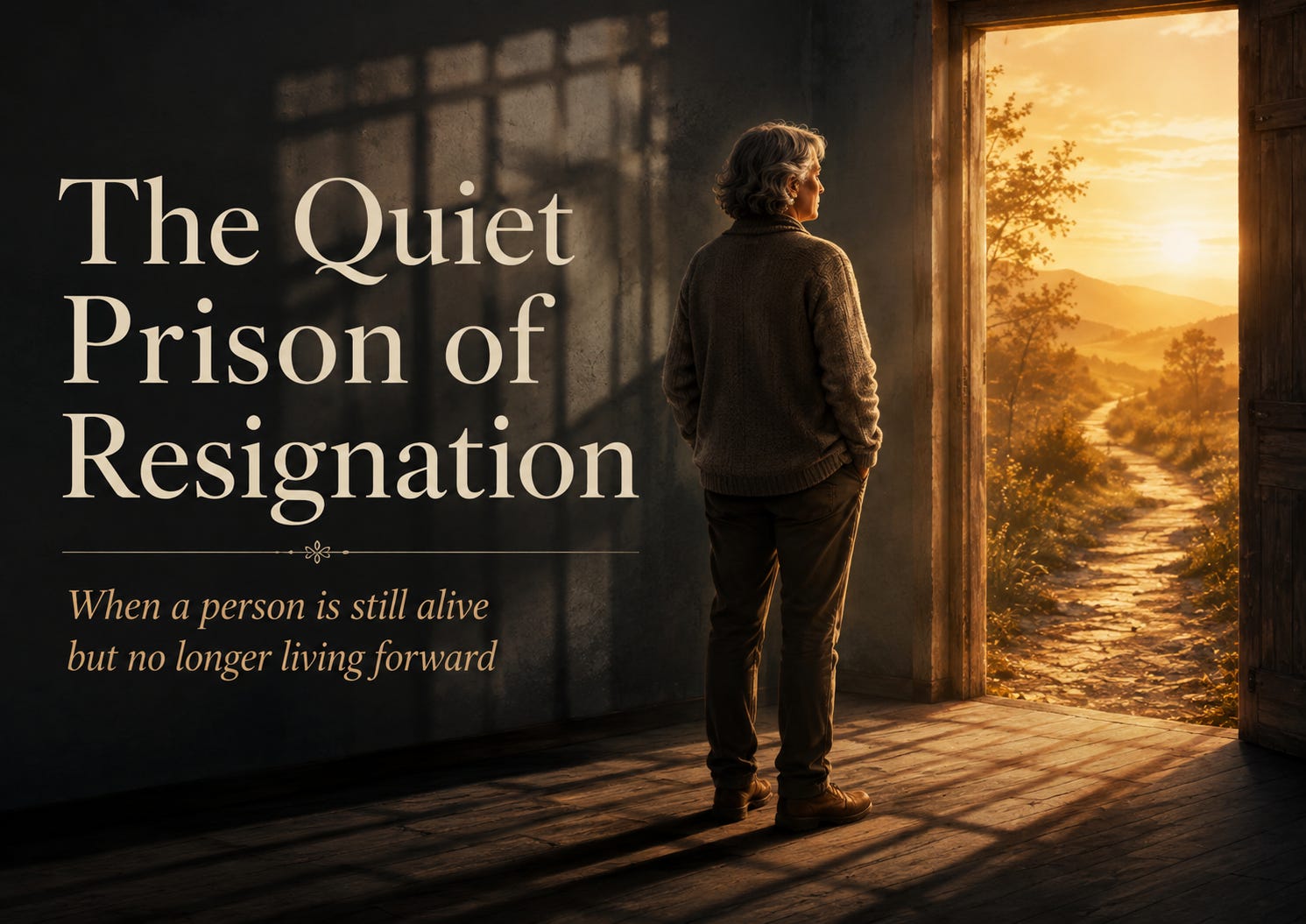
This week, we have gone beneath the surface of aging and asked four difficult questions. What are you doing with your life? Who are you when the labels come off? Why are you still here? What must you overcome? Today, we bring those questions together and name the condition that can take hold when they remain unanswered.
That condition is resignation.
Thanks for reading! Subscribe for free to receive new posts and support my work.
Resignation is not always obvious. It does not necessarily look like despair, depression, or complete withdrawal. More often, it looks respectable. It looks like staying busy enough to avoid thinking too deeply. It looks like maintaining familiar routines, talking mostly about the past, and saying, “I’m fine,” when something inside has gone quiet.
A resigned person may still laugh, socialize, travel, volunteer, and keep the house in order. From the outside, life may appear comfortable and stable. But underneath the activity, there is often a loss of expectation. The person no longer believes anything deeply meaningful is waiting for them.
That is the quiet prison of resignation.
The walls are not made of concrete. They are built from conclusions. My most useful years are behind me. Nobody really needs what I have to offer. I missed my chance. I am too old to begin again. My circumstances have already decided my future. It is safer not to hope too much.
Those beliefs can become so familiar that we stop recognizing them as beliefs. We begin treating them as facts.
In Age Out Loud, I describe the hidden undercurrents of negative thinking about aging that can quietly sabotage our life, liberty, and pursuit of happiness. We absorb the cultural expectation that aging means becoming weaker, less capable, less visible, and less useful. When those assumptions go unchallenged, they do not remain abstract ideas. They begin shaping what we attempt, what we avoid, and what we expect from the years ahead.
This is why resignation is so dangerous. It does not simply change how we feel. It changes how we live.
When we stop expecting meaningful possibilities, we stop preparing for them. We do not strengthen our bodies because we cannot see what we are preparing them to do. We do not stretch our minds because we assume learning belongs to the young. We do not form new relationships because we tell ourselves everyone already has enough friends. We do not share our wisdom because we assume nobody is interested.
Eventually, the lack of action seems to confirm the belief. Nothing new happens because we stopped doing the things that make something new possible. Then we look at our shrinking life and say, “See? I knew there was nothing more for me.”
That is how resignation becomes self-reinforcing.
It begins with a belief, creates a feeling, and produces a behavior. The belief says, “It is too late.” The feeling becomes discouragement or anxious apprehension. The behavior becomes avoidance, procrastination, or withdrawal. Over time, that behavior creates the very life we feared.
This is not weakness. It is a pattern. And patterns can be interrupted.
The first step is recognizing what resignation has cost us.
It may have cost us a friendship because we kept waiting for the other person to call. It may have cost us physical strength because we accepted inactivity as normal. It may have cost us a dream because we kept preparing without ever beginning. It may have cost us years of contribution because we assumed our experience was no longer relevant.
Sometimes resignation costs us more quietly. It costs us curiosity. It costs us wonder. It costs us the feeling of waking up with something to look forward to. It costs us the sense that the future still has a claim on us.
That loss is difficult to measure, but it is real.
One of the saddest things I have witnessed is a person who is still very much alive but has stopped living forward. Their body is present, but their expectation has retreated into the past. They spend most of their emotional energy remembering what used to be, regretting what was lost, or protecting themselves from what might go wrong.
The past becomes more vivid than the future.
There is nothing wrong with remembering. Our memories are part of our identity. They hold the people we loved, the work we did, the places we lived, and the moments that shaped us. But memory becomes a prison when the only meaningful version of ourselves exists in a chapter that has already closed.
Some people live as though their real life ended when the career ended. Others live as though it ended when the children left home, when their health changed, when a spouse died, or when a dream failed. They keep breathing, functioning, and getting through the days, but inwardly they have accepted a smaller definition of life.
They are no longer asking, “What is possible now?”
They are asking, “How do I keep from losing anything else?”
That shift changes everything.
A life built around protection will always become smaller. We avoid new relationships because they could bring disappointment. We avoid new challenges because we could fail. We avoid adventure because something might go wrong. We avoid hope because hope makes us vulnerable.
But a life without vulnerability is also a life without growth, intimacy, surprise, or transformation.
We cannot protect ourselves from every disappointment without also protecting ourselves from possibility.
The tragedy is that resignation often disguises itself as wisdom. We tell ourselves we are being sensible. We say we know how life works now. We have learned not to get our hopes up. We call this maturity, but sometimes it is simply accumulated disappointment that has hardened into low expectation.
True wisdom does not deny difficulty. It simply refuses to give difficulty the final word.
Experience should make us more discerning, not more defeated. It should teach us how to take better risks, choose better relationships, recognize better opportunities, and recover more intelligently when things go wrong. The wisdom of age is not meant to keep us out of the arena. It is meant to help us enter the arena with clearer eyes.
In the book, I argue that human beings are designed to create, connect, and contribute. When those three currents stop flowing, we become like a ship without a rudder. We lose our direction because we have lost the activities that remind us why we matter.
Resignation shuts down all three.
We stop creating because we believe our best work is behind us. We stop connecting because isolation feels easier than risking rejection. We stop contributing because we have accepted the idea that older adults are primarily recipients of care rather than sources of wisdom, service, leadership, and value.
That is why loneliness is not always solved by placing more people in the room. A person can be surrounded by family and still feel disconnected. The deeper need is not simply company. It is meaningful connection. It is being known, needed, heard, and invited to contribute.
Being cared for matters, but care without contribution can unintentionally diminish dignity.
Older adults are not merely people with needs. They are people with gifts.
They carry stories that could steady a younger person. They possess skills that could disappear if they are not passed on. They have survived losses that give them the credibility to sit beside someone in pain. They have perspective that could keep a family, business, church, or community from repeating avoidable mistakes.
Yet resignation tells them to keep all of that locked inside.
It says, “Do not impose.”
It says, “Nobody asked.”
It says, “Let the younger people handle it.”
It says, “Your time has passed.”
That is not humility. It is the silencing of a generation.
Our culture suffers when experienced adults fade quietly. Families lose stories. Communities lose leadership. Younger people lose access to perspective. Skilled trades lose craftsmanship. Churches lose spiritual maturity. Society loses the deep reservoir of resilience that can only be created through years of living.
The cost of resignation is never limited to the person who resigns.
That is why Age Out Loud is not merely about personal fulfillment. It is about reclaiming a resource our culture desperately needs. It is about recognizing that age can be an asset and that the later years can become a season of extraordinary usefulness, depth, courage, and contribution.
But before liberation can begin, we have to tell the truth about the prison.
We have to admit where we have stopped expecting. We have to recognize where comfort has become captivity, where caution has become avoidance, and where disappointment has become identity. We have to notice the dreams we have dismissed before giving them an honest hearing.
Most of all, we have to confront the belief that nothing can change.
That may be resignation’s most powerful lie.
Change may not look the way it did when we were younger. We may have different energy, responsibilities, resources, and limitations. We cannot rewind life, recover every opportunity, or restore every ability. But we can still choose our response. We can still learn, connect, serve, create, contribute, forgive, repair, begin, and become.
Aging does not eliminate agency.
The future may not be unlimited, but it is still unwritten.
That distinction matters.
When we say the future is unlimited, we risk denying reality. Time is precious, bodies are mortal, and circumstances place real boundaries around us. But when we say the future is unwritten, we reclaim responsibility for what we will do with the life that remains.
That is not shallow optimism. It is honest possibility.
I have walked through a season when the future I expected disappeared. When Barbara died, I did not simply lose my wife. I lost the life I thought we would continue living together. I had to grieve what was gone and slowly become willing to imagine a future I had never planned.
There was no formula for that. There was pain, confusion, healing, faith, and the gradual decision to move forward. I learned that moving forward does not mean forgetting. It means carrying the love, lessons, and values of the past into a life that is still unfolding.
That decision eventually opened my heart to Michelle, to new adventures, to deeper purpose, and to the work I am doing now. None of that erased the loss. It revealed that loss did not have the authority to end my life while I was still living.
That is the line resignation tries to cross. It takes a painful chapter, a role change, a disappointment, or a cultural stereotype and declares the entire story finished.
But the chapter is not the book.
The loss is not the identity.
The limitation is not the whole future.
The past has shaped you, but it does not own you.
This week, we asked three foundational questions. Who am I? Why am I here? What must I overcome? Resignation offers shallow answers. It says you are who you used to be, you are here mostly to avoid trouble, and what you must overcome is probably too difficult anyway.
I reject those answers.
You are more than the roles you have performed. You are a person formed by faith, experience, relationships, hardship, resilience, wisdom, and possibility. You are still here to create, connect, contribute, love, serve, grow, and carry out the assignment that belongs uniquely to you. What you must overcome is not necessarily your age or circumstances, but the beliefs that have convinced you to live beneath your remaining potential.
Naming resignation does not instantly set us free, but it does something important. It turns on the light.
Once you can see the walls, you can begin looking for the door.
Once you can identify the belief, you can challenge it.
Once you can name what has been lost, you can begin reclaiming what remains.
Once you stop calling the prison home, freedom becomes imaginable.
That is where we are going next.
The answer to resignation is not distraction. It is not denial. It is not pretending we are younger than we are, filling every hour with activity, or chasing some artificial version of relevance.
The answer is liberation.
Liberation means being released from the identity you outgrew, the ageist beliefs you absorbed, the fears that narrowed your life, and the expectations that taught you to fade quietly. It means reclaiming your value, renewing your vitality, rediscovering your purpose, and choosing to live forward.
Next week, we will begin mapping that journey.
For today, I want you to sit with one honest question: Where has resignation made your life smaller?
Perhaps it has affected your health, relationships, creativity, faith, service, or sense of adventure. Perhaps it has kept you from making a call, joining a group, sharing your story, beginning a project, or admitting what you still want.
Name it without condemning yourself. Awareness is not shame. It is the beginning of freedom.
Then ask yourself what might become possible if you no longer allowed that resignation to make your decisions.
Share your answer in the comments, even if you are only beginning to understand it. Honest conversation breaks isolation, and isolation is one of resignation’s strongest allies.
You are still here. You still matter. Your future still has a claim on you.
The door is there.
Next week, we begin opening it.
Thanks for reading! Subscribe for free to receive new posts and support my work.
Comments
Nothing yet. Say the first thing.
Sign in to join the conversation.