
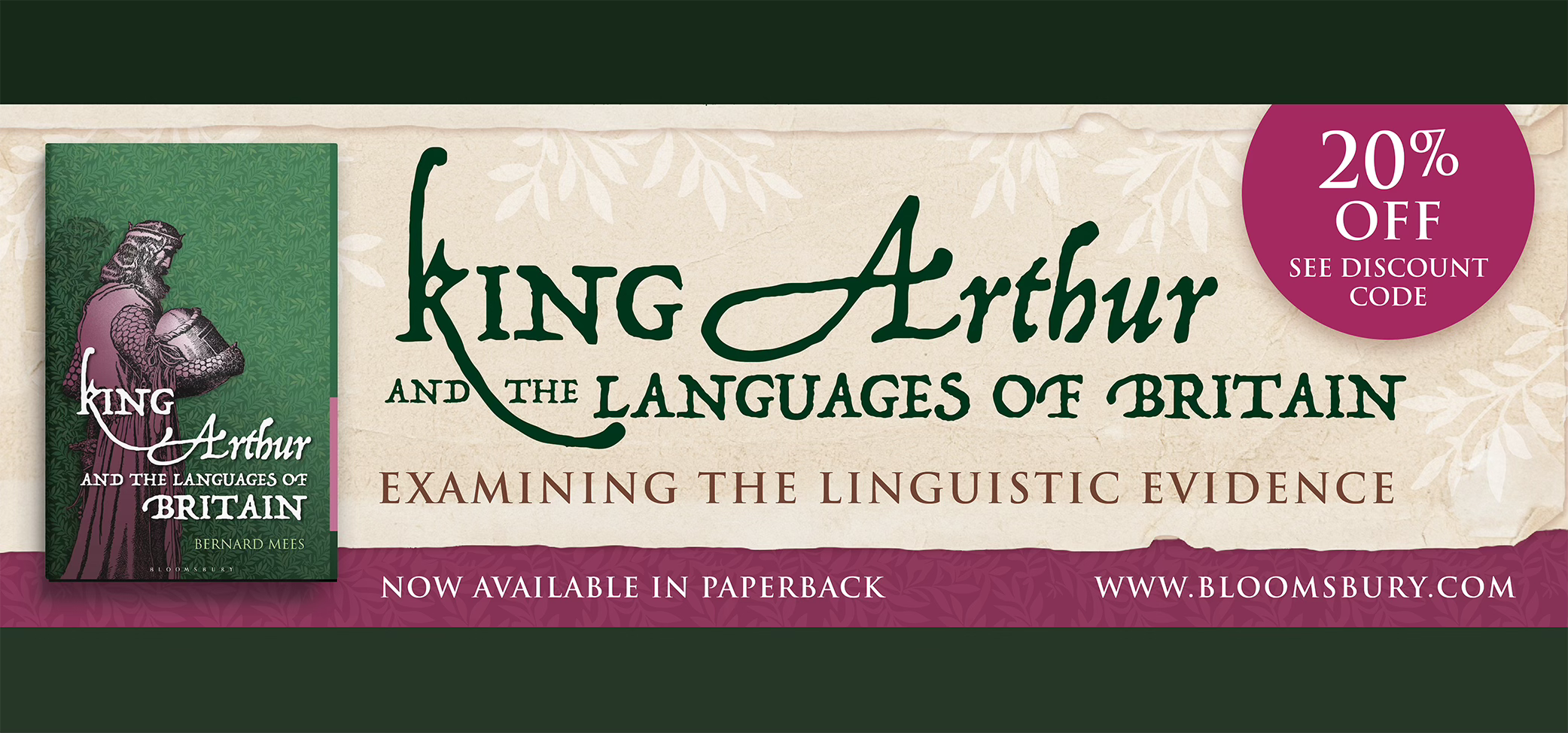
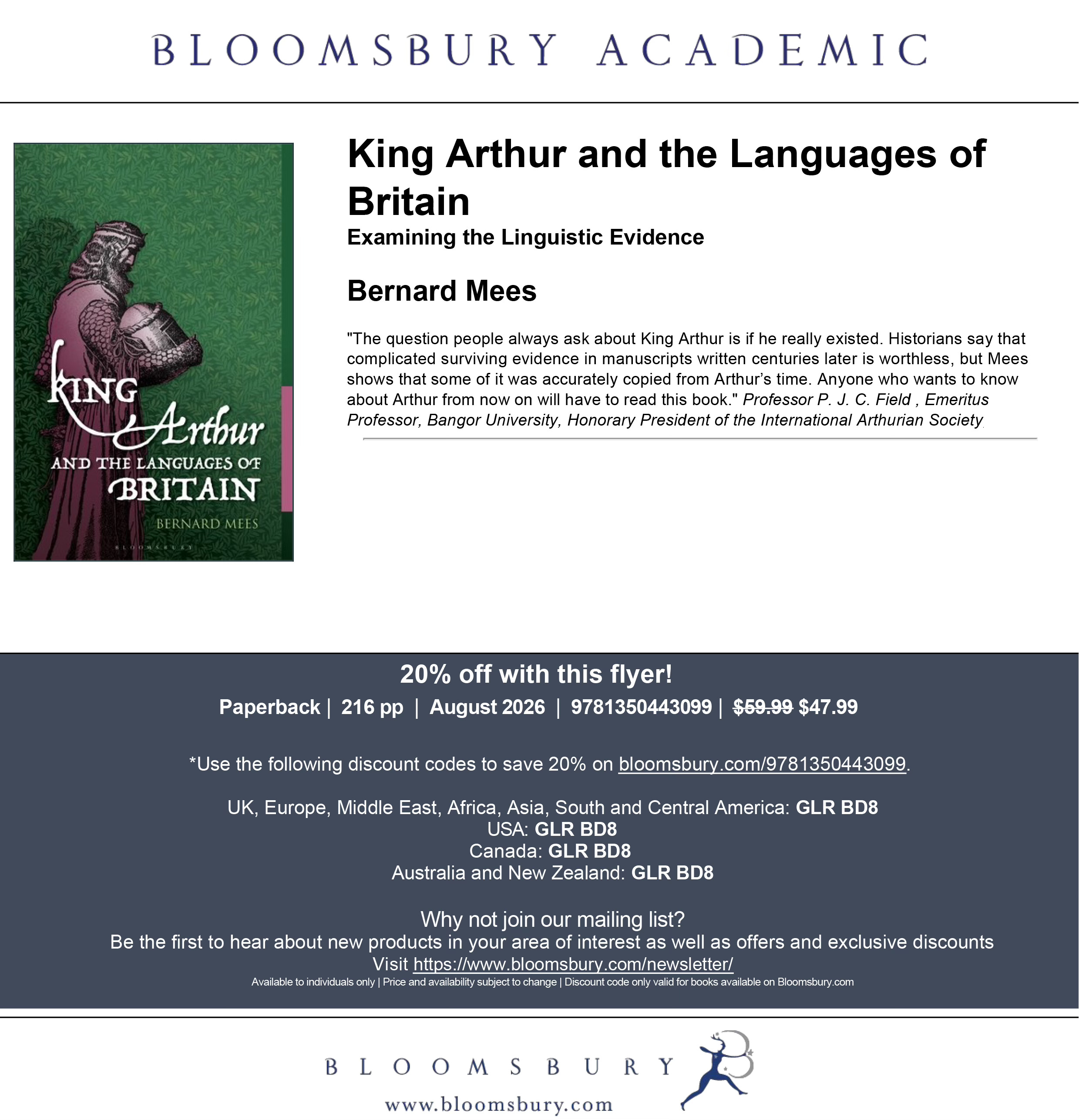
My most recent book King Arthur and the Languages of Britain is due out in paperback in August (see bloomsbury.com/9781350443099) – and not only has the cover price come down to a more reasonable level, the publisher has sent me a flyer with a discount code for 20% off (GLR BD8). I’ve appended the flyer to the end of this post for anyone who may wish to use it.
Substack encourages authors to write posts on any books they publish, so I thought I’d spend a bit of time explaining why I wrote a book on a topic like King Arthur. These days almost no one makes a profit from writing books of the kind academic presses issue. A typical academic book sells several hundred copies and the author receives several hundred dollars or pounds in royalties. But I think I’ve discovered something too important to be buried in the pages of an academic journal.
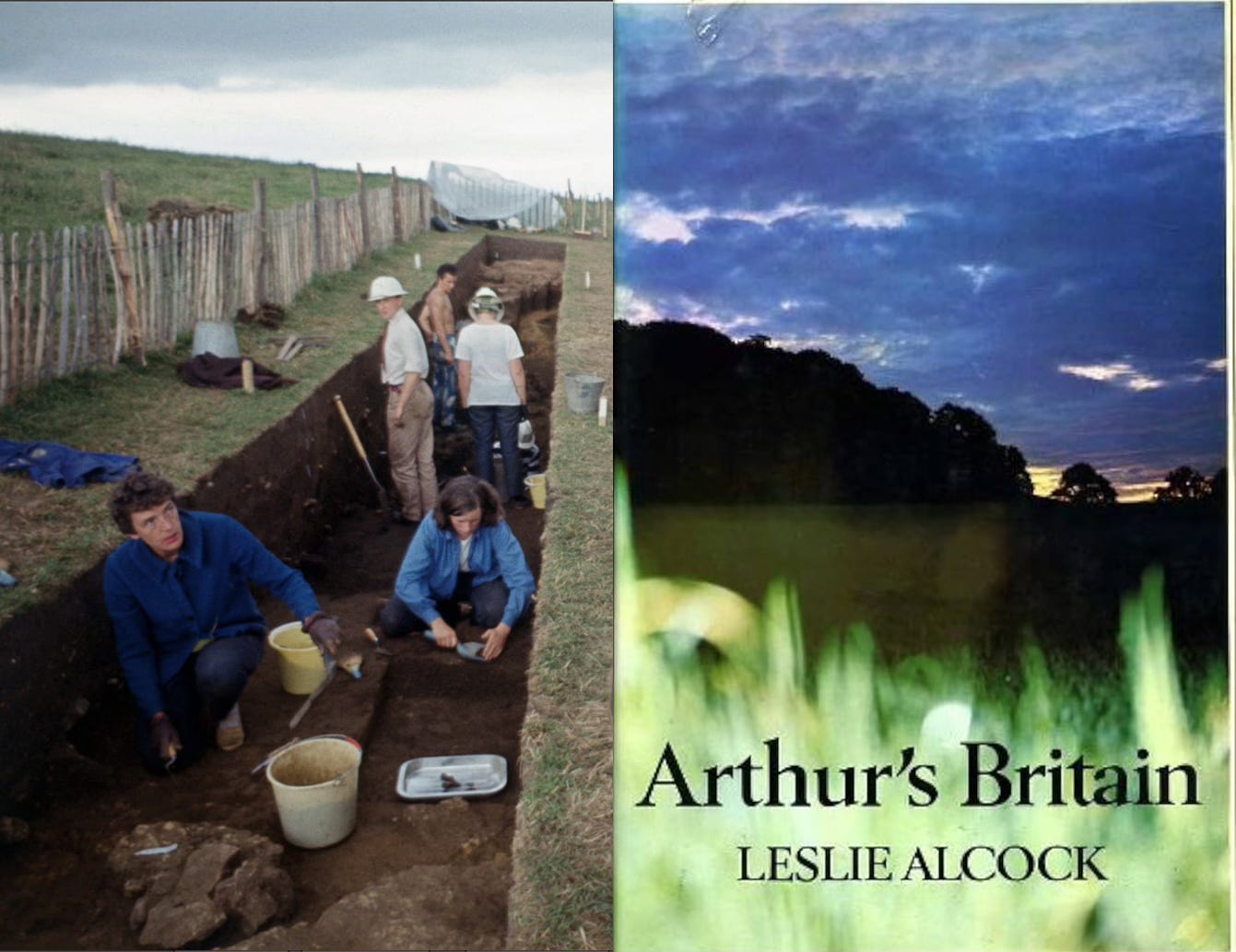
In 1966, British archaeologists began to investigate the hillfort of Cadbury Castle in Somerset. The team was led by an archaeology lecturer from the University of Wales and it was supported by a team of volunteers, most of whom were Arthurian enthusiasts. The excavation was premised on the idea that Cadbury Castle may have been the site of King Arthur’s capital Camelot. It seems like a quixotic quest today, but the resultant book Arthur’s Britain, first published in 1971, quickly became a bestseller.
Yet not everyone was happy about the excavations at Cadbury Castle and the success of Arthur’s Britain. A lot of griping arose about what was going on at the time, both from professional archaeologists and historians. Wealthy Americans were partly funding the dig in Somerset, and anti-American sentiment in Britain was just as strong then as it is now.
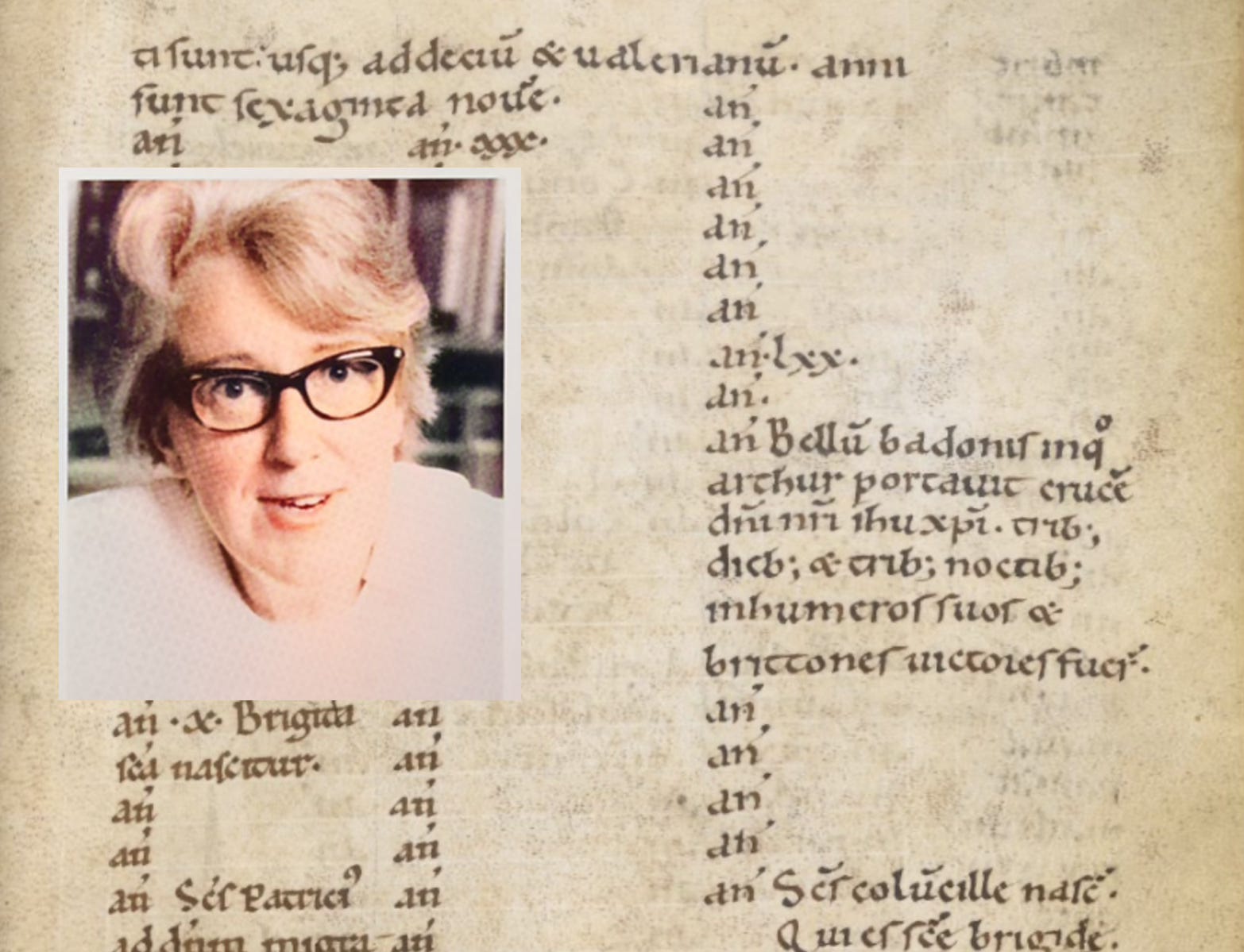
Then in 1973, Kathleen Hughes, a history lecturer at Cambridge University, presented a paper at the British Academy that criticised the main historical source that mentions King Arthur. The work is usually called the Welsh annals – or the Annales Cambriae in Latin – and it mentions Arthur twice, in entries for the years 516 and 537. The entry for 516 claims that Arthur led the Britons to victory at the Battle of Badon, an encounter also mentioned by the sixth-century cleric Gildas, while that for 537 records that Arthur died at a place called Camlann along with another figure.
Hughes’s paper was published in 1974 and since that date it has served as the key study of the Welsh annals relied upon by Arthurian sceptics – those who claim that King Arthur was not a historical figure. The oldest surviving copy of the Welsh annals includes entries from the fifth to the tenth century, and the work is often, accordingly, called a tenth-century chronicle. Hughes thought that the entries in the Welsh annals that mention Arthur were retrospective concoctions – that it was not likely that they stemmed from the sixth century. But had she really demonstrated that?
Hughes was not an expert in Welsh history – she specialised instead in the study of medieval Ireland. She also lacked the linguistic skills to analyse the Welsh annals properly. She recounted in her paper that she had asked a professor in Edinburgh who specialised in languages for advice, and ploughed on with her analysis of the Welsh annals based on what he (apparently) told her.
As a result, Hughes’s analysis passes over the linguistic evidence in the Welsh annals that betrays how old they really are. I still find it hard to believe that a paper that was so methodologically flawed could have proved so influential. But Hughes’s analysis was seized on by sceptics and her judgement is now still widely touted as evidence that Arthur, somehow, cannot have existed.
There had always been some historians who were not willing to allow that King Arthur was historical – or at least not certainly so. In 1969, the Welsh linguist Melville Richards claimed:
most of us would now tend to agree, some more grudgingly than others, that there was an historical person bearing a name of Latin origin, namely Arthur from Artorius.
But by the end of the 1970s, scepticism seemed to have taken over – all because of Hughes’s study of the Welsh annals.
I had first read Hughes’s paper when I was a student, but looking at the matter again after thirty years researching historical linguistics, I could see that the early entries in the Welsh annals were full of unexplained behaviour. Hughes’s study provides little help to a linguist trying to determine how old the entries that mention Arthur are – if anything, her analysis is misleading.
So had anyone else noticed this? I read all the literature on the Welsh annals written since that date and found that none of it seemed to address the linguistic evidence either. No one with the appropriate background in linguistics had bothered to publish anything on the Welsh annals.
There are two basic forms of medieval chronicle. One is traditionally known as annals and they include mostly year-to-year records of historical events, made more or less at the same time as they occurred. In the copies that have survived, this type of chronicle is often prefaced by earlier material, such as summarises of events from the Bible or the time of the Roman empire. But annals mostly feature records of medieval events that are historically accurate.
The other type of chronicle is a composite work. Chronicles of this type may include some entries that reflect year-to-year records of events, but they will also tend to feature entries that are derived from what is recorded in early historical works such as Gregory of Tours’s History of the Franks or Bede’s Ecclesiastical History of the English People. The Welsh annals contain no entries that record information obviously taken from works such as the histories of Gregory of Tours or Bede, although they do have many entries that record events mentioned in other sets of medieval annals.
Sometimes medieval chronicles borrow records from each other and Hughes claimed that the Welsh annals had many borrowed entries, including several of those dating from the sixth century. But a chronicle with many borrowed entries normally preserves telltale linguistic signs of borrowing, indications of anachronism and confusion that Hughes was not able to show are present in the Welsh annals.
So what do the Welsh annals reveal when they are analysed from a linguistic perspective? The first of the sixth-century entries records the death of someone called Ebur in an entry for AD 501. It took me a while to realise it, but Ebur is the figure called Ibar who is recorded dying at the same time in Irish annals. But Ebur is a linguistically earlier form than Ibar. Ibar is the Old Irish name of St Iberius of Wexford – it’s what he was known as in the seventh century and more recently.

But linguists can reconstruct what St Iberius would have been called during his lifetime because earlier forms of Irish are recorded in ogham inscriptions. In the early sixth century, St Iberius should have been called Ebur, and in the fifth century Eburas. The spelling of St Iberius’s name recorded in the Welsh annals is exactly what you would expect to find in a record of his death from AD 501, not a much more recent account.
It is not just the record of the death of St Iberius that preserves a linguistic form typical of the sixth century. Similar evidence is preserved in many of the sixth-century records preserved in the Welsh annals. That makes it likely that all the sixth-century entries in the Welsh annals are reliable historical records, including those that mention Arthur.
The Welsh annals show clear linguistic evidence of preserving year-to-year records of events from Wales, Ireland, Scotland and northern England reaching back at least as far as the beginning of the sixth century.
But there is other evidence that the sixth-century entries in the Welsh annals are reliable. The entry for 537 that records the death of (King) Arthur mentions that it was also a time of mortalitas or ‘dying’ in Britain and Ireland. Since the late 1990s, this event has been linked by climate scientists with the effects of the volcanic winter of 536, a time when dust emitted by erupting volcanos played havoc with the weather, causing famines to break out right across Europe. The scientific evidence for the volcanic winter supported my linguistic analysis – Hughes seems to have gotten things quite wrong.
There is even some linguistic evidence for archaism in the entries that mention Arthur. The other person who died at Camlann in 537 is called Medraut in the oldest copy of the Welsh annals that has survived, but he is called Modred in the two more recent ones. Copyists of medieval manuscripts sometimes scrambled names they found in them, and it had first been noticed in the 1950s that the variation of Medraut and Modred only made sense if the vowels of the two forms had been accidently reversed by a scribe. An older form of Medraut (spelled as Medrot) could have been the origin of the variant spelling Modred. A copyist of the manuscripts may have gotten the order of the vowels confused, turning Medrot into Modret, an early form of the name later spelled Modred.
I also began to notice telltale signs of archaism in the Latin employed in the sixth-century entries. Sometimes the Latin phrases found in the Welsh annals seem odd. The death of St Iberius, for example, is recorded as ‘Bishop Ebur rests in Christ’ which is not what would be expected in a record from the tenth century. Similarly, the term mortalitas employed to describe the loss of life that occurred in 537 is typically used to refer to plagues in medieval Latin. But after examining the records carefully I began to realise that they were just very old. The entries use expressions paralleled in records such as inscriptions on tombstones from the fifth and sixth centuries, and other early sources such as similarly dating entries in other sets of annals. These tell-tale signs of archaism had also been ignored by Hughes who, as a historian, did not recognise them.
It became increasingly clear to me that the Welsh annals were a set of year-to-year records, the earliest of which could be dated to the sixth century. The sixth-century entries mentioned King Arthur and they preserve all the linguistic signs that they reasonably could to show that Hughes’s analysis of them was wrong.
So what did other specialists in the area think of my analyses? I approached the publisher Bloomsbury and their commissioning editor soon informed me that he was interested in seeing a book-length study. I put together a draft of what later became King Arthur and the Languages of Britain, and after my manuscript was reviewed by professors from leading universities in the US and the UK, the hardcover and ebook versions eventually appeared last year. But Bloomsbury put very high prices on them, ones that they charge to universities. Now after a break of eighteenth months, they are releasing a much more reasonably priced paperback edition.
As I wrote in the introduction to King Arthur and the Languages of Britain, I don’t expect that closed-minded types will agree with what I’ve written. I know how historians behave – many will never admit they were wrong. But after thirty years working in the field, it’s very unlikely that there is anyone out there with a stronger understanding of the linguistic evidence. It may be that someone in the future will come up with a better way of assessing the sixth-century entries in the Welsh annals. But until that time sceptics will have to deal with the clear evidence that Hughes’s analysis was misleading and that it was not an acceptable basis to ground their scepticism on.
Comments
Nothing yet. Say the first thing.
Sign in to join the conversation.