
The strangest of the early accounts that have survived from the Arthurian period is that of the Byzantine historian Procopius of Caesarea. Writing just before the middle of the sixth century, Procopius describes an island called Brittia that was ruled by kings of the Britons, Angles and Frisians. It is usually thought that Procopius meant Saxons by his reference to Frisians, although his description of Brittia is otherwise strange. Not only does he claim that the lands beyond the long wall that divided the island were uninhabitable, but also that Brittia was a place to which the souls of the dead migrated.
Procopius worked at the court of the Byzantine emperor and heard tales about Brittia from Frankish and Anglian ambassadors. He alludes to migrants travelling to Brittany and that the Angles owed allegiance to the Franks. Procopius also recounts at some length a story about a niece of the king of the Angles who led an army against a people called the Varni after she was spurned by their king. But the most remarkable story Procopius records is one he himself thought a bit incredible: that dwellers on the Frankish coast near the mouth of the Rhine were obliged to transport the souls of the dead at night to Brittia:
At a late hour of the night they hear a knocking at their doors and a muffled voice calling them together for their task. They rise immediately and go to the shore, not understanding why, but compelled to nevertheless. There they see empty boats – not their own boats, but different ones – and they go on board and take to the oars. When the boat is under way, they notice that it is fully laden, with its sides and oarlocks hardly a finger’s breadth above the water. Yet they see no one, and in an hour’s time they arrive at Brittia, completing a voyage that in one of their own craft, not using sails but rowing, would take a day and a night. Then when they have reached the island and have been relieved of their burden, they depart with all speed, their boats now becoming light and rising above the waves, for they sink no further into the water than the keel itself. Neither on the voyage nor at landing do they see anyone, but they hear a kind of voice from the island which seems to announce to those who take the souls in charge. Each name of the passengers who have come over with them is called out, the positions of honour which they formerly held are recalled, and their fathers’ names are announced as well as their own.
The origin of the story of the spectral ferries to Brittia is unclear. Thanet in Kent was formerly an island and its name sounds similar to the Greek word thanatos ‘death’. But it has also been contended that the story related by Procopius may reflect an aspect of the cult of the goddess Nehalennia.
Nehalennia has long remained a controversial figure, with all sorts of theories arising over the years regarding her origin and how she is depicted. Yet the latest research indicates that Nehalennia was a Germanic goddess who had a particular connection with Britain.
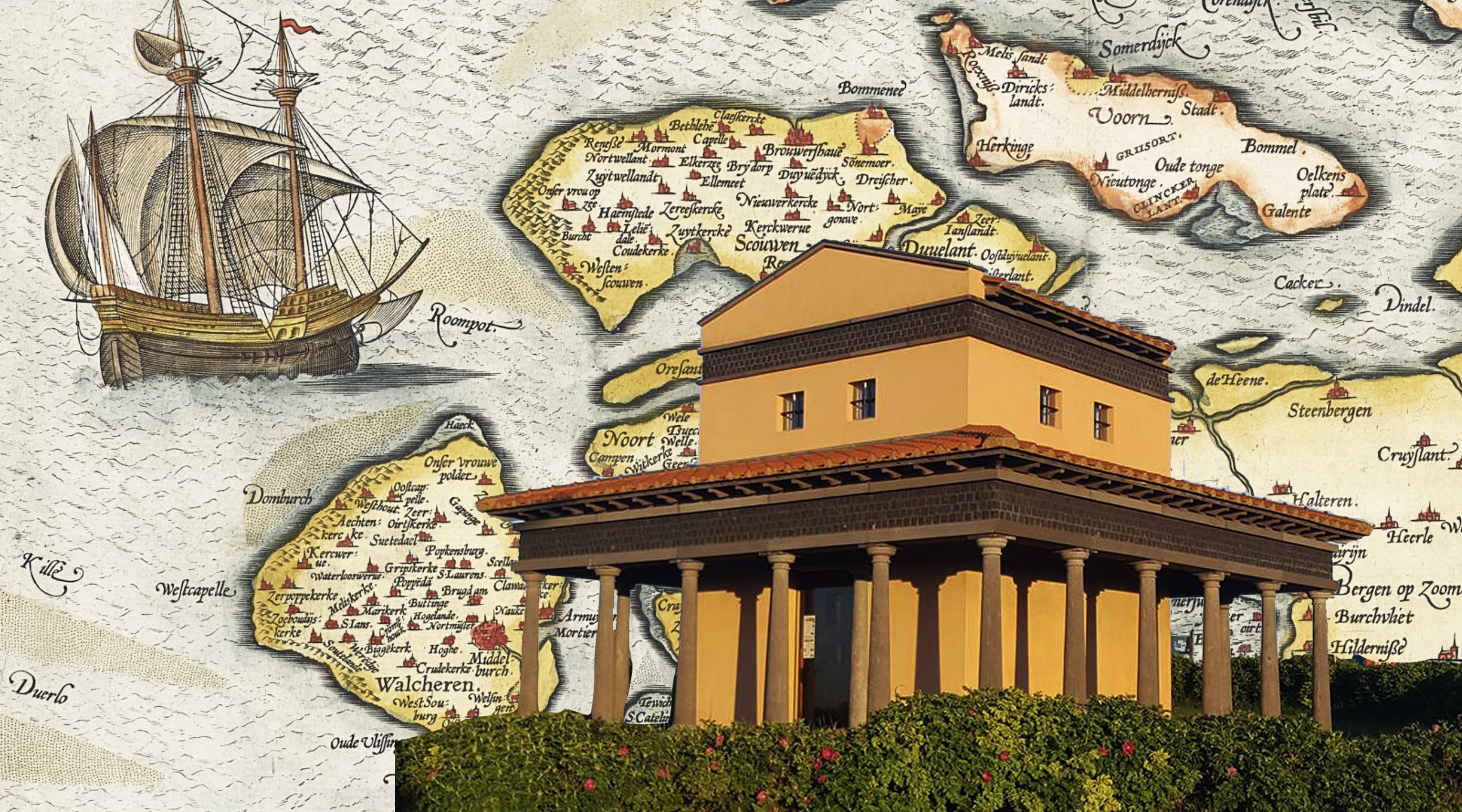
One evening in 1647, violent storms struck Domburg, on the island of Walcheren in the Netherlands. In their wake, the ruins of an ancient temple were revealed that had been obscured by the dunes at Domburg for centuries. Altars raised in honour of Nehalennia were discovered in the ruins, near the mouth of the river Scheldt in Zeeland.
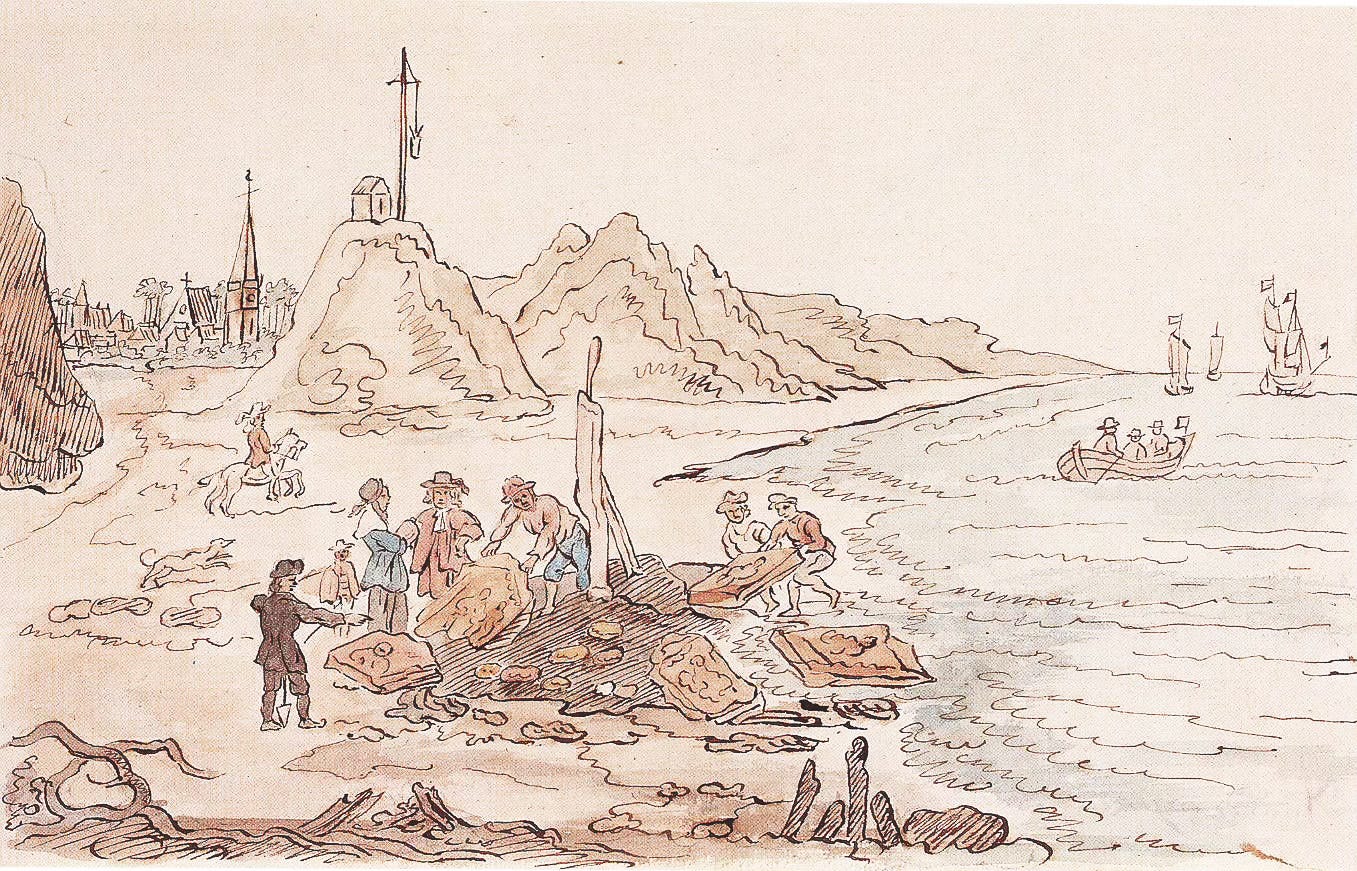
In 1970, the first of what turned out to be an even larger trove of ancient altars dedicated to Nehalennia was discovered in the Eastern Scheldt near Colijnsplaat, on North Beveland, about 25 kilometres east of Domburg. Many of the altar stones can be seen today in the Dutch National Museum of Antiquities in Leiden and a replica of a temple of Nehalennia was erected in 2005 at Colijnsplaat. Yet how the cult of the ancient goddess should be understood has long been the subject of considerable disagreement.
Hundreds of fragments of altars were rescued from Domburg and Colijnsplaat, with many of them recording inscriptions. The altars have all been dated to the late second and early third century, and they clearly indicate that Nehalennia was a goddess of the sea. They tend to record quite formulaic inscriptions, a typical example reading:
Deae Nehaleniae M Excingius Agricola cives Trever negotiator salarius CCAA VSLM
To the goddess Nehalennia. Marcus Excingius Agricola, a citizen of the Treveri, a salt merchant from Cologne. Fulfilled his vow, willingly, deservedly.
The altars were raised by merchants with Germanic, Celtic and Roman names, evidently after swearing vows to do so if the goddess granted them a safe voyage. Some of the dedications include pleas for the safekeeping of merchandise and give thanks for a prosperous journey, and the dedicators include merchants who the inscriptions record traded salt, fish oil and pottery. One of the merchants, Placidus son of Viducus, is also recorded as the commissioner of an altar dedicated to local spirits and the cult of the emperor that was found in 1976 in York. The traders evidently transacted most of their business with Britain and had the altars to Nehalennia erected after making successful return voyages.
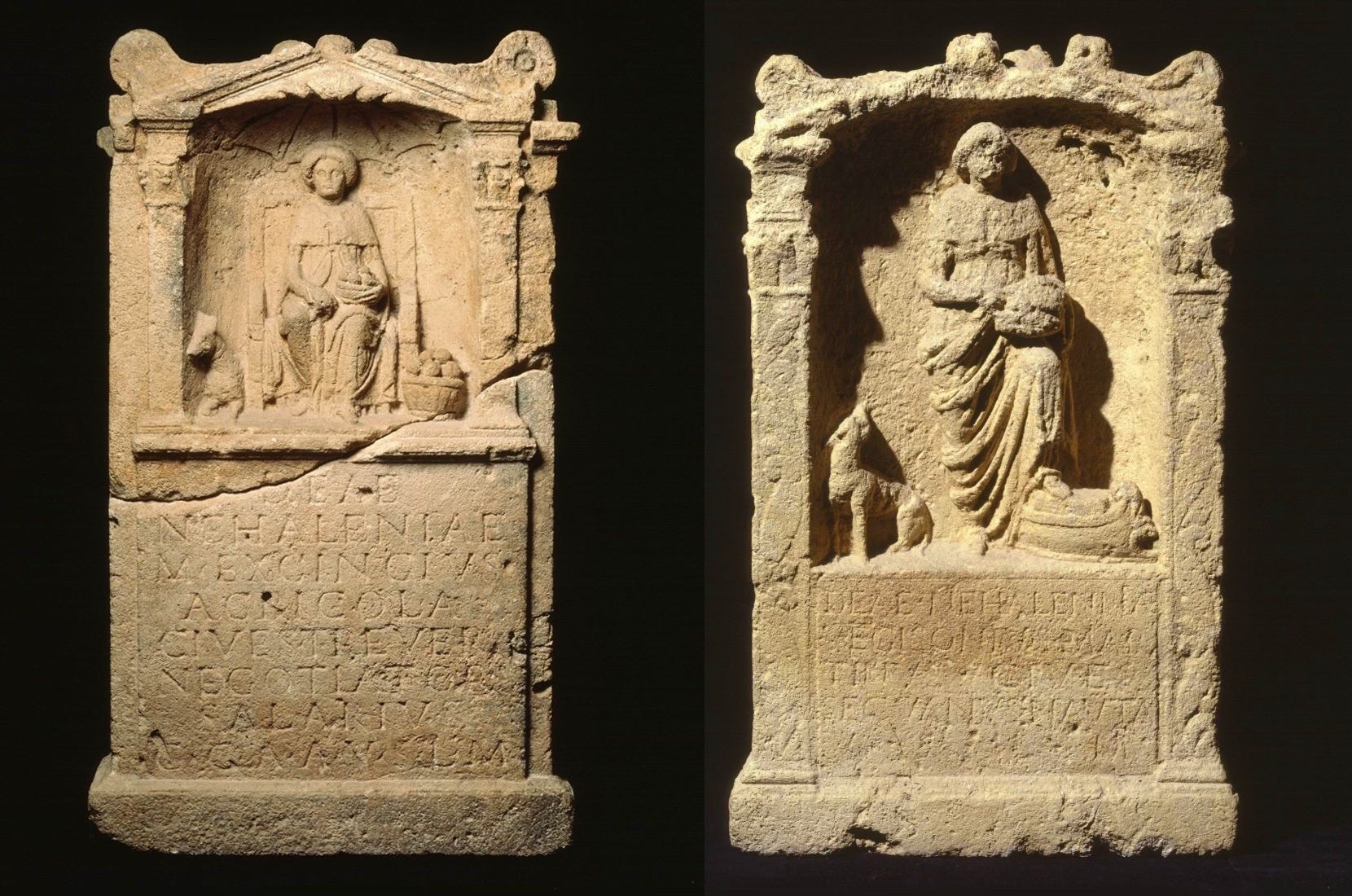
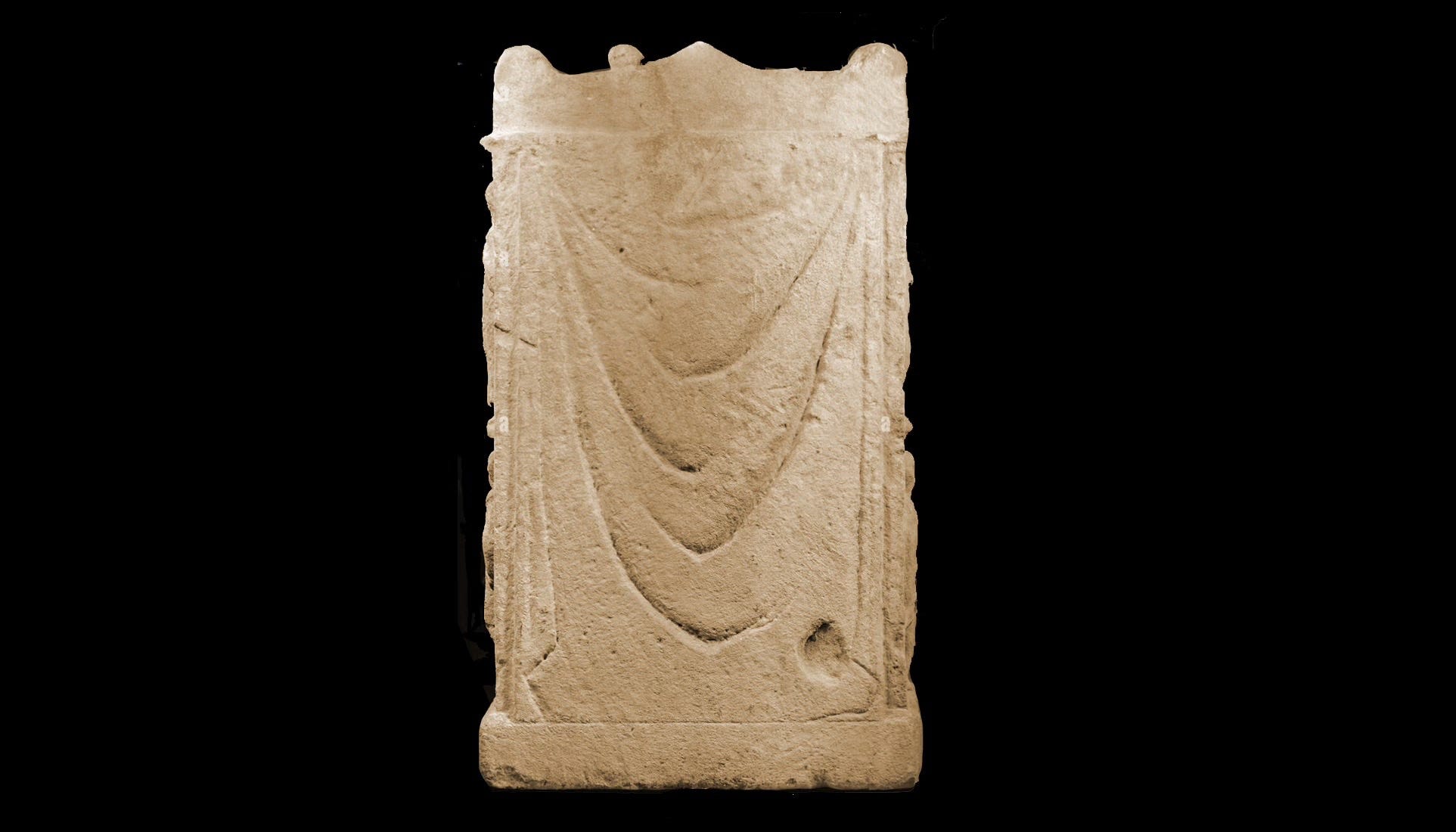
Many of the altars dedicated to Nehalennia also feature depictions of the goddess seated or standing in her temple. She is dressed in what appears to be a local manner, wearing a short cape, sometimes with her foot on the prow of a ship, holding a fruit basket, with a dog sitting alongside her. Dedications to Roman gods such as Neptune and Hercules were also found in conjunction with the Nehalennia altars. But the most mysterious decoration on the altars is a curtain depicted on the rear of some of them, and it suggests something more about the cult of Nehalennia than just a connection with seafaring.
It has long been disputed whether the cult of Nehalennia was of Celtic or Germanic origin. But the latest linguistic analysis of her name indicates that it is etymologically Germanic, a compound of elements related to Old English nēah ‘near’ and linnan ‘to cease’. Her connection with the sea suggests that Nehalennia was a goddess who was invoked by seafarers as a calmer of the seas, although it has also long been thought that there may have been another, less quotidian aspect to her cult.
The depiction of Nehalennia with a dog by her side has been claimed to symbolise the protection not just of living travellers. The dog has been supposed to be akin to Cerberus, the three-headed dog who guarded the underworld in Greek and Roman mythology, the dog-headed Egyptian funeral god Anubis, and Garm, the hound that guards the gate of Hel in Norse mythology. The curtains depicted on some of the Nehalennia altars have similarly been compared to those sometimes represented on Roman sarcophagi and they have been explained as indicating the veiling of the future that awaits the souls of the dead. Nehalennia may have been understood to be a goddess who led the souls of the dead on their last voyage, into the afterlife, and this aspect of her cult may be remembered in the story of the ferrying of the souls of the dead to Brittia recorded by Procopius.
No suggestion of an otherworldy aspect to the veneration of Nehalennia is recorded in the inscriptions on the altars that have survived, and the connection of the goddess with the story recounted by Procopius has been disputed. The dedicators of altars to Nehalennia are recorded coming from far and wide – from Rouen, Cologne, eastern Gaul and as far afield as Basel – and many may have only visited Zeeland for business purposes. Colijnsplaat seems to have been known as Ganuenta in Roman times and the local people in Zeeland appear to have been the Marsaci, a Germanic tribe who are also known from altars found in Cumbria. A group of Marsacian soldiers was stationed in Old Penrith during the Roman period, as members of what seems to have been a detachment of Marsaci associated with the First Cohort of the Batavi, one of the empire’s most formidable units.
So could the story recorded by Procopius reflect a memory of the cult of Nehalennia? It is difficult to determine now what the curtain on the altars indicated symbolically or whether the dog pictured with the goddess was supposed to indicate a connection with the afterlife. The temple to Nehalennia in Colijnsplaat seems to have been destroyed at the end of the third century by a storm flood that hit the mouth of the Scheldt, causing the altars to fall into the estuary, and the temple at Domburg is likely to have been abandoned at a similar date. By the time Procopius was writing, all that may have been left of the cult of Nehalennia was a distant memory of a pagan cult connected with voyages to Britain. But a trace of the cult of the goddess of sea voyages could well have survived in Procopius’s account of ghostly crossings to Brittia in the years that followed the fall of the Roman empire.
Comments
Nothing yet. Say the first thing.
Sign in to join the conversation.