
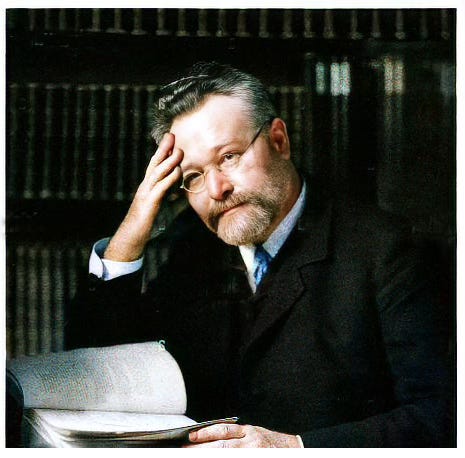
The origins of the English language were first set out in the nineteenth century by German linguists such as Jacob Grimm and Eduard Sievers. Most people have heard of Jacob Grimm because of the collection of fairy tales he and his brother Wilhelm published in 1812. But Sievers also made many important contributions to the history of the English language. Not only did he publish an influential grammar of Old English, a revised version of which is still in print today, he was the figure most responsible for transforming linguistics, turning it into a science of language.
Sievers’s contribution to our knowledge of early English was particularly important. He was the first to analyse the metre of Old English poems such as Beowulf, and the five types of scansion he deduced are still learned by students today. Sievers was also responsible for first discerning the development known as Sievers’s law that explains why Old English here ‘army’ has a genitive herges, but ende ‘end’ has a genitive endes (with no g).
A professor of philology at the University of Leipzig, all the brightest linguistics students of the day flocked to Sievers’s lectures. He was the leading figure among the generation of German linguists known as the Neogrammarians (Junggrammatiker) – originally a term used to mock them. Neogrammarian linguistics developed later into structuralism, the main approach to understanding language still current today.
In his grammar of Old English, Sievers was the first to set out how the early English language developed, step by step, from its Common Germanic ancestor, or what linguists usually refer to now as Proto-Germanic. But Sievers principally relied on correspondences in the medieval Germanic languages to explain what occurred. Sievers compared Old English to Old Norse, Old High German and Gothic, and projected back what they had in common. He reconstructed the development of Old English from Proto-Germanic; he did not employ direct evidence such as that available today in the form of runic inscriptions.
Yet the number of runic inscriptions from Britain unearthed by archaeologists has increased substantially since Sievers died in 1932. Tests of the DNA in bones found in cemeteries from the Anglo-Saxon period have also shown that many of the people who migrated to Britain during the fifth century came not just from northern Germany and southern Scandinavia, but also from the Netherlands and France. There seems to have been a substantial number of Franks among the early migrants to Britain, and many objects of typically Frankish design have been found in Anglo-Saxon cemeteries.
The Frankish settlers do not seem to have been able to establish any significant towns or kingdoms or to have had much other clearly noticeable political influence. Yet the presence of people from France among the fifth-century migrants may explain unexpected features in two of the earliest runic inscriptions from Britain.
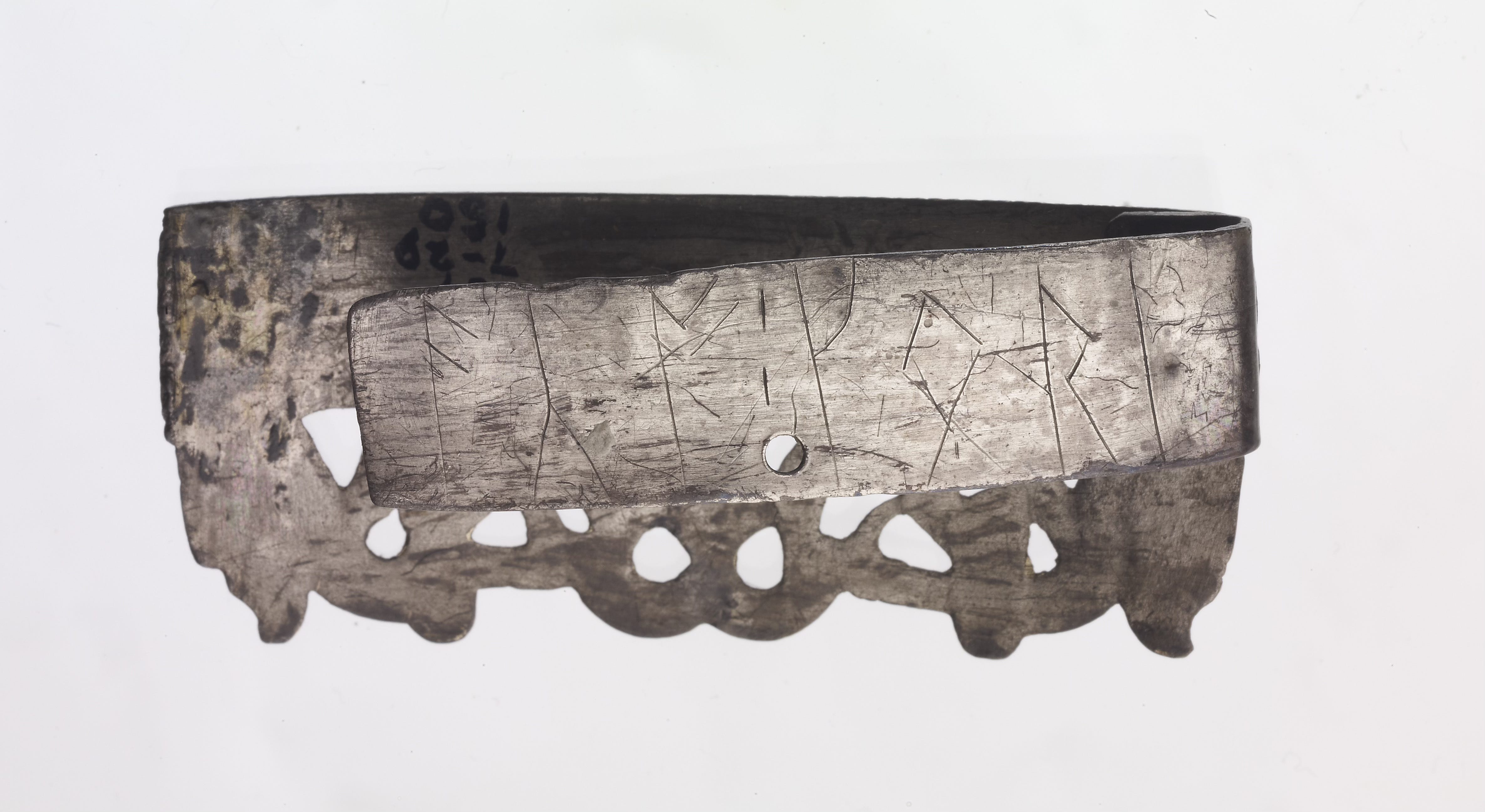
The first example appears in an inscription discovered on the fitting of the sheath of a sword, excavated in 1855 at Chessell Down on the Isle of Wight. The scabbard fitting is silver-gilt and it formerly served as the mouthpiece – the top part of the scabbard where its owner would have inserted his sword.
The fitting appears to date from the fifth or sixth century, and given where it was found, its inscription would be expected to record a linguistically Jutish text. The runes on the Chessell Down scabbard mount are quite clearly executed and they have most recently been read as æko : cœri. The runes employed in the Chessell Down inscription seem to date from the sixth century and the meaning of the second term is disputed, but the first is clearly a name, presumably Æcco. No comparable later Old English name is attested, but a similar name Acco is known from medieval Germany.
Other names recorded in early runic inscriptions from Britain have a slightly different ending. In 1985, an inscription on a mounting from an old purse was recovered from a man’s grave at Watchfield in Oxfordshire. Its inscription reads haribœki : wusa, and the second element seems to be a name Wusa. The grave in which the inscription was found has also been dated to the sixth century, and the two names, Æcco and Wusa, both seem to be those of men, but with different endings, -o and -a respectively.
The alternation of the endings -o and -a is not expected from a Neogrammarian perspective. In medieval German and Frankish, men’s names of a similar type are characterised by ending with -o, for example in the man’s name Otto, and the other ending -a is reserved for the names of women, like Helga and Hilda. But in Old English, men’s names of this type, including Horsa, Penda and Offa, always end with -a.
According to the developmental scheme established by Sievers, the ending -a characteristic of Anglo-Saxon men’s name arose because the old -o retained in German and Frankish developed to -a in Old English. The name Wusa on the Watchfield purse mount shows the expected early English development, but Æcco does not. But is the variation significant? Objects of Frankish design have been uncovered in the area, so could Æcco be a Frankish name?
Similar evidence of linguistic behaviour not expected from a traditional Neogrammarian perspective is recorded in an early runic inscription from Loveden Hill in Lincolnshire. It was discovered in the 1950s during the excavation of a large Anglo-Saxon cemetery and it is preserved on a burial urn conserved today in the British Museum. Over 1,800 graves were found at the Loveden Hill site, most of them preserving objects made in manners typical of those found in Anglian settlements, but some objects made in typically Frankish manners were also discovered at the site.
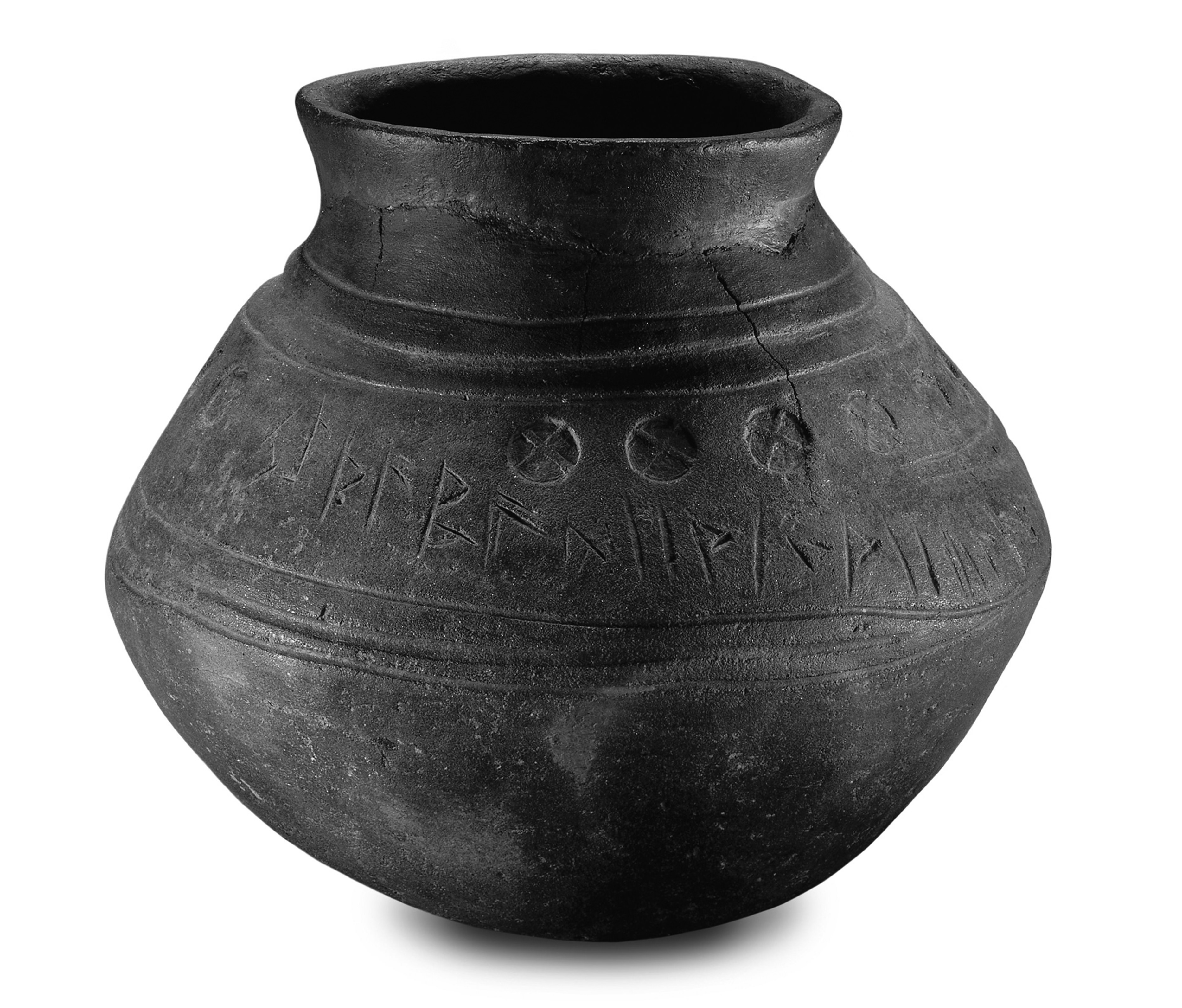
The rune-inscribed urn from Loveden Hill also contained tweezers and a bone gaming-piece, and it has been dated to the fifth or sixth century. The inscription on the urn is written from left to right, but its characters become less well formed as the inscriber continued.
The first sequence recorded in the Loveden Hill inscription is a name sïþæbæd which seems to consist of two elements. The first appears to be Old English sīþ ‘way’ and the second Old English beadu ‘fight, war’. But a name of this sort would be expected to become Sīþbeadu in Old English, with no vowel connecting sīþ and beadu, but with one retained at the end of the name. Anglo-Saxon names beginning with sīþ are also very rare, much as Æcco seems not to have an obvious later reflection in Old English. So what has gone on?
There are three unexpected aspects of the spelling of the name Sīþæbæd recorded in the Loveden Hill inscription, and of these, the vowel in the second element -bæd is the simplest to explain. The development of the diphthong ea recorded in Old English beadu occurred at a relatively late stage in the history of early English, and the Loveden Hill inscription may simply predate it.
The loss of the final vowel of Sīþæbæd can also be explained by the late date of the emergence of compound stress. In Old English, both elements of compounds were typically accented, as if the two elements were still recognised to be separate words. But some Old English compounds are recorded that were evidently formed before the development of dual stress in compounds and that behave, phonologically, like single words. The loss of the final vowel of Sīþæbæd can be explained as a sign that the name was only accented on its first element, not both.
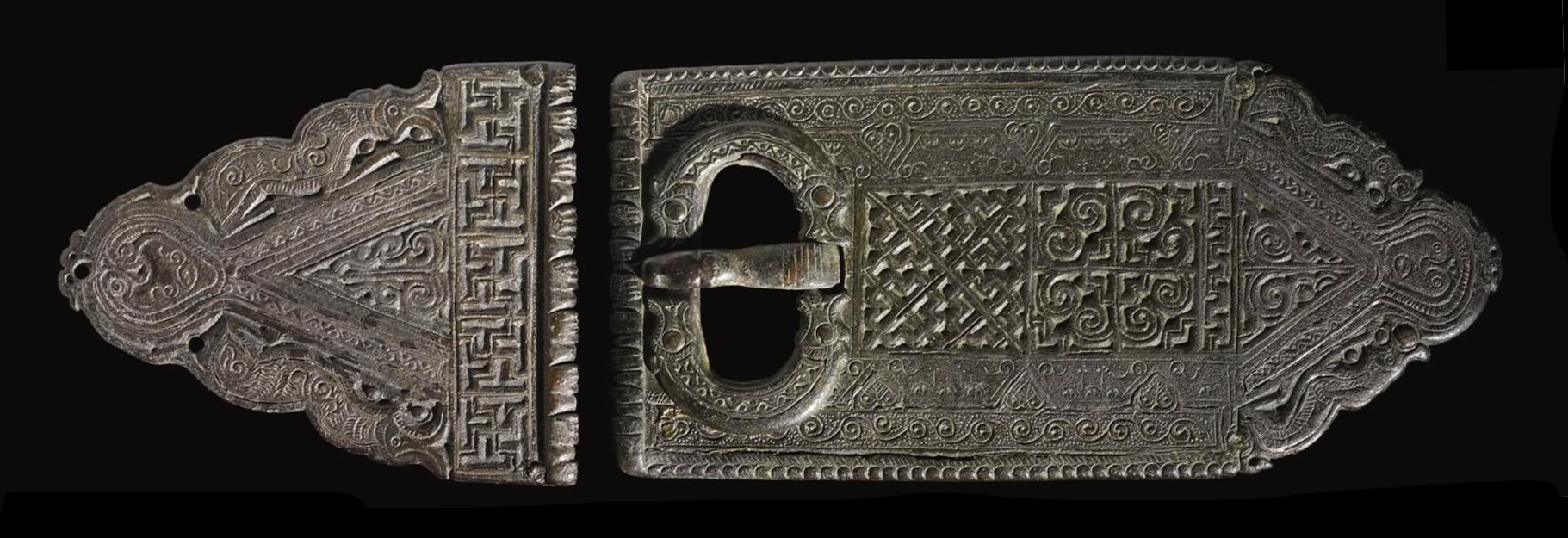
The vowel between Sīþ- and -bæd is another matter, however. The equivalent vowel is always lost from Old English, Old Saxon and Old High German names when the first element has a long vowel in its root, and it would be expected to have also been lost from English before the Anglo-Saxon migrations occurred. But comparable Frankish names dating from the fifth and sixth century such as Chlōdomēr retain the vowels that connect their two elements that were regularly lost in English, and it appears that the name Sīþæbæd has developed in a similar manner.
Both Æcco and Sīþæbæd preserve linguistic features not expected in Old English and the most obvious way to explain the two names is to assume that they are not regular Anglo-Saxon coinages. Æcco and Sīþæbæd retain features that are typical of fifth- and sixth-century Frankish names, not those employed by speakers of early English. It may be that Æcco and Siþæbæd spoke dialects that just developed in similar manners to Frankish and later died out. But the most obvious explanation is that Æcco and Siþæbæd were both Frankish speakers or were the children of speakers of Frankish.
The many Frankish migrants who crossed the English Channel during the fifth century were first revealed in recent DNA testing of skeletons from early Anglo-Saxon cemeteries. But their participation in the wave of Anglo-Saxon settlement after the collapse of Roman rule in Britain is indicated by both the presence of objects of characteristically Frankish design among goods uncovered from fifth- and sixth-century cemeteries, as well as, apparently, also, names preserved in early runic inscriptions. They may not have had any obvious political influence in the early development of the Anglo-Saxon kingdoms, but the presence of many Frankish migrants may still be detected among the material remains from that crucial period.
The Age of Arthur is a reader-supported publication. To receive new posts and support my work, consider becoming a free or paid subscriber.
Comments
Nothing yet. Say the first thing.
Sign in to join the conversation.