
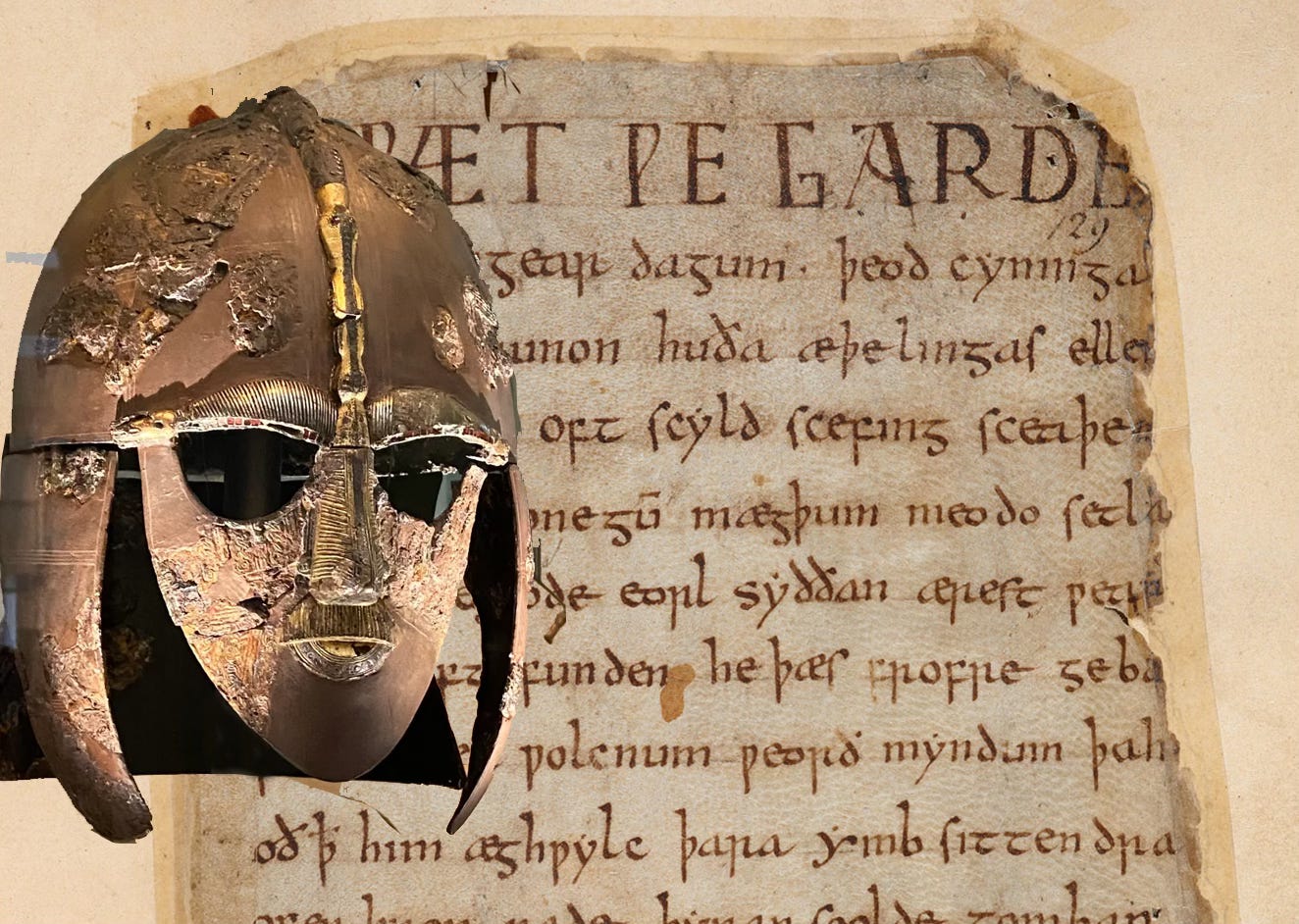
My 2023 book the English Language Before England tries to answer the question “where did the English language begin?” It does so using the direct evidence of inscriptions, something that had never been attempted before. Most histories of the English language avoid the early direct evidence. Instead, they rely on a series of assumptions developed from comparative studies of Old English, Old Norse, Gothic, Old Frisian, Old High German and Old Saxon, many of which do not make much obvious sense.
Most books on the history of the English language claim that English was first spoken in the middle of the fifth century – after the migrations of the Angles, Saxons and Jutes to Britain. Often the language first spoken in Britain by the Anglo-Saxons is referred to as Prehistoric Old English, although some linguists have even taken to calling the language Pre-Old English. They don’t seem to be able to make up their minds what to call the language of Hengist and Horsa or to justify why they have chosen a mid-fifth century date for the beginning of English.
Linguists usually designate the earliest stage of a language with the modifier Proto-. The earliest Norse is usually called Proto-Norse, the earliest Germanic is Proto-Germanic. So the earliest English should be called Proto-English. But when was Proto-English first spoken?
It is sometimes assumed that Proto-English arose from an admixture of the various dialects spoken by the Anglo-Saxon migrants, not long after they got off the boats that brought them across the sea from Northern Germany and Denmark. But that is not what the earliest runic inscriptions suggest. The oldest runic inscription from England was found in the 1930s in an early Anglo-Saxon graveyard near Caistor St Edmund – or Caistor by Norwich as it was then known – and it suggests a different picture.
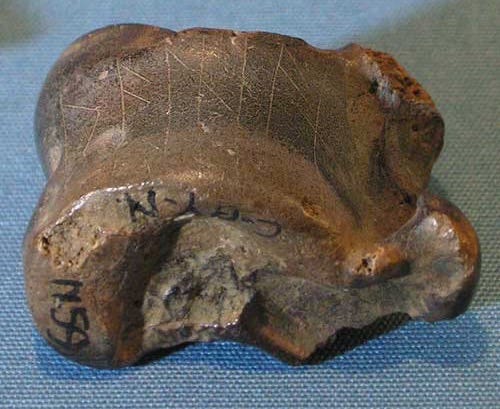
The Caistor St Edmund inscription is recorded on a deer’s ankle bone, but the first expert in Old English to try to analyse it did not know how to make any sense of its text. He read the Caistor St Edmund inscription as rah(w)han, transcribing the third rune as if it had the same phonological value as the Gothic letter 𐍈. The Gothic letter 𐍈 was called ƕair and it represented the sound hw still used in some dialects of English to distinguish the pronunciation of words such as whine and whet from wine and wet. But no one could make any sense of rah(w)han.
In the 1970s, a new reading of the Caistor St Edmund inscription emerged. The inscription is now read by linguists as raïhan and it appears to record an inflected form of the word written as raha in an early Old English-Latin glossary. Early Old English raha has now become roe in English, the name of a small type of deer.
So it is evident that the Caistor St Edmund inscription refers to the deer anklebone it was found on – raïhan presumably means ‘from a deer’. The deer anklebone, an astragalus, was discovered in an urn with thirty-odd sheep astragali and a similar number of black and white gaming pieces. Animal astragali were often used as dice in ancient times, and the black and white gaming pieces from Castor St Edmund seem to be the oldest recorded evidence from Britain for tafl, an early board game similar to chess that simulated the siege of a castle.
But is the Caistor St Edmund inscription the oldest Proto-English inscription? It has been dated by archaeologists to 425-450, a time when the Anglo-Saxon migrations were still ongoing. But what about all the early runic inscriptions that have survived from Northern Germany and Denmark? Just because people like Hengist and Horsa got on boats and sailed to Britain doesn’t mean they stopped speaking the language they grew up with when they landed and suddenly started speaking English instead.
Proto-English developed out of an earlier language usually called Ingvaeonic or Anglo-Frisian. But for linguists, Proto-English should have first emerged when sound changes exclusively reflected otherwise only in Old English begin to appear in inscriptions. You don’t start speaking a new language the minute you get off a boat, the emergence of a new language occurs when new pronunciations and usages develop that are not found in other, related languages. Yet the Caistor St Edmund inscription is very brief and it does not record any sound changes that are distinctively English. From a linguistic perspective, raïhan is no different from what would be expected of a fifth-century inscription written in a language ancestral to German, Frisian or Dutch.
The Caistor St Edmund inscription could be either Proto-English or Ingvaeonic. Its diphthong ai is older than the monophthong recorded in early Old English raha and the development of ai to (long) a is one of the oldest sound changes that distinguished Proto-English from the other early Germanic languages.
Yet runic inscriptions from Northern Germany or Denmark that evidence sound changes only known otherwise in Old English would be considered linguistically Proto-English. So is there any evidence for this? Could some distinctively English sound changes predate the Anglo-Saxon migrations?
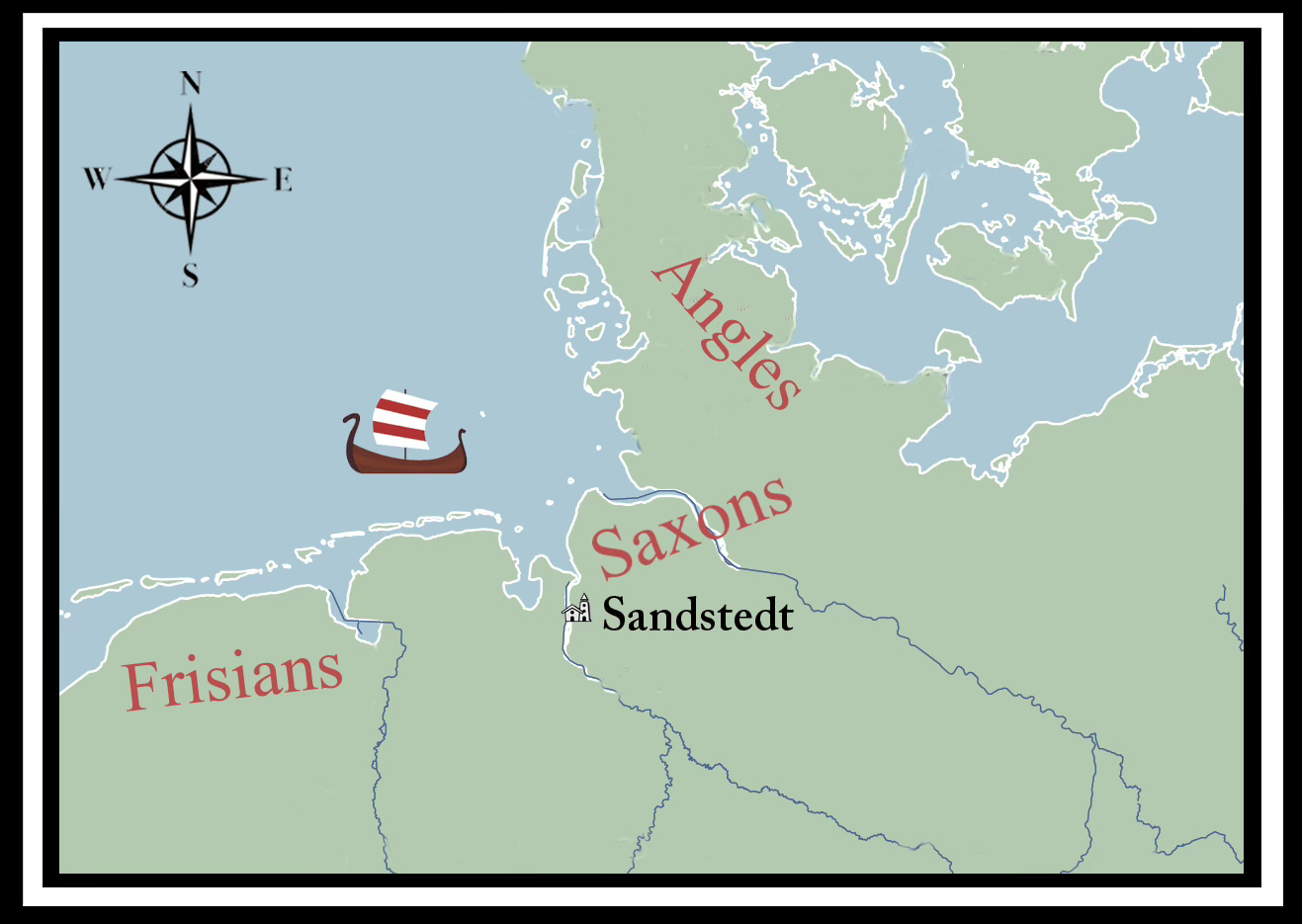
Evidence for Proto-English evolving in Northern Germany before the time of the Anglo-Saxon migrations was first discovered almost a century ago. In 1927, the overseer of the public baths at Brake in Lower Saxony approached the Natural History Museum in Oldenburg with some pieces of bone that he claimed had been found during dredging on the lower course of the River Weser. The bone pieces were decorated with pictures and what appeared to him to be runic inscriptions.
The discovery of the Weser inscriptions was widely reported in Germany. A professor of German at Hamburg studied them and proclaimed them to be linguistically Saxon, written in an ancestor of the Low Saxon dialects spoken in that region of Germany. But by the 1930s doubts had been raised about the Weser inscriptions. By that time, the overseer had presented more inscribed bones to the museum at Oldenburg and they were suspected to be forgeries.
In the 1980s, however, a German criminologist was investigating forgeries of archaeological finds as part of his doctoral studies. He examined the Weser bones, expecting them to preserve clear evidence of forgery. To his surprise, all he could determine was that the Weser inscriptions appeared to be genuine. He dated the bones they are preserved on through amino acid analysis to about the year 400 – just before the beginning of the Anglo-Saxon migrations to Britain.
The most important of the Weser inscriptions appears to have been found at a site near Sandstedt on the Harrier Sand, an island in the River Weser, and it preserves three lines of runic text. The first reads latam : hari, followed on the second line by kunni : and a character much like a letter Y followed by an e-rune; and then on the final line just hagal. What the letter shaped like a Y represents is not immediately obvious – suggestions have included a local variant of a k-rune, a w-rune or a z-rune.
Except for the sequence with the Y-like letter, the words in the Sandstedt inscription are fairly simple to make out: they say ‘(we) let (the) army-kin … hail’. The verb latam ‘(we) let’ can also mean ‘(we) leave’ and the term hagal means ‘hail’ in the meteorological sense, perhaps used as a collective such as ‘hail of spears’ or ‘hail of arrows’. Early runic inscriptions typically do not indicate the distinction (known as definiteness) between ‘a’ and ‘the’ that we do in Modern English. But what does the unclear word read variously as ke, we or ze indicate?
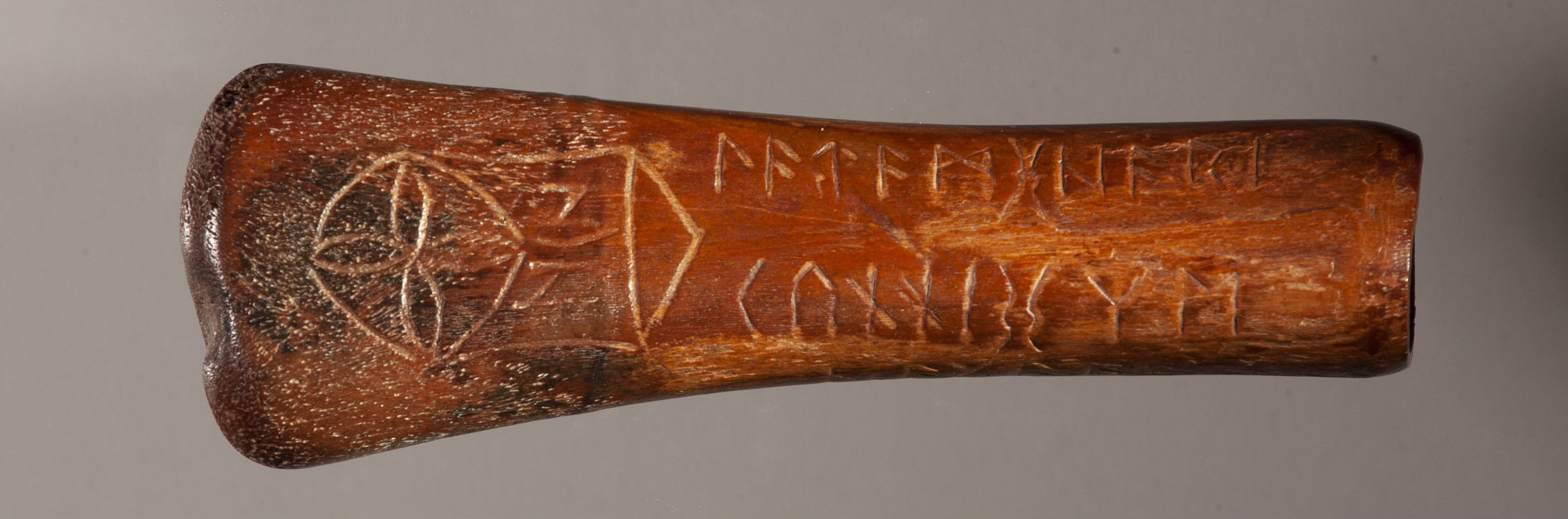
The most obvious analysis of the difficult sequence is we ‘we’. The verb latam is inflected with a first-person plural ending -m and it should have a similar first-person plural subject. The Sandstedt inscription seems best understood to mean ‘leave (the) army-kin (do) we, (a) hail (of spears/arrows)’.
Why the inscription was written on the bone from Sandstedt is not clear. It has been suggested that the bone may have formerly been hung up in a religious sanctuary of some kind, and that the inscription was meant as a warning: that anyone who approached the temple it was found in would be hit by a hail of spears or arrows – or even just by hail of the regular meteorological kind.
The main significance of the Sandstedt inscription for the history of the English language, however, is that Old English is the only one of the Germanic languages that has a pronoun we ‘we’ with an e rather than an i and no final r. The equivalent pronoun in Old High German is wir, in Old Saxon, Old Frisian and Old Dutch it is wi, in Old Norse it is vér, while in Proto-Norse it is wiz and in Gothic it is weis. The Sandstedt inscription appears to record a distinctively Old English linguistic development in its pronoun we.
So when did Proto-English first develop out of its Ingvaeonic ancestor? The Caistor St Edmund inscription indicates that most of the distinctively English sound changes that occurred before the advent of the Old English period developed after the Anglo-Saxon migrations. But the earliest evidence for what seems to be a distinctively English sound change appears to predate the migrations to Britain. The runic inscription from Sandstedt preserves the earliest evidence for a Proto-English sound change and it may accordingly be considered the oldest English inscription.

The Age of Arthur is a reader-supported publication. To receive new posts and support my work, consider becoming a free or paid subscriber.
Comments
Nothing yet. Say the first thing.
Sign in to join the conversation.