

The Welsh epic the Gododdin recounts that a great feast was held at Edinburgh Castle before the assembled warriors rode out to meet the Saxons in battle. The warriors came from all parts, including Aeron (Ayrshire), Al Clut (near Glasgow) and Elmet (near Leeds), and they seem to have been spear-throwing and sword-wielding light cavalry. Yet the name of Edinburgh recorded in the Gododdin is not etymologically clear. The site that the feast was held at is called Eidin in the Welsh poem, a form that seems quite odd from a derivational perspective. The Celtic name of Edinbugh was coined in one of the dialects formerly spoken in northern Britain that are often grouped together as “Cumbric”, but its etymology has long been disputed.
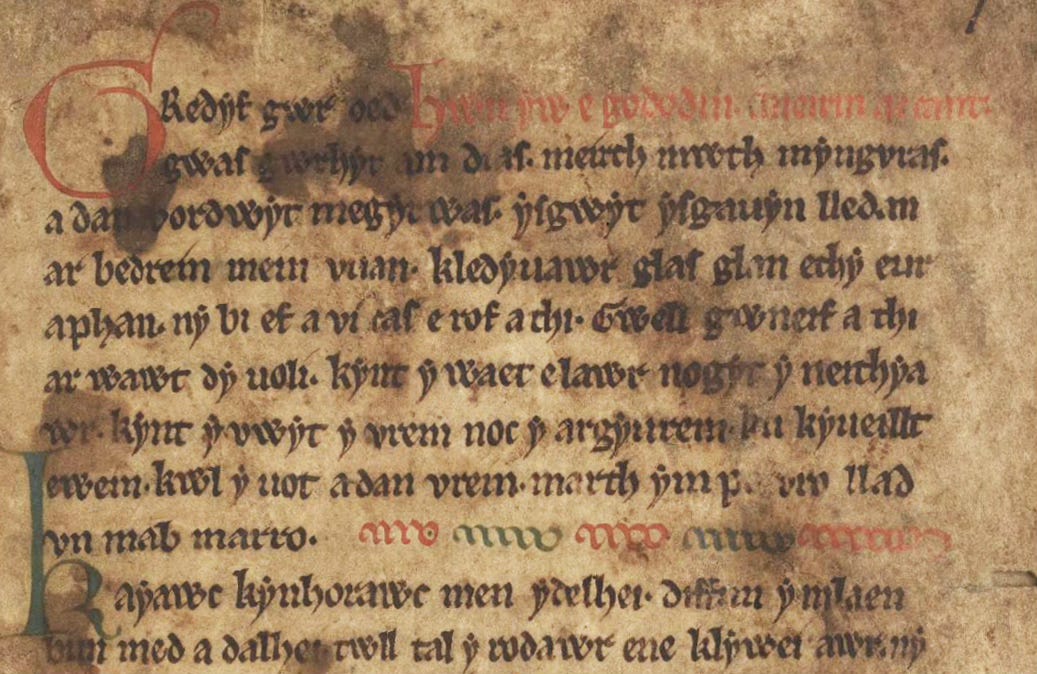
The Gododdin is preserved in two versions in a medieval Welsh manuscript known as the Book of Aneirin. The second version of the poem is evidently much older than the first, and some of its sections seem to preserve the names of lords of the people the poem was named after. A particularly clear example is that of Yrfai, son of Wolstan, whose father seems to have an Anglo-Saxon name:
Text within this block will maintain its original spacing when published
Gnaut i ar fisciolin
amdiffin Gododin
im blain trin terhit rei.
Gnaut i lluru alan buan brithei.
Gnaut rac teulu Deor em discinhei.
Gnaut mab Golistan cennei bei guletic
i tat indeuit a lavarei.
Gnaut ar les minidauc scuitaur trei
guarud rac ut Eidin Urvei.
Text within this block will maintain its original spacing when published
It was usual for him to be mounted on a high-spirited horse
defending Gododdin,
at the forefront of the men eager for fighting.
It was usual for him to be fleet as a deer.
It was usual for him to attack Deira’s warband.
It was usual for Wolstan’s son – although his father was no sovereign lord –
that what he said was heeded.
It was usual for the sake of the mountain court that shields be broken through,
reddened before Yrfai, the lord of Eidin.
The Gododdin indicates that the Saxons were from Deira, the kingdom to the south of Bernicia that appears to have originally encompassed the East Riding of Yorkshire. The Deirans seem to have seized modern Catterick in North Yorkshire and the Gododdin rode over 120 miles south to the site of the battle which is called Catraeth in the poem. The Gododdin were defeated at the battle, however, in a loss that seems to have presaged the later collapse of their kingdom. In 638, the Anglo-Saxons of Bernicia appear to have taken Eidin from the last of the Gododdin chiefs, renaming it Edinburgh, and the fate of its former rulers passed into Welsh lore.
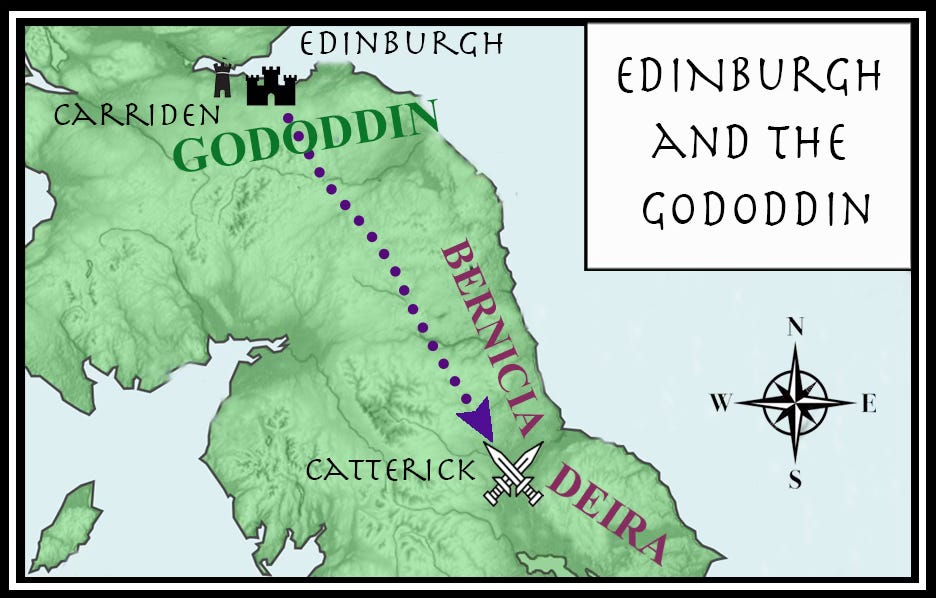
The date at which the battle at Catterick occurred has long been disputed, but the Cumbric name of Edinburgh is first recorded in the Annals of Ulster in an entry for 638 that records a siege at Eten. The place-name recorded in the Gododdin is spelled slightly differently, as if it may be a more recent spelling, although the date of the composition of the Welsh poem is not entirely clear. The Gododdin may have been composed shortly after the battle at Catterick as the older version of the poem features many linguistic and thematic archaisms – the Gododdin reads very much like a work that was originally composed in the late sixth or early seventh century.
Yet the Old Welsh form Eidin is not the expected reflex of an earlier Eten. The diphthong in the first syllable of the Welsh name appears to be irregular and it is not preserved in Kair Eden, the oldest recorded spelling of the name of Carriden. Carriden is the site of an old Roman fort, 17 miles west of Edinburgh, whose name seems to mean ‘the fort of Eden’.
It seems likely that the name Eden was used to describe the region about Edinburgh originally, but what it signified in Cumbric has often been disputed. Edinburgh Castle was clearly the site of the les minidauc or ‘mountain court’ mentioned in the Gododdin where the northern heroes all gathered before riding out to battle. But all sorts of unlikely explanations have been advanced over the years for the origin of the form Eden, from the suggestion that it reflects the English man’s name Edwin to the Welsh term eidion ‘beef’ or ‘ox’. Linking the name of Edinburgh to an English man’s name seems rather strange for the capital of a Celtic tribe, and in the early seventh century, the Welsh term eidion should have been spelled odion, not Eten or Eden.
The diphthong preserved in the first syllable of the spelling Eidin in the Gododdin is not reflected in any of the names recorded for Edinburgh other than those found in Welsh sources and it appears to be a secondary development. The Welsh spelling Eidin may reflect influence from the Middle Welsh term eidio ‘defence, fortress’.
But what about the Cumbric name Eden? Its root is most likely to be the same as that of Old Irish ette ‘wing, fin, wing of an army, feather’ and Welsh edn ‘bird’. So was Edinburgh originally known as the ‘place of the wing’ or ‘place of the bird’? A place-name that refers to a ‘wing’ seems unlikely at first, but a fortress in northern Scotland called Pinnata Castra ‘the winged fort’ is recorded in Roman sources. It is not clear exactly where Pinnata Castra was, but its name may reflect a physical feature of the fort. It is possible that the court of the Gododdin at Eden was somehow thought to be physically ‘winged’ in some manner too, although archaeological investigations of Edinburgh Castle undertaken in the 1980s only found evidence for early medieval refuse and Iron Age huts, with habitation of Castle Rock seeming to date back as far as the Bronze Age.
The name of Pinnata Castra has long intrigued historians. The Romans called the upright projecting parts of battlements pinnae or ‘wings’, and it has been supposed that Pinnata Castra ‘the winged fort’ may have received its name because its walls featured battlements.
Accordingly, it might be supposed that both Pinnata Castra and Eden received their names in a similar manner. The Romans knew the Gododdin as the Votadini, a derivationally Celtic name that seems to mean ‘the smelters’, and members of the northern tribe may have served in the Roman army. Members of the Votadini serving in the Roman army could have learned that battlements often included projections called pinnae ‘wings’ in Latin and applied the equivalent term in Cumbric to refer to the court of the Gododdin kings at Edinburgh Castle.
But rather than being named for battlements, Eden seems more likely from a grammatical perspective to have received its Cumbric name from a reference to a single ‘wing’ or ‘bird’, not a description comparable to pinnata ‘winged’. The ending -en does not appear to be adjectival – it is more likely to reflect an old genitive inflection, comparable to that preserved in Welsh adain ‘wing’. The place-name Eden appears more likely to reflect a meaning ‘of the wing’ or ‘of the bird’, not to describe battlements.
So how did Edinburgh receive its name? It may be that Edinburgh Castle was just named for its altitude – as a place so high up that it was associated with birds. Castle Rock was formed from a volcanic intrusion or “plug”, its summit towering 80 metres above the surrounding landscape, and a connection of the site of the old court of the Gododdin kings with birds may be the best explanation for the old place-name Eden. Edinburgh has been English-speaking since it was conquered in the seventh century by the Bernicians, but its name preserves an important trace of the language of its former rulers, the kings of the Gododdin.
Comments
Nothing yet. Say the first thing.
Sign in to join the conversation.