
The German physicist Max Planck is best known for his contributions to quantum mechanics. In 1900 he advanced a law of radiation that included the assumption of what has become known as “Planck’s constant”. His discoveries saw him win the Nobel Prize for physics and a series of German research institutes are named after him today.
Yet Planck is also known for a principle of the history of science. It is usually expressed as “Science progresses one funeral at a time” and it is a reflection on how stubborn experts can be. What usually happens in science, Planck asserted, is that a new theory does not usually catch on because everyone acknowledges that it is likely to be true. Instead, the opponents of the new theory gradually die off and younger generations of scientists prove to be less stubborn.
Planck’s principle may seem overly cynical, but a similar problem is common in other academic disciplines, including in history. Historians tend to cling on to explanations they learned when they were much younger, even when new evidence comes along that is not compatible with older theories. It takes more effort to shift the opinion of many historians than you might at first think should reasonably be required.
In 2009, a British research student published a new assessment of the Welsh annals – or the Annales Cambriae as they are known in Latin. The Welsh annals are preserved in three different manuscripts, and in the earliest version its entries begin in the fifth century, but end in the tenth century. Doubts had long been expressed about how reliable the earlier entries in the Welsh annals are. The entries for events occurring in the eighth and ninth centuries seemed reliable enough, but what about the earliest ones? Two of these mention King Arthur, fighting at the Battle of Badon in 516 and dying at a place called Camlann in 537. But are these entries reliable, as reliable as those from the eighth and ninth centuries?
The historian decided to go through all the eclipses and similar natural events recorded in the Welsh annals to see if their dates aligned with those accepted nowadays by astronomers and climate scientists. Scientists have long been interested in events such as eclipses and changes in the climate, and have developed calendars reaching back centuries in which you can look up when they occurred. The historian discovered that all the mentions of natural phenomena recorded in the Welsh annals appear to have occurred at the times scientists had calculated corresponding events did – and these events included one mentioned in an entry that also names King Arthur.
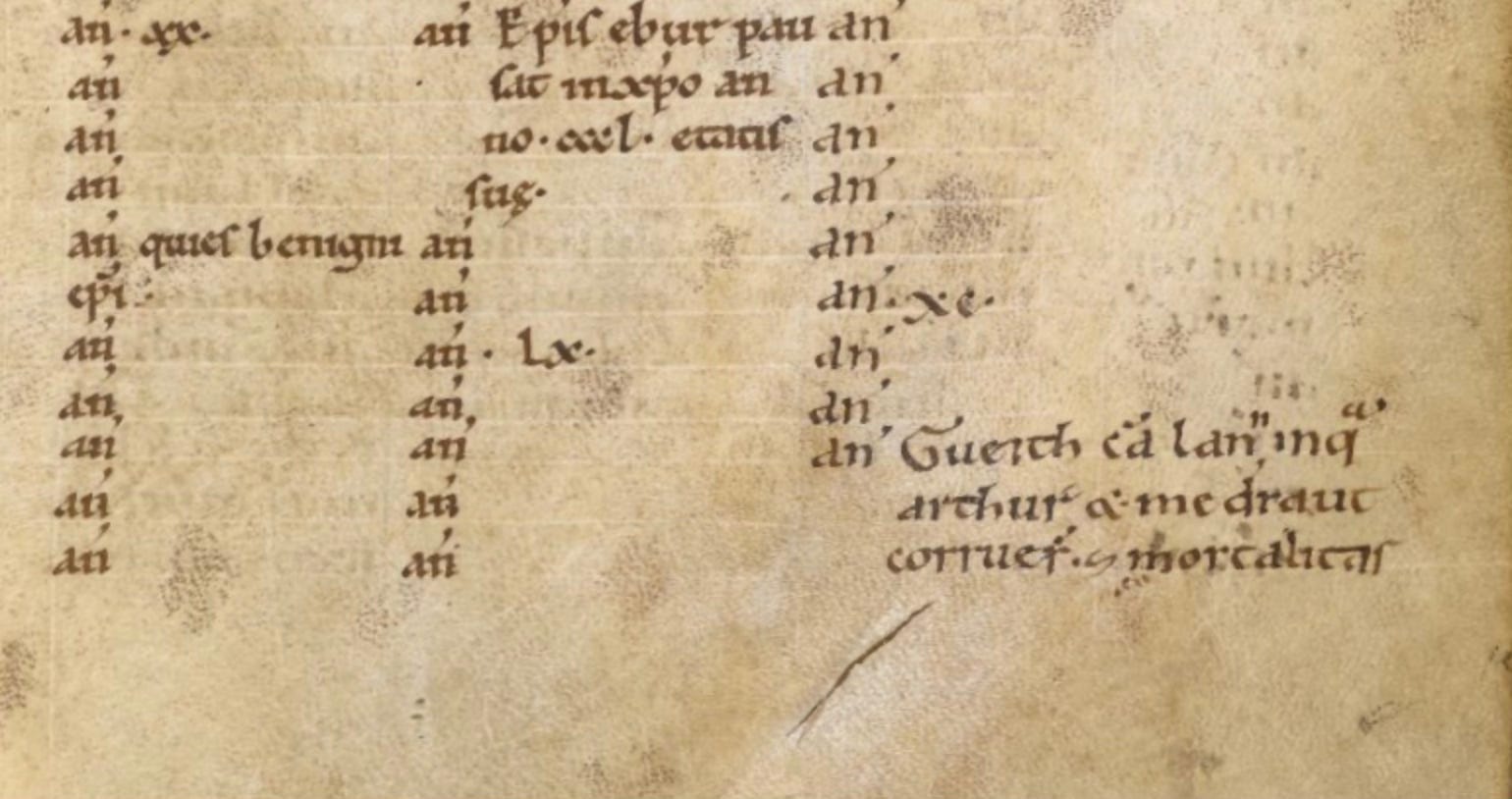
The 2009 study of natural phenomena in the Welsh annals made it very likely that the entry for 537 was a contemporary record of events. The record in the Welsh annals reads in translation:
Year of the Strife of Camlann in which Arthur and Medraut fell. And a mortality occurred in Britain and Ireland.
The “mortality” recorded in 537 is paralleled by an entry for 536 in the Annals of Ulster that records there was a “shortage of bread” that year. Similarly, the Roman historian Cassiodorus recounts that Italy was struck by famine in 536 and 537, and his Greek contemporary Procopius describes what caused it. In 536, Procopius records that:
during this year a most dread portent took place. For the sun gave forth its light without brightness, like the moon, during this whole year, and it seemed exceedingly like the sun in eclipse, for the beams it shed were not clear nor such as it is accustomed to shed.
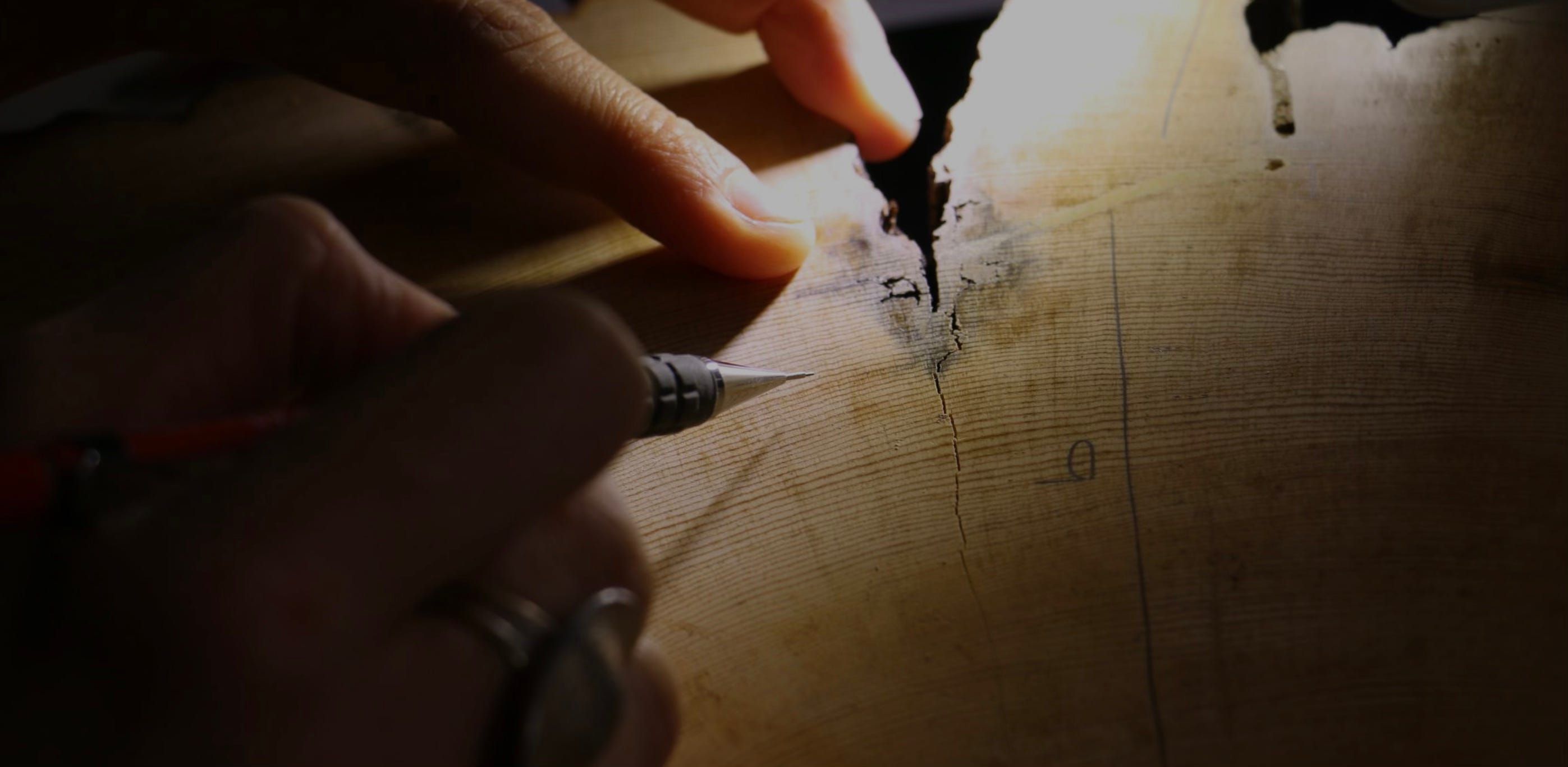
Since the 1980s, scientists had been trying to explain the reason for the strange weather event recorded by Procopius. By the 1990s it had become clear that the year 536 was an especially cold one. Studies of tree growth from the period indicate that a prolonged period of abnormally cold weather occurred in 536. Similarly, samples of ancient ice taken from Greenland and Antarctica recorded high levels of volcanic dust in the atmosphere at the time. Scientists had rediscovered the volcanic winter of 536.
The obvious consequence of the volcanic winter is that it caused famines to break out in Italy, Britain and Ireland. Crops were severely affected by a cloud of dust that had been thrown up into the atmosphere by erupting volcanoes, causing the light of the sun to dim. The lack of sunshine seems to have proved particularly dire in Scandinavia where archaeologists have found evidence for the widespread abandonment of villages at the time. The volcanic winter of 536 was such a shock to the agricultural societies of sixth-century Europe that an American historian has dubbed 536 the worst year to be alive.
The volcanic winter may also explain two unexpected inclusions in the Ecclesiastical History of the English People written in the eighth century by the Northumbrian monk Bede. Writing almost two centuries after the volcanic winter, Bede records two astronomical events, one in 538 and another in 540. His records were later copied into the Anglo-Saxon Chronicle and they provide the following information:
A.D. 538. This year the sun was eclipsed, fourteen days before the calends of March, from before morning until nine.
A.D. 540. This year the sun was eclipsed on the twelfth day before the calends of July; and the stars showed themselves full nigh half an hour over nine.
Why Bede recorded these two eclipses in his Ecclesiastical History has long been unclear. But according to modern astronomical calculations, neither eclipse could be seen from England – they could only be seen in Asia Minor and Spain, Italy or the Balkans respectively. Accordingly, it has been proposed that Bede put a reference to them into his work because he was trying to find an explanation for the strange weather event that occurred at the time which, as Procopius recounted, “seemed exceedingly like the sun in eclipse”. Bede evidently found what he thought explained the phenomenon in two entries from a Roman chronicle that recorded two eclipses happening at about the right date.
Bede seems to have copied the entries from a now lost source, thinking that the eclipse of 538 could be linked with the dimming of the sun during the volcanic winter two years previously. His inclusion of the entry for 540 also makes sense because scientists have determined that another especially cold year occurred at that date. The second cold year may have been caused by more volcanic dust thrown up into the atmosphere at the beginning of the period from 536 to around the year 660 that is now known as the “Late Antique Little Ice Age”.

Why Bede included the two eclipses in his Ecclesiastical History would otherwise be quite unclear. But it is more obvious what the importance of the entry for 537 in the Welsh annals means for historians. The entry that mentions King Arthur is at least partially reliable – there clearly was a famine that year. But is that enough evidence to change the minds of sceptical historians?
Given the scientific evidence, it seems very likely now that Arthur and Medraut did die at Camlann in 537. Both Arthur and Medraut (the Modred or Mordred of the later romances) have derivationally Roman names, and the use of Roman names was much more common in the sixth century than it was in later periods. Since the 1970s, it has also been clear that Camlann is probably the Roman fort at Castlesteads in Cumberland which still seems to have been inhabited during the sixth century. Who Medraut was is less clear, however, as the entry for 537 does not indicate explicitly whether he fought on the same side as or against Arthur in the “strife” that year. Medraut may have been a northern British king, just as Geoffrey of Monmouth makes Modred the son of Loth, King of Lothian – one of the Gododdin.
But mother nature was not yet done with Britain. In 541, plague struck the island. Recent scientific testing has revealed that an outbreak of bubonic plague, known today as the Plague of Justinian, arrived in Britain that year. With the famine of 537 followed shortly by plague, it is no wonder that King Arthur’s death was later seen as a disaster, the end of a British golden age. Yet it now seems clear that the record of Arthur dying in 537 along with Medraut at Camlann is historically reliable, no matter what reservations Planck had about how science progressed in his day.
The Age of Arthur is a reader-supported publication. To receive new posts and support my work, consider becoming a free or paid subscriber.
Comments
Nothing yet. Say the first thing.
Sign in to join the conversation.