
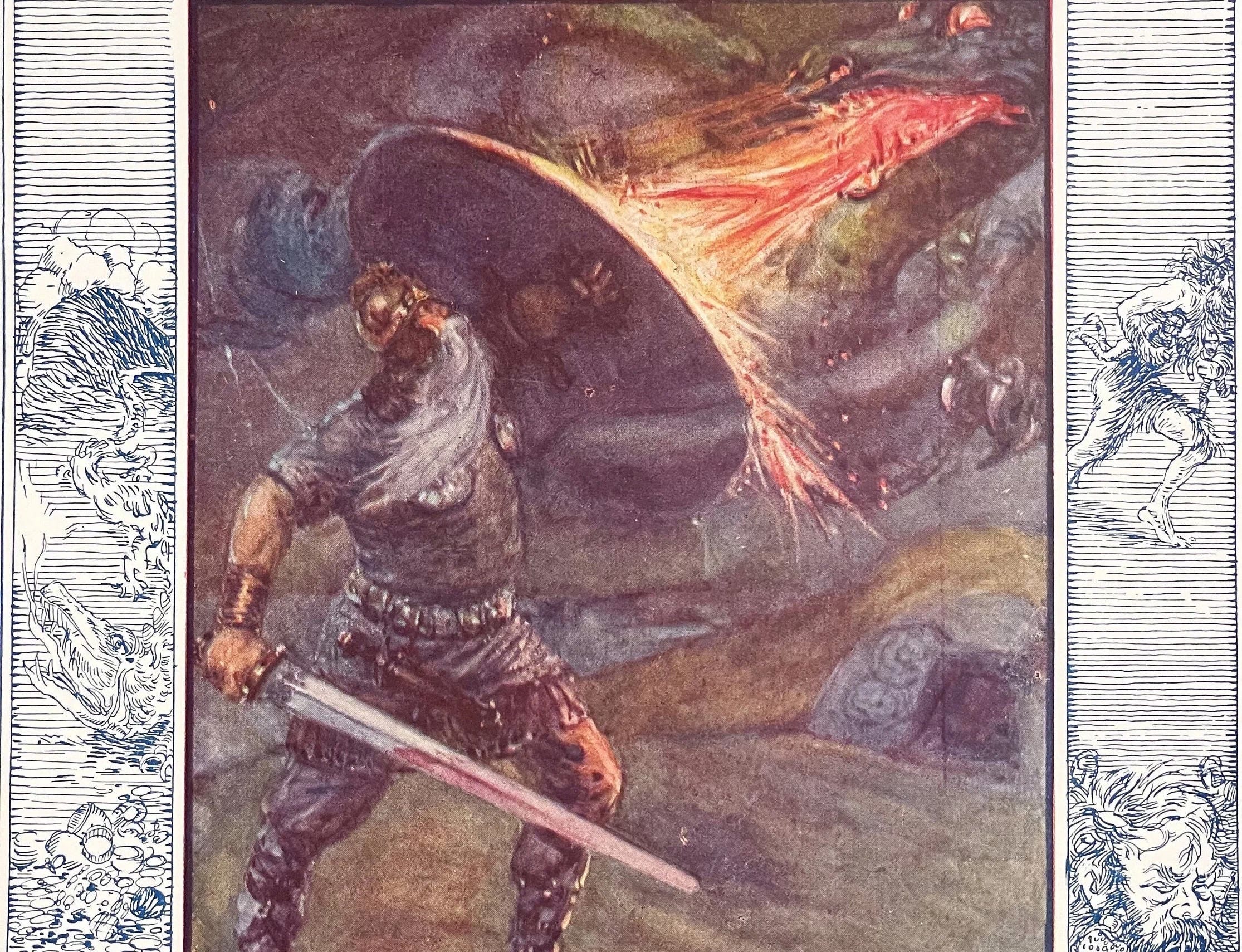
The Old English poem Beowulf is widely considered to be the greatest literary work to have survived from the Anglo-Saxon period. It is only known from an eleventh-century manuscript, but the poem records many linguistic signs that indicate when it was composed. The most recent linguistic analyses of the poem date it to the end of the seventh or the eighth century, the period in which it has traditionally been supposed to have been written. Some medievalists have argued that Beowulf is a more recent composition, closer in date to the eleventh-century manuscript in which it is recorded. But their arguments seem implausible from a linguistic and thematic perspective.
Beowulf depicts many aspects of early Anglo-Saxon society. The world of Beowulf is a heroic one, where warriors slay monsters, kings reward them with treasure, and ladies bring them wine. The poem also preserves Christian themes that may have been added to it as it was retold over the years, and it ends with a famous, final encounter between Beowulf and a fire-breathing dragon that has proved particularly popular among modern fantasy writers.
One of the many striking images of the poem is Beowulf’s discovery of a rune-encrusted sword in the underwater lair of the mother of the monster Grendel. Beowulf takes the ealdsweord eotonisc or ‘giantish old sword’ and later presents it to the Danish king Hrothgar who describes it in the following manner:
Hroðgar maðelode, hylt sceawode,
ealde lafe, on ðæm wæs or writen
fyrngewinnes, syðþan flod ofsloh,
gifen geotende, giganta cyn
frecne geferdon; þæt wæs fremde þeod
ecean dryhtne; him þæs endelean
þurh wæteres wylm Waldend sealde.
Swa wæs on ðæm scennum sciran goldes
þurh runstafas rihte gemearcod,
geseted ond gesæd hwam þæt sweord geworht,
irena cyst, ærest wære,
wreoþenhilt ond wyrmfah.Text within this block will maintain its original spacing when published
Hrothgar spoke, he examined the hilt,
the old relic, on which was written [a sign of] the origin
of an old war, after the flood had slain –
the rushing torrent – of the giant kin,
they fared perilously; they were a people estranged
from the eternal Lord; for this a final reward
by means of the surging waters, the Almighty gave them.
So, too, was on the coverings shining gold
with runes properly marked,
set and said, for whom the sword was wrought,
the best of blades, first among weapons,
with a wreathed hilt and serpentine ornament.
What Hrothgar was describing in this passage has been the subject of some dispute, but most interpreters have agreed that it includes an allusion either to the biblical flood or a similar one recorded in Old Norse mythology in which most of the giants perished, and that the runes on the sword’s hilt recorded the name of its former owner.
To understand the passage better, it is typically compared to the runic inscription preserved on an Anglo-Saxon sword or scramasax found in the Thames in the nineteenth century. The sword preserves an enumeration of the runic alphabet and a name Beagnoth inlaid on its blade, and it has been dated to the tenth century. From this perspective the description of the runic inscription in Beowulf does not seem to be recounting a particularly old practice.
But the runic inscription described by Hrothgar was clearly not inlaid into the blade of the sword rescued by Beowulf. The poem records that Hrothgar looked at the hilt and saw a runic inscription inscribed among the golden coverings of the sword fitting that reminded him of an ancient battle that occurred shortly after the time of the giants. The way the sword is described, it appears to have been thought to be very old, manufactured centuries before the period in which Beowulf is set. It is as if Hrothgar saw an inscription comparable to one of those found on the oldest surviving Anglo-Saxon sword fittings, such as that recorded on a silver-gilt sword pommel discovered in the nineteenth century at Guilton in Kent.
In Anglo-Saxon times, giants were thought to have built the many ruined buildings of Roman origin that were still standing about the English countryside. The sword found by Beowulf is described as being giantish as if that was another indication that it was very old. Swords of Roman manufacture may have still been known at the time Beowulf was composed and Roman swords sometimes bore inscriptions indicating who had made them. But the earliest inscriptions found on Anglo-Saxon sword fittings are often more difficult to make sense of than those preserved on Roman swords. Like Hrothgar’s description of the sword found by Beowulf, they need more context for their inscriptions to be properly understood.
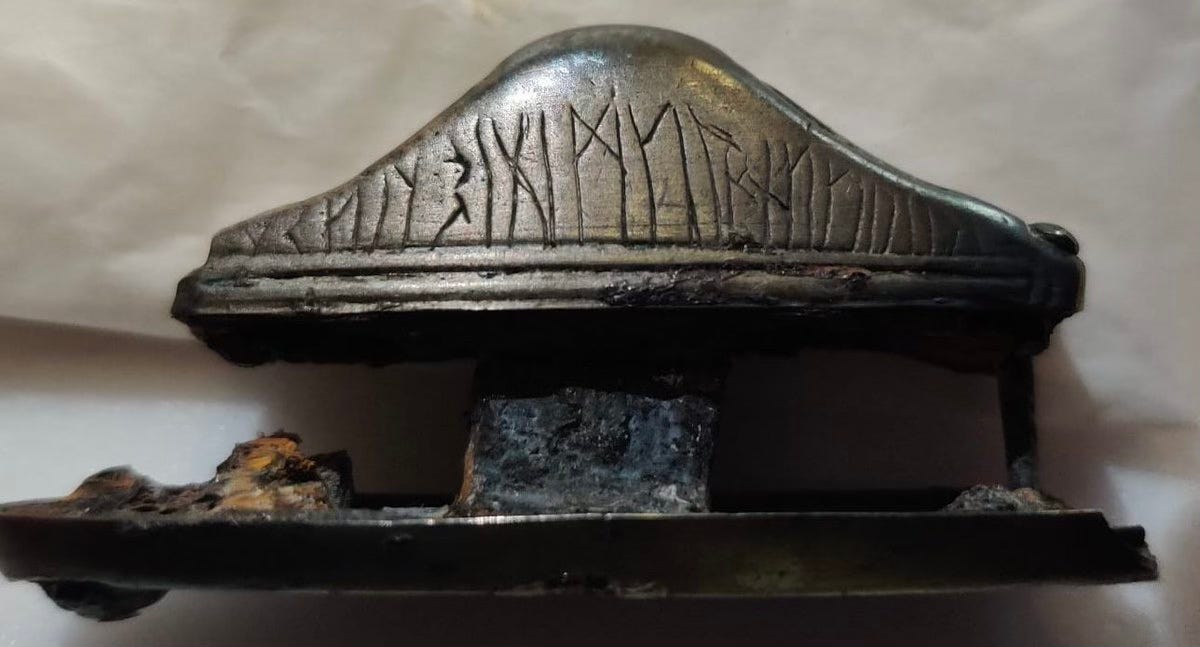
The inscription on the sword-pommel from Guilton is particularly difficult as the runic characters recorded on it are somewhat worn and idiosyncratic. It is generally accepted that the Guilton inscription records a name, but how to read the rest of the runes preserved on the pommel has long been disputed. The Guilton pommel is conserved in the World Museum in Liverpool, although it is not currently on public display. It has been dated to the fifth or sixth century and its inscription is generally accepted to preserve the name Sigimer.
Who Sigimer was is not made clear by the inscription, but some interpreters have seen an s-rune after the name which would mean that the runes record a possessive ‘Sigimer’s’. Following the rather dubious s-rune, three more characters can be made out that seem to read nem, followed by several more characters that are even less clearly preserved. It has been proposed that this sequence may have been part of a word nemde ‘named’, but a more plausible explanation is that nem is just an early English term that literally means ‘a taking’.
Rather than an indication that Sigimer owned the sword, the Guilton inscription appears to indicate that the sword was Sigimer’s ‘taking’. But what would ‘taking’ mean in this instance?
The proposal that the word preserved on the Guilton pommel was meant to be read as nem seems to be confirmed by an inscription on a brooch from West Heslerton in Yorkshire. The brooch is of a similar date to the Guilton pommel, but it was discovered in the 1980s by an archaeologist who is self-employed and he has only ever published a grainy black-and-white photo and a sketch of it. Inscribed on the foot of the brooch, the inscription clearly reads neim, but it was not obvious to the archaeologist who published it what neim meant.
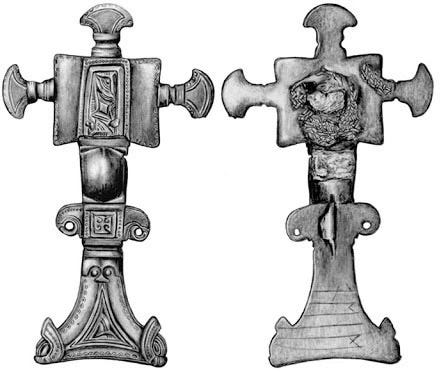
A runic inscription from Yorkshire should be expected to preserve a text written in the Northumbrian dialect of early English and neim is the expected Old Northumbrian equivalent of Kentish nem ‘a taking’. The Greeks are similarly called Greicas in Old Northumbrian where they are called Grecas in other Old English dialects. The West Heslerton inscription seems to record that the brooch it is preserved on was also a ‘taking’ of some sort, but what sort is not made clear by the inscription.
More context may be provided by another early runic inscription discovered in 1996. It is preserved on a scabbard fitting found at Bergakker in the Netherlands that is conserved today in the Valkhof Museum in Nijmegen. The inscription appears to be written in Frankish and the scabbard fitting has been dated to the fifth century. But the Bergakker inscription is much longer than those from Guilton and West Heslerton, and it also seems to record a name inflected as a possessive.
The Bergakker inscription includes an idiosyncratically shaped u-rune, much as some of the runes on the Guilton pommel seem rather odd, and it records a ligature of a w-rune and an a-rune as its seventh character. The individual words in the inscription are separated out by punctuation marks and they appear best to be read as haþuþuwas : ann : kusjam : loguns. The Bergakker inscription evidently begins with a name Haþuþuwaz, inflected as a possessive, and then a sentence that seems best understood to mean ‘(he) granted the chosen ones a brand’.
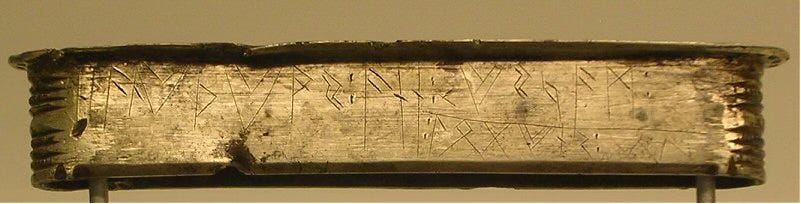
The term loguns literally means ‘flame’ and swords are often referred to poetically as ‘flames’ or ‘brands’. The Bergakker inscription appears to record that a man called Haþuþuwaz gave swords to people described as kusjam ‘chosen ones’. So little is known of the Frankish language, the Bergakker inscription is difficult translate surely, but it seems to preserve a record of a lord called Haþuþuwaz giving a sword to one of his most favoured retainers.
The reference to ‘taking’ in the inscription on the Guilton pommel seems likely to reflect a similar kind of expression. Yet where the Bergakker inscription appears to record the name of the person doing the giving, the Guilton pommel seems to record who took or received the sword.
The West Heslerton inscription provides even less context than that on the Guilton pommel. The brooch it is preserved on was discovered in a woman’s grave and the inscription may, accordingly, record a woman’s ‘taking’. But the Guilton and West Heslerton inscriptions both seem to indicate similar things – that the objects they are preserved on were gifts. The Guilton pommel was presumably part of a sword given to Sigimer by his lord and the West Heslerton brooch appears to also have been a gift of some sort. The two objects were both presumably ‘takings’ in the sense that someone presented with a gift takes or receives it. Sigimer and the unnamed woman from West Heslerton seem to have been the functional equivalents of the chosen ones mentioned in the Bergakker inscription, people endowed with gifts of swords and jewellery that have runic inscriptions preserved on them that record that they were received from someone else.
The Guilton and West Heslerton inscriptions do not make much sense if they are not provided with more context. But Hrothgar’s description of the rune-encrusted sword found by Beowulf is not very clear at first either. It is not immediately apparent why the inscription on its hilt should have reminded Hrothgar of an age-old battle from the time of the giants. Hrothgar’s comments are made much clearer, however, when the reader of the poem is informed of the necessary context – that the giants were damned long ago by God in a great flood and that the earliest-known Anglo-Saxon swords sometimes preserve runic inscriptions on their fittings. Similarly, early runic inscriptions are often difficult to understand when they are not considered in their fuller context. The reference to ‘taking’ on the Guilton pommel does not make much sense all by itself – it can only be clearly understood when it is compared to the similarly-dating West Heslerton and Bergakker finds. The inscriptions from Guilton and West Heslerton are so brief it at first seems that little can be gleaned from them. Yet both preserve indications that they were gifts, presumably from the lords the two owners of the objects served, unlike the more fantastic treasure rescued by Beowulf from the watery lair of Grendel’s mother.

Comments
Nothing yet. Say the first thing.
Sign in to join the conversation.