
2021 was a turning point for Ageism Is Never In Style. We launched our very first global media campaign, Strike Out Ageism, and it firmly put us on the map.
Designed to strike out ageist statements and transform them into empowering ones, the campaign received overwhelmingly positive feedback - but it also ruffled feathers. And rightly so. After all, is a campaign truly disruptive if everyone finds it comfortable?
One phrase in particular sparked divided reactions: grandma
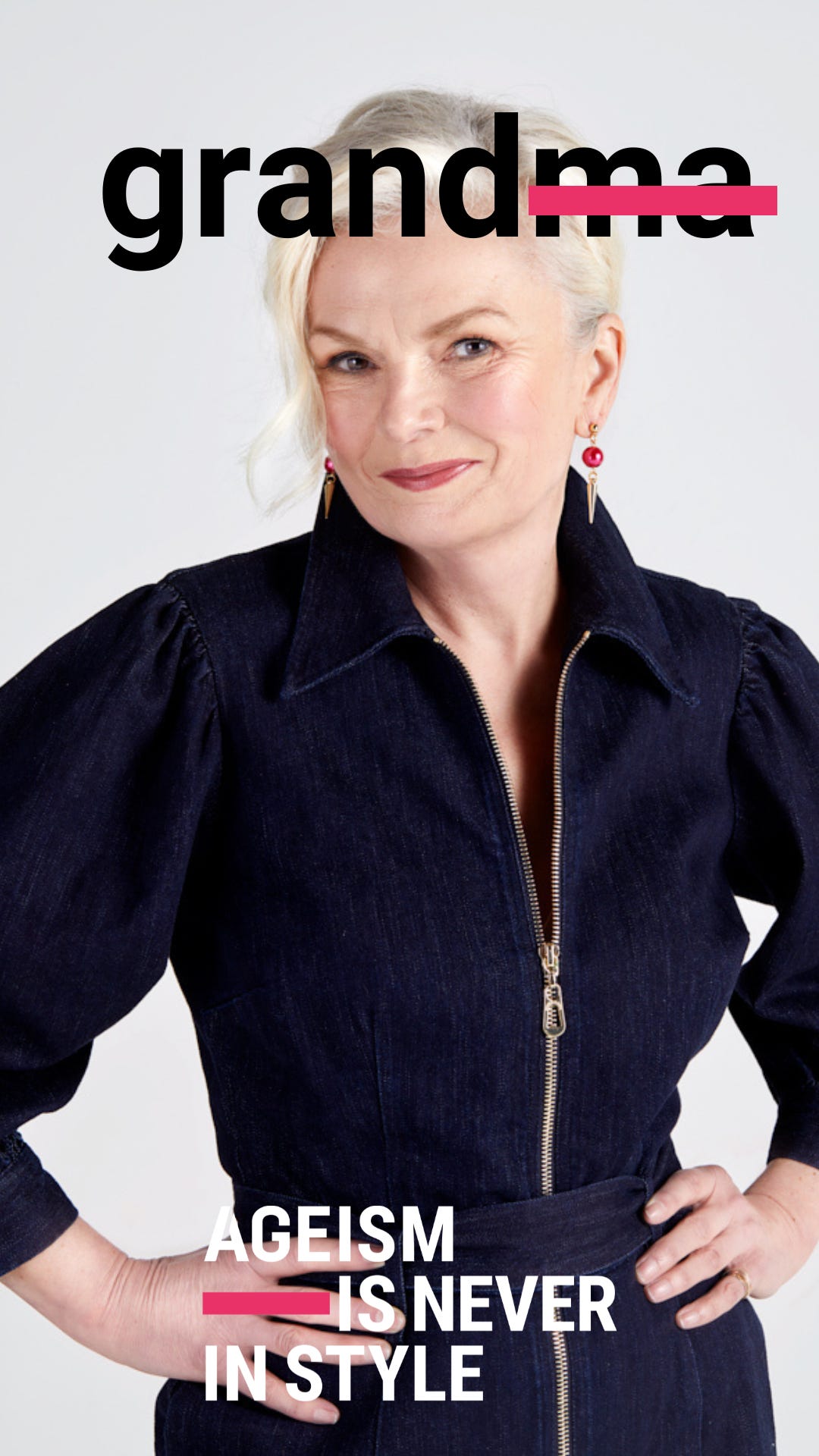
From the very beginning, we were clear: this was never about challenging the idea of being an actual grandparent. Nor is it about suggesting a grandparent can’t be cool, contemporary and/or stylish.
It was about how “older” women - especially in media - are too often labelled with familial terms like grandma, granny, or grandmother, regardless of whether they actually are one. Age-related storytelling frequently reduce older women to that one context. Because apparently, when you reach that age, there’s nothing else.
And when we say older, we’re not even talking 70s or 80+. We’re talking 50+.
As Suzanne Noble at Sex Advice for Seniors pointed out at the Advantages of Age Awards whilst presenting the “Most Ageist Headline” award:
“Of course, if you’re an older woman, it’s impossible to be written about in the newspaper without referring to your age—or the fact you’re a grandmother, even if you’re not. I know because I’ve been referred to as a grandmother in multiple publications, and my kids are way, way, way off procreating.”
What this boils down to is labels and context. Reducing a woman to a stereotype is patronising, reductive, ageist and sexist.
The UK courts agreed. Just a few months after our campaign launched, a UK employment tribunal determined that calling a female employee "grandma" or "grandmother" at work can constitute age-related harassment and direct discrimination.
As Employee Law Advice reported":
“The fact that [the claimant] was a grandmother is irrelevant. Everyone has the right to be treated with dignity and respect in the workplace and that includes not being stereotyped, labelled or defined by a protected characteristic. Although [the claimant] was, in fact, a grandmother, she clearly didn’t want to be defined as or referred to as a grandmother at work, particularly if it was to have a “dig” or a joke at her expense.”
Even so, many people didn’t get it. I ended up debating it on BBC Radio’s Jeremy Vine Show, where my opponent argued:
“When my grandchild was born, I was very happy to be welcomed back to the office with people saying “hello grandma!.”
I pointed out, that’s completely different - it has a particular relevant context, and isn’t the same thing as being brandished and labelled as ‘grandma’ to denote age. Many listeners messaged me directly afterward agreeing.
Over the years, we’ve stood firm. And whilst the tide has shifted - Mintel even specifically requested to feature our Grandma graphic in their report on improving age representation - we still face pushback.
Some say we’re “picking issues where none exist.” Some call it “woke.”
Others argue it’s a compliment: “Grandma stands for wisdom and a lifetime of being a woman.”
But therein lies the problem.
Why is a lifetime of being a woman still, in 2026, reduced to her familial and maternal context? It’s ageist and sexist to suggest that this is all she is - or all she dedicates herself to - as she gets older. Classic gendered ageism.
My mum, now in her early 70s, is not a grandmother. Yet she’s routinely assumed to be. When she corrects people, responses range from pity to contempt. She’s perfectly content with no grandchildren, but society still insists on defining her by a role she doesn’t occupy. And it’s no one’s business why she may or may not have them.
Remember, when it isn’t only patronising and reductive, calling someone “grandma” can also be painful. Many women are not grandmothers (or mothers for that matter), and not out of choice.
Then you might argue, well it’s meant to be kind and a compliment. I’m afraid benevolent gendered ageism, dressed as kindness, is still ageism.
Too many still need to heed this message. The grandparent label and trope continues to dominate in media, films, advertising, modelling, casting calls, fashion, and more. For example, in Spinal Tap 2, released late 2025, an older female drummer was just listed in the credits as ‘Granny Drummer’. And don’t even get me started on the patronising #GrandmaCore fashion trend.
And members of community who work in the arts and media echo this (note: we have kept their quotes anonymous out of respect to avoid personal professional implications). One very established pro 50+ model shared with us how she was just called “grandma” on set. Not by name. Just “grandma”.
In her own words:
“Being referred to on set as ‘grandma’ was a test of my professionalism.”
And this isn’t an outlier.
Just this week we asked members of community who model, act, perform etc, if they’ve had similar experiences. The responses speak for themselves:
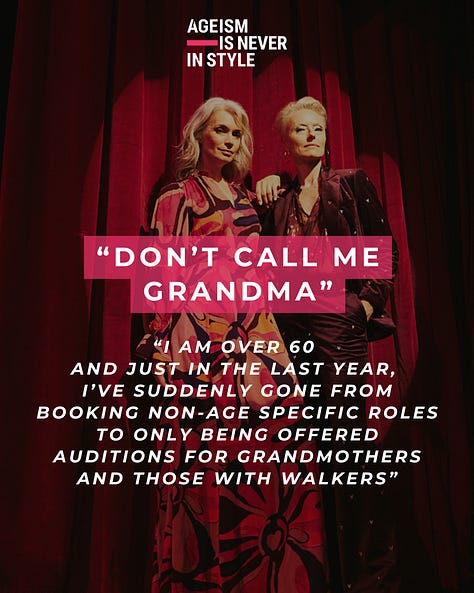
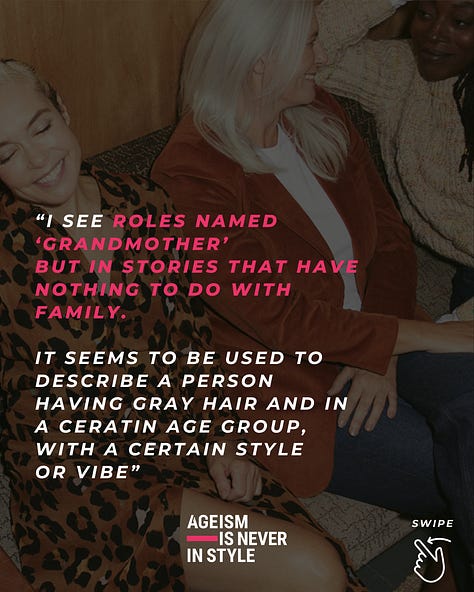
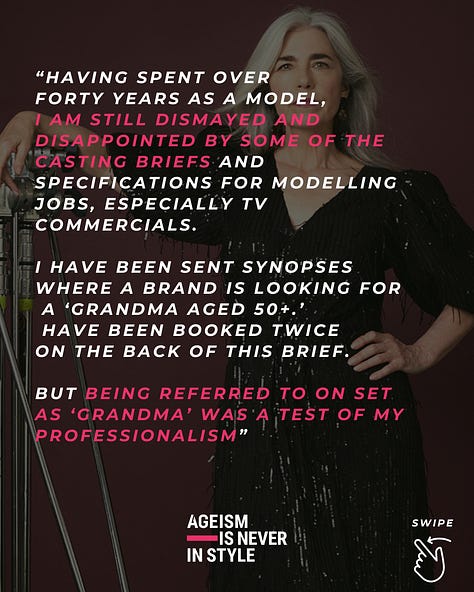
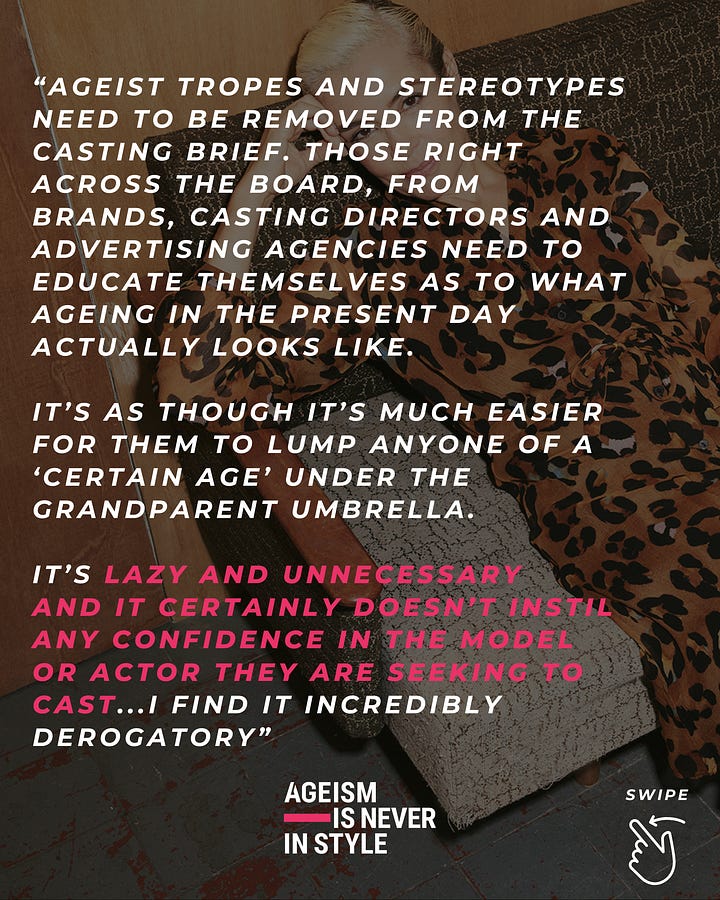
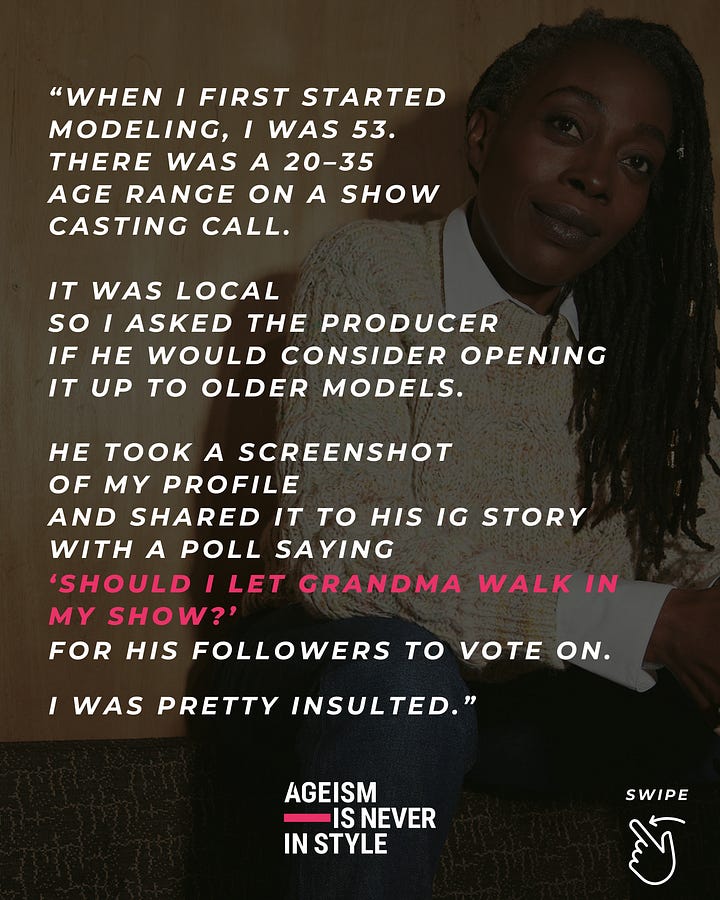
It isn’t just calling someone grandma. It’s the styling, the framing, the storytelling as a whole, that limits and stereotypes:
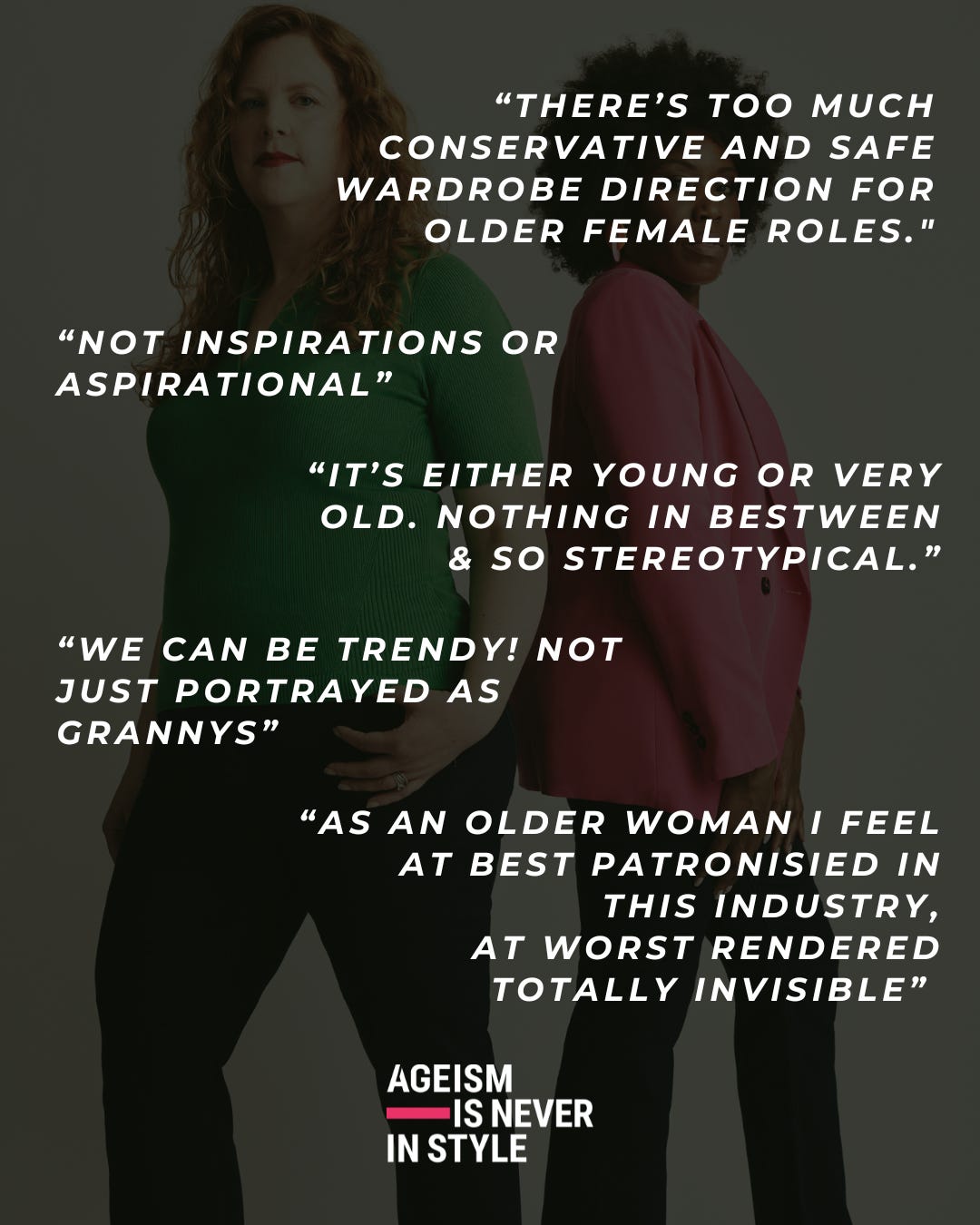
To be clear, older men can and do face similar labels. In 2019 a 72-year-old hardware test engineer at Google sued the company, alleging his manager called him "grandpa”. But when it comes to media in particular, the pattern is generally gendered, depicting and label older women as grandparents - often irrelevant to the story, the product, or their actual identity.
Now, governments and economists are panicking about declining birth rates. So one could reasonable speculate that going to start seeing an increased push for grandparental narratives to “encourage” reproduction.
This would align with countries that are already incentivising reproduction. China has lifted its one child policy. Hungary, South Korea, Russia, and Poland offer incentives for having children. Meanwhile, the right wing party Reform UK have talked about taxing women who aren’t going to have children…. The Handmaid’s Tale much?
Yet Goldman Sachs notes that whilst a fertility rate of ~2.1 births per woman is usually considered the “replacement level,” rising life expectancy means the fertility rate needed to stabilise the global population could be closer to ~1.5–1.6. This gap could be further mitigated by tapping into the economic and workforce potential of older workers, who are living longer and healthier lives, helping to support economic growth even as population growth slows.
Tapping into older workers means cultivating cultures where they feel valued, respected, treated fairly, and able to contribute.
And enough evidence shows being called “grandma” or similar in the workplace isn’t going to do that.
Independent Age found that 46% of over-60s find common age-related language patronising, insulting, or offensive. If we want people to feel included, respected, and able to contribute across the life course, we must reassess and transform our language. That sometimes means uncomfortable reflection—and accepting that language once deemed acceptable may no longer be.
As I’ve always said, language evolves. And I get it - it isn’t easy. But it’s our expertise at Ageism Is Never In Style, and that’s why we bring our said expertise to educate companies, organisations, teams, and individuals, working with them to navigate this complex web sensitively, intelligently, and confidently - helping them avoid missteps whilst creating cultures of inclusion and belonging.
Because we can design the right systems, the right services, the right policies and the right products to cater to ageing audiences and tap into the longevity opportunity, but if you get the language, framing narratives, comms and storytelling wrong, no one will bite. And you might even alienate, and achieve the very opposite to what you were trying to address and resolve.
Ageism threatens seizing the longevity opportunity.
So what it boils down to this: we need to keep reflecting, understanding, and expanding the way we talk about age. Yes, that means taking into account nuance, context, and audience. Absolutely tone can make a difference too. But that also means sometimes it requires uncomfortable reflection and recognising that language once deemed acceptable isn’t anymore.
And sometimes - and in the right contexts - we can and do reclaim language. But sometimes, language simply needs to change. Right now, this is one of those times.
If I’m honest, part of me can’t believe we’re having to still discuss this. When there’s been so much education, understanding, reflection and engagement around inclusion, why in 2026, does it still stop at ageing? But the other part of me knows all too well the reality…
And remember: intentions don’t automatically override impact. Sure, there are subtleties but for those who may not immediately understand it, I’d gently encourage taking a moment to consider the perspective of someone who’s spent a lifetime being labelled, boxed in, and reduced to their biological roles.
So let’s put it this way: to err on the side of caution, if terms like “grandma” are irrelevant to context, don’t use them.
We are taking a stand on this. And the UK courts continue to too. In February this year, another worker received a £60k payout for an age discrimination claim after being called “grandma.”
So yes, it might feel overly sensitive or “woke” to some. But right now, it really is a case of go woke - or go broke.
Also may be of interest:
Comments
Nothing yet. Say the first thing.
Sign in to join the conversation.