
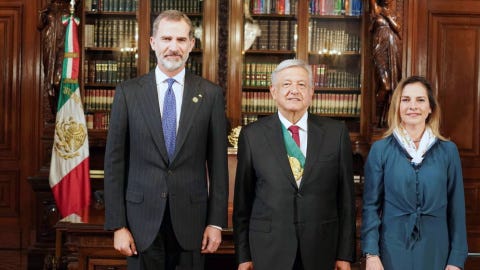
Felipe VI has acknowledged that among the actions of the Spanish Empire during the conquest of the Americas there was “much abuse”, as well as “moral and ethical struggles and controversies”. This is a modest gesture intended to help normalise relations with Mexico, which in 2019 asked the monarchy to apologise to Indigenous peoples for the violence, plunder and massacres committed during colonial times. That request, which actually took the form of a private letter, was deliberately leaked by the Spanish monarchy and led to a diplomatic crisis in which Spain —both government and monarchy— dug in its heels and refused to apologise.
Such an apology would not have been unusual. The letter from then Mexican president Andrés Manuel López Obrador was also sent to the Vatican, since the Church played an active role in the invasion of the Americas and in subsequent processes. In fact, the Church had already moved ahead: in 2015 Pope Francis asked forgiveness for the “many sins committed in the name of God against the native peoples of America”. Even earlier, in 2000, Pope John Paul II had lamented the “painful violence and persecution” suffered by Indigenous peoples. Why could Spain not do the same?
Other countries that had colonies or that killed and expelled Indigenous populations have apologised for their imperial past. The United States Congress, for instance, passed a resolution in 2009 that explicitly apologised “to all Native Peoples for the many instances of violence, maltreatment, and neglect inflicted upon them by citizens of the United States”. Canada, Germany, the United Kingdom, Australia and Japan are other examples that, to varying degrees, have acknowledged their colonial past and issued apologies in one form or another. In general, however, former colonial powers have refused to recognise that such gestures entail legal responsibility, which would lead to compensation. And almost always these are partial acknowledgements, referring to specific cases or motivated by the desire to improve contemporary economic relations —as occurred with Italy’s apology to Libya prior to agreements on gas and oil. In other words, there is strong resistance to structurally linking the old colonial networks —and their many abuses— with the benefits extracted in the metropole.
The visceral response of Spanish nationalism, which has been stirred even by Felipe VI’s modest and informal remarks, must be understood in the context of the fragility and reaffirmation of an identity built upon founding myths and extreme violence. This is not unique to Spain —it has occurred in other former imperial nations— but in Spain’s case it seems particularly difficult to acknowledge.
Spanish imperialism was built on conquest and slavery, but this began well before the invasion of the Americas. In fact, the slave-based sugar plantations that Columbus established just months after arriving on the island of Hispaniola —which were effectively the first capitalist factories, later “improved” across the Americas to make African slave labour more efficient— were imported from practices already developed by Spaniards and Portuguese in the Azores, Madeira and the Canary Islands. Likewise, brutality towards Indigenous populations had already been rehearsed against the Guanches in the Canary Islands, in accounts that are chilling to read. More broadly, the Atlantic islands functioned as a laboratory for developing a model of colonisation based on sugar, deforestation, forced labour and the slave trade, as historian Jean-Baptiste Fressoz has pointed out.
We must not forget that the main interest of the conquistadors was the plunder of resources such as gold, silver and coerced labour. The Spaniards —in reality, predominantly Castilians— enslaved Indigenous peoples from the outset, using methods already employed on the Iberian Peninsula against Muslim populations: they referred to rapid raids on Indigenous communities to capture new slaves as cabalgadas, razias, or even, strikingly, vendimias (“harvests”). This forced labour was used across all economic activities, especially plantations and mining. But as the Indigenous population rapidly declined due to the devastating combination of disease and malnutrition, Charles I authorised the African slave trade from 1518 in order to maintain a supply of cheap labour.
It is also true that there were moral and ethical controversies, as Felipe VI notes, since part of the Church was deeply disturbed by the treatment of Indigenous peoples. The Crown was receptive to this view until the mid-sixteenth century, leading to the enactment of the New Laws in 1542 —which is what the current monarch refers to when he insists that his predecessors attempted to protect Indigenous populations. Certainly, these were reforms and laws that were largely unenforced, a point that underpins the description of “much abuse”, through which Felipe VI appears to absolve the monarchy of responsibility, placing it instead on encomenderos and conquistadors who disobeyed the metropole.
But the entire process of the invasion of the Americas involved more than human suffering. It also constituted what Marx termed the “primitive accumulation” of capitalism —the initial step in the enrichment of fortunes that would go on to drive the expansion of capitalist dynamics in Europe. It is true that Spain failed to convert that wealth into a fully fledged capitalist transformation, largely due to the rent-seeking character of its elites, something already criticised at the time by mercantilist economists. Luis Ortiz, a sixteenth-century royal official, bitterly complained that foreigners “treat us worse than Indians” because European countries exported manufactures to Spain while Spaniards exported raw materials, wool, silks and similar goods. Spain, despite being an empire, already occupied a “semi-peripheral” role in economic terms in the sixteenth century: although Spaniards extracted gold and silver from the Indigenous populations —Ortiz’s own words— other European countries took “the money of the kingdom through their industry, without working to extract it from the mines, as we do”. In other words, Spain actively participated in colonial extraction but failed to translate that accumulation into domestic industrial development, remaining subordinated to other European economies.
In subsequent centuries, other countries —notably England— would provide the decisive impulse to capitalism both domestically and across Europe, a process built upon the combined availability of fossil fuels and colonial networks. Spain, however, did not remain outside later forms of plunder. More than 8% of enslaved Africans —over one million people— were transported on ships flying the Spanish flag. A substantial body of academic literature, beginning with the work of historian José Antonio Piqueras, has documented how Spanish and Catalan families enriched themselves through the slave trade —a relationship that contributed to the emergence of early industrial capitalism in Spain. Human trafficking was a highly profitable business that enabled the accumulation of large fortunes on the peninsula, which were later reinvested —centuries after the conquest of the Americas— in early bourgeois projects. Indeed, Spain was the last European country to abolish slavery, doing so in Cuba as late as 1886.
None of the above would have been possible without the complicity of the monarchy, which not only enacted the laws governing the empire and its possessions but also owned slaves itself —the so-called “king’s slaves”. Needless to say, subsequent legislation was deeply shaped by commercial and economic interests in which the monarchy was, at the very least, complicit —not least because the revenues from the slave trade also flowed into the state’s coffers. The monarchy thus bears a long record of accumulated grievances that could justify an honest recognition of the facts and a corresponding apology. Because this is not merely a matter of “many abuses”, but of a structural relationship between the welfare of some —at the centre of the empire— and the plunder, massacre and violence inflicted upon others —in the colonies.
Fortunately, we have long since left that period behind and can view the past with far greater objectivity. The danger is that Spanish nationalism refuses to do so, because doing so would mean recognising that the identity it celebrates is built upon the suffering of others. Modern democratic societies confront their past, learn from it, and look to the future with new principles and values. What Felipe VI’s words reveal is that the monarchy itself is still unwilling to take that step: it prefers to speak of isolated “abuses” rather than acknowledge the structural relationship of plunder and violence upon which its own power was also built.
No posts
Comments
Nothing yet. Say the first thing.
Sign in to join the conversation.