
Work from home and avoid spending time driving to work; use public transport whenever possible; don’t drive at the maximum permitted speed; avoid air travel; moderate your use of air conditioning; use a bicycle or your own legs as a means of transport… All these measures are part of the usual demands of the degrowth movement, yet they are drawn from recommendations published by the International Energy Agency in response to the current energy crisis triggered by the war in Iran.
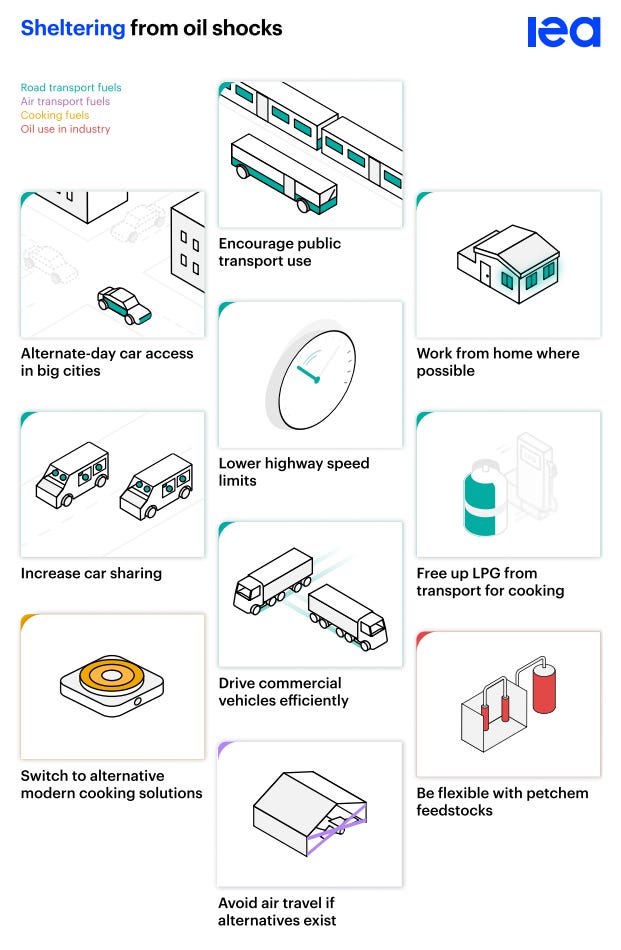
This represents an ironic convergence between an ecological political movement—which argues that reducing energy and resource consumption is a necessary condition for making our economic activity sustainable within planetary limits—and a mainstream organisation founded more than half a century ago, whose primary purpose is to monitor and ensure the security of the energy flows on which contemporary societies depend. While degrowth advocates defend these measures as structural and think in ecological terms, the IEA sees them as temporary adjustments to cope with the current crisis. Even so, the convergence is significant.
As with the recent energy blackout in Spain and Portugal, the current energy crisis highlights our profound dependence on flows of energy and resources that are usually invisible to us: we switch on lights and computers, turn on heating or air conditioning, take hot showers, and fill up our cars without pausing to consider everything that makes such actions possible. Energy surrounds us, yet we ignore it. As a result, we tend not to worry about its supply: we take it for granted. In fact, most people pay attention only to price, not to physical quantities (for example, the tonnes of resources required) or to their origin. Energy is the black box of the economy: an essential mechanism on which our way of life depends, but whose functioning remains opaque to most.
The truth is that, as a species, we are living beyond what the planet can sustain. According to the latest State of the Global Climate report by the World Meteorological Organization, atmospheric carbon dioxide concentrations in 2024 reached their highest level in two million years. Indeed, the annual increase in 2024 was the largest recorded since 1957, pointing towards a very bleak future. This is despite the fact that we have known for almost a century the main—and highly damaging—consequences of this trajectory. Yet global indicators have continued to worsen since the major international climate agreements, such as the Kyoto Protocol signed in 1997. This does not mean that what has been done so far is useless—far from it: every effort counts, and every fraction of a degree avoided is a welcome contribution—but it is clearly insufficient.
Our global economic system remains off track, and the resulting adjustments in the Earth system’s parameters already entail irreversible consequences for millions of species… and no less dangerous ones for humans. This horizon is especially harsh for the poorest within each society and for those living in regions most affected by global warming. The ecological—or ecosocial—crisis is far deeper and broader than the energy crisis triggered by the war in Iran. And what is most striking is that mainstream thinking can propose extraordinary solutions that should long ago have been incorporated into everyday, normal policy.
However, it is essential to understand that demand-reduction measures are not socially neutral. It is not the same to ask someone with an office job to work from home as it is to ask a warehouse worker or a truck driver; it is not the same to recommend public transport to someone living in a city with a metro network as to someone in a poorly connected rural area of depopulated Spain. If this asymmetry is ignored, the risk is clear: that the burden of adjustment will fall on those who have contributed least to the problem and/or have the fewest resources to adapt. For this reason, any serious programme to reduce material consumption must incorporate a redistributive policy to compensate for these initial inequalities. Otherwise, degrowth will become a privilege for those who can afford it and a burden for everyone else.
In any case, governments could turn necessity into virtue and use the current crisis to address some fundamental challenges. Nearly half of the oil consumed in the European Union is used for road transport, so emissions could be drastically reduced through strong intervention in this sector. According to the IEA, teleworking in jobs where it is feasible could reduce total vehicle fuel consumption by up to 6%; another 6% could be achieved by lowering speed limits by 10 km/h; a further 3% by promoting public transport; and up to an additional 8% through measures such as car-sharing, more efficient driving, and proper tyre maintenance. While the IEA frames this in terms of reducing oil consumption to lessen dependence on imports, it also implies a reduction in emissions. This is where degrowth meets energy security.
Governments have generally focused on supply-side policies, such as producing electric vehicles and shifting the energy sources of large industries. These measures are necessary, but they can—and should—be complemented by demand-side policies like those proposed by the IEA. The effects here would be much faster, though they would also require strong political determination. For example, massive investment in public transport is essential to make it a viable alternative to private vehicles—especially those powered by internal combustion engines. This would also help address persistent service-quality problems in rail networks. New routes and connections must be designed, higher frequencies guaranteed, and above all, priority given to infrastructure that moves the largest number of people. Existing inertia works against us, as urban geographies have been designed as if the fossil fuel era would last forever; adapting mobility to new conditions is therefore a major challenge.
Central banks and the European Union “found” sufficient funds to bail out banks during the 2008 financial crisis. Something similar happened in 2020 when the world came to a halt due to the pandemic, and governments launched massive stimulus plans. Now we should do exactly the same—indeed, with even greater urgency. But not only because of the war in Iran, but because of the broader ecosocial crisis that forms the backdrop. Although degrowth means much more than reducing energy and resource consumption, this is precisely one dimension that must be addressed swiftly. And this is a major opportunity to do so.
In short, the measures that conventional thinking proposes as emergency responses are precisely the kinds of transformations that should constitute the normal functioning of any responsible economic policy. The choice is clear: either we manage the reduction of material consumption in an orderly, democratic and just way, or crises themselves—energy, climate, geopolitical—will impose that adjustment in a chaotic and unequal manner. Degrowth, far from being a naïve utopia, is simply one of the political names we give to the recognition of the planet’s physical limits. The material metabolism of our societies will sooner or later see a reduction in energy and resource use; the time we still have allows us to decide how—and for whom—those adjustments will be most severe.
No posts
Comments
Nothing yet. Say the first thing.
Sign in to join the conversation.