
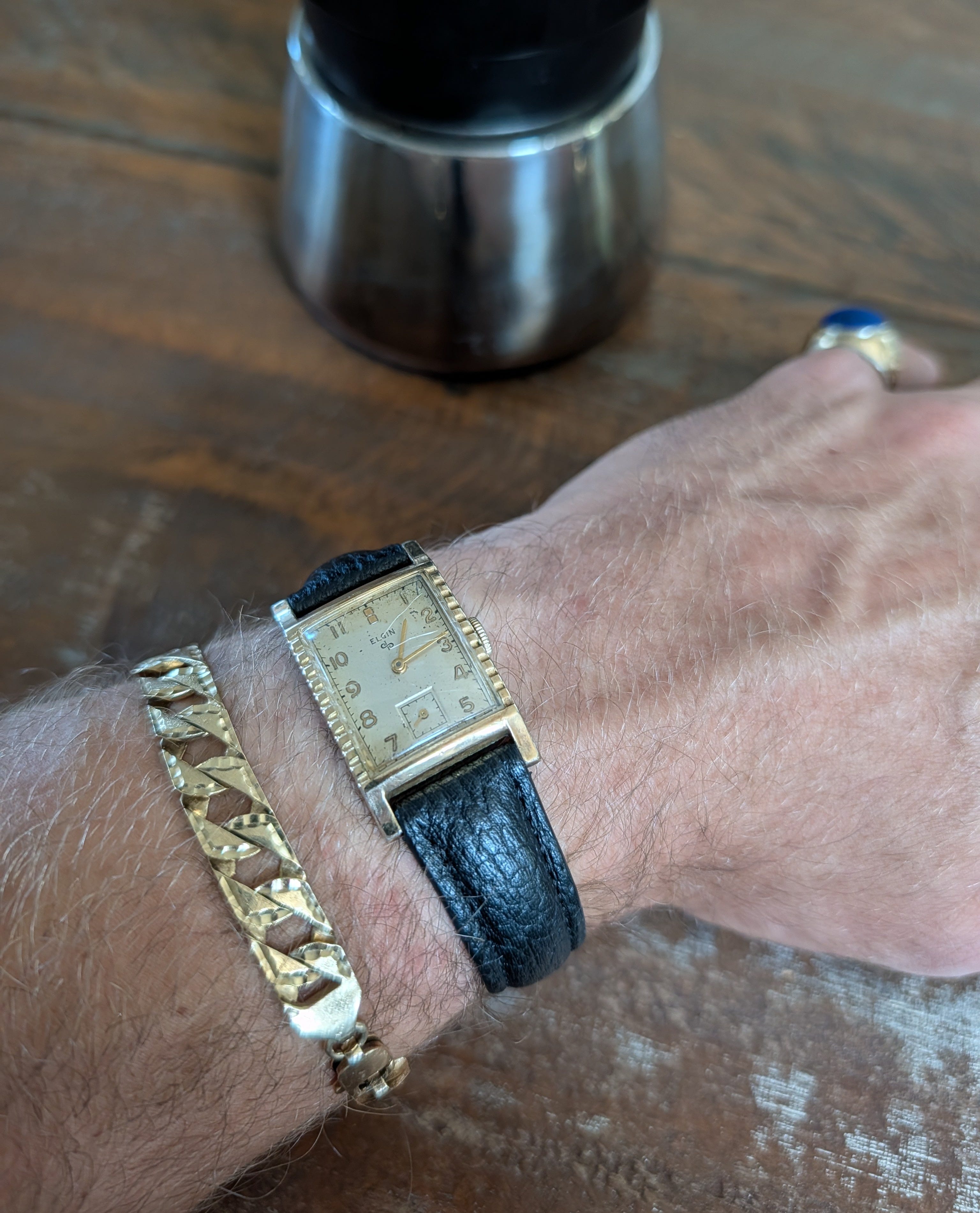
I wear mechanical watches not because they are efficient, but because they refuse efficiency as a moral imperative.
In a culture that treats convenience as a proxy for progress, that refusal is quietly subversive. Automatic and hand-wound watches, especially vintage ones, persist as reminders that some forms of precision, meaning, and durability cannot be automated without being diminished. They do not promise to save time. They insist that time must be engaged with.
This distinction matters more than we are inclined to admit.
A mechanical watch requires participation. A hand-wound movement demands a daily ritual: tension applied by hand, resistance felt, limits respected. An automatic watch relies on motion, on the wearer’s presence in the world, to sustain itself. When neglected, both stop. There is no alert, no backup battery, no cloud synchronization. The consequence is immediate and legible. Timekeeping, in this sense, is not outsourced; it is stewarded.
That demand runs counter to the prevailing technological ethos. Modern devices promise liberation from friction. They abstract time into invisible signals managed by systems we neither understand nor control. Time becomes something that happens elsewhere, tracked, optimized, and monetized by black boxes designed to minimize our involvement. What is gained in convenience is often lost in agency.
Mechanical watches reject that bargain.
Most of the watches I am drawn to are vintage. They were built in eras shaped by scarcity, reconstruction, and material constraint, conditions that forced designers and craftsmen to prioritize durability and repairability. These watches have outlived not only their original owners but entire technological paradigms. They remain functional because they were designed to be understood, serviced, and preserved rather than sealed and replaced.
This is not nostalgia. It is evidence.
A vintage mechanical watch is a coherent system. Its logic can be traced. Its failures can be diagnosed. Its parts can be cleaned, adjusted, or replaced. Nothing about it demands blind trust. In an age increasingly defined by opaque technologies and institutional systems that resist scrutiny, this intelligibility carries moral weight. It suggests that accountability, mechanical or otherwise, depends on visibility.
The dismissal of such objects as obsolete reveals less about their relevance than about our cultural assumptions. We have come to equate progress with disposability, and innovation with erasure. What cannot be endlessly updated is presumed inferior. What demands care is treated as inefficient. Yet civilizations, like machines, do not endure by eliminating maintenance. They endure by institutionalizing it.
Mechanical watches make this principle tangible.
They also challenge the modern fixation on perfection. A patinated dial, softened edges, or a movement bearing the marks of careful servicing are not defects; they are records of survival. They testify to use rather than abandonment, continuity rather than replacement. Contemporary design, by contrast, increasingly favours sterility, objects meant to look untouched until the moment they are discarded. The former assumes longevity; the latter assumes replacement.
This aesthetic divide reflects a deeper philosophical one. Mechanical watches accept limits. They require regulation rather than domination, balance rather than acceleration. Time is not conquered; it is negotiated. That orientation stands in sharp contrast to a culture that treats time as an adversary to be beaten, compressed, or optimized out of existence.
What mechanical watches offer instead is a relationship with time, one grounded in responsibility rather than illusion. They do not promise mastery. They promise coherence, provided the wearer does their part.
To wear such a watch today is not a rejection of technology, but a rejection of technological infantilization. It is a refusal to outsource meaning to systems that ask nothing of us while demanding constant attention. Mechanical watches do not interrupt. They do not persuade. They simply keep going, within limits, as long as care is taken.
That is not merely good design. It is a model of engagement increasingly absent from modern life.
Perhaps the real question is not whether mechanical watches still make sense in a digital age, but whether a culture increasingly allergic to maintenance, limits, and participation still understands what meaning requires. We have become highly skilled at saving time while growing steadily less capable of inhabiting it, optimizing, automating, and abstracting our days until life feels frictionless yet strangely hollow.
In the process, we have built a culture of disposability that treats care as inefficiency, responsibility as a burden, and intelligibility as optional. Things in our lives that demand care, whether watches, relationships, or institutions, are dismissed as inefficient when, in fact, they are asking something more difficult: participation. Objects are designed to be replaced, systems to be obeyed rather than understood, and individuals to be insulated from consequence rather than shaped by it. This is not progress; it is infantilization.
Mechanical watches refuse that regression. They demand care, accept limits, and make failure visible. They do not offer an escape from time. They offer a way back into it. And the discomfort they provoke may say less about their relevance than about our unease with the obligations that meaningful adulthood, personal or cultural, has always required.
Comments
Nothing yet. Say the first thing.
Sign in to join the conversation.