
Story Summary: A female interloper crashes an "emotions" wine tasting. (Scroll Down To Read)
(It’s completely anonymous…and fun!)
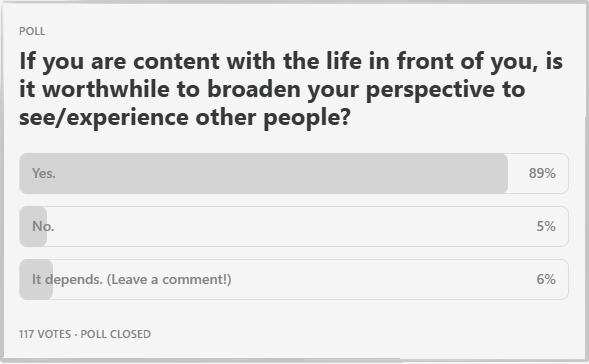
Nalini Jacob-Roussety ties simple questions to deeper philosophical frameworks! Listen to her discuss the poll question above. Comment in the discussion area at the end.
💡Paid subscribers help us publish stories like this every week and access our full archives.
📖 Email cut short? Read This Story on Substack
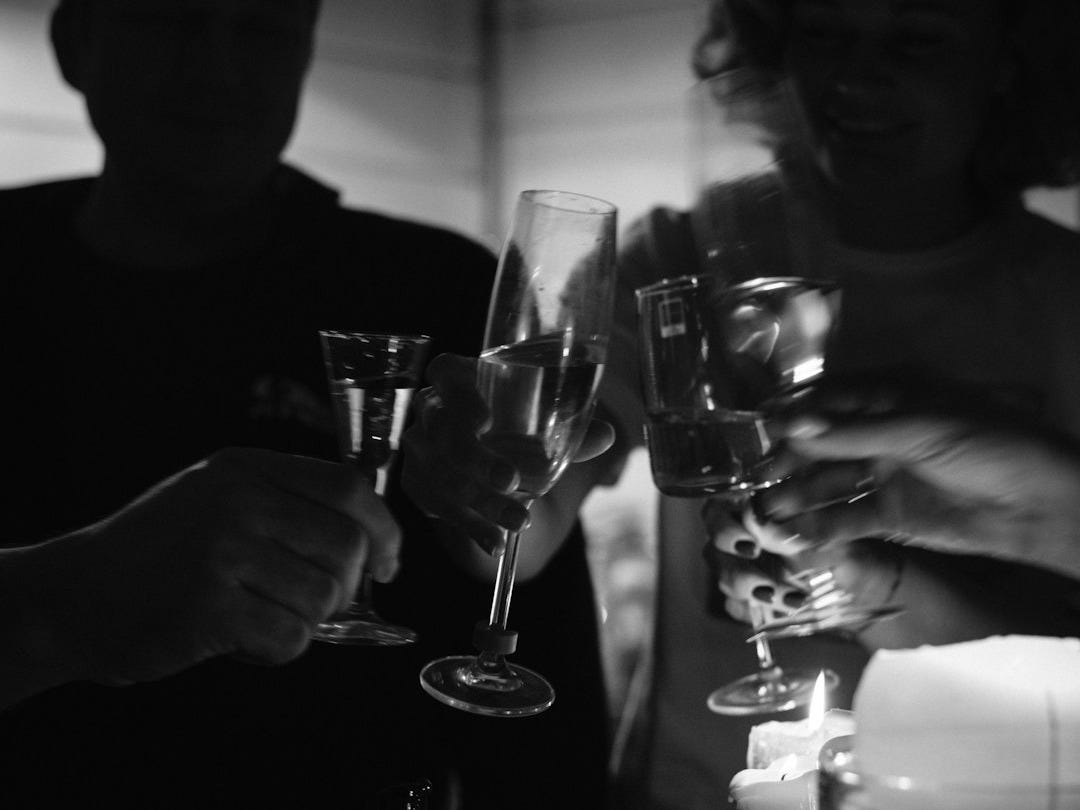
For the fourth time that evening, Reginald smoothed his moustache in the mirror. It was perfect. Was it? Just a touch here... Now it was perfect.
Soon his guests would arrive—only a few this evening, a small coterie from the Mayfair Club, on whom he could practice his hosting skills, grown rusty over the winter. They were Reginald’s lunching buddies and thus probably his closest friends, because one is never better able to share one’s innermost feelings than in the close, dark smokiness of a gentleman’s club, half-deep into a bottle of Intimacy on a Sunday afternoon.
Potts would meet his guests at the door and lead them to the salon, a room that Reginald always kept furnished in the most current tastes. At present it boasted a deep yellow carpet, sofas and a chaise longue upholstered in silks, curtains that billowed luxuriously to the floor, and dark-wood furniture with such delicate carvings that they might be mistaken for spun sugar. Also, in the salon this evening, the showpieces for tonight’s party: a set of recordings by the latest operatic sensation, which Potts would put on the phonograph the moment the first guests arrived, and an ice sculpture of a swan, down the beak of which one could pour one’s drink and have it emerge, perfectly chilled, from a channel between the wings. A little extravagant for such a small soirée, perhaps, but he did not mind overindulging when it came to presenting the drinks.
Reginald was renowned for the richness and diversity of his drink collection and for his winning formula in serving them. Most of his parties followed a similar structure: something light to start—a taste of bubbly Joviality, perhaps—then onto a richer Joy, ease into fruity Remembrance—sweet yet bitter on the palette—and finish with a long snifter of Contentment. He could create the most memorable rise and fall in an evening; his carefully curated menus were guaranteed to draw out laughter and friendship and gentle, nostalgic sighs. It was this that people came to Reginald for—the reason he was famous among his set, and the reason that people talked so warmly about his parties for weeks after the fact. Tonight, he would dip his toes back into the waters and warm up for another marvellous season.
Reginald smoothed his moustache for a fifth time—now it truly was perfect—and heard the doorbell and Potts’s measured steps across the hall. There were the rustlings of hat and coat, Potts’s courteous “Right this way, gentlemen,” and the sound of steps and the opening salon door. As soon as the record scratched into life, Reginald knew it was time to make his entrance. A final glance at his moustache in the mirror, and at last he descended the stairs.
* * *
“Gentlemen, thank you so much for coming!”
Reginald threw his arms wide as his friends stood to greet him. To his left was Marcus Shaftesbury, heir to the family business (textile factories) and in the meantime an incorrigible dilettante who enjoyed nothing more than scoffing in art galleries and driving around London with the wind in his hair. Next to him stood Lord William Ashton, a more reserved type who spoke little but was usually endearingly blunt when he did. Reginald turned to the chaise longue, expecting to see Bommels lying there with his shoes kicked off—shoes that had been kicked off many times before, under countless beds all over the city; no wonder one could never see one’s face in them—but it was empty.
Marcus raised a glass in Reginald’s direction.
“Reggie!” he cried. “What-ho, old chap!”
Reginald smiled broadly and looked at the glasses twinkling in his friends’ hands. On a nearby table with finely fluted legs, a silver tray held two remaining glasses of the yellow-gold wine. Clearly Potts had poured the aperitifs.
“And what are we drinking, gentlemen?” Reginald asked, although naturally he already knew. The serving order was written in his own curlicue hand on the chalkboard in the cellar, and with each bottle he brought up, Potts would mark a large tick on the board.
“Pottsy started us off with some Bonhomie,” said Marcus. “And a delightful little number it is too. Is it new?”
“Yes, bottled just last week, I believe, in one of those pubs in the East End, just before closing time. The hour of songs and arms around shoulders. You won’t find jollity purer than that in all of England, I’ll wager.”
“Wager nothing, we can taste it,” said Lord Ashton.
Reginald raised an eyebrow. “But where is Bommels?”
“Ah,” said Marcus. “He’s running late. Told us he had to stop to pick up a friend.”
A friend? Reginald swayed a little. How presumptuous! This was a private gathering, and everything had been carefully planned. The guests, the music, the order of the drinks—it had all been run through the formula in Reginald’s mind, cross-checked against the temperaments of the guests and the outcomes of previous parties, to arrive at this beautiful conclusion. His methods were flawless, which is why his parties were flawless. But at the last minute to throw a friend into the mix?
At once Potts was at his elbow, holding out a glass of the Bonhomie. Reginald took a large swig.
A gorgeous warmth flowed through him and he sighed through his nose. Well, was not magnanimity a key trait of any host? And was Bommels not young and foolish and thus utterly predictable in his unpredictability? This was exactly the sort of thing a host of Reginald’s calibre should have foreseen, and if he had not—well, that was his error. In any case, there was nothing to be done now; one could hardly turn a guest away at the door. No, best to keep the chin up and fathom it out. If anything, this would be a good test of his skills. To manage an unexpected element in the mix—why, it might even be quite entertaining.
The men began to arrange themselves in chairs and smooth out their trousers for an evening of tasting. Reginald settled into his own armchair and took another sip of the Bonhomie—it truly was an excellent wine, he would have to have Potts get another—and began to relax. A friend, indeed. Well, what did it matter? Everyone was welcome here.
* * *
After they had polished off the Bonhomie, Potts brought up a bottle of Curiosity from the cellar. Reginald always liked to serve something that encouraged lively conversation when he was among educated gentlemen. Just a few sips and they started in on the latest poor-housing reforms, and wondered out loud whether liberalism was a passing fancy or a new, permanent fixture of the political elite.
“The only thing I’m interested in liberating,” blustered Lord Ashton after half an hour of fevered discussion, “is more wine from that cellar of yours.”
Reginald laughed and clicked his fingers for Potts, who promptly ferried up a new bottle. This was a rich red Euphoria, which they polished off in no time, and followed with small glasses of fizzing Merriment to cleanse the pallet.
The cellar, of course, was a wonder. Unlike the salon, it had been in frequent use ever since Reginald had first arrived in this house. Back then the house had often thrown open its doors to guests and friends, and while they had been entertained in different rooms, they had always been served from the collection stored just beneath their feet.
The cellar extended nearly the full length of the house, although it was much narrower, and could only be accessed via a single flight of stairs beneath the grand staircase in the entrance hall. The cellar was cold and dimly lit, but it did the wines good to be stored underground, where the temperature was unlikely to change dramatically, and where the bottles could not have been harmed by running feet or jutting elbows. Floor-to-ceiling racks lined the walls, and a further bank of them stood in the centre of the room, so that there was only a single tight pathway between them. The pathway ran in the shape of a rectangle around the room, with just enough space for one person to pass along it. Back before he had finished his labelling, Reginald had been known to walk the full circuit of the room if he accidentally passed the bottle he wanted, rather than try to turn around between the racks.
The labelling system was at once vital and completely unique to Reginald. It had taken Potts his near eight years of service to familiarise himself with it, although even now he was still prone to the odd mistake. This was because the bottles were arranged along a kind of emotional spectrum that felt like second nature to Reginald, but had to be learned by anyone else.
He kept the various forms of Happiness near the door, so that they were always accessible for parties; within this section, all the forms and hues of that base-note emotion were laid out just so. Merriment sat next to Mirth, of course, but try to slip a bottle of Hilarity in between and the whole order would be thrown off. The Happinesses passed into the Sadnesses through a very particular set of feelings—key to the transition were Nostalgia, Longing and Regret—and then, where the path took a turn at the back of the room, the bottles became predominantly blue glass and held the deeper Miseries and bitterer flavours. These were spirits, and could only be served in small quantities. Coming back down the room brought one through the full spectrum of negativity—the Angers, the Jealousies, the Anxieties—until three-quarters of the way back to the door the bottles became ice-clear. These contained the ‘absence’ emotions: Ennui, Depression, Loss. From there it was a simple transition, through Hope, back to Happiness again.
An impressive collection, no doubt, but the bottles on the racks did not make up the entirety of it. At the back of the cellar, placed against the farthest wall and hidden mostly from view by the pressing shadows, there was a wooden cabinet, locked with a key. This cabinet contained Reginald’s private collection, those bottles that were most important to him and that would never find their way into the salon, no matter how esteemed the guests. A few of his friends knew about the existence of this trove, but they knew better than to ask questions about it. The key to the cabinet hung at all times on a string around Reginald’s neck, and he kept it so well hidden under his clothing that nobody of his acquaintance knew it was there. Even Potts, who was aware that his master kept a key somewhere in the house, never suspected that it was secreted upon his person.
Now, upstairs in the salon, Reginald shifted slightly in his chair and felt the key stick against the sheen of sweat on his chest. He did not touch it; he had learned over the years to offer no indication whatsoever that it was there. Instead, he coughed slightly to loosen it and then took a sip from his glass of Sentimentality. They were settling into the evening now, transitioning from jokes and silliness to a deeper feeling of connection designed to resonate in all their minds and linger long after the party had ended.
Reginald caught Marcus’s eye. His friend was standing by the ice swan, his eyes half closed as he rolled the gorgeous liquid around his mouth and tapped his foot in time to the opera. Lord Ashton, leaning far enough back in his armchair as to almost seem relaxed, lifted his glass.
“Let’s raise a toast, gentlemen. To the finest friends a fellow could ask for.”
“Hear hear!” said Marcus, emptying the last of his drink down his throat.
Reginald took a sip and smiled. Yes, this was the way to host a party.
Just then, there was a gentle knock at the door. Potts entered, and Reginald fancied that he looked quite pale.
“Mr. Bommels, sir... and his friend.”
The butler backed away hurriedly and the doorway immediately filled with the wide shoulders and overwhelming presence of Bommels. He looked half-cut already—on that lesser intoxicant, alcohol—and he swayed slightly as he supported himself with both hands against the door frame.
“Sorry I’m late, chaps! Went to pick up a friend of mine and obviously had to stop for a drink. But never mind, we’re here now.” He turned to look over his shoulder. “Come in, don’t be shy!”
The only thing that kept Reginald from dropping his glass was the ingrained knowledge that it was from a one-of-a-kind line produced by the country’s top crystal craftsmen. Instead, he placed it upon a nearby table and gazed upon the truly unbelievable thing that had just walked through the door. As Bommels stepped aside, a wide, stupid grin on his face, he was followed into the room by a woman.
* * *
“Ho ho!” said Marcus, the first to break the silence that had descended upon the room. “I had not realised you were bringing entertainment, Bommels!”
Reginald stood—the only polite thing to do upon the entrance of a guest—but could not think what to do with his hands. Lord Ashton had sat forward in his chair and was turning quietly purple.
Bommels reddened slightly and glanced over his shoulder at the woman. “Oh, n-no,” he stammered. “This is my friend. She has come to drink with us.”
Marcus snickered into his glass. Reginald took a step forward and stopped. Protocol dictated that he greet the guest, and there was still enough of the taste of Sentimentality on his tongue that this seemed the right thing to do, but how was he meant to go about it? A stiff handshake was how he would greet a man, and a kiss on the hand was too deferential for such an intrusion. After all, she must have known that she was not supposed to be here, and yet she stood there smiling and holding out her hand towards him. Unable even to consider resisting the proffered hand, Reginald took it and she shook heartily.
“Good evening, Mr. Hawnsworth,” she said.
“Gentlemen.”
“Good evening...” began Reginald, and then he paused and looked at her questioningly.
“Miss Stockton,” she said.
Stockton. What a sturdy, workaday name for such a delicate creature. Miss Stockton, far from being the thick-armed matron one might imagine, was one of the most elfin women Reginald had ever seen. In fact, the only solid-seeming thing about her was her hair, which fell in thick, dark curls over her forehead and half-exposed shoulders. Her eyes were large and pale blue, yet they were bold compared to the almost translucent colour of her skin. Reginald fancied that he could see the lacework of veins around her décolletage, and they were so close to the surface that he need only reach out and press on one to cut off the flow.
Her dress was well made yet clearly inexpensive, and it sat about her in dark, wispy folds like tendrils of mist above a pond. So insubstantial a figure did she cut that it hardly seemed to matter how humble her dress was, because it seemed somehow very little to do with her. Reginald was unused to this: a woman who was not her clothing.
Miss Stockton settled herself into a nearby armchair with a sort of airy grace and rested her hands gently in her lap, not even bothering to remove her little gloves.
“Isn’t she marvellous?” proclaimed Bommels. “You’ll never guess where I found her. The theatre!”
“And there was I thinking you dug her up from a grave,” murmured Lord Ashton.
Miss Stockton seemed not to hear this. She was too preoccupied with watching Bommels, who fussed and flustered about the room, telling the story of how he had met her backstage at the theatre when he had been looking for one of his actor friends after a play.
“I found her there, sitting amidst a mountain of linens and crinolines and silks and satins, and I thought to myself, I have never seen such an angel of fabrics in my entire life. She could spin a whole new world into creation and I would gladly live in it. Isn’t that right, Elisabeth? Isn’t that the first thing I said to you?”
She nodded graciously.
Bommels was silly about her, that much was clear, and that would explain why he had brought her along; only love could make a man so forget himself. But watching Miss Stockton steadily meet the man’s gaze until he blushed and turned away, Reginald could not for the life of him work out what she thought of him.
At that moment, Potts returned carrying a tray with fresh glasses and an unopened bottle: a bracing red Passion, not of the romantic kind, but of the kind taken from scholars absorbed in their work. Reginald caught Potts’s eye before he could distribute the glasses, and the man came over, a slight sheen of sweat visible on his upper lip. While Bommels continued with his story, man and servant spoke in undertones.
“Master, my most humble—”
“No, Potts, it is done. But take these away,” he gestured at the glasses, “and bring us a tot of Recklessness instead.”
“Sir? The list—”
“Never mind the list—it was created for a quite different evening than this one. I shall dictate the new order as we go.”
Potts bowed, retreated and closed the door on the party.
* * *
The Recklessness took the edge off Miss Stockton’s coming. After throwing it back, Reginald felt a little easier, could almost begin to believe that this unusual guest was a blessing from whom they all might get a little fun. After all, it wasn’t often that someone from the other half found their way into company as blessed as this. What harm in allowing her to feel elevated for an evening?
Miss Stockton, for her part, was a gracious guest. She accepted each drink with a polite nod and drank it down as quickly as any of the men—quicker, even, in some cases—and she was not afraid to state her feelings about each course. She certainly had a taste for Audacity, so much so that she helped herself to a second glass, but she turned her nose up at Blitheness for being too “flat and simple.” Although Lord Ashton frowned deeply whenever she expressed an opinion, and Marcus wiggled his eyebrows suggestively and tugged at the ice swan’s beak, Reginald said nothing. It pleased him to allow her to play the expert.
Eventually the final side of the opera recording reached its end, and Marcus strode over to the stack by the phonograph to choose another. When the first notes of Aida began to play, Miss Stockton clapped her little hands with delight.
“Ah, excellent choice!” she said, and Lord Ashton gripped the arm of his chair so hard Reginald thought he might snap it off. “I outfitted an Aida last year at the theatre.”
Marcus perked up. “Excuse me, you outfitted?”
“Yes. I am a costume designer.”
Marcus erupted into laughter and a little Blitheness sloshed out of his glass. “Miss, I believe you meant to say ‘seamstress.’”
Miss Stockton turned her steady gaze upon him. “No, sir. I am a costume designer. I design the costumes.”
“Do you mean that you make the costumes to someone else’s design?” asked Reginald, in an attempt to smooth over the confusion.
“No. I believe I have been quite clear. I design the costumes.”
“That’s right!” said Bommels. “She really does! She’s a costume designer! Isn’t she marvellous?”
At last Lord Ashton could take no more. “That’s enough!” he said, standing and putting his glass down on the sideboard with more force than Reginald would have liked. “It’s one thing to sit and drink with a woman, but one with pretensions such as these... It really is too much.”
He rang the bell for Potts, who immediately appeared in the doorway.
“Fetch my coat and hat, good man. I’ll be leaving.”
Reginald stood and placed a placating hand upon his friend’s arm. “Now, William, surely there’s no need—”
“There certainly is a need, Reginald.” Lord Ashton’s eyes were blazing now, all trace of Blitheness gone. “And I shall seriously reconsider ever attending one of your parties again.”
With that, he swept from the room. The subsequent silence was filled by a single quiet click. The beak had fallen off the gently melting swan.
* * *
For a few moments, nobody moved. Reginald felt stiff, and the key seemed to press against his chest like a branding iron. To have upset Lord Ashton... He wielded enormous influence and word would spread. But he had also been tremendously rude to one of Reginald’s guests. It was understandable, of course, but there were certain rules that one never broke at a party, and outright rudeness was one of them, especially since Miss Stockton had been nothing but polite. Resolved, Reginald stood once again and pressed his hand to his chest. He could feel the key through his shirt.
“My apologies, Miss Stockton, for that display.”
For her part, Miss Stockton looked paler than before—if indeed that was possible—but calm. Her mouth was set in a grim line, and she made no move to look at Bommels, who was hovering at her elbow like a lost dog.
“Perhaps it would be best if we called a halt to this evening, in light of—”
“Don’t stop on my account,” Miss Stockton interrupted Reginald. “I would hate to think that a man like that could call an end to this party when we were all having such a pleasant time.”
“Quite right!” said Bommels.
“Ah, but the woman can drink!” exclaimed Marcus.
Reginald nodded and took his seat again. There was a little Blitheness still in his glass, but he decided to leave it. He rang the bell for Potts. It was true, this woman could drink, and now it occurred to him that she had put away everything he had offered her with barely a flutter. The men around him might have become merry and misty-eyed by turns, but through it all, Miss Stockton had sat and drunk and betrayed nothing of how she was feeling. Why, even now she was sitting there as quietly as if Lord Ashton’s outburst had not moved her at all.
Reginald decided to knock back the last of the Blitheness after all. Miss Stockton was interesting, for an evening, and he was not ready to let her go quite yet.
Potts appeared at his elbow. “Sir, shall I fetch the coats?”
“No, that won’t be necessary. We will be having another bottle. How about a nice Calm?”
He cast his eyes around the room, but Miss Stockton’s eyebrows were raised.
“Excuse me, Mr. Hawnsworth,” she said, “but before we continue, may I ask you a question?”
He nodded assent.
She held up her glass, empty now. “Do you consider yourself a connoisseur?”
“Why, certainly I do.”
“Reginald’s collection is the most comprehensive, the most esteemed, the most brilliant—” began Bommels, but Reginald held up a hand to quiet him.
“Yes, this is what you’ve told me before,” said Miss Stockton. “It’s the reason I was so keen to come this evening, to meet the man who has acquired so many precious treasures. I only ask because what we have tasted so far has been rather... light.”
Light! Reginald was nonplussed. These were the finest wines the world had to offer and she called them light!
“Whatever do you mean?” he asked through gritted teeth.
“I mean that we have drunk a fine selection of wines this evening, but they have all been quite pleasant.” Something about the way she said the word made it sound distasteful. “Given that your collection is so ‘comprehensive,’ I would have thought your cellar would contain the full spectrum of human emotion. Is that the case?”
The chair felt scratchy against Reginald’s shirt sleeves. “It most certainly is.”
“Then might we try something different? Something that is not all happiness and light?”
Reginald could only think to say, “But... this is a party.”
In response, she plucked at a loose thread on her skirt and shrugged. “Very well,” she said. “I would not want to upset the party.”
Well, it was clear what she meant by that: the party had already been upset, and not by her. Reginald sat forward in his chair again and licked his lips. Something about her picking at her skirt, the gentle nonchalance of it that was so clearly designed to make him believe she did not care, when it was quite obvious that she did—and why shouldn’t she? She would only be in a home such as this, drinking from a collection such as his, once in her life. Of course, she would want to taste everything he could offer.
He thought about the steady expression she wore as she drank, how nothing seemed to affect her, and at once it felt like a challenge. Find something that can move me, she seemed to be saying. I want to understand. For a peculiar moment he believed she was talking to him, but through different lips, from behind a different face. How long had it had been since someone had wanted to experience these things with him? No wonder Bommels was silly about her.
Potts was still leaning over him, awaiting his orders. Reginald raised a finger to indicate that he should wait.
“What do you want to try?” he asked.
* * *
They began with Despair. Potts’s hand shook a little as he uncorked the bottle and poured the liquor—so deep blue as to be almost purple—into tiny glasses and handed it around the room on a tray. The gentlemen exchanged nervous smiles, but Miss Stockton threw back her head and took it in one gulp, then looked at the men through watery eyes and raised an eyebrow.
Reginald had tasted this one, a long time ago, in more self-indulgent times, and it was not pleasant to be reminded of it now. Even the smell of the stuff set his chin to trembling, but he closed his eyes and took a sip. The stinging liquid loosened his muscles and made his head swim. He knew the origins of this bottle (like he knew the origin of every bottle in his cellar); it had come from a young woman, unfit for motherhood, just at the moment when she was forced to give up her child. But the images that flooded Reginald’s mind were not of this woman. Instead, he saw a child, barely older than a babe in arms—the ivory paleness of its skin, the delicate blue of its lips. It was a blue that he had seen on only one other pair of lips; a blue that he could see now, if he stared deeply enough into the bottle of Despair.
“Good God, what terrible stuff for a party!” exclaimed Marcus, reaching for his handkerchief.
The noise jolted Reginald’s eyes open. On the chaise longue, Bommels’ eyes were smarting and he was attempting to look lackadaisical despite the down-tugging at the corners of his mouth.
“What’s next?” said Miss Stockton.
“Come now—” began Bommels, but Reginald shushed him. Miss Stockton sat as straight and proud as ever.
What followed was an hour of clinking bottles and gasped exclamations as Potts squirrelled into the rarely used racks and brought up the bottles that had not seen light for many years. There was absinthe-green Envy from a lover rejected for a wealthier suitor, colourless Depression from an ageing factory worker, and a raw purple Terror extracted from the aftermath of a house fire. At the taste of Anxiety—a common enough liquor to find in the tenement houses of London—fingers could be heard drumming on wood, and glasses clinking against rings on shaking hands.
Reginald narrated the history of each drink as Potts served it, becoming more effusive with every bottle. The diminutive Miss Stockton sat in front of him, eyes glued to his face, drinking in the tales of the unfortunate and unloved who had bequeathed this bounty upon them. As ever, her features were still and her expression unknowable, but Reginald fancied he could see a touch of admiration behind her eyes. At last, he felt, he was getting through to her.
“I say, Reggie, don’t you think that’s enough?” said Bommels, overhearing his request to Potts to bring up the deepest ruby Rage he could find. “We don’t want things to get out of hand.”
“Yes,” added Marcus, lounging against the fireplace in an attempt to look casual, but failing entirely to cover the trembling of his hands. “I fear we’ve already gone too far for poor Miss Stockton as it is.”
“Certainly not,” she said. “I guarantee that my heart is more than a match for any of yours.”
Reginald smiled. Oh, the deliciousness of her! If he could bottle her in this moment, what would she be? Stubbornness? Pride? No, a pure, unmistakable draught of Strength.
“Perhaps it would be best if we—” began Bommels, but Miss Stockton turned her eyes upon him and his sentence descended into stammering.
“Very well,” said Reginald, and he signalled Potts to fetch the Rage.
When the butler returned, he was carrying a squat, gold-topped bottle on a tray, accompanied by more fresh glasses; these were made from delicate cut glass and had gold leaf on the stems. Potts poured out the Rage and handed it to the guests. Marcus coughed and raised his glass to his nose; Bommels attempted to bury himself among the cushions on the chaise longue. Reginald and Miss Stockton eyed each other across the tops of their glasses. They drank.
For a moment the room was filled with the sounds of heavy breathing and grinding teeth, but nobody spoke. All the men looked at Miss Stockton, waiting for her verdict.
“Well, that’s certainly rich,” she began. “A good flavour, but it is quite weak. Has this perhaps been watered down?”
Reginald opened his mouth to respond, but it was Marcus who spoke first.
“You take that back, you... you harridan!”
Bommels got to his feet. “Don’t speak to her like that! How dare you?”
Miss Stockton only stared at Marcus as he got up and strode across the carpet to tower over her.
“All evening you have sat there and accepted this man’s gracious courtesy”—he jabbed a finger towards the white-lipped Reginald—“only to insult him in his own home! Watered down, indeed! Such an accusation should not be tolerated. This man is a connoisseur!”
“It is just that I have experienced stronger, in my time,” she replied, fixing her gaze on Reginald, her voice quavering not one jot.
Marcus threw up his arms and addressed the other gentlemen. “I don’t know what you expected. You can lead a peasant to art but you can’t make her appreciate it.”
“Ah, at least the drink has made you honest,” said Miss Stockton. She looked at the red-faced man and spoke to him evenly. “Since you clearly believe me to be a representative of my class, perhaps there is something I can do for you gentlemen? A pirouette, perhaps, so you can examine my ragged clothing? A raucous drinking song? Or shall I remove my gloves so you can examine the dirt under my fingernails?”
“That can’t be all a woman of your station has to offer,” smirked Marcus.
Miss Stockton swirled the wine in her glass, and said nothing, allowed Marcus’s words to hang in the air. After a few moments, seemingly irritated that she had not risen to his bait, Marcus returned to the fireplace and brooded over the mantel clock. Miss Stockton seemed not to notice. She looked at Reginald over the rim of her glass as she took a sip, and then bared her teeth as she swallowed.
“Do you have something to say to me, Miss Stockton?” Reginald asked.
“Yes. How dare you?”
The atmosphere in the room chilled further, but now that the potent aftertaste of the Rage had worn off, nobody seemed willing to speak up against her.
“How dare I?” said Reginald.
“How dare you take people’s emotions and use them for your entertainment.”
“This is not mere entertainment, Miss Stockton. The bottling of emotions, the curation of a rich and varied cellar, the years of practice it takes to become a connoisseur—this is an art form.”
“An art form built on the backs of people poorer than you.”
Reginald hemmed slightly. “I assure you they were significantly less poor by the time our deals were complete.”
“So, stealing their emotions is OK because you paid them?”
Reginald bristled. “Since I paid them, it is not stealing.”
There was a crash as Miss Stockton stood and dashed her glass against the carpet. The shards lay there, glittering, as the last of the wine seeped into the pile. The woman’s eyes flashed, and for a moment it occurred to Reginald that he had done it, he had found the drink that could affect her: glittering Rage in a gold-leaf glass.
“It is stealing if you offer them money you know they can’t refuse.”
“They were at all times at liberty to turn me down.”
“Oh, ‘liberty’—a word for people who have it to throw in the faces of those who don’t. Tell me, exactly what liberty did these people have in front of your generous offer? The liberty to allow their children to starve? The liberty to sell their bodies to avoid a night on the street? Or perhaps the liberty to watch an ailing wife die for the want of medicine?”
These last words sliced at Reginald’s heart like a paper cut. She was speaking hotly, of course, and could have no way of knowing just how deeply her words had cut.
“You walk into those poor houses and factories and hovels, and you make your grand offers knowing full well that anybody who is desperate to keep soul and body together will be unable to refuse them. Then you leave with your prizes, stoppered up in bottles like gemstones, and do you know what the worst part of it is? The nature of your thievery—you’re not making off with mere material possessions, for they have none. You’re taking their very souls.”
Reginald attempted to scoff, but it came out a touch higher than he was expecting. “Come now, my art is in the bottling of emotions only—fleeting things, the work of a moment. Why, you have gone through at least ten different emotions in the last hour alone. If I had taken any one of those from you, you would barely have noticed the loss. Although I daresay if I drew your anger from you now, you wouldn’t know what to do with all the blood in your cheeks.”
Miss Stockton took a step towards Reginald. Marcus flinched, as if to step forward and stop her, but quick as a flash, she rolled up the sleeve of her arm and the shock of suddenly exposed white skin stunned them all into stillness.
“Oh ho, drain me would you? Go ahead, if you dare. I guarantee I’ll be a drink that won’t go down easily. You call your art ‘fleeting,’ but the evidence of your cellar betrays you. You don’t take only the small, passing emotions. No, you’re a connoisseur, you plumb the deepest, richest wells the human race has to offer. But hasn’t it occurred to you what this means for the person you’re drawing from? When you take such things, you leave the sufferer adrift—because one emotion follows from another, Mr. Hawnsworth, and a person must feel every inch of their emotions in order to recover from them.”
“Nonsense, where is the harm in taking away somebody’s grief? If anything, I am doing them a kindness.”
“Take away someone’s grief—offer them nothing but money in return—and you leave them empty, not well.”
Miss Stockton turned on her heel and returned to her chair. The moment she was seated again, the spell on the room seemed to break—Potts moved forward and started collecting the shards of glass in a handkerchief. At the fireplace, Marcus flicked open his lighter and lit a cigarette.
“You may have a point about needing to feel one’s emotions in order to recover from them, Miss Stockton,” he said. Reginald lifted his eyebrows to hear him agree with her. Marcus continued, “At least so far as the educated classes go, for we are subject to greater depth of feeling and thus require more careful contemplation in order to process strong emotion. But I believe that Reginald is correct—when it comes to the masses, they have neither the energy nor the intelligence to take a proper reckoning of their feelings, to come to a clear-eyed understanding of them and to move into calmer waters. Instead, they ricochet from one crisis to another, such that taking away their emotions and leaving them ‘empty,’ as you say, is more of a kindness than leaving them to drown forever in the swamp.”
Reginald nodded. “Quite so.”
From the chaise longue, Bommels looked over at Miss Stockton and sunk his neck into his collar. Her knuckles had turned quite white, and her lips had contracted into two thin lines.
“Is that so, Mr. Shaftesbury, Mr. Hawnsworth? Tell me, if it’s people of your station who are ‘subject to greater depth of feeling,’ then why are we drinking these insipid offerings? Doesn’t Mr. Hawnsworth have something deeper for us to sample in his cellar? Some of his own vintage, perhaps?”
Reginald stared hard at Bommels, who sank yet deeper into his collar. At once, he felt the string around his neck, and the key sliding slightly across his damp chest—for Miss Stockton to have asked such a question, she surely must have been told about the secret part of his cellar, the locked cupboard that his friends knew about but had certainly never seen inside. This intrusion, at last, was enough for him.
He stood and gave a curt nod. “Miss Stockton, I think it is time for you to leave.”
Her eyes gleamed. “Ah, now we’ve hit upon it. You do have your own emotions bottled up down there, don’t you? Tell me, are they richer than those of the people you exploit, or are they not? Is that why you won’t serve them to us, because then we could taste for ourselves that they are, in fact, just the same?”
Reginald’s hands clenched automatically into fists and he had to make a conscious effort to unclench them. “Potts, please remove her.”
Potts moved towards Miss Stockton, but she stood and held up one gloved hand.
“No need for any of that, I’m leaving. I just have one final question, Mr. Hawnsworth. How soon after having these emotions of yours did you bottle them? Because the very existence of the bottles would imply that you did not come to a ‘proper reckoning’ or a ‘clear-eyed understanding’ of them—as Mr. Shaftesbury suggested all people of your calibre must do—for then there would be nothing left to bottle. Did you instead extract them at the peak, as a kindness to yourself?”
“Potts, get her out!” Reginald’s voice rose to a pitch he would never normally use in company.
But Potts could not bring himself to put his hands upon Miss Stockton—however rough she might be, she was still a young woman and it would never do for him to strong-arm one of her sex from a sitting room. Instead, he used his body as a wall, looming over her and gradually encouraging her out of the door, while she flung her final words at Reginald over his shoulder.
“I would be careful, Mr. Hawnsworth. I know a lot of people who sold their emotions to the likes of you—oh, poor people, for sure, but I think you’ll find the experience is universal, after all. There’s only one thing to do with an emotion, and it is not what you do, sir. Extracting it, bottling it, labelling it and applying all the powers of your intellect to it will not help you to deal with it, not one jot—the only way to do that is to feel.”
She was out of the room now. There was the sound of shuffling feet on tile, then the opening and slamming of the front door, and with that, she was gone.
* * *
The house was quiet. The party had broken up quickly after Miss Stockton’s departure—Marcus and Bommels had left, heads bowed, barely able to meet Reginald’s eye, the bitter taste of Rage still in their mouths. For the first time, one of Reginald’s parties had been a disaster.
Now he was lying in his bed, staring at the dark ceiling, breathing gently through his mouth. His moustache had been brushed once again to its proper neatness.
In the soft moonlight that filtered between the curtains, Reginald sat up and wiggled his feet into the slippers next to his bed. He padded carefully to the bedroom door, opened it and slipped down both flights of stairs to the cellar. The feeble moon crept through the skylight at the far end, and it was all he needed to see his way between the racks to the locked dresser at the back. He pulled out the key from around his neck, fitted it to the lock and turned it.
Inside was an elaborately carved rack for bottles. The wooden slats that made up the rack were hewn with images of twisting roses and creeping vines—hours of labour by a master carver that somehow gave the impression of easy, effortless beauty. There were only slots for ten bottles, and eight of these were empty. Reginald took out the penultimate bottle, still three-quarters full, and then locked up the dresser and tucked the key back under his nightshirt.
He padded up the stairs and let himself into the salon. It looked so different at night; the rich furnishings had been muted by darkness, turning the room into a collage of greys and blacks. The shadows were non-threatening, the edges softened. It hardly felt like the evening’s events could have happened in this quiet room.
He sat in the armchair Miss Stockton had used and planted his feet firmly on the floor. From here he could see the chair from which he had faced her, could almost see himself sitting there, white-faced and clench-fisted. Unrecognisable. He turned away and caught sight of what remained of the ice swan. It had half melted now, turned into a formless lump that sat in its own puddle in the high-lipped metal tray.
Reginald retrieved a champagne flute from the sideboard, popped the cork of the bottle and poured. The liquid that filled the glass was bright, golden and fizzing. He held it up to the moonlight and watched the bubbles.
Miss Stockton had been right when she had asked if he had bottled his darkest moments, as a kindness to himself—to extract the pain before it could overwhelm him. Well, why shouldn’t he? Anyone with the means would have done it; there had been no need for him to suffer long with visions of empty beds and cold, blue lips. But she had been wrong when she had asked about the most private part of his cellar. She had assumed that he had kept the bottles filled with his own personal flavours of Grief and Despair—but that was not the case. Those feelings had barely remained in their bottles an hour before he had poured them down the sink. No, what he kept in his cabinet was much more private and precious than that.
Reginald leaned back and took a sip of the sparkling liquid. After this glass, only one and a half bottles would remain—he had nearly reached the end of his supply, and he had no way to replace it. Once it was gone he would be forced to rely on what he could draw from others, but of all the emotions one could buy, this was by far the most difficult to attain. People, it seemed, were more reluctant to part with this feeling than any other, no matter the sum of money a man like him might offer.
But for now, at least, his glass was still full. He raised it and took another sip. His own Joy ran through him like warm summer rain—extracted all those years ago when he had had it in abundance, carefully rationed now to shore him up during trying times.
Discussion Questions (Leave a comment!):
Over the course of the night, the group samples many strong emotions, many negative, such as despair, rage, depression, terror, anxiety. If you could, would you want to taste negative emotions, or only positive ones? What would be your top five emotions to sample at this party?
If you could withdraw and bottle your emotions as the narrator did, which, if any, of your emotions would you bottle and why? Would you leave them bottled or go back to sample them from time to time?
Miss Stockton argues that by buying and bottling the emotions of the poor, you are robbing them the experience of feeling, processing and moving forward from those emotions. Do you agree that negative emotions from experiences must be felt, or are there some which could simply be bottled and learned from without being experienced? How is bottling an emotion different from prescribed medication?
Miss Stockton argues that “It is stealing if you offer them money you know they can’t refuse.” Do you agree with this statement?
If you were invited to Reginald’s party, would you attend?
AWARDS:
Rated “Most Popular Fiction Magazine 2024” by Chill Subs
Rated “Top 10 LitMag of 2023, 2024” by Chill Subs
Rated #1 “The Very Best Literary Magazine” by Ranker
Rated “Top 50 Fiction” on Substack
NEWS:
🤟If you are new to our Substack, take a look at the Welcome Message from our Editor and Founder, Kolby Granville.
🖥️ Want a book club with a focus? We have started a Luma Page for our virtual/zoom and in-person short story discussion groups. Join today!
🆘 Volunteer as an acquisition reader and help us decide which story submissions get published. No experience required, just a keen eye for stories that make you think. If you’re interested, just shoot Kolby an email and he’ll get you set up.
👩🏫 Educators, find out how to get a free copy of a themed edition.
Thanks for reading, sharing, and re-stacking this post!
Maddie
ADVERTISE WITH US
Interested in advertising in this email? Learn more.
Comments
Nothing yet. Say the first thing.
Sign in to join the conversation.