
If you would like to submit in this newsletter, here’s how.
Read Steve Grover’s short story, "Bread for the World”:
Click the image to get your copy!
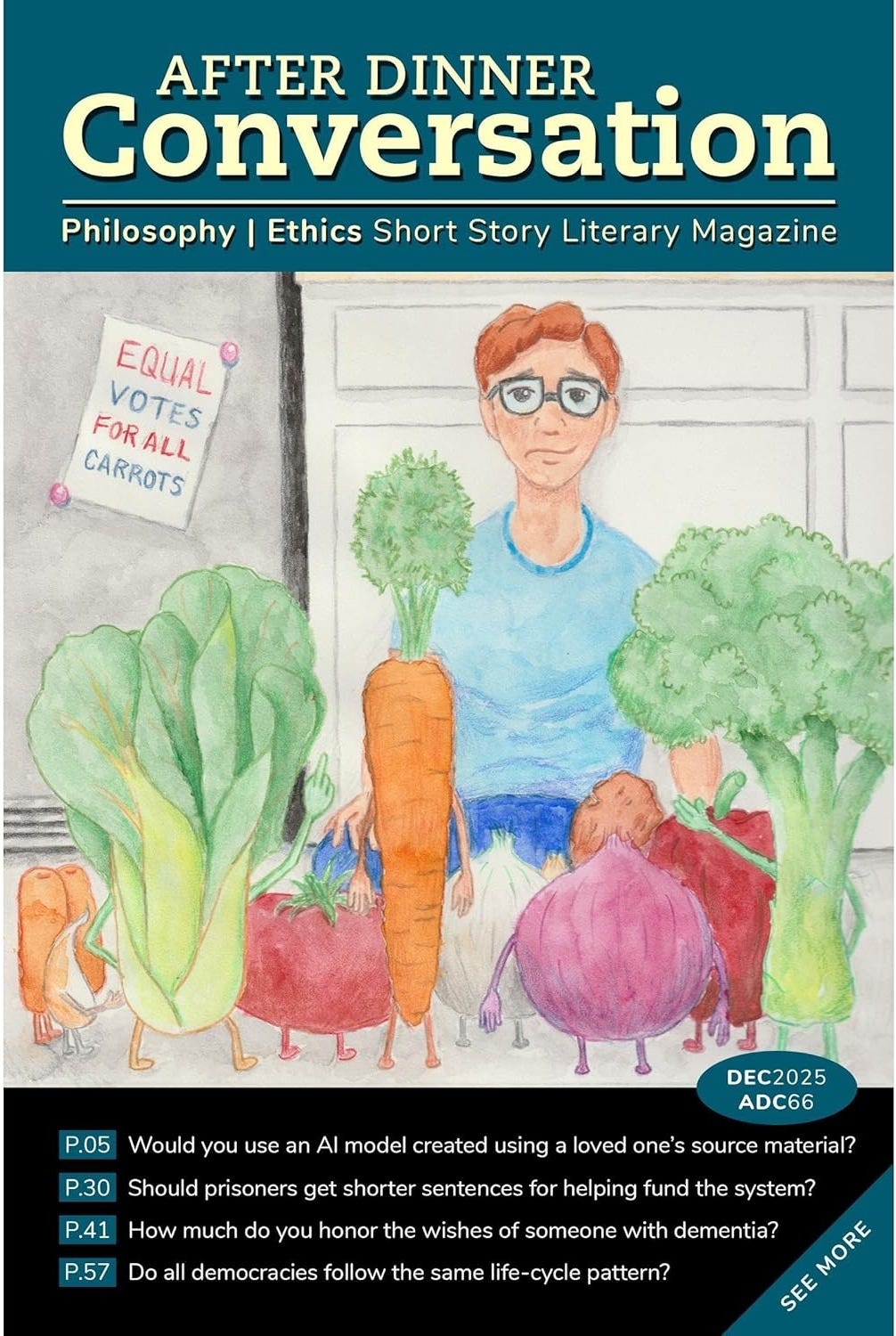
After Dinner Conversation - Philosophy | Ethics Short Story is a reader-supported publication. To receive new posts and support my work, consider becoming a free or paid subscriber.
Q&A
Which philosophy or philosopher most aligns with your own beliefs?
The Lutheran theologian Dietrich Bonhoeffer probably aligns most closely with my beliefs. In his writings (at least the parts I choose to focus on), he takes God’s rules of behavior as a given, so there is not a lot of technical discussion of whether or not A, B, or C is right or wrong. That frees him up to talk more about what we should be doing in the world to make it a better place. And all his writings on that topic focus on being more empathetic and compassionate toward our fellow humans. It’s a full-time job, and I find his writings a helpful reminder of our responsibility to others.
If you do a search on his quotes, there are many that resonate today. One that I particularly like is: “We must learn to regard people less in the light of what they do or omit to do, and more in the light of what they suffer.”
Bonhoeffer’s life is fascinating, too. He was involved in a plot to kill Hitler, for which he was arrested and imprisoned in a concentration camp. He was executed pretty much out of spite in April 1945, just a few days before Germany surrendered.
If you want to see a real-life example of the challenges associated with trying to adapt a single philosophy to all situations, you don’t need to look much further than Dietrich Bonhoeffer.
Is there any standard publishing or writing advice that you disagree with? Or any standard advice that you feel is too often neglected?
I think the adage “write what you know” is not very helpful. It might be useful to get a new writer started on something, but if you stick to that rule for very long, you’ll have a pretty limited range of what you can write about.
I don’t know anything about plumbing, for example. But if I come up with a good story idea that centers around a plumber, I can research that profession and relatively quickly find out enough to draw my character. It’s easier in a short story where space is at a premium and maybe not as much background information is needed. It’s a little different with a novel, where you might show them at their job multiple times with a greater level of detail. Not an insurmountable problem, it just requires more research.
Is your process for writing philosophical fiction different from the way you approach other works?
On a very basic level, my process for writing philosophical fiction is similar to other fiction in that there will always be some underlying conflict or tension that is being explored over the course of the story. I think where there is a difference is a question of emphasis. A “philosophical” story will likely spend more time dwelling on the choices and the thought process that the characters go through when wrestling with whatever philosophical dilemma is at the heart of matter. If a philosophical choice is paired with thoughtful characters, then the emotions around the choice might be higher too.
How do you come up with ideas for your short stories?
I keep a list of possible story ideas and keep adding to it whenever a new possibility pops into my head. The list might contain a character, an unusual setting, or a key event that triggers an interesting response.
When I start a story, I try to imagine a few of the scenes before I start writing. I like to have some idea of the shape of the story before I get going. Usually, things change quite a bit once I start writing and go through several drafts. But I need to feel somewhat confident that there is enough in the original idea to sustain a good story arc before I commit to writing a draft. Maybe this is just an elaborate way for me to justify my procrastination.

Steve Grover is a recovering economist living in Maupin, OR, where he writes short fiction. When not at his writing desk, he can often be found fly fishing or playing the fiddle (rarely at the same time).
Steve has an MFA in Fiction from Pacific University and a PhD in economics from the University of Wisconsin-Madison. He also attended the 2025 Bread Loaf Writers’ Conference.
Instagram: @fishinmusician67
Share After Dinner Conversation - Philosophy | Ethics Short Story
ADVERTISE WITH US
Interested in advertising in this email? Learn more.
Comments
Nothing yet. Say the first thing.
Sign in to join the conversation.