
I spent fifteen years producing content across Los Angeles, New York, and eventually the recruiting corridors of Florida. In that time, I watched a Hollywood production collapse because the director spent the entire budget on the look before anyone had finished the script. I watched a New York theater institution implode because they cared more about the review than the structural integrity of the play. And when I crossed into the world of college athletics, I realized the same glitch was running on a different system.
The athlete walks into the most consequential negotiation of their young life with a highlight reel, a handshake, and the sincere belief that the coach is rooting for them.
The coach has a spreadsheet.
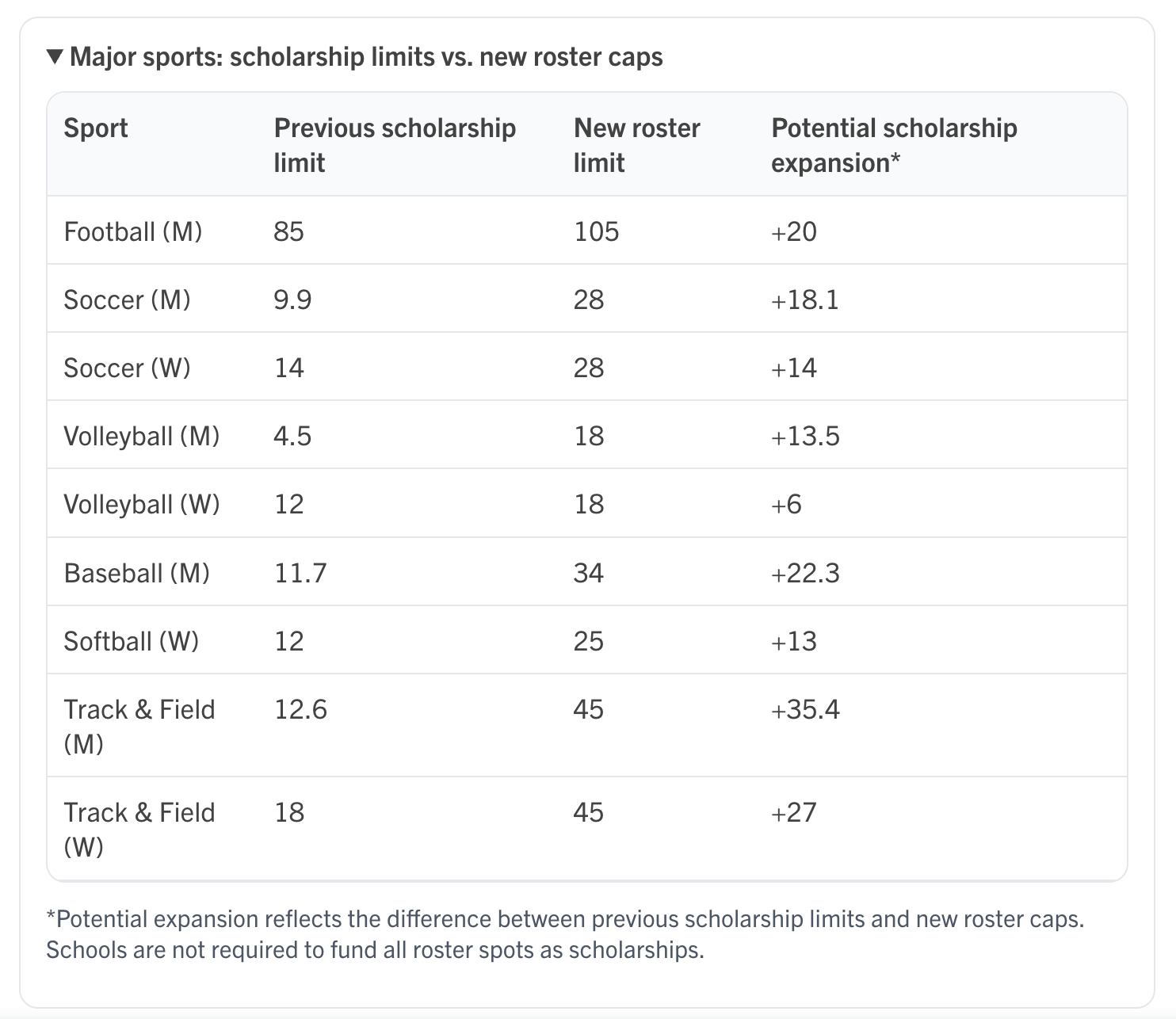
The NIL economy is worth $2.6 billion in 2026, with roughly $1.8 billion flowing directly to athletes through school payments, collectives, and brand deals. Under the House v. NCAA settlement, schools can now distribute up to $20.5 million per year directly to their rosters. Arch Manning’s 2025 NIL earnings reportedly exceeded $6 million, which was more than the base salary of a starting NFL quarterback. That detail says everything about where the money has gone.
Meanwhile, fewer than 2% of high school athletes receive any NCAA athletic scholarship at all. Most families respond to those odds by spending more on exposure. More camps. More recruiting services. More highlight film. The professional equivalent of repainting your house before the foundation inspection.
A full-ride scholarship at a private Division I program is a financial event worth north of $200,000 over four years. Treating it like a lottery ticket is not optimism. It’s a management failure dressed up as faith in your kid.
Here is the part that should genuinely concern you.
New NIL privacy laws in states including Arkansas and Connecticut allow schools to withhold NIL contract details from public disclosure. That means the school sitting across the table from you knows the market rate for your position, your sport, your conference, and your profile. You don’t. That’s not a negotiation. That’s an interview where one party has done their homework and the other brought their varsity jacket.
The athletes who close that gap aren’t the ones with the most followers. They’re the ones who arrive with documented proof of their own value, a record the school can verify independently, before anyone starts talking numbers.
More than 10,500 college football players entered the transfer portal across all divisions in the most recent cycle. In men’s basketball, over 2,300 players entered in 2025, representing more than 40% of all Division I players. The portal is frequently described as empowering. What it actually is, for most athletes, is a high-speed auction with too many sellers.
Roughly 30 to 40% of Division I men’s basketball players who enter the portal don’t land at the same level. They go down, or they leave the sport. That figure doesn’t make the recruiting service brochures.
If your only value is the jersey you’re currently wearing, you have no leverage in that market. You’re a hired gun competing against 10,000 other hired guns, and the coaches scrolling the portal at midnight are not looking for the most visible option. They’re looking for the one they can verify. Character, leadership, competitive record, cultural fit. The stuff that doesn’t live on a highlight reel.
I’ve been in enough rooms on both sides of this to tell you plainly: the question every coach is trying to answer isn’t “can this kid play?” They’ve watched the film. The question is “will this person be worth this investment in year three, when they’re not starting, when the team is struggling, and when the portal is open?”
Most prospects have no documented answer for that question. They have clips. Clips are not an answer.
Antoine Bethea played 14 years in the NFL and won Super Bowl 50. His longevity wasn’t accidental. It was the product of a professional identity that programs could count on, year after year, regardless of what the stat sheet said in a given week. That kind of record gets built before anyone asks for it. It doesn’t get manufactured in the spring before signing day.
NIL collective spending exploded 824% year-over-year in June 2025 as programs rushed to front-load distributions before new compliance rules took effect. The window of chaotic, unregulated money is closing. What replaces it is a more structured market where the athletes who arrive with documented proof of value will consistently outperform the ones who arrived with documented proof of reach.
The school will always have more information than you going into that conversation. The only way to close the gap is to own your own record before the conversation starts.
Build it before you need it. Own it before someone else does.
Afterburn works with athletes and families who want to arrive at the recruiting table with documented proof of value, not just highlights. Let’s talk about what that looks like for your athlete.
No posts
Comments
Nothing yet. Say the first thing.
Sign in to join the conversation.