
I spent fifteen years bouncing between the fluorescent-lit casting rooms of Los Angeles and Manhattan before trading them in for the sun-baked turf fields of Florida. Different coasts, different industries, completely different vocabulary.
Same delusion.
Hollywood producers and college scouts are, at their core, suffering from the exact same occupational hazard. At some point, both of them looked a human being in the face and saw a row in a spreadsheet. In LA, the obsession was “can they hit their mark?” In Florida, it’s a verified vertical and a 40-yard dash time. Drafting a teenager based purely on a sprint metric is a bit like casting a lead actor because they can read a phone book really fast. Sure, it’s impressive. But unless the script is specifically about a guy desperately trying to locate a plumber at 11pm in 1998, nobody’s buying a ticket.
This is how the college recruiting trap works. It reduces a person to a filter result and then acts surprised when the filter result doesn’t know how to handle adversity.
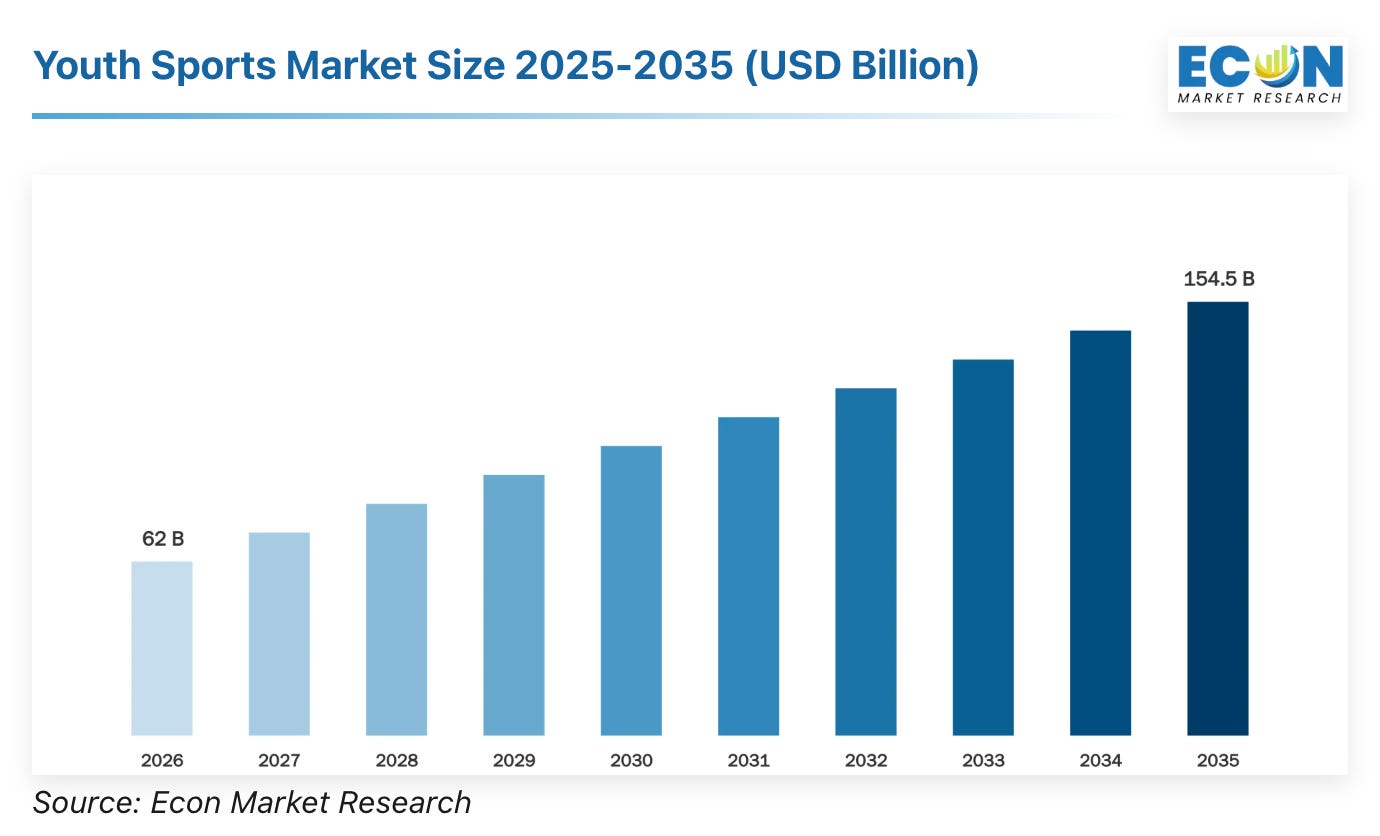
The global youth sports market hit $62 billion in 2026. That figure should stop you cold. This is no longer a developmental pipeline. It’s an industrial complex designed to process children at scale and call it opportunity.
American families spent an average of $1,500 per child on youth sports in 2024, a 46% increase since 2019 according to the Aspen Institute, twice the rate of overall inflation in the same period. Some families reported spending up to $25,000. The machine is extracting more every year and delivering the same outcome for most people.
What outcome is that? Fewer than 2% of high school athletes receive any NCAA athletic scholarship at all. Two percent. That’s not a funnel. That’s a drain with better marketing.
Here’s the cruel irony at the center of the college recruiting trap. The moment every family in the country starts spending thousands on private coaches to get a verified wingspan and a 4K highlight reel, the data stops being a differentiator. It becomes baseline noise. The machine demands these metrics because data is easy to categorize, easy to rank, and, nobody says this part out loud, incredibly easy to monetize.
Programs keep paying premium prices for a highlight reel and then acting shocked when the athlete transfers by November. Turns out people are harder to predict than sprint times.
Here’s the story that plays out every single recruiting cycle. A program takes a five-star recruit on the strength of a 4.4 and some film of him outrunning smaller, slower kids at a June camp. Six months later, that athlete is in the transfer portal. Not because he wasn’t fast. Because he had zero emotional resilience the first time he got benched, and no stopwatch was ever going to predict that.
He was purchased as a metric. He failed as a human being in a human environment.
Now compare that to the three-star athlete who doesn’t have generational speed but walks into any room and immediately becomes its gravitational center. The one whose worldview aligns so precisely with the head coach’s vision that staff members are referencing him in meetings before he’s enrolled. That player isn’t a commodity. He’s a cornerstone.
A highlight reel tells a coach what happened. Your athlete’s documented record tells them who is happening.
Up to 35% of elite athletes experience burnout, depression, or anxiety, largely because their entire sense of self-worth has been attached to a performance number. When the number drops, which it always does eventually, there’s nothing underneath it.
The spreadsheet can’t measure locker room gravity. It can’t calculate whether a player will still be coachable at 2-7 in November. It doesn’t account for whether a kid’s worldview is going to strengthen the culture a program is trying to build, or quietly corrode it.
Coaches know this. The good ones will tell you, off the record, that the athletes they regret recruiting almost always looked great on paper. And the ones they wish they’d taken a longer look at were the ones whose tape was fine but whose character was unmistakable.
That’s the gap the recruiting machine is structurally unable to close, and the one that a well-documented athlete identity directly fills.

The athletes who sidestep this trap aren’t doing it by getting faster or by hiring better highlight editors. They’re doing it by showing up with something most prospects don’t have: a defined point of view.
An athlete who has done this work doesn’t just send a highlight tape. They send context. They have a clear answer for “why this program” that goes three layers deeper than geography and uniform color. They’ve positioned their story so that evaluators are engaging with a fully documented human asset, not another filter result. They walk into a campus visit and the staff already knows who they are, not just how much velocity is on their fastball.
Identity must precede influence. When an athlete arrives with a documented record of who they are and how they compete, they stop being a passive participant in the recruiting machine. They start dictating the terms of their own exposure. They force evaluators to look up from the spreadsheet.
That’s the difference between being sorted and being chosen.
The system will always demand metrics. It will extract them, rank them, and eventually discard them when the numbers decline, and they always do. A stopwatch can only tell a coach how fast someone is running. It never tells them what they’re running toward.
Afterburn works with athletes and families who are ready to build something a recruiter can’t sort into a spreadsheet. Start the conversation here.
No posts
Comments
Nothing yet. Say the first thing.
Sign in to join the conversation.