
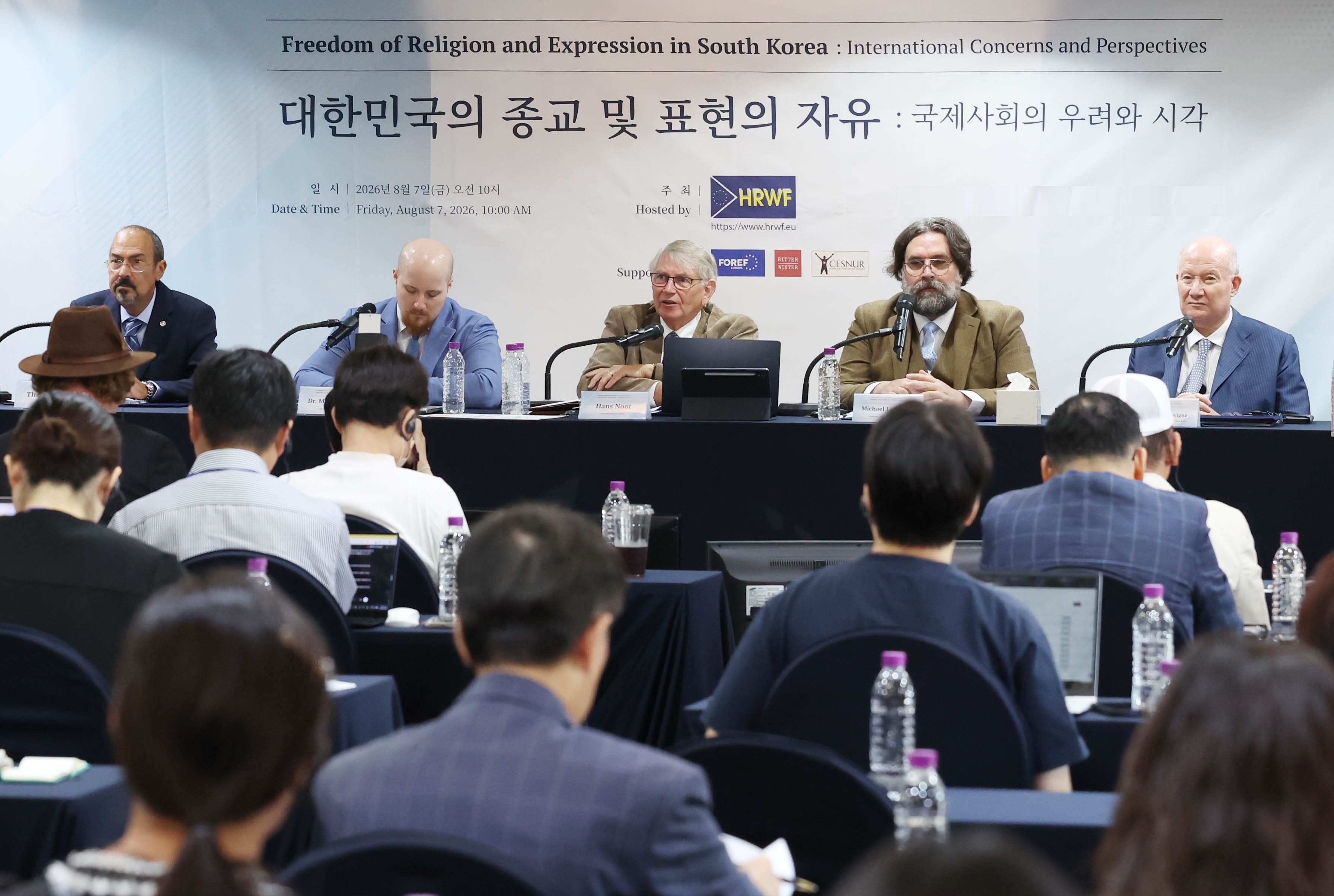
SEOUL, South Korea — International rights and religious-freedom organisations have raised concerns over what they describe as growing pressure on religious minorities and freedom of expression in South Korea, including the pretrial detention of 95-year-old Shincheonji Church chairman Lee Man-hee, writes Winston Mwale.
The concerns were raised Friday during a press conference organised by Human Rights Without Frontiers (HRWF), in partnership with CAP Liberté de Conscience, FOREF, CESNUR and Bitter Winter, at the Seoul Foreign Correspondents’ Club.
The organisations called on South Korean authorities to review Lee’s detention and ensure that legal and administrative measures involving religious minorities are applied in a neutral, proportionate and rights-respecting manner.
Lee was arrested June 24 after a Seoul court issued a detention warrant in connection with allegations that he orchestrated the mass enrolment of Shincheonji members into the conservative People Power Party between 2021 and 2024.
Prosecutors allege that more than 50,000 followers were mobilised to join the party to influence internal party contests and elections. The court cited concerns about possible destruction of evidence in ordering his detention. Lee and Shincheonji have denied wrongdoing. (Reuters)
The church has separately argued that detention is disproportionate given Lee’s age, fixed residence and cooperation with investigators. It has also raised concerns about his health and need for medical support.
At Friday’s conference, HRWF Associate Director Hans Noot said freedom of religion and expression were fundamental to democratic societies and warned against treating religious communities or dissent as problems to be contained.
He said the conference was not intended to defend a particular theology or religious movement but to defend the principle that fundamental rights should apply equally to all.
Thierry Valle, president of CAP Liberté de Conscience, questioned whether keeping a 95-year-old man in pretrial detention was compatible with South Korea’s international human-rights obligations.
He referred to South Korea’s ratification of the International Covenant on Civil and Political Rights in 1990 and the Convention against Torture in 1995, arguing that the presumption of innocence and human dignity should remain central to the proceedings.
Valle said democratic countries could use less restrictive measures in cases involving elderly defendants and pointed to examples including Cardinal Joseph Zen’s release on bail in Hong Kong in 2022.
Michael Langhans, executive director of FOREF Germany, presented a separate legal analysis questioning whether Lee’s detention was necessary given the evidence already available to prosecutors.
He also questioned whether the investigation had been conducted neutrally, arguing that the use of labels such as “sect” or “cult” could influence perceptions of the case.
The allegations against Lee remain subject to judicial determination. Independent reporting says the Seoul Central District Court issued the detention warrant after finding a risk of evidence destruction.
A subsequent request to review the legality of his detention was dismissed.
The organisations said Lee’s case should be viewed within a broader debate over freedom of religion or belief in South Korea.
HRWF said concerns have also been raised about the treatment of Segero Church in Busan, which it said has faced continued scrutiny following the release of Pastor Son Hyun-bo.
The conference also addressed conscientious objection, opposition to a mosque project in Daegu and religious accommodation in educational institutions.
HRWF said it has documented the imprisonment of hundreds of Jehovah’s Witnesses in South Korea over conscientious objection.
Although South Korea subsequently introduced alternative civilian service, critics argue that the system remains punitive because the alternative service lasts 36 months in correctional facilities — twice the length of regular military service.
The organisations also raised concerns involving the Family Federation for World Peace and Unification, including the case of 83-year-old Hak-ja Han Moon.
Márk Nemes, deputy director of CESNUR, said pressure on Shincheonji could have consequences beyond South Korea because the church operates internationally.
He cited recent academic investigations involving Shincheonji congregations in Europe, Argentina and Australia, which he said had identified increased hostility toward the movement.
Nemes argued that freedom of religion and expression protected under Articles 18 and 19 of the International Covenant on Civil and Political Rights should also be considered in assessing the impact of developments in South Korea on religious communities abroad.
Massimo Introvigne, managing director of CESNUR and editor-in-chief of Bitter Winter, said South Korea had crossed what he described as a “worrying line” by detaining Lee.
He argued that international standards, including the United Nations Standard Minimum Rules for the Treatment of Prisoners, commonly known as the Mandela Rules, should be considered in determining appropriate treatment for an elderly defendant.
Introvigne also questioned whether the charges against Lee were proportionate, while arguing that the case reflected wider pressure on minority religious groups.
The organisations urged South Korean authorities, the media and the international community to scrutinise the developments with particular attention to due process, proportionality and equal protection of fundamental rights.
At the conclusion of the conference, participating scholars signed a letter calling on the South Korean government to release Lee from custody.
The press conference comes amid a wider investigation by South Korean authorities into alleged political involvement by religious organisations.
Independent reporting has linked the investigation to allegations that religious groups sought to influence political contests through their members.
In Lee’s case, prosecutors allege that Shincheonji followers were mobilised to join the People Power Party, while the church disputes the allegations.
The case therefore sits at the intersection of two competing principles: the state’s authority to investigate alleged unlawful political activity and the obligation to protect freedom of religion, expression and due process.
For the organisations represented at Friday’s press conference, the central question is whether South Korea can enforce its political and criminal laws while ensuring that religious minorities receive equal protection under national and international human-rights standards.
Comments
Nothing yet. Say the first thing.
Sign in to join the conversation.