
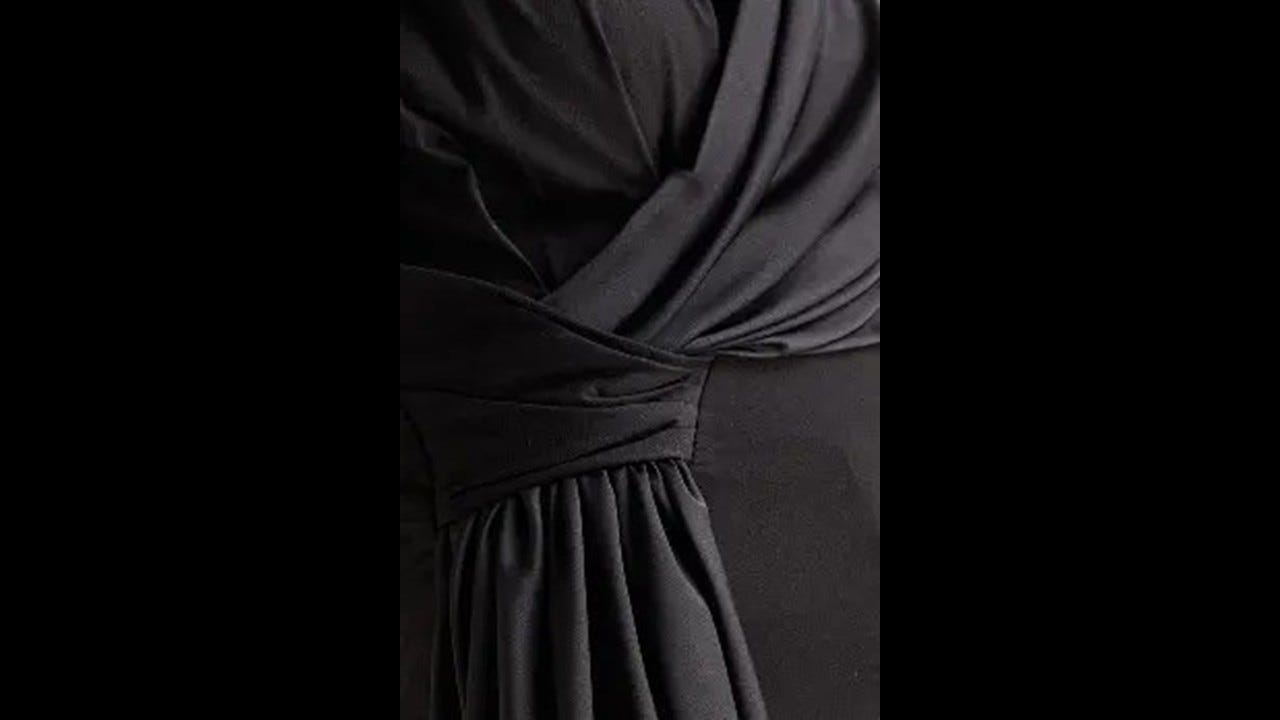
French fashion has never really been about clothes.
It has always been about structure.
Not beauty. Not trend. Structure.
The corset. The silhouette. The waist snapped in half. The heel that changes your spine and, with it, your posture in a room. Even the little black dress which pretends to be effortless while enforcing discipline with terrifying efficiency.
This is not decoration.
It is control.
Every year the Met Gala reminds the world that fashion is spectacle. Capes. Drama. Human chandeliers wobbling up museum stairs. But in France, spectacle is secondary. The real work happens underneath. In seams. In boning. In lines drawn so precisely they decide who gets to breathe and who does not.
I realized this standing in my kitchen in rural France, wearing black for the fourth day in a row, holding a pair of heels that would sink straight into my gravel driveway like artifacts from a monarchy that never met mud.
France did not invent couture to decorate women.
It invented it to control the line.
And once you see the line, you cannot unsee it.
If you want to understand French fashion, start at Versailles.
Not in the Hall of Mirrors.
In the dressing rooms.
In the quiet violence of being assembled.
The palace was a machine. It did not just house royalty. It manufactured hierarchy. Every ribbon, every fold of silk, every inch of lace was calibrated to signal exactly where you stood and how close you were allowed to stand to someone else.
Clothing was not personal expression.
It was political positioning.
At court, a woman did not wake up and choose an outfit.
She was constructed.
Layer by layer. Structure before softness. Form before breath.
The corset was not an accessory.
It was infrastructure.
At Versailles, dressing was not vanity. It was ceremony.
The day began publicly. Even intimacy had witnesses. Women of rank were dressed in stages, according to hierarchy. Who handed you a sleeve mattered. Who tied your ribbons mattered more. A misplaced gesture could signal allegiance or insult.
You did not simply wear silk.
You were calibrated by it.
The bodice held you upright. The panniers widened you into architecture. Skirts did not float; they occupied territory. To move through a doorway required calculation. To sit required choreography. To turn required clearance.
There is a reason portraits from that era look so controlled. The clothing made spontaneity nearly impossible.
Even proximity was regulated. The width of a skirt determined how close another body could approach. Space was measured in fabric. Power was measured in inches.
Nothing about it was accidental.
The palace ran on optics and oxygen.
Breathing too freely was not encouraged. Moving too casually was not admired. Ease was suspicious. Precision was rewarded.
And the women learned.
They learned how to hold still.
How to command attention without appearing to reach for it.
How to conserve breath and deploy it carefully.
Structure first. Expression second.
By the time they entered the Hall of Mirrors, the performance had already begun hours earlier, in smaller rooms with tighter laces.
Imagine being laced so precisely that inhaling becomes a negotiation. Not suffocating. That would be dramatic. Just restricted enough that every breath requires intention.
Posture corrected. Spine aligned. Ribcage disciplined. Shoulders squared. Movement altered.
You don’t slump in a corset.
You don’t forget yourself either.
And if you faint, you faint beautifully.
Which, historically speaking, was still considered success.
I once tried on a reproduction corset in a small boutique outside Bordeaux. For educational purposes.
Within three minutes I understood two things:
Women in the 18th century were stronger than I am.
Power is easier to perform when someone has physically arranged your body into it.
The woman lacing me tightened one more inch and said, “Now you look correct.”
Correct.
Not comfortable. Not beautiful.
Correct.
That word has been doing a remarkable amount of work in France for centuries.
French fashion did not merely shape how women looked. It shaped how they occupied space. How straight they stood, how far they leaned, how much of a table they were permitted to claim before it became indecorous.
The line of a garment became the line of a life.
Control the waist, and the spine follows.
Control the spine, and the room adjusts.
And once the room adjusts, you rarely need to raise your voice.
The corset has been criticized, defended, romanticized, reclaimed. It is easy to see it as oppression. It is also possible to see it as armor. What is harder to deny is that it worked.
It created a silhouette that commanded attention long before the woman inside it was permitted to speak.
When the laces were pulled, I stood straighter immediately. I breathed differently. I understood, briefly and slightly alarmingly, how structure can feel like certainty.
And how certainty can feel like power.
Revolutions loosened the corset. They did not erase the instinct.
The line migrated.
Into shoulders sharpened like strategy.
Into waists drawn high and tight in new ways.
Into hemlines that rose or fell depending on how much freedom could be tolerated that decade.
Into the choreography of entering a room as if the room were already yours.
French fashion has always understood something quietly dangerous: structure changes behavior.
Change the line, and you change the posture.
Change the posture, and you change the room.
I have lived long enough in France to know that rooms matter here.
And once you see the line—in silk, in boning, in gravel—you cannot unsee it.
Next, Part II: the woman who decided breathing was not optional.
No posts
Comments
Nothing yet. Say the first thing.
Sign in to join the conversation.