
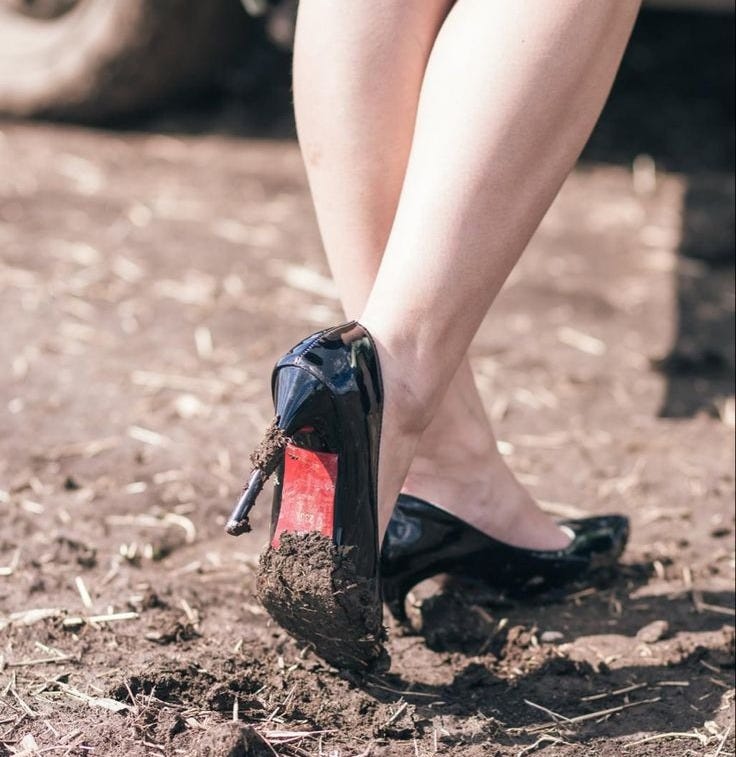
I watched The Devil Wears Prada 2 recently, which confirmed something I’ve suspected for a while.
Miranda Priestly would not survive in rural France.
Not because she lacks authority.
But because here, authority arrives in slippers, owns a chainsaw, and does not care what you’re wearing.
In Paris, Miranda controls the room with silence, posture, and a single raised eyebrow.
In the Dordogne, the woman at the marché controls the room by ignoring you completely until you demonstrate a working knowledge of seasonal produce and basic respect for goat cheese.
I once asked for something out of season.
She looked at me the way one might look at a person who had just suggested we should boil the Mona Lisa.
We moved on.
The first rule of Miranda’s world is appearance.
The first rule here in rural France is… competence.
You can arrive in linen, silk, or what you believe to be a thoughtfully curated outfit.
None of it matters if you:
can’t reverse down a one-lane road with a stone wall on one side and a tractor on the other
hesitate at a roundabout
or fail to acknowledge the existence of a neighbor who has been watching you park for the last six minutes
Let’s talk about transportation.
In Miranda’s world, a sleek black car glides up to the curb and someone else opens the door.
Here? You are the door. You are the driver. At times, you are also the obstacle.
French country roads are less “roads” and more suggestions that something once passed through here successfully.
They curve without warning. Narrow without apology. And occasionally introduce you to a vehicle that has no intention of yielding.
There is a moment, always, where you must decide who you are.
I have, on more than one occasion, chosen incorrectly.
Miranda has assistants.
I have Jean-Michel.
Jean-Michel is not my assistant.
Jean-Michel appears when something breaks, stands over it thoughtfully, and then disappears for two days before returning with a part, a cigarette, and an opinion you did not ask for but are now required to consider.
If Miranda ran Runway magazine like Jean-Michel runs repairs, the September issue would arrive in November, slightly crooked, but somehow still impressive.
Then there is the matter of lunch.
In Miranda’s world, meals are efficient, controlled, and often skipped entirely.
Here, lunch is a structured event with emotional weight.
You do not “grab something.”
You sit. You wait. You participate.
Courses arrive in a sequence that feels less like dining and more like a philosophical exercise in patience. There is wine. There is bread. There is a moment where you realize you are no longer in control of the timeline.
And no one seems concerned.
Miranda does not cook.
Miranda delegates cooking to someone who understands heat, timing, and risk.
I, unfortunately, do not have that option.
I once attempted to grill duck breast.
This felt like a reasonable extension of my skills.
It was not.
There is a very specific moment when duck fat meets flame and becomes something closer to a public safety concern. The fire rose quickly, decisively, and with a level of confidence I did not share.
A neighbor appeared.
Not summoned. Just… present.
He watched for a moment, nodded once, and adjusted something with a calm authority that suggested this was not his first duck-related emergency.
We did not speak about it again. Miranda would have fired me before the flames reached the second course.
And then there’s the outfit.
Miranda would never be seen in the same thing twice.
Here, I have seen the same man wear the same orange pants for what I can only assume is a multi-year commitment.
No one comments.
Because it is not about the pants.
It is about whether he:
shows up
does what needs to be done
and leaves without unnecessary discussion
This is the part Miranda would struggle with.
Not the clothes. Not the cars.
The pace.
Because at some point, it becomes clear that nothing here is trying to impress you.
It is not trying to optimize your time, streamline your experience, or anticipate your needs.
It is simply… happening.
At its own speed.
With or without your understanding.
And eventually, something shifts.
You stop trying to manage it.
You stop trying to “do it right.”
You stop trying to win.
You just start… moving through it.
Which, now that I think about it,
is exactly what Miranda Priestly would never do.
No posts
Comments
Nothing yet. Say the first thing.
Sign in to join the conversation.