
Studio Notes offer glimpses into my studio practice and creative process. In this entry, I discuss the inspiration behind my most recent oil painting: a pearlescent rendition of The Ecstasy of St. Teresa after Gian Lorenzo Bernini’s sublime 1652 masterpiece.
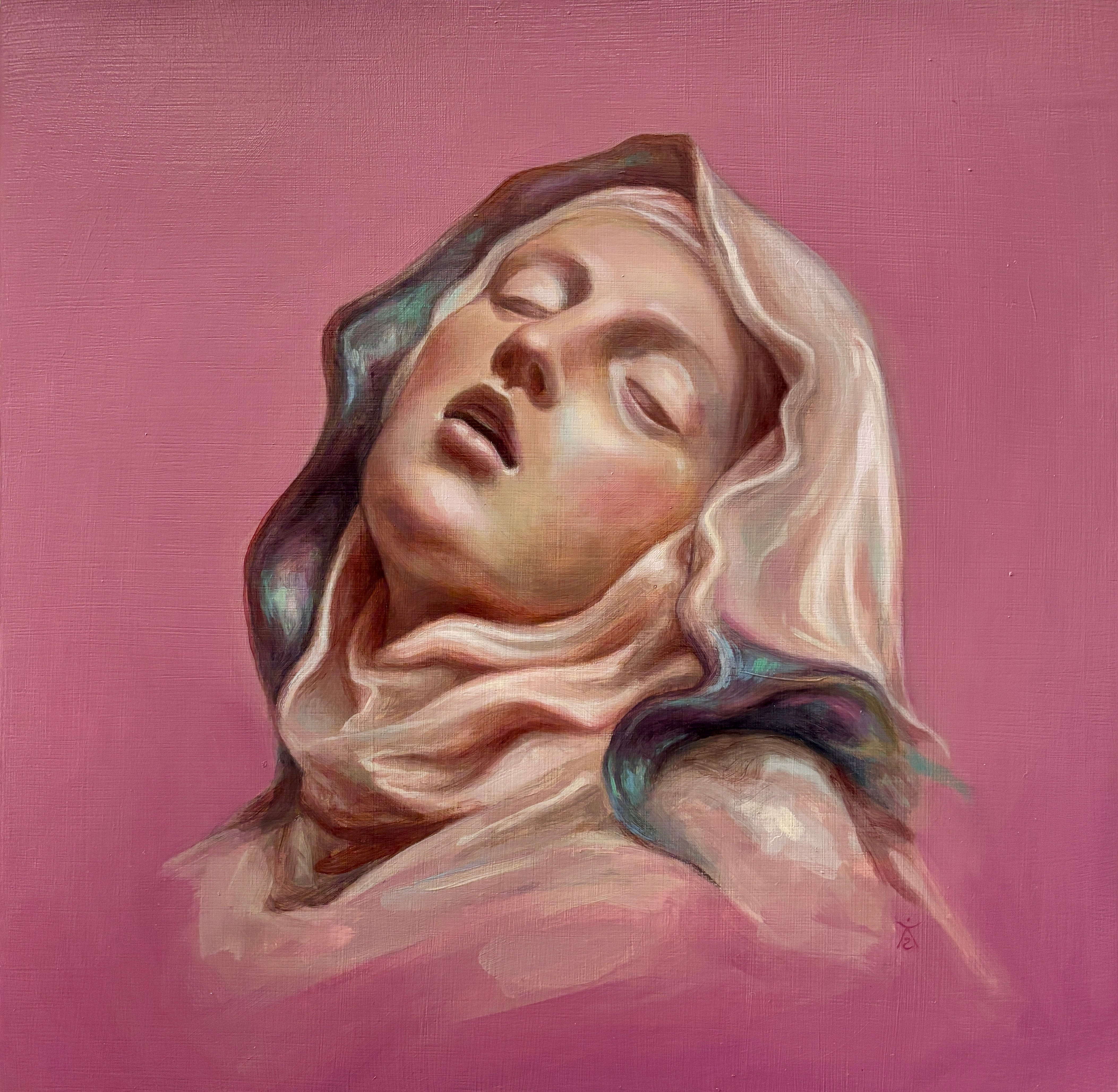
The 16th-century mystic, Teresa of Ávila, is perhaps best known for her rapturous ecstasies. A Spanish Carmelite nun, she preached the virtues of contemplative life and salvation through divine love. She was sharp-witted and unusually determined for a woman of her time, and she spearheaded a reform of the Carmelite Order, restoring it to its original austerity and devotional rigour. She was, like mystics tend to be, a yearner.
I cannot say that I espouse Christian notions of sin, purity, and chastity, nor do I feel called to a more ascetic path, but I’m also a yearner, and this is some of what draws me to St. Teresa. I often crave a more contemplative life, and am inspired by the tenacity of her desire and the unwavering one-pointedness of her aim: the union of the soul with the Beloved. Her well-documented mystical ecstasies were all-consuming and erotically charged. In her autobiography, The Book of Her Life (1565), she writes:
“I saw an angel close by me, on my left side, in bodily form. […] He was not large, but small of stature, and most beautiful—his face burning, as if he were one of the highest angels, who seem to be all of fire: they must be those whom we call cherubim.
[…] I saw in his hand a long spear of gold, and at the iron’s point there seemed to be a little fire. He appeared to me to be thrusting it at times into my heart and to pierce my very entrails; when he drew it out, he seemed to draw them out also, and to leave me all on fire with a great love of God. The pain was so great, that it made me moan; and yet so surpassing was the sweetness of this excessive pain, that I could not wish to be rid of it. The soul is satisfied now with nothing less than God. The pain is not bodily, but spiritual; though the body has its share in it, even a large one.”1
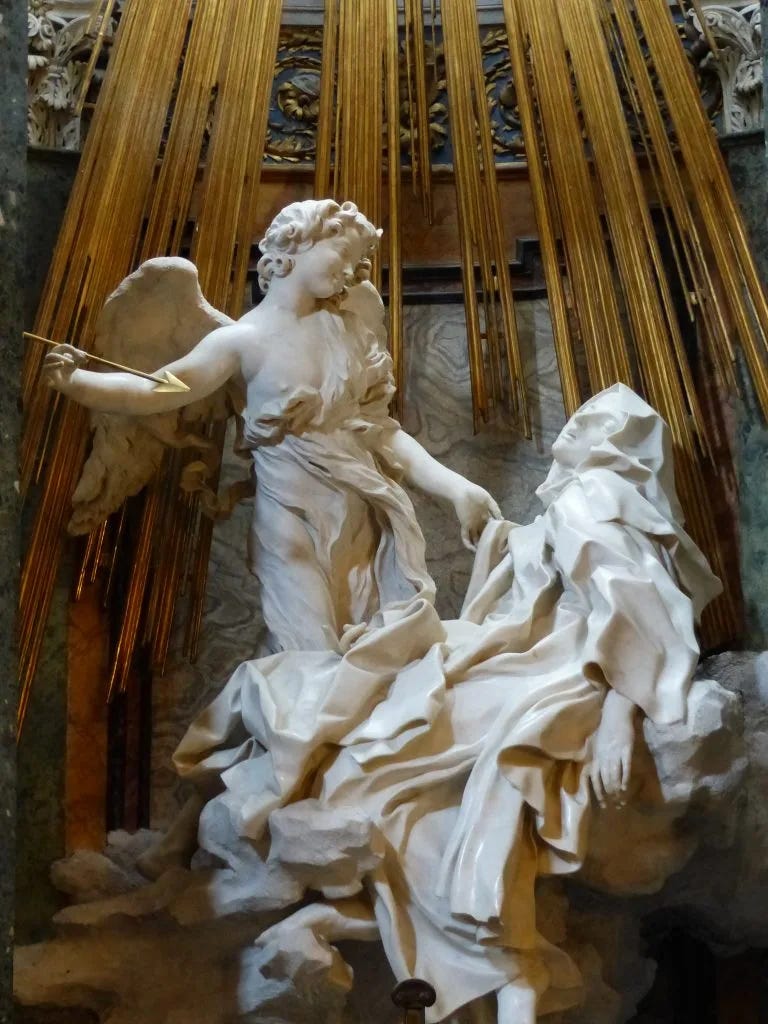
This encounter, known as the Transverberation, began a series of rapturous divine union experiences and occurred later in life, when she was already in her mid-forties. It was immortalized by the Italian sculptor Gian Lorenzo Bernini, who exquisitely captured Teresa as she dissolved into waves of convulsive pleasure, adrift somewhere between bliss and agony. Surely, there is nothing sweeter than a God-given Orgasm.
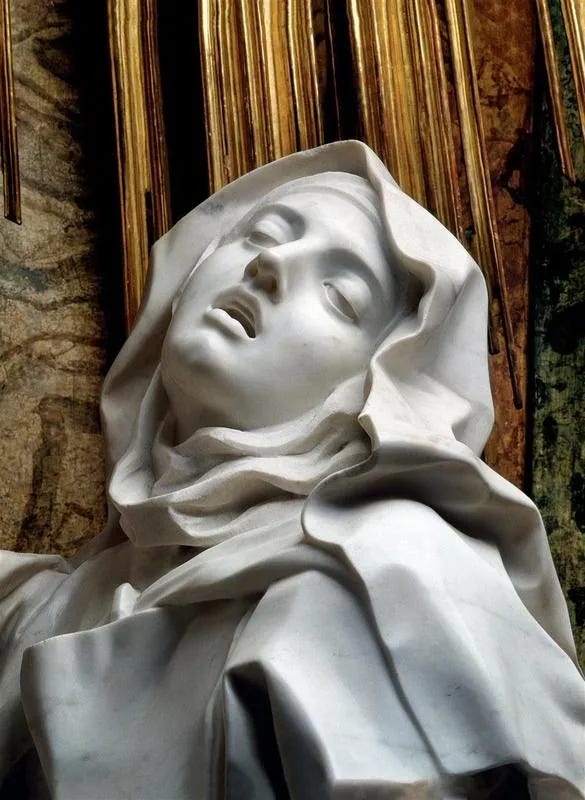
Teresa wasn’t the only Christian mystic to romanticize sacred union with the divine. At the heart of Christian mystical tradition is a burning eroticism—a passionate longing for the soul’s utter dissolution into the sublime embrace of the Beloved. Nuns and sisters are known as Brides of Christ; consacrated virgins who feel called to redirect their inherent erotic longing and surrender to higher grace.
All who make love with Spirit will conceive and become pregnant with an otherworldly joy. They will nurture a pure, innocent, and unsullied spirit that radiates divine love into the world, and they will give birth to acts of compassion and beauty. — Meister Eckhart
This conceptualization of God or Christ as lover or bride is not unique to Christianity but permeates mystical traditions across cultures and faiths. This longing for sacred, ecstatic union with Spirit—or a spirit—is a lot older than Christianity. The concept of hieros gamos, ancient Greek for “sacred marriage”, can be traced to the beginning of recorded history, appearing in ancient mystery cults, pagan religious rites, and shamanic practices, where ecstasy, possession, and communion with non-human intelligences were central features of spiritual life. This is a topic I hope to explore in greater depth in a forthcoming instalment of A Magical Theory of Art, for relationships with deities and spirits have long been understood as essentially co-creative, a technology capable of bestowing visions and revelations that inspire works of art, and even change the course of human evolution.
If my art and writing resonate with you, you can support my practice by purchasing a print or becoming a paid subscriber. Thank you for helping me bring more of this work into the world.
In Teresa's case, the fruits of her sacred union live on beyond the Carmelite Order’s monastic reforms and find lasting expression in her influence on Christian mysticism through writings celebrated as masterpieces of both Christian theology and Spanish literature. Among these, The Interior Castle (1577) remains the most widely studied. Divinely inspired by a vision of the soul as a crystalline, iridescent castle within, she guides the spiritual seeker through its seven chambers, each representing a stage of spiritual development, until the soul's final union with the Divine in the innermost chamber of the heart.
“It is foolish to think that we will enter heaven without entering into ourselves.” — St. Teresa of Avila
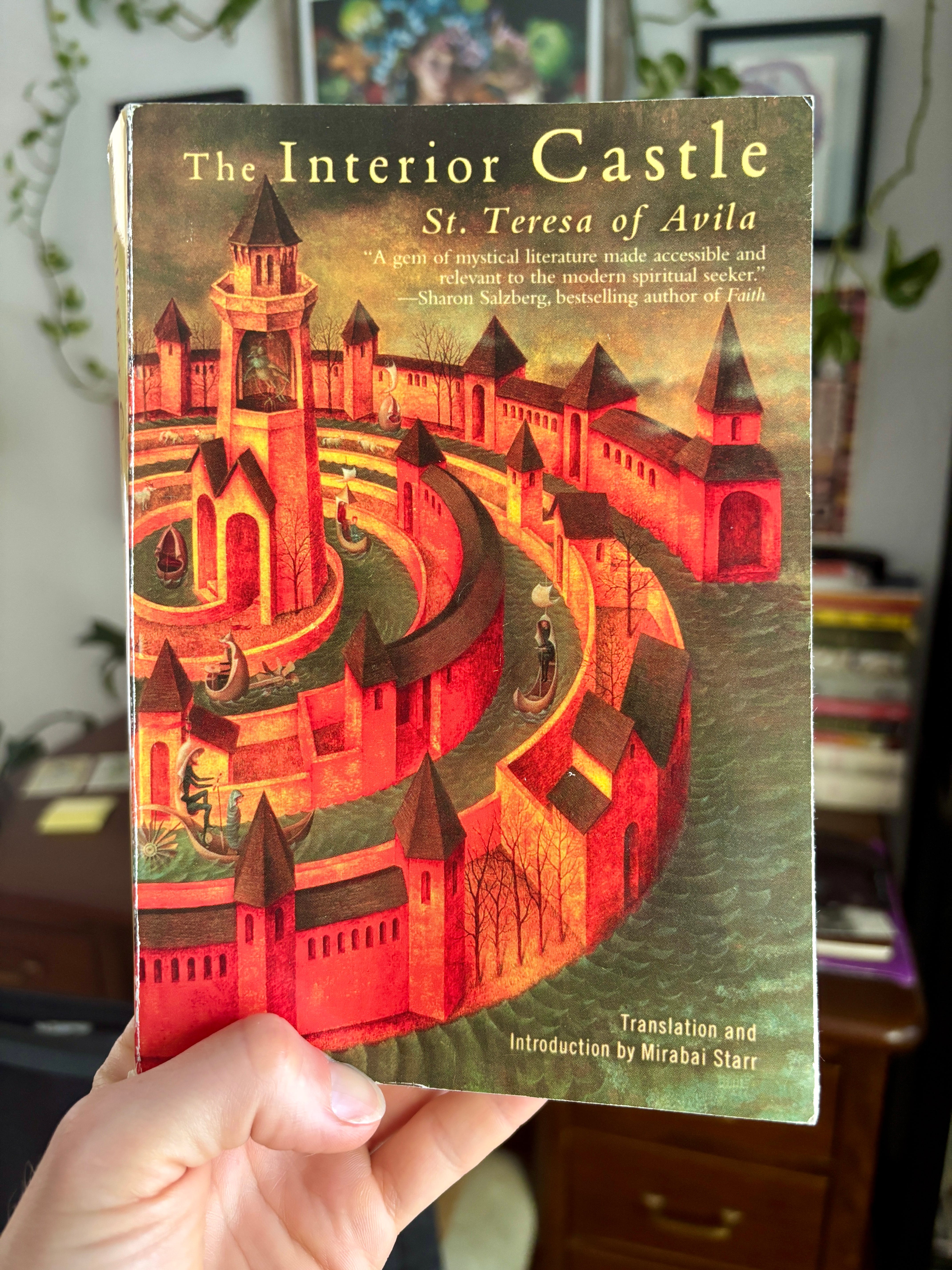
In the introduction to a modern translation of The Interior Castle, Mirabai Starr notes how Teresa’s “life was characterized by the struggle to balance the radical nature of her personal truth with the political discretion required to prevent her from being condemned as a heretic”2. Despite being an overarching theme within the Christian canon, ecstatic rapture associated with spirit marriage was regarded as dangerously suspicious throughout Europe.
During the Spanish Inquisition, when accusations of heresy could be rather fatal, claims of mystical union were often scrutinized as potential evidence of diabolical influence. Throughout Medieval and early modern Europe, the crime of congressus cum daemonibus—intercourse with spirits—was considered way worse than mere heresy, and was seen as a serious moral crime of unredeemable bestiality.
What separates sacred, God-given ecstasy from profane, bestial possession is not always the phenomenological ground of the experience, but the interpretive frame imposed on it. Comparable ecstatic and visionary states could easily slip into accusations of witchcraft and be read as demonic.
Around the time Teresa was getting it on with the cherub, one of Europe’s largest witch hunts was raging in the Basque Country and the Pyreneés, the border region overlapping Spain and France. Here, a different type of ecstasy was on trial: the akelarre, the Basque word for the infamous Witches’ Sabbat, where all sorts of bestiality allegedly happened between so-called witches and the black he-Goat or Akerbeltz. Witch hunts are a complex topic, one that has often more to do with deep-seated fears of otherness than with actual witchcraft.3
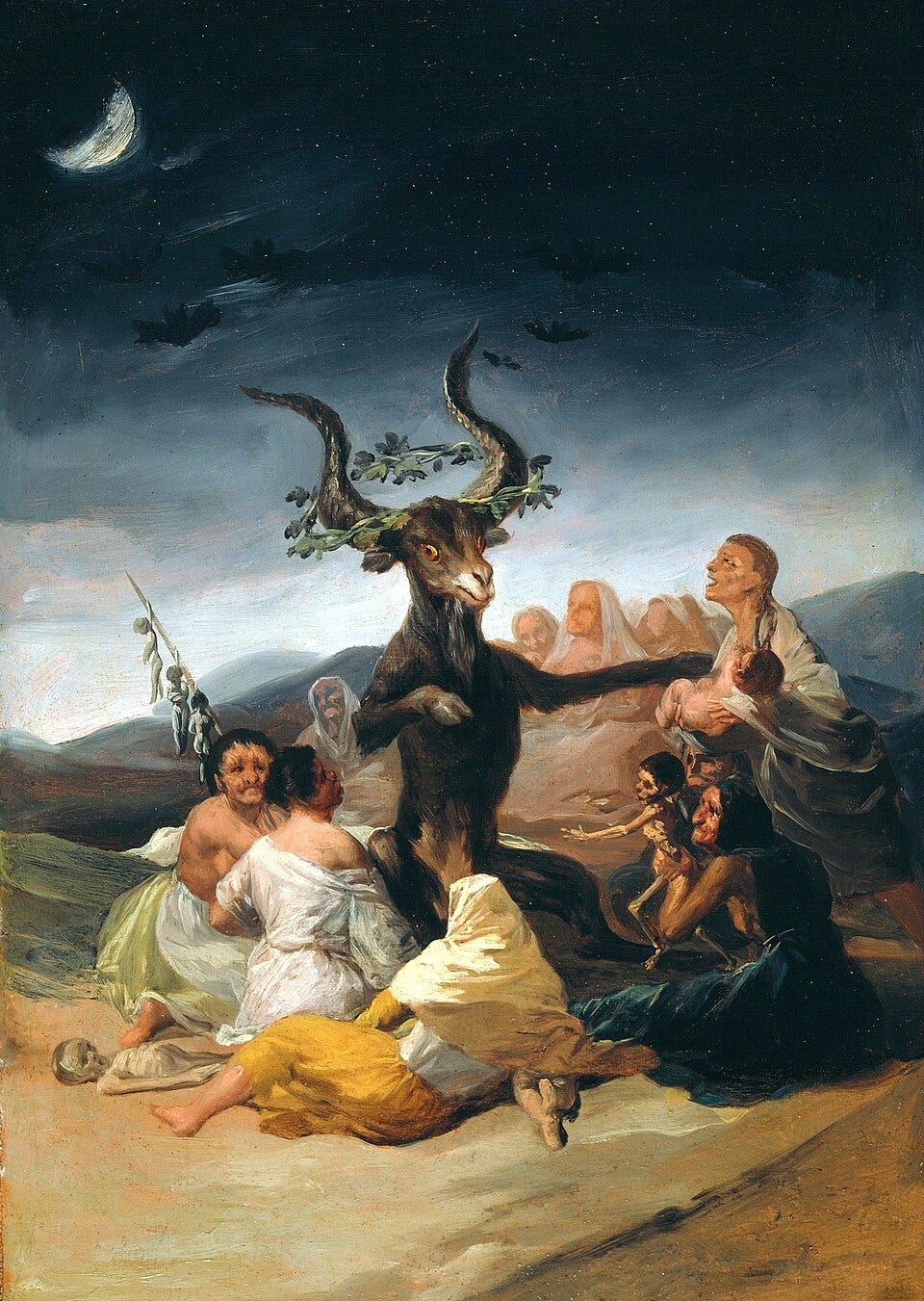
Carl Jung’s concept of amplificatory interpretation comes in handy when trying to parse the meaning individuals and societies project onto ecstatic or otherwise unexplainable experiences. According to Jung, the unconscious amplifies the symbolic associations connected to an image and weaves everything into a meaningful framework for understanding these extraordinary experiences. Faced with the ineffable, the psyche instinctively reaches for familiar narratives and images to make sense of what it cannot otherwise explain. These narratives are often sourced from popular culture, which in Teresa’s time, and during the era of the witch hunts, was suffused with Catholic iconography of angels and demons, as well as rich folklore filled with beasts, witches, and maleficium.
In American Cosmic (2019)4, religious scholar Diana W. Pasulka draws on Jung’s concept to shed new light on Teresa’s ecstasies and to illustrate the relationship between cultural representation and framing. She writes that, at first, Teresa does not recognize the entity but eventually identifies it as a cherub based on the Catholic angelology she is already familiar with:
“Our Lord was pleased that I should have at times a vision of this kind: I saw an angel close by me, on my left side, in bodily form. This I am not accustomed to see, unless very rarely. Though I have visions of angels frequently, yet I see them only by an intellectual vision, such as I have spoken of before. It was our Lord’s will that in this vision I should see the angel in this wise. He was not large, but small of stature, and most beautiful—his face burning, as if he were one of the highest angels, who seem to be all of fire: they must be those whom we call cherubim.5”
However, Pasulka highlights that Bernini’s representation of the event does not tell the whole story, yet it continues to shape how we frame Teresa’s ecstasy. The entity is neither depicted as fiery nor illuminated, nor is it small. Instead, Bernini’s image reinforces familiar cultural conceptions of angels, framing Teresa’s experience as distinctly Christian and God-given.
Pasulka, whose initial area of study focused on the Catholic and Orthodox doctrine of purgatory, came across an overwhelming number of unexplained accounts while conducting her research: reports of orbs of light, unidentified flying objects, and apparitions preserved in the Vatican archives. These findings eventually led her to turn her lens as a religious scholar toward modern conceptions of the UFO phenomenon, resulting in pioneering work in this field of study6. Pasulka notes how Teresa’s Transverberation and encounter with the small being looks an awful lot like some contemporary accounts of alien encounters, which are framed as such because of the media ecosystem and technological narratives of our times.
Teresa died in 1584, and nine months after her death, her body was exhumed and reportedly found intact. Parts of her body were divided into relics and dispersed throughout Spain, Portugal, France, and Italy. Still, she is buried at the Convent of the Annunciation in Alba de Tormes, Spain. She was officially canonized as a saint in 1622 and was the first woman to receive the title of Doctor of the Church in 19707. The Feast of the Transverberation of St. Teresa of Avila is celebrated on August 26.
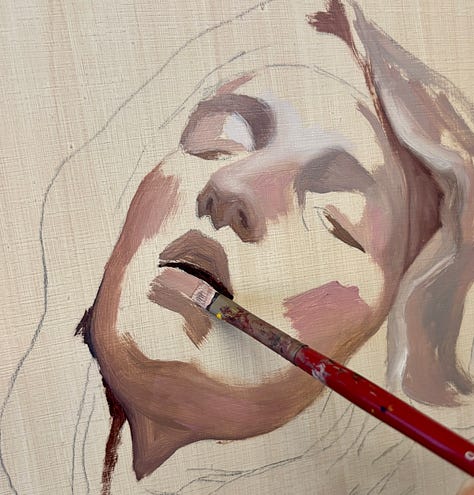
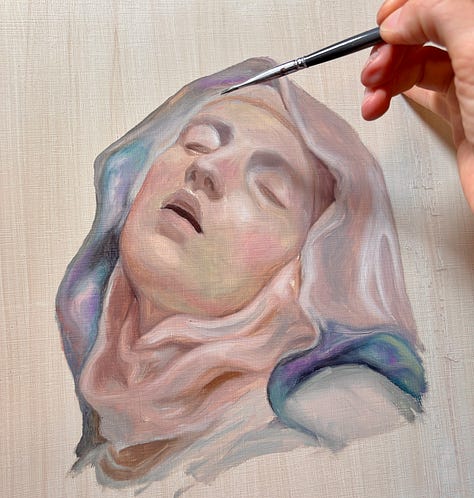
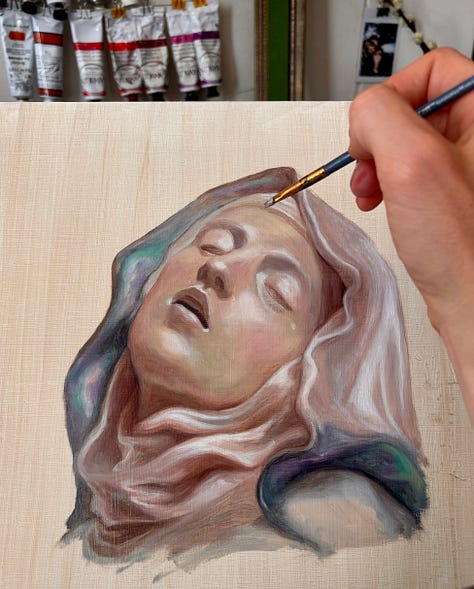
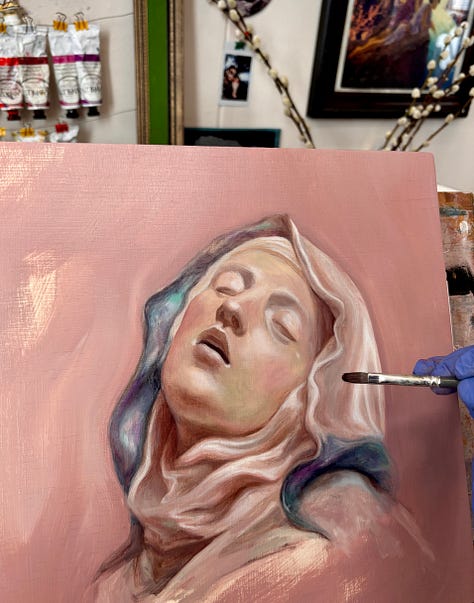
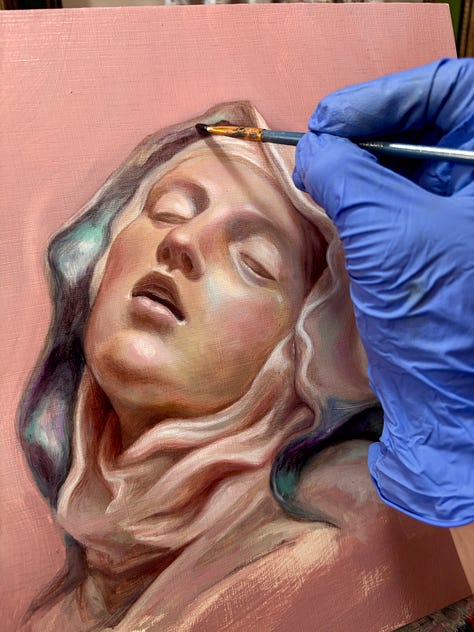
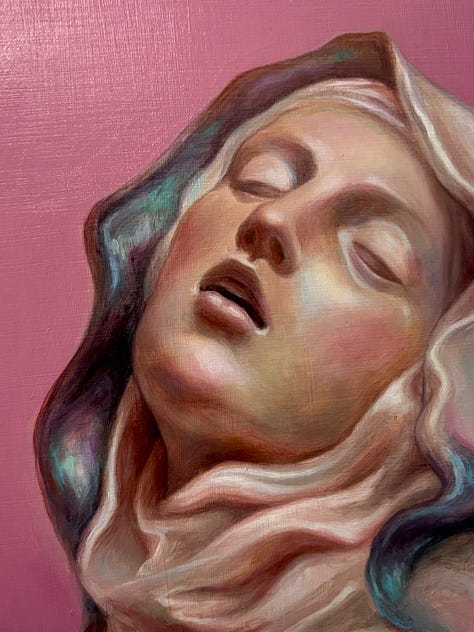
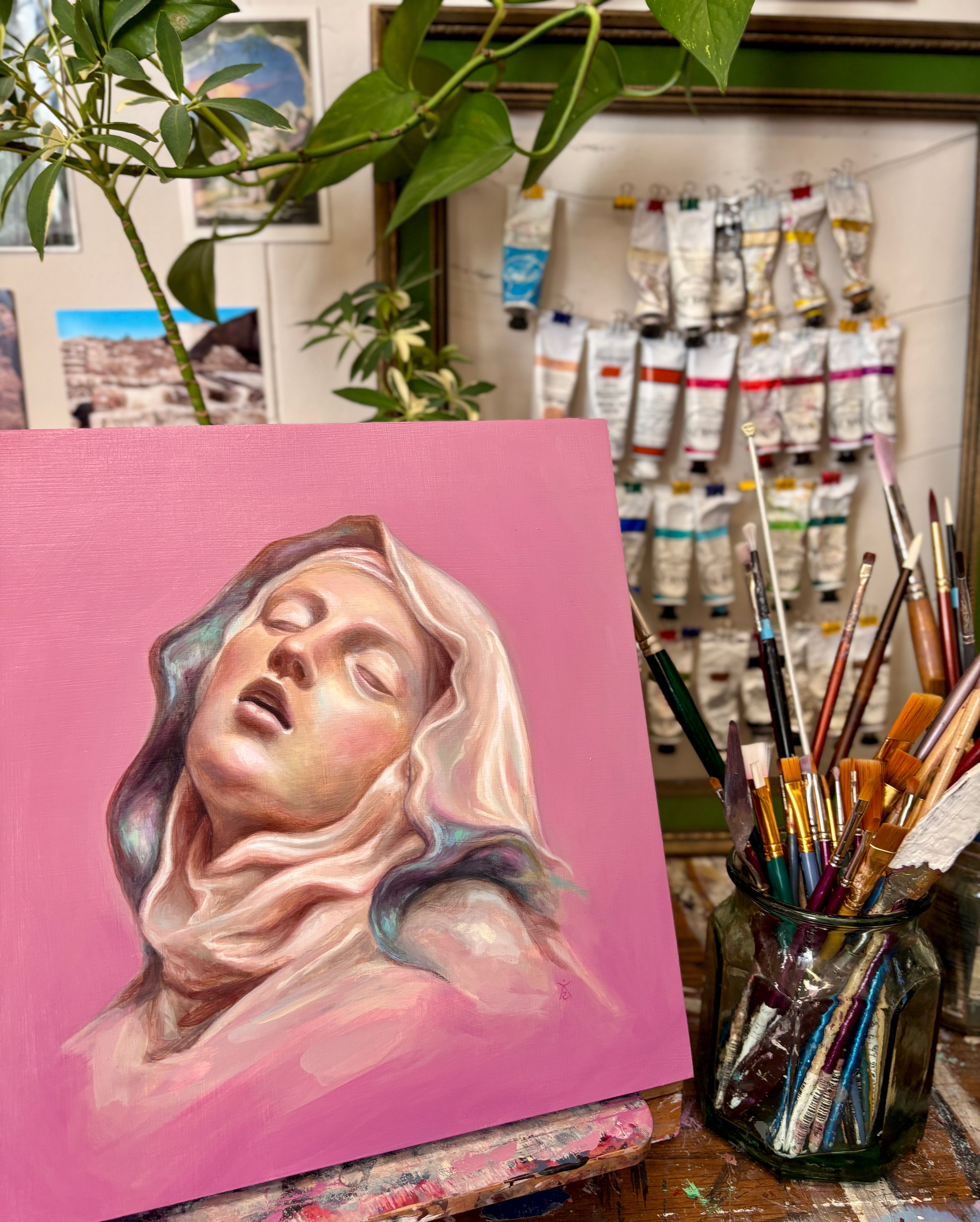
If you love this painting, it could be yours! Please inquire via direct message <3
If my art and writing resonate with you, you can support my practice by purchasing a print or becoming a paid subscriber. Thank you for helping me bring more of this work into the world.
Teresa of Ávila. (1577) The Interior Castle. Translated and introduced by Mirabai Starr. New York: Riverhead Books, 2004.
I’ve been reading lots about the origins of the akelarre and the Basque witch hunts, as I’m about to go on a trip to Spain this summer to explore the region. I thought this book was a fantastic, thoroughly researched resource:
Carreras Tort, J. (2024). Land of the goat: Witchcraft in the Pyrenees. Three Hands Press.
Pasulka, D. W. (2019). American cosmic: UFOs, religion, technology. Oxford University Press.
St. Teresa of Avila, The Book of Her Life, Chapter XXIX
Ryan, S. (2025, February 5). #166 Diana Pasulka – Religious History, UFO Phenomena and the Ancient Mysteries of Purgatory [Video]. YouTube.
Comments
Nothing yet. Say the first thing.
Sign in to join the conversation.