
A Magical Theory of Art explores the parallels between art and magic, examining the potential of occult practices to unlock the artistic imagination. Here, I turn to perhaps the most magical and ubiquitous of all media technologies, the alphabet, to explore Creation in the deepest, broadest sense.
From the alphabet’s overlooked influence on Plato’s Theory of Forms, to the West’s mystical obsession with recovering the Divine Language, to Austin Osman Spare’s hacking of this symbolic system, I invite you into the occult corners of media theory.
In Techgnosis,1 Erik Davis offers a captivating account of the interdependence of culture and technology, focusing especially on how communication media have shaped the religious imagination. More than any other invention, the introduction of new information technologies invariably transforms conceptions of self and reality, as each enables new ways of communicating the incorporeal realm of mind and meaning. This has been the case from the earliest writing prototypes, be they pictograms, hieroglyphs, and later, alphabets. Now fully internalized, writing has altered humanity in profound yet subtle ways. More specifically, this essay will explore the alphabet’s legacy on the Western occult imagination.
A core thread weaving this piece is the notion that writing is a machine. Not only that, but media technologies generate entire material ecologies around themselves, all entangled within an essentially cyborgish feedback loop. From ink and papyrus to parchment, the printing press, the typewriter, the personal computer, and now AI language models, each new medium extends the reach of symbolic thought while simultaneously reshaping the conditions of human experience. Davis points out that “the material history of writing is an utterly technological tale” (p.16), and considering how technology is a double-edged sword, one that simultaneously amplifies certain modes of consciousness while amputating others, humans have long wrestled with this magical, god-like power to manipulate reality through signs and symbols.
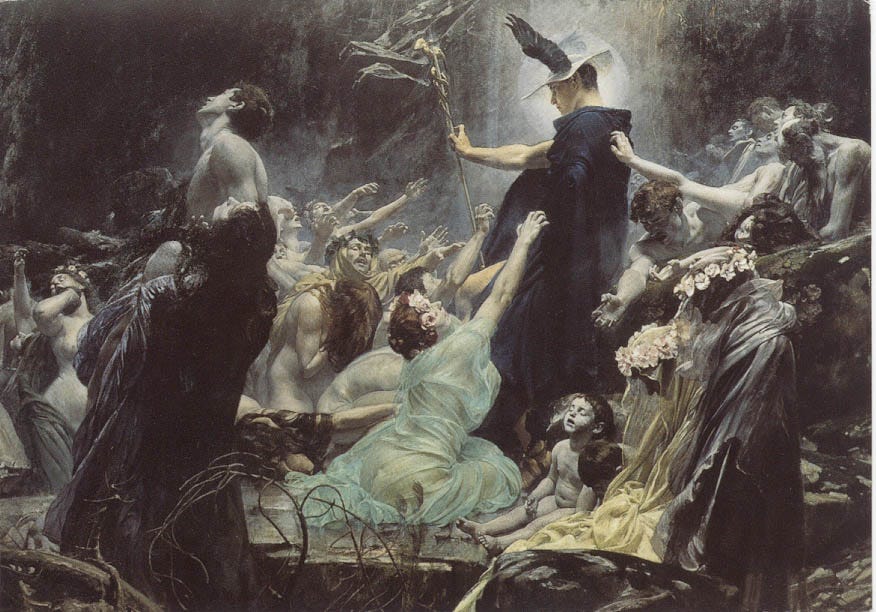
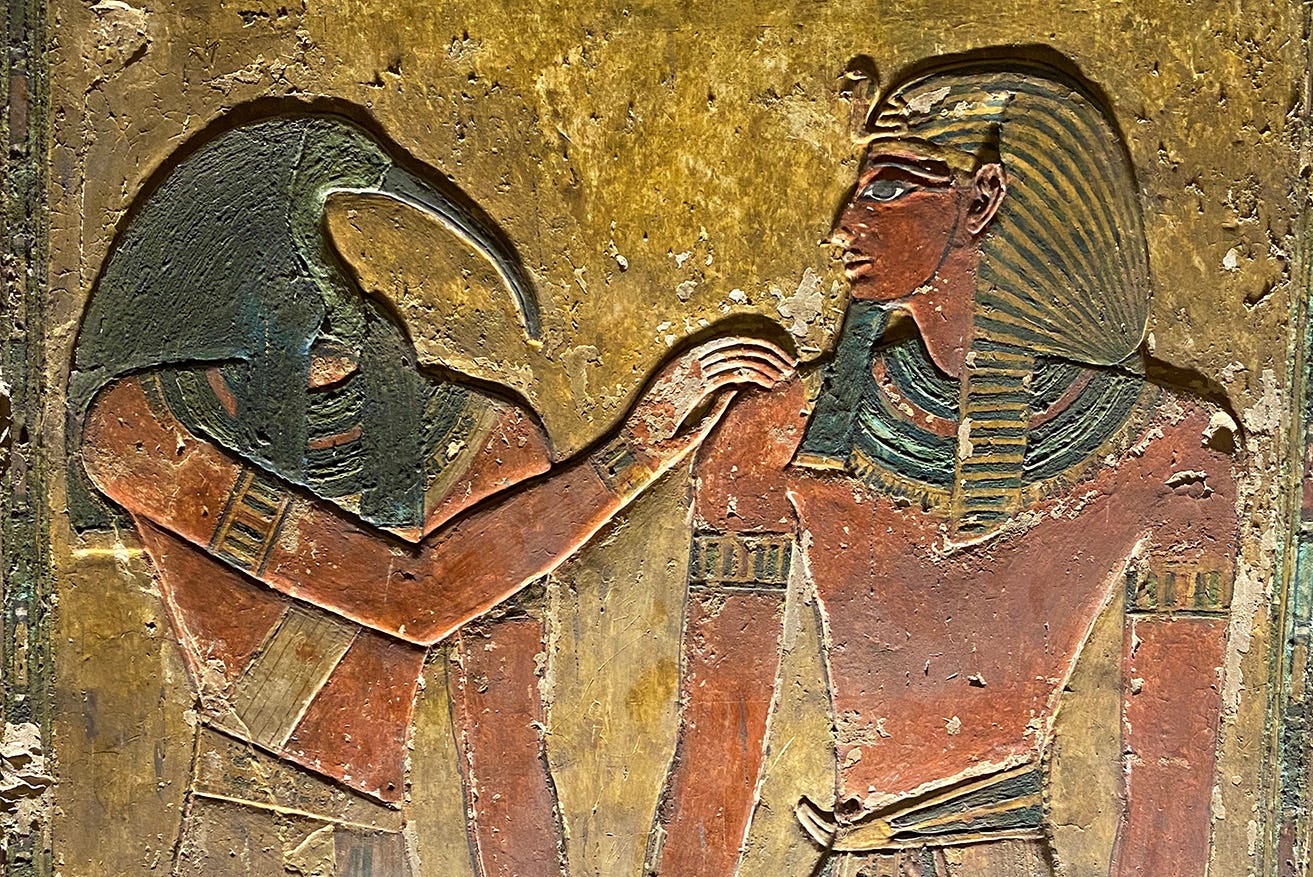
This tricksterish power is anthropomorphized in mythic figures such as Hermes in Greece and Thoth in Egypt. Associated with language and communication, both are credited with the invention of writing systems, whether hieroglyphic or alphabetic, as well as numbers and mathematics. Therefore, their long-standing association with magic underscores how symbolic representation is a mysterious world-binding, world-shaping force, one that reconfigures the world in its attempts to describe and inscribe it.
If my art and writing resonate with you, you can support my practice by purchasing a print or becoming a paid subscriber. Thank you for helping me bring more of this work into the world.
“More than any single invention, writing has transformed human consciousness.” — Walter Ong
Thoth makes an apparition in Plato’s Phaedrus, in which Socrates recounts an instructive tale on the cost of technological progress. Legend has it that upon visiting King Thamus, ruler of a great city in Upper Egypt, the Divine Scribe attempts to persuade him to make writing widely available to the Egyptians, promising that it will enhance memory and wisdom among the people. Weighing the pros and cons, King Thamus declines, concluding that Thoth’s invention would instead destroy memory, outsourcing this important faculty onto external markings. By eroding the oral context of learning, the king foresaw that writing would produce only the appearance of knowledge. Filled with the conceit of wisdom, literate people would become a burden to society.2
In Technopoly3, media theorist Neil Postman comments on the tale, highlighting that “Thamus is concerned not with what people will write; he is concerned that people will write” (p. 7). The ruler appears to understand that writing is not a neutral technology, but one whose effects are shaped by the structure of the medium itself.
As mentioned, writing is a tool, an engineered machine, and like any technology, it carries within it inherent bias, meaning a predisposition “to construct the world as one thing rather than another, to value one thing over another, to amplify one sense or skill or attitude more loudly than another” (Postman, p. 13). Socrates, famous for his penchant for dialogue and orality, sides with King Thamus, yet ironically, Plato’s own legacy could not better exemplify writing’s inherent bias, for little did he know that his perspective of the world had itself been shaped by one of the most revolutionary media technologies: the alphabet.
Derived from the Phoenician script, the Greek alphabet emerged around 800-700 BCE4 and was the first writing system to capture both vowels and consonants, thus “completing the technological colonization of the spoken word” (Davis, p. 19). While hieroglyphs kept meaning-making tethered to the animist matrix of the sensory world, with this new system, signs could now be fully abstracted from their referents, and “the Greeks began to associate truth with what was eternal, incorporeal, and inscribed” (Davis, p. 20). The alphabet, and the literate rationalism it engendered, may very well be at the heart of ancient Greece’s philosophical turn.
Born in 428 BCE, Plato lived at the precise moment this new technology began to saturate elite Greek society, and belonged to one of the earliest generations systematically educated in reading and writing. It is perhaps no coincidence that Plato would go on to formulate one of the most abstracted and disembodied ontologies in Western thought, one that irrevocably shaped religion, mysticism, and rationalism alike: the Theory of Forms. For Plato, the “real world” was the abstract realm of transcendent Ideas, of which the sensory human world is only a pale, fallen, and shadowy reflection5.
While King Thamus was concerned with what would be lost through the spread of writing and literacy, technology gives as much as it takes, bringing with it both the boons of progress and the banes of unforeseen consequences. By facilitating the interiorization of the writing machine, the alphabet enabled the spread of rational literalism, unleashing new forms of power and knowledge that would eventually pave the way for the techno-scientific mindset that shaped the Western world.
The alphabet’s inherent bias leans toward categorization, linear logic, analysis, and separation, which shaped the user as much as it shaped civilization. For interiorized, the writing machine enabled sharper introspection, giving rise to a more separate, rational self who could now reach towards the divine and formless, propelled by reason. Davis writes:
“For Plato, literate introspection may have catalyzed something far more mystical: his revolutionary belief that an incorporeal spirit lurks within the self, and that this immortal spark of intelligence is independent of the speaking, breathing body” (p.20).
Of course, Davis admits, the idea of an immortal, reincarnating essence beyond the mortal body is ancient, having existed for millennia within the mystery cults and shamanic lore of the region. The Orphic and Pythagorean traditions were influential to Plato, but he redirected these currents toward his rationalist project. Where earlier shamanic streams sought mystical knowledge through descent, going deep into the belly of the Earth as an entry point into the cosmos, the seeker of Truth now sought it through ascent. What scholar Ioan P. Couliano called the “Platonic Space Shuttle” launched the rational spark beyond the pull of the body so it might glimpse its own divinity in the noetic light.
While the alphabet cannot be the sole culprit for the long-standing chasm between spirit and body, immanence vs. transcendence, Plato’s metaphysics would come to exert a profound influence on the Western psyche, seeping into the Abrahamic religions of the written word that followed, and later into the Neoplatonic, Kabbalistic, and Hermetic currents that shaped the Renaissance and beyond.
If my art and writing resonate with you, you can support my practice by purchasing a print or becoming a paid subscriber. Thank you for helping me bring more of this work into the world.
“The limits of my language define the limits of my world.” — Ludwig Wittgenstein
While the Greek alphabet helped abstract thought from the natural world, the Hebrew tradition sacralized the alphabet as a divine, god-given creative code. Meanwhile, this abstraction proved especially compatible with the religious innovation of the monotheistic God: invisible yet omnipresent, disembodied yet absolute, capable of governing a People across territories through codified law rather than coaxed or petitioned locally, through ritual (Davis, p. 23).
This is a God who now bestows inscribed tablets of commandments, laws, and instructions that media technologies such as the scroll and, later, the codex would crystallize and canonize to great political effect. The writing machine made Judaism and Christianity into religions of the Book, a book increasingly understood as the literal Word of God.
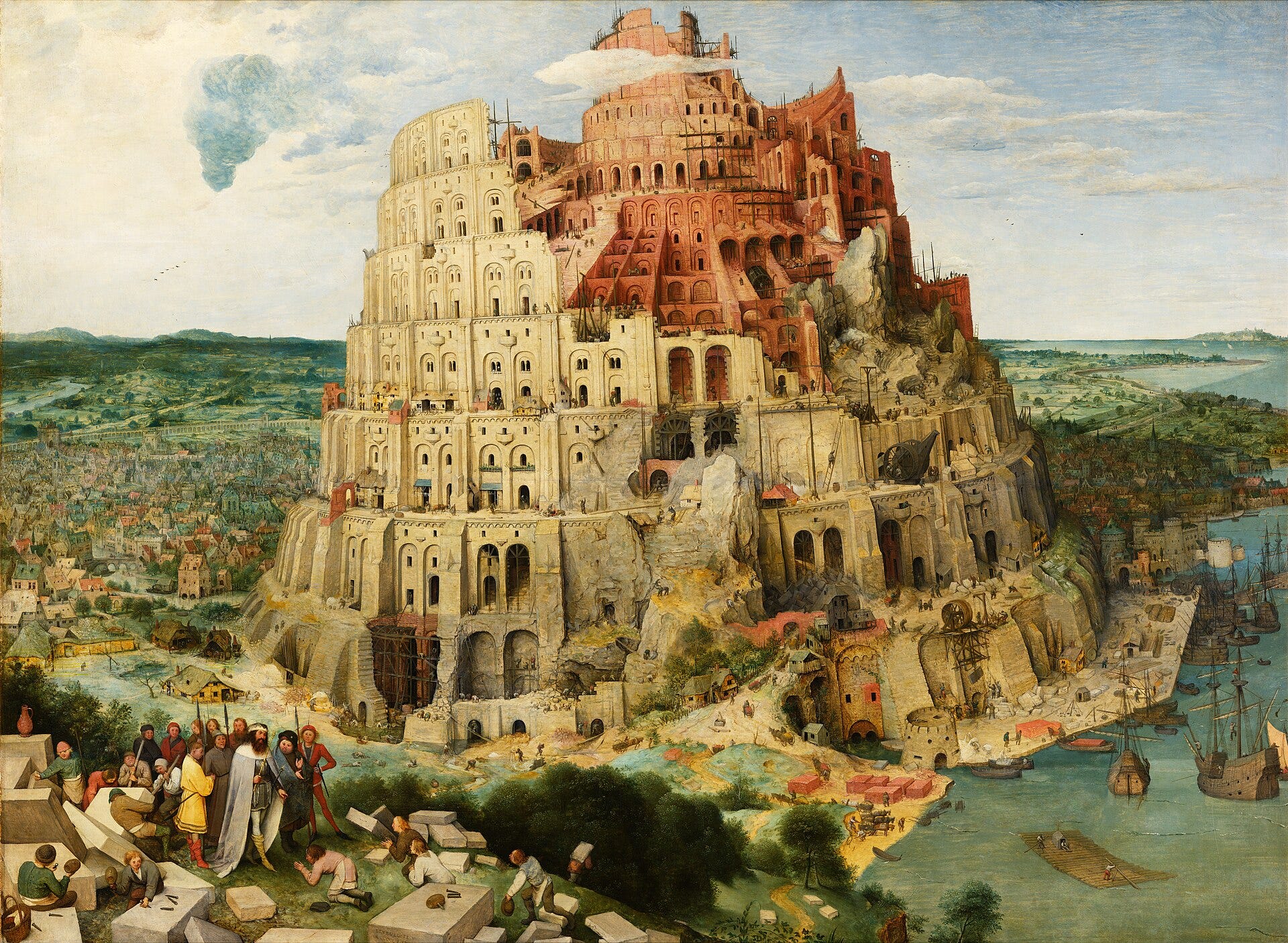
But nestled within this very Book is a paradox. The story of the Tower of Babel in Genesis 11 hints at the fact that humanity is no longer in possession of the Original Tongue. While Adam names all living creatures in Eden, he does not invent language. His word is the Word. In the Abrahamic imagination, language, in its primordial state, is ontologically at-one with reality. Yet, after the construction of the Tower of Babel, humanity finds itself scattered under the “Confusion of Tongues,” severed from linguistic unity, and plunged into the chaotic multiplicity of fractured, fallen languages.
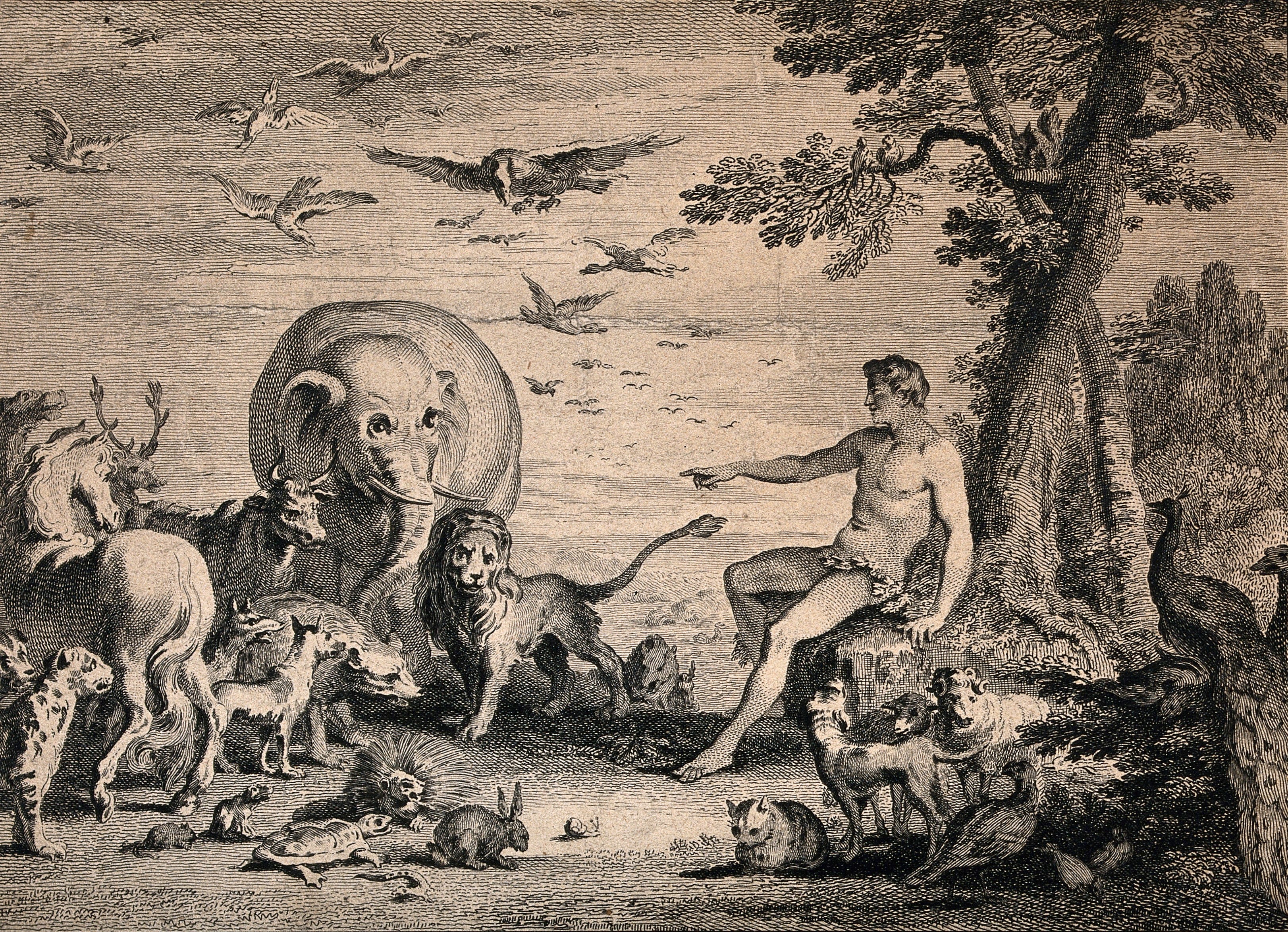
Noting that we are reminded of Plato’s metaphysics. In a sense, the lost original tongue is an Ideal Form, the luminous source from which all imperfect linguistic reflections descend. It is the language of Creation, untouched by distortion or noise, a pure signal clear from interference.
This paradox gave rise to one of the great obsessions of Western mysticism: the recovery of the Adamic tongue, a pure and Divine Language untouched by the distortions of the mundane world with its sticky commerce, politics, hubris, and inherent ambiguity. Streams of Christian mystics, Kabbalists, Neoplatonists, and Renaissance occult philosophers increasingly treated letters as the operative codes underlying reality, like “Cosmic DNA Codes” (Davis, p. 23) capable of revealing the path back to the source, back to Eden, and toward alignment with the Will of God. To speak this language was to redeem one’s participation in God’s plan and to be a pure, co-creative agent as Adam once was before the fall.
The Hebrew alphabet, in particular, took on unparalleled cosmological significance. In texts like the mystical Sefer Yetzirah (ca. 3rd–6th century CE), Creation unfolds through the combinations of sacred letters and numbers, each representing a living force within the divine architecture of the cosmos (Davis, p. 23). Its opening passage reads:
“In two and thirty most occult and wonderful paths of wisdom did JAH the Lord of Hosts engrave his name[…]. He created this universe by the three Sepharim: Number, Writing, and Speech. Ten are the numbers, as are the Sephiroth, and twenty-two the letters, these are the Foundation of all things [emphasis added].”6
Within these esoteric currents, the generative power of the Word is exalted, becoming a direct link to the enspiriting matrix animating all levels of the Great Chain of Being. The mystical alphabet seeks to recover the Word of God and access to the operative forces that shape reality—here lies the inherent bias. This orientation towards the technology of text and sign reveals a thirst for greater agency within a universe that, despite the widening chasm of abstraction, remains essentially alive and animistic.
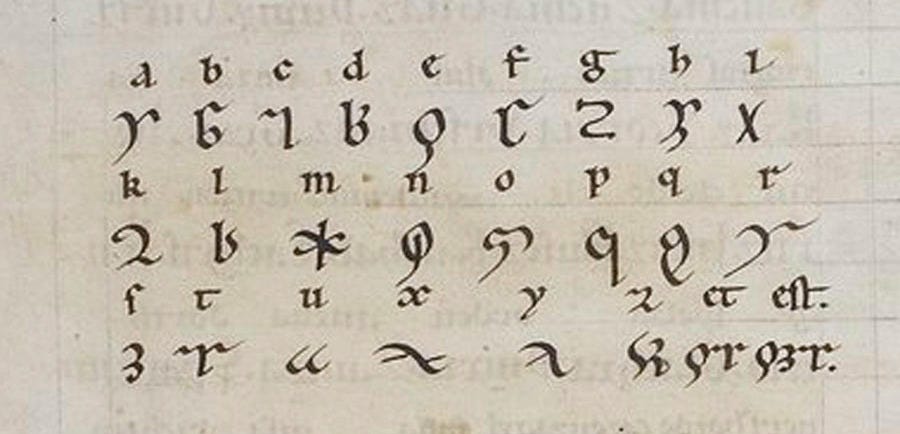
This quest to redeem the Divine Language leads to a series of fascinating semiotic artifacts. Among the earliest is the Lingua Ignota of the 12th-century Christian mystic Hildegard von Bingen, a fully constructed language revealed to the Benedictine abbess through ecstatic vision. Although its intended function remains enigmatic, scholars generally understand it as an experimental medium of divine communication and communion, an attempt to overcome the inherent limitations of the fallen language.7
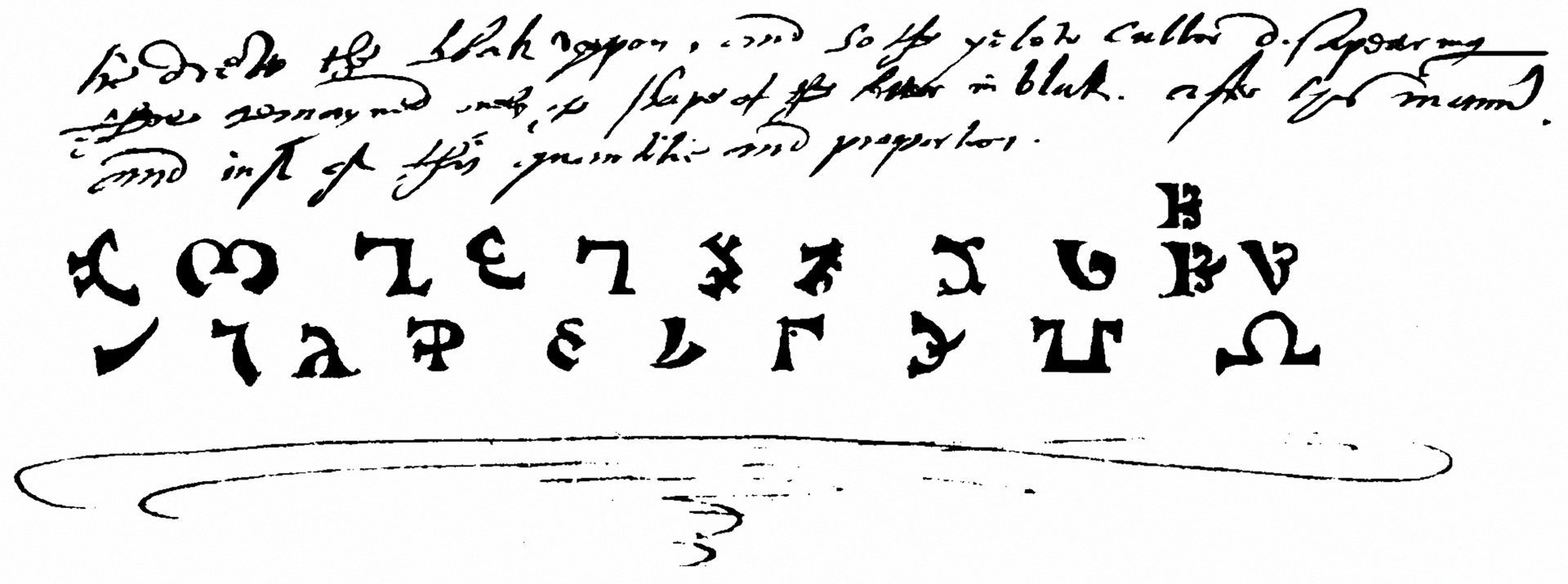
Later in the 16th-century Renaissance, English occultist and mathematician John Dee and his associate Edward Kelley famously received, through scrying, a complete system of angelic magic (often referred to as Enochian), including a transmitted Angelic alphabet and an entire book written in the language, the Loagaeth. Dee’s angelic language is a fully articulated celestial tongue, which, despite never supplanting Hebrew’s mystical authority, would later become foundational to Western occultism.8
If my art and writing resonate with you, you can support my practice by purchasing a print or becoming a paid subscriber. Thank you for helping me bring more of this work into the world.
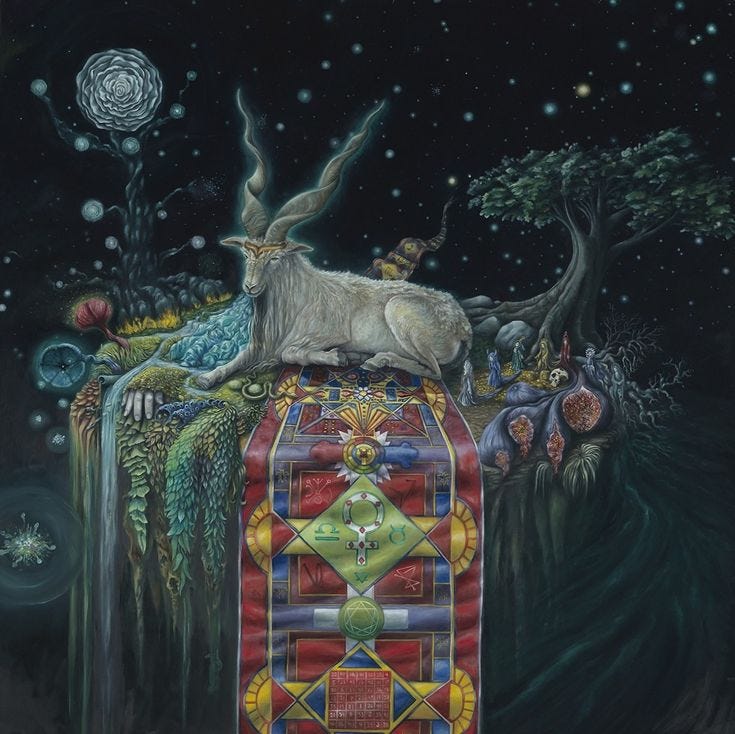
“Look not so deeply into words and letters […] by playing child’s games with symbols thou shalt never understand.” — Aleister Crowley
Perhaps we owe the posterity of Dee’s Angelic alphabet in part to the Hermetic Order of the Golden Dawn, which adopted and elaborated upon it in the late 19th century. Drawing, once again, on Neoplatonism, Hebrew mysticism, and Hermeticism—a body of texts attributed to the legendary Hermes Trismegistus (a syncretic blend of the aforementioned Thoth and Hermes) which significantly informed the worldview of Renaissance magi and alchemists such as John Dee—this British occult society became highly influential within Western esotericism, incubating figures such as Aleister Crowley and the Irish poet W. B. Yeats, and leaving a lasting impression on modern occult culture more broadly, notably through the iconic Rider-Waite-Smith tarot.
But while the Golden Dawn was busy coming up with intricate systems of correspondences, sacred alphabets, theurgical liturgy, and ceremonial rites intended to reach a transcendent godhead, another, more enigmatic figure was developing a completely different metaphysics. If the “Platonic space shuttle,” bolstered by millennia of body-denying Christian doctrine, had produced what Davis describes as “a chasm between the timeless heaven of the transcendent godhead and the demon-hunted mud puddle where our bodies copulate, sicken, and die” (p. 22), then London artist and occultist Austin Osman Spare embraced the latter as an equally, if not more potent source of divine Creativity through a magical philosophy grounded in art, desire, and pleasure.
Harnessing the latent creative power of the subconscious was central to Spare’s ethos and creative practice. In a sense, literate rationalism, with its elevation of the conscious mind and drive toward abstraction and asceticism, hindered the activation of the generative drives buried within the psyche—forces that primarily spoke the felt, embodied language of desire. While he saw that conscious desire only intensified separation, unconscious desire could mobilize the organic process of natural selection.
It therefore makes sense that one of Spare’s main legacies would be a technique of sigilization based on the deconstruction of the alphabet. If letters and numbers had been understood as mystical signifiers of primordial, creative forces or codes regulating the universe, Spare just hacked the system. Instead of being access points to higher realms, his sigils embody the force of raw desire, becoming seeds that catalyze the subconscious towards its own fulfillment. In Visual Magick, Jan Fries explains the process as such: “Sigil magick is a form of feedback: the desire arises from the deep, is recognized, sigilized, cast into the deep again, and finds fulfilment from that agency.”9
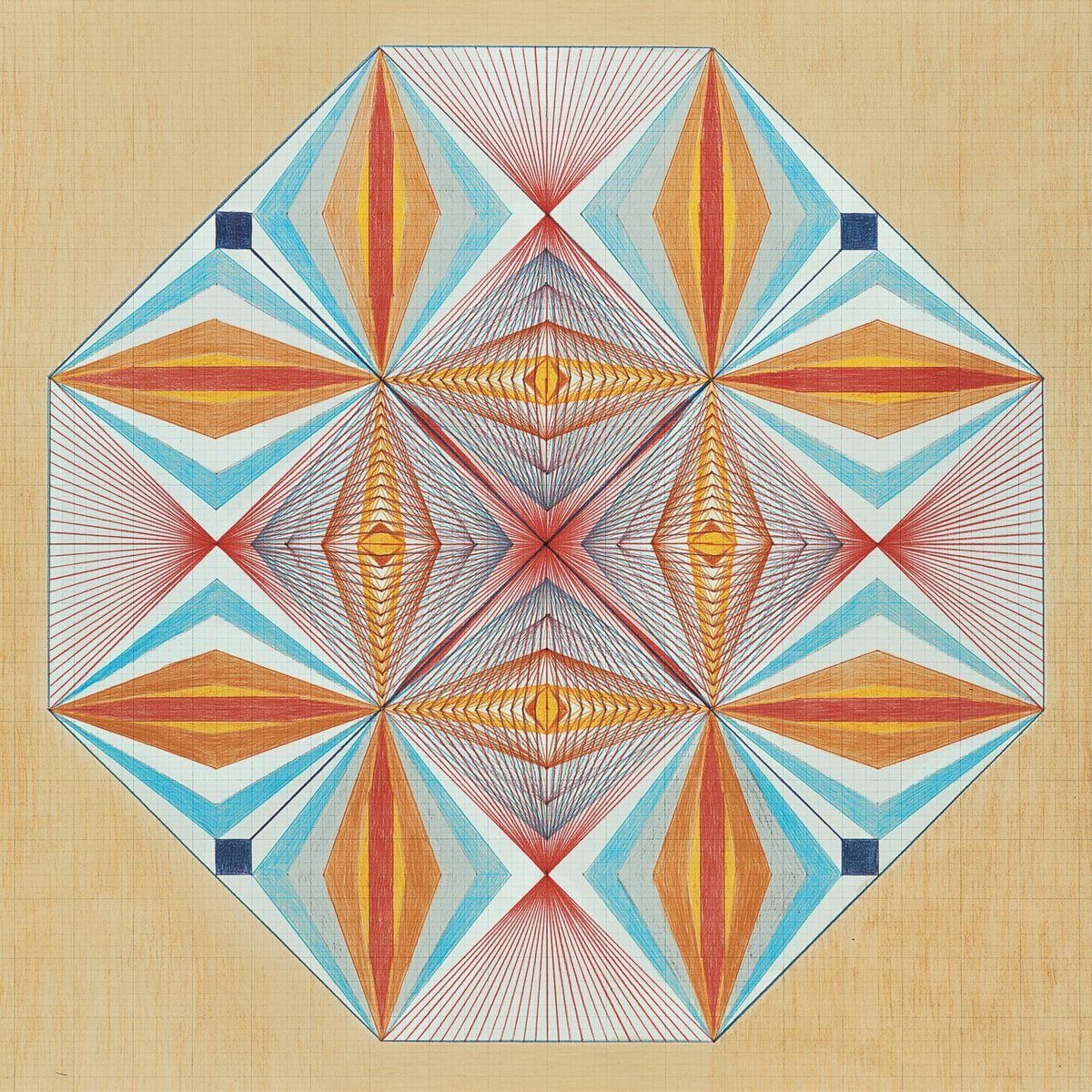
Spare’s sigils are essentially designed through a deliberate dismantling of the writing machine. The method is quite simple: one writes a desire, removes repeated letters, and recombines the remaining shapes into an aesthetically pleasing glyph. The sigil is then transmitted and absorbed into the subconscious to be forgotten (there are various ways of doing so that you can Google). In a way, Spare’s sigil-making process subverts the rule of literate rationalism by dissolving language back into the instinctive and embodied field from which it emerged.
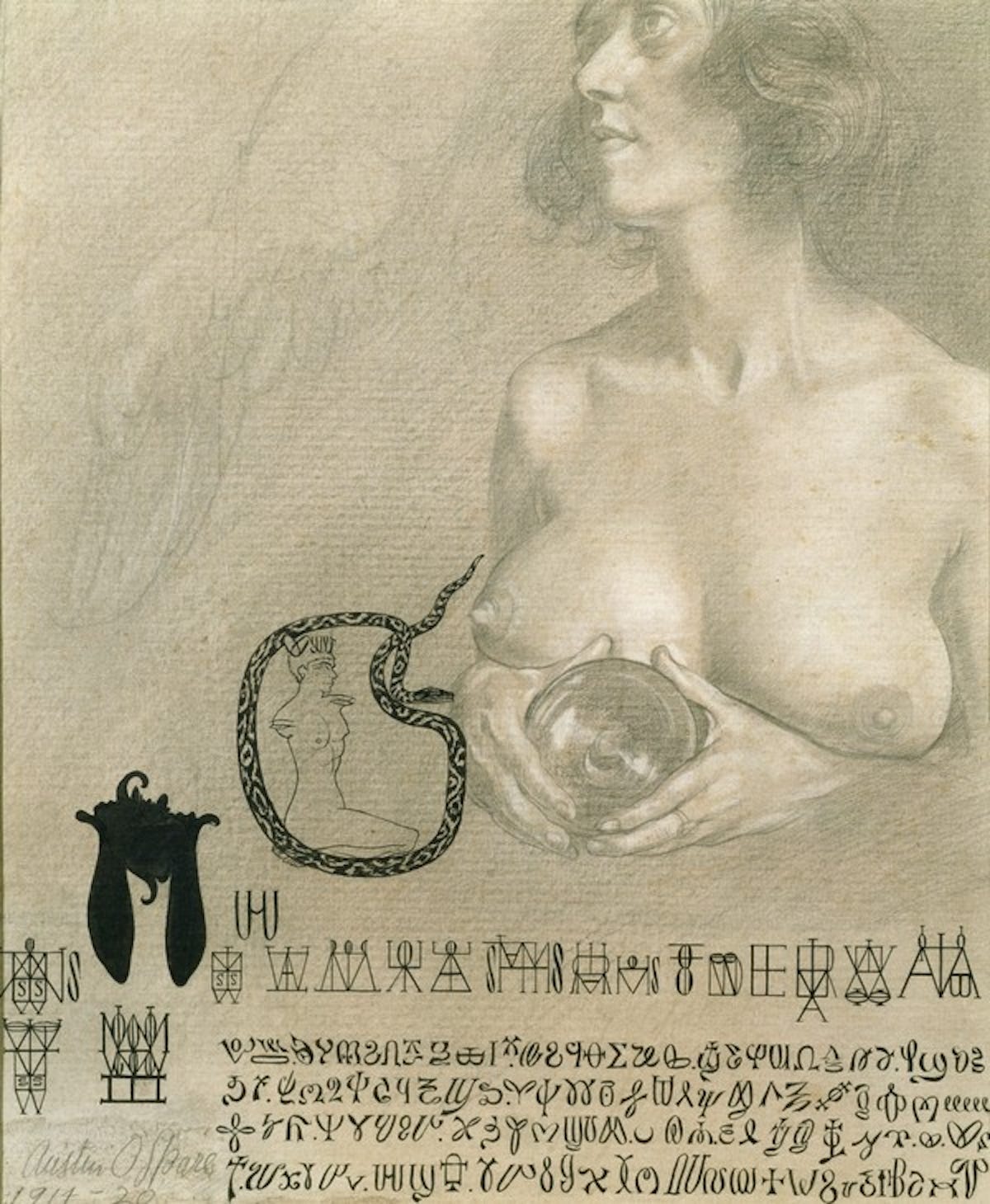
Like von Bingen and Dee, Spare also devised his own mystical alphabet. But instead of turning upward toward a transcendent source or Ideal Form, each letter in his “Atavistic Alphabet,” also known as the “Alphabet of Desire,” represents what Kenneth Grant described as a “sex-principle potent to awaken remote atavistic strata of the psyche.” As such, Spare’s “graphic symbology represents a definite language designed to facilitate communication with the psychic and subliminal world10.” It is the organic and biological drives of the psyche that this language seeks to articulate, which is perhaps another way of understanding the Adamic tongue, the primordial, perfect language of Creation. And because Spare’s embraced non-dualism, the distinction between ascent and descent, God and Nature, immanence and transcendence, is not so relevant in the end: up or down, the serpent eats its tail.
If my art and writing resonate with you, you can support my practice by purchasing a print or becoming a paid subscriber. Thank you for helping me bring more of this work into the world.
This essay has attempted to pull back the curtain on a most ubiquitous yet magical communication technology, the alphabet, and illuminate its widespread yet overlooked impact on the Western religious and magical imagination. In turn, these metaphysical narratives have shaped the cultural context in which more elaborate media technologies continue to be designed and deployed, and the cycle goes on.
If this is the case with something as rudimentary to the writing machine as the alphabet, what unintended effects might more complex and “advanced” media technologies exert upon our sense of self and of the cosmos? For one thing, the transcendent trope has shapeshifted into a view of the human as nodes within a vast cosmic information network, in which technologies are less and less conceived as human tools, but as vessels of an expanding collective mind—the body and nervous system of a collective consciousness striving to become aware of Itself, orchestrating its own upleveling and evolution through technological innovation (Davis, p. 313).
Yet, as figures such as Hermes and Thoth remind us, technology is fundamentally tricksterish. Maybe, as Davis suggests, a wiser approach is to treat it neither as extensions of the self, nor as Gods, nor as slaves, but as “unknown constructs with whom we must make creative alliances and wary pacts” (p. 355).
Davis, E. (2015). TechGnosis: Myth, Magic, and Mysticism in the Age of Information (Rev. ed.). North Atlantic Books. (Original work published 1998)
Postman, N. (1992). Technopoly: The Surrender of Culture to Technology. 1st ed. New York
Poletti, F. (2002). Plato’s Vowels: How the Alphabet Influenced the Evolution of Consciousness. World Futures, 58(1), 101–116. https://doi.org/10.1080/02604020210401
Fries, J. (1992). Visual Magick: A manual of freestyle shamanism. Mandrake of Oxford.
Grant, K. (1972). Austin Osman Spare and the Zos Kia Cultus. In The Magical Revival (pp. 180–198). Frederick Muller Ltd.
Comments
Nothing yet. Say the first thing.
Sign in to join the conversation.