
Monks worked at manual labor as a spiritual discipline. They farmed fields, vineyards, and orchards. They built mills, workshops, irrigation systems, and roads and bridges. The Plan of Saint Gall (c. 820), the earliest surviving architectural plan of an ideal (if unrealized) medieval monastery, depicted a Benedictine community. The Plan provides some of the clearest visual evidence that manual labor was deeply integrated into Benedictine life. Its gardens, orchards, workshops, breweries, bakeries, mills, barns, and hospitals illustrate how manual labor, technical skill, and practical management were woven into monastic life as disciplines alongside prayer and study [[ii], [iii]].
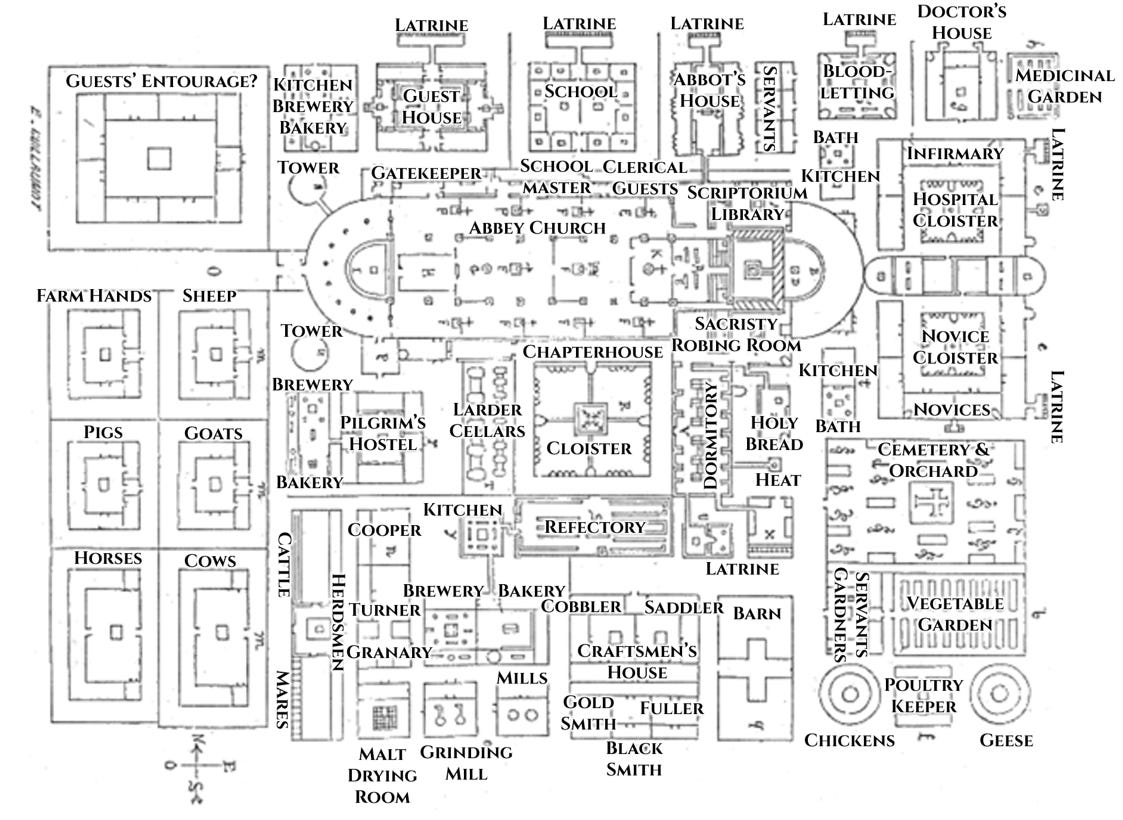
Figure 1.66: Simplified view of the Plan of St. Gall (c. 820) [[i]]
The primary industry of the Middle Ages was agriculture. Roman agriculture encompassed a substantial body of practical knowledge [[iv]]. Intensive viticulture and olive cultivation were widespread. The technical details of nitrogen fixation were not yet known, but Cato (234–149 B.C.) praised lupine beans as a soil-enriching crop [[v]], and Marcus Terentius Varro (116–27 BC) discussed the role of legumes in maintaining agricultural productivity [[vi]]. Roman farmers recognized the value of crop rotation, and they understood that alternating cereals with legumes could increase yields and sustain soil fertility.
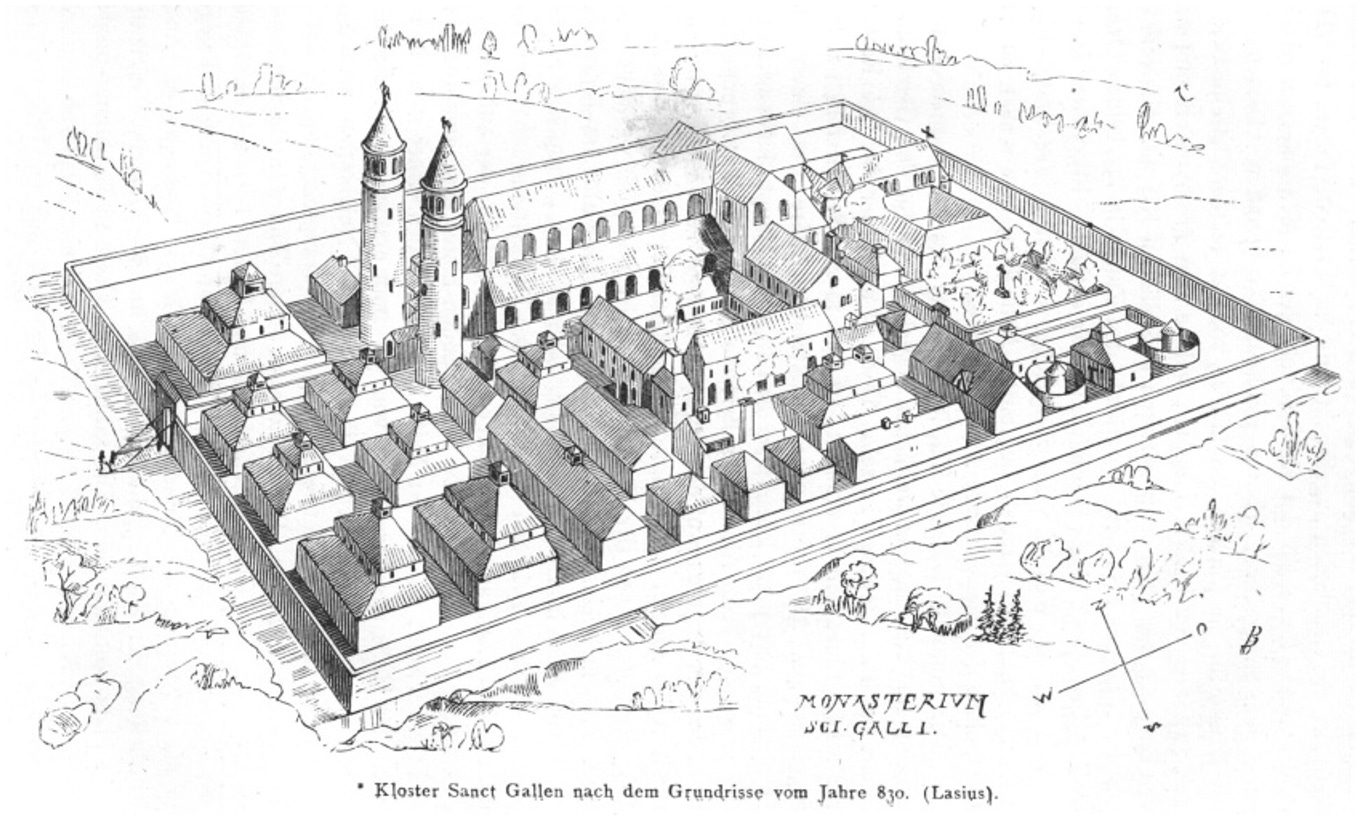
Figure 1.67: An 1876 reconstruction of the buildings in the original Plan of St. Gall [[vii]].
Monasteries played a central role in the agricultural colonization of Europe.
Rulers of the early Middle Ages like Theodoric the Great (c. 454–526) in Italy, the Lombard kings of the seventh and eighth centuries, Alfred the Great (849–899) and Charlemagne (c. 742–814) had as their policy, in the words of Paulus Orosius (c. 375–c. 418), ‘to turn the barbarians to the ploughshare,’ to lead them ‘to hate the sword’ [[viii], [ix]].
Henry H. Goodell (1839–1905), founder and President of the Massachusetts Agricultural College (presently known as the University of Massachusetts Amherst) extoled “the work of these grand old monks during a period of fifteen hundred years. They saved agriculture when nobody else could save it. They practised it under a new life and new conditions when no one else dared undertake it” [[x]].
The heavy wheeled moldboard plow enabled farmers to cultivate the dense, fertile clay soils of northern Europe by cutting, lifting, and turning the earth far more effectively than the light Roman plow. Combined with the horse collar, which allowed horses to pull heavy loads efficiently without choking, the new technologies increased productivity, expanded the amount of land under cultivation, and helped support the population growth and economic revival of medieval Europe. The novel three-field crop rotation system alternated winter grain, spring crops (including soil-enriching legumes), and fallow land on a three-year cycle. By bringing a greater proportion of land under cultivation each year, it increased yields and helped sustain soil fertility [[xi]].
There’s no specific record of these techniques’ invention, so they probably didn’t arise within the literate monastic system. However, by combining long institutional memory with continent-wide networks, monasteries became powerful engines for the diffusion of agricultural innovation throughout medieval Europe. “Every Benedictine monastery was an agricultural college for the whole region in which it was located” [[xii]].
Beyond agriculture, monks experimented to develop best practices in the practical arts of metallurgy, irrigation and land reclamation, brewing, viticulture and winemaking, sheep husbandry and wool production, and medicine. The Cistercian Order were leading iron producers from the 13th century on [[xiii]]. They also opened up for agriculture “hundreds of thousands of acres of woodlands and wastelands by forest clearing, draining, or irrigation” [[xiv]]. Water powered mills were making beer by the tenth century [[xv]]. Monasteries planted vineyards and exported wine; they raised sheep and sold the wool [[xvi]]. They also advanced the medical arts.
Medicine was studied in the earliest Benedictine monasteries, and the long series of medical works written during the Middle Ages and continuing without a break into the 16th centuries and modern times, is one of the best examples of a tradition in which empirical observations were increasingly combined with attempts at rational and theoretical explanation, with the result that definite medical and surgical problems were solved [[xvii]].
The spread of Benedictine monasticism also illustrates the resilience of a decentralized institution. The Lombard sack of Monte Cassino around 577 did not extinguish the Benedictine tradition; instead, displaced monks carried the Rule to new communities, helping extend its influence beyond Italy. The monastic concept went viral.
By 600, monasticism had spread rapidly, with some one hundred monasteries in Italy and two hundred in Gaul [[xix]]. Many were not Benedictine but followed the stricter rule of the Irish monk Columbanus (540–615), whose ascetic tradition eventually yielded to the broader appeal of Benedict’s more moderate rule. Encouraged by the patronage of Pope Gregory the Great (c. 540–604), the Rule spread to England through Augustine of Canterbury (d. 604), was strengthened by figures such as Hadrian (d. 710) and Benedict Biscop (c. 628–690), and from there expanded into Francia and Germany through missionaries including Boniface (c. 675–754) [[xx]].
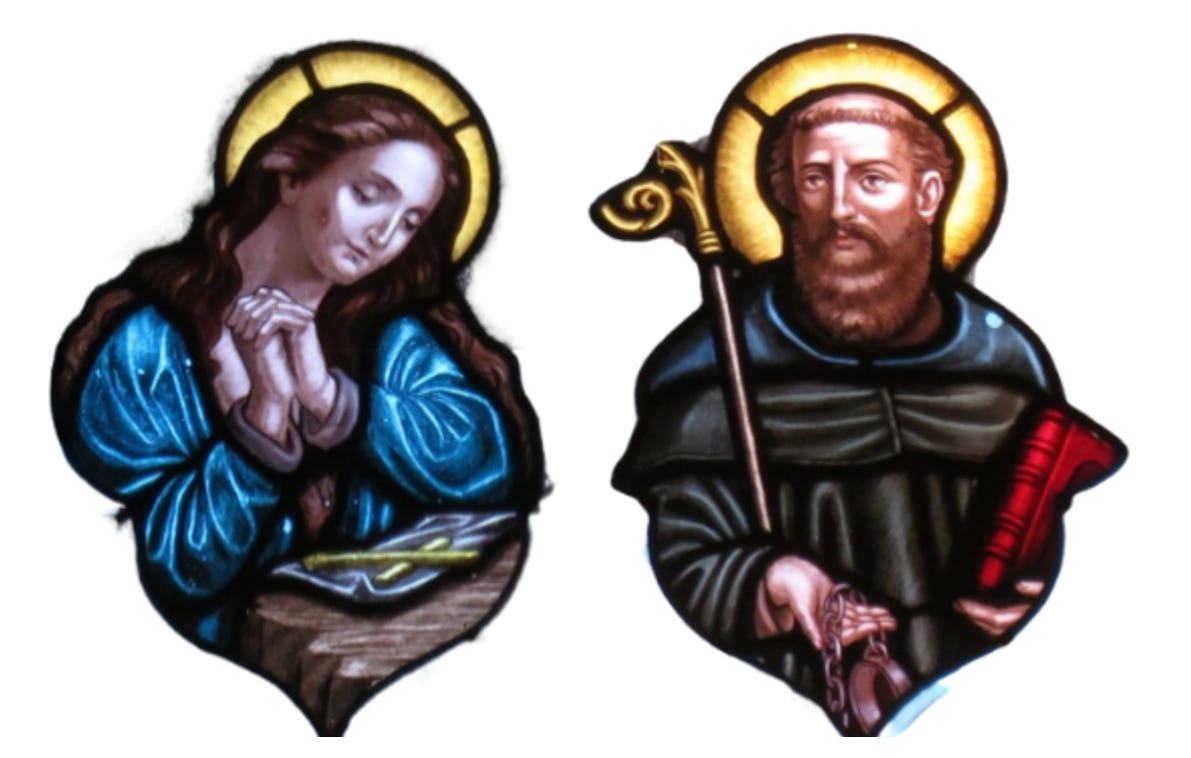
Figure 1.68: A modern stained-glass depiction of St. Scholastica (480–543) and her brother, St. Benedict (c. 480–543) [[xviii]].
Benedictine monasticism was not centralized but distributed across a network of autonomous houses. As a result, destruction by war, invasion, Viking or Saracen raids, or civil unrest rarely proved permanent; surviving monks could rebuild communities and replenish libraries from copies preserved in other monasteries. Indeed, Monte Cassino was again sacked in 881-883 by the Saracens [[xxi]]. Rebuilt, Monte Cassino became a leading center of scholarship in the 11th century [[xxii]], but was destroyed in an earthquake in 1349 [[xxiii]], secularized by an edict of Joseph Bonaparte (1768–1844) in 1807, and again by the Italian government in 1866-1868 [[xxiv]], bombed to rubble in 1944, and rebuilt once again. As the debris was cleared, two skeletons were found in the intact tomb under the altar, believed to be the remains of St. Benedict (c. 480–543) and his sister, St. Scholastica (480–543) [[xxv]].
That’s all for now. Remember always to keep calm, and make physics great again.
See you next week,
Hans
P.S. Pick up your copy of Fields & Energy Book I: Fundamentals and Origins of Electromagnetism, if you haven’t already:
Next time: II 1.7.2.6 Monasticism & Education: How Monks Saved Education and Invented the University
Enjoyed the article, but maybe not quite enough to spring for a paid subscription?
Then click on the button below to buy me a coffee. Thanks!

Full Table of Contents [click here]
You may follow me online in other places as well:
Telegram: 𝔸𝕖𝕥𝕙𝕖𝕣𝕔𝕫𝕒𝕣’𝕤 𝔸𝕖𝕥𝕙𝕖𝕣𝕤𝕥𝕣𝕖𝕒𝕞
Gab: @aetherczar
Twitter: @aetherczar
Amazon: Hans G. Schantz
[[i]] Plan of Saint Gall. Simplified view showing different structures. This image comes from Dictionary of French Architecture from 11th to 16th Century (1856) by Eugène Viollet-le-Duc (1814-1879). See: https://commons.wikimedia.org/wiki/File:Plan.abbaye.Saint.Gall.png I used a variety of sometimes contradictory sources to label the plan. See also: https://upload.wikimedia.org/wikipedia/commons/b/b0/SaintGallPlan.png and https://www.reddit.com/r/Pentiment/comments/14ysgw6/kiersaus_layout_is_based_on_the_9th_century_plan/
and https://thegardenhistory.blog/2019/08/31/the-perfect-monastic-garden/
A complete archive of the St. Gall Manusciprts is available, here: https://digital.library.ucla.edu/catalog/ark:/21198/zz0015vcjk
[[ii]] Previté-Orton, Charles William (1877-1947), Cambridge Medieval History, vol. 1, Switzerland: Castalia Library, 2024, p. 287. See: https://archive.org/details/shortercambridge0000prev/page/286/mode/2up
[[iii]] Horn, Walter (1908–1995), and Ernest Born, The Plan of St. Gall, 3 vols. Berkeley: University of California Press, 1979. See: https://archive.org/search?query=creator%3A%22Horn%2C+Walter%2C+1908-1995%22
[[iv]] Crombie, A.C., Augustine to Galileo, vol. I, Cambridge, Massachusetts: Harvard University Press, 1961, p. 189. See: https://archive.org/details/bwb_KV-166-220/page/188/mode/2up
[[v]] Cato, Marcus Porcius, (234–149 BC), Cato, the Censor, on farming, New York, Columbia University Press, 1933, p. 61. “What crops manure the grain field? Lupins, field beans, vetches. What are you to make manure of? Animal bedding, lupin vines, chaff, bean vines, husks, foliage of evergreen oaks and other oaks.” The editor adds in a footnote: “The fertilizing effect of leguminous crops was also understood. Cato mentions three, the lupin, the field bean and the vetch, which he says ‘manure the grain land.’ This was of course a matter of practical observation only. We are not told whether these three were used as green manure crops or not, but this is the most natural inference as to the ocinum which was sown in the vineyard on poor soils. Varro, a century later, speaks expressly of plowing down green manure crops (i. 23, 3). The use of ashes is mentioned in three places (cc. 37, 2; 38, 4; 1 14, x), but nothing is said of the use of lime to improve the soil although lime burning for building purposes must have been common.” See: https://archive.org/details/catocensoronfarm0000unse/page/60/mode/2up
[[vi]] Varro, Marcus Terentius (116–27 BC), Varro on farming. M. Terenti Varronis Rerum rusticarum libri tres, London: G. Bell & Sons, 1912, p. 64. “Some things should be sown with a view: not so much to present profit as to next year’s crop, because when cut down and left there they improve the soil. Thus lupins, before they produce many pods—and sometimes bean- stalks, if the podding stage be not so far advanced that it is profitable to pull the beans—are usually ploughed into poor land for manure.” See: https://archive.org/details/varroonfarmingmt0000marc/page/64/mode/2up.
[[vii]] Rahn, J. Rudolf, Artist’s reconstruction of the buildings in the plan, 1876. “Reconstruction of the buildings of the abbey of Saint Gall according to the historical plan from the early 9th century.” Note the Plan is from St Gall, but was apparently never built, and may not have been produced or intended for there. See: https://en.wikipedia.org/wiki/Plan_of_Saint_Gall#/media/File:Rahn_Kloster_Sanct_Gallen_nach_Lasius.jpg
[[viii]] Crombie, A.C., Augustine to Galileo, vol. I, Cambridge, Massachusetts: Harvard University Press, 1961, p. 189. See: https://archive.org/details/bwb_KV-166-220/page/188/mode/2up
[[ix]] Orosius, Paulus (c. 375–418), The seven books of history against the pagans; The apology of Paulus Orosius, Irving Woodworth Raymond, translator, New York: Columbia University Press, 1936, p. 392. The exact phrase is “…the barbarians came to detest their swords, betook themselves to the plough, and are affectionately treating the rest of the Romans as comrades and friends, so that now among them there may be found some Romans who, living with the barbarians, prefer freedom with poverty to tribute-paying with anxiety among their own people.” Paulus Orosius was a Spanish priest, historian, and disciple of Augustine whose History Against the Pagans became one of the most influential historical works of the Middle Ages, helping shape Christian understandings of Rome, history, and civilization for nearly a millennium. See: https://archive.org/details/sevenbooksofhist0000irvi/page/392/mode/2up
[[x]] Stebbins, Calvin, Henry Hill Goodell; the story of his life, with letters and a few of his addresses, Cambridge, Printed at the Riverside press, 1911, pp. 252-253. See: https://archive.org/details/henryhillgoodell00goodrich/page/252/mode/2up
[[xi]] Crombie, A.C., Augustine to Galileo, vol. I, Cambridge, Massachusetts: Harvard University Press, 1961, pp. 190-1. See: https://archive.org/details/bwb_KV-166-220/page/190/mode/2up
[[xii]] Flick, Alexander Clarence, The Rise of the Mediaeval Church, And Its Influence on the Civilisation of Western Europe from the First to the Thirteenth Century, New York: Burt Franklin, 1909, p. 223. See https://archive.org/details/bwb_S0-ACM-949/page/222/mode/2up
[[xiii]] Gimpel, Jean, The medieval machine : the industrial revolution of the Middle Ages, New York : Barnes & Noble Books, 2003, p. 68. “From 1250 to the seventeenth century the Cistercians were the leading iron producers of the Champagne region, and by the end of the eighteenth century they owned half of the industrial iron and steel complex of the ‘Plateau de Langres.’ But before 1330 they already owned between eight and thirteen iron-producing factories.” See: https://archive.org/details/medievalmachinei0000gimp_n8d4/page/68/mode/2up.
[[xiv]] Gimpel, Jean, The medieval machine : the industrial revolution of the Middle Ages, New York : Barnes & Noble Books, 2003, p. 47. “For example, for the monastery of Les Dunes, the lay brothers converted some 25,000 acres of the sandy and marshy deserts of Flanders coastline into fertile soil, while for the monastery of Chiaravalle, near Milan, they built an irrigation canal, completed in 1138, to bring water to the crops.” See: https://archive.org/details/medievalmachinei0000gimp_n8d4/page/46/mode/2up.
[[xv]] Gimpel, Jean, The medieval machine : the industrial revolution of the Middle Ages, New York : Barnes & Noble Books, 2003, p. 14. “In Europe, from the end of the tenth century the cam enabled millwrights to mechanize a whole series of industries which up to then had been operated by hand or by foot. In France, one of the first mills for making beer is mentioned in a document relating to the monastery of Saint-Sauveur at Montreuil-sur-Mer between 987 and 996; water-driven hammers seem to have been operating as early as 1010 at Schmidmiihlen in Oberpfalz in Germany.” See: https://archive.org/details/medievalmachinei0000gimp_n8d4/page/14/mode/2up
[[xvi]] Gimpel, Jean, The medieval machine : the industrial revolution of the Middle Ages, New York : Barnes & Noble Books, 2003, pp. 46-55. “The foreign buyers from Flanders and Italy were always anxious to sign long-term contracts with the Cistercian monasteries, whose whole agricultural economy—at least in England —was geared to raising sheep for export. Fountains Abbey in Yorkshire had up to 18,000 sheep, Rievaulx 14,000, and Jervaulx 12,000; they could export respectively 76, 60, and 50 sacks annually. By signing contracts with the Cistercians, the buyers had the advantage of being able to purchase a uniform product and, due to careful breeding, a particularly high-quality wool. They also had the benefit—due to the highly centralized Cistercian organization—of having to deal with only one individual, the cellarer, who was responsible for the material and financial administration of the monastery….”
“While in England many lay brothers reared sheep and exported wool, in certain regions in France and Germany they planted vineyards and exported wine. The motherhouse of Citeaux, situated in the great wine-growing region of Burgundy, set an example by planting what became one of the world’s most famous vintages, that of the Clos-Vougeot, and is where the wine connoisseurs, the Chevaliers du Tastevin, meet each year. In Germany, the Cistercians of Eberbach, who seem to have been the first to discover the advantages of cultivating vines on terraced hillsides, transported in their own ships approximately 53,000 gallons of wine yearly down the Rhine, mostly to Cologne, where it was sold wholesale to local merchants.”
See: https://archive.org/details/medievalmachinei0000gimp_n8d4/page/46/mode/2up
[[xvii]] Crombie, A.C., Augustine to Galileo, vol. I, Cambridge, Massachusetts: Harvard University Press, 1961, p. 176. See: https://archive.org/details/bwb_KV-166-220/page/176/mode/2up. More details on the revival of medicine, p. 223.
[[xviii]] Nheyob, Saint Joseph Church (Dyer, Indiana) - stained glass, Sts. Scholastica & Benedict, 13 October 2016. See: https://commons.wikimedia.org/wiki/File:Saint_Joseph_Church_(Dyer,_Indiana)_-_stained_glass,_Sts._Scholastica_%26_Benedict.jpg
[[xix]] Brown, Peter, The Rise of Western Christendom, 2nd ed., Malden, MA, Blackwell Publishing, 2003, p. 221. See: https://amzn.to/4uv464j.
[[xx]] Previté-Orton, Charles William (1877-1947), Cambridge Medieval History, vol. 1, Switzerland: Castalia Library, 2024, p. 288. See: https://archive.org/details/shortercambridge0000prev/page/288/mode/2up
[[xxi]] Previté-Orton, Charles William (1877-1947), Cambridge Medieval History, vol. 1, Switzerland: Castalia Library, 2024, p. 370. See: https://archive.org/details/shortercambridge0000prev/page/370/mode/2up
[[xxii]] Reynolds, L.D. and N.G.Wilson, Scribes and Scholars: A Guide to Transmission of Greek & Latin Literature, 2nd ed., Oxford: Clarendon Press, 1974, pp. 96-97, 118. See: https://archive.org/details/bwb_S0-BKW-016/page/96/mode/2up
[[xxiii]] Rennie, Kriston R., The Destruction and Recovery of Monte Cassino, 529-1964, Amsterdam University Press, 2021, p. 43. See: https://dokumen.pub/qdownload/the-destruction-and-recovery-of-monte-cassino-529-1964-9789048552122.html
[[xxiv]] Ibid. p. 111.
[[xxv]] Ibid. p. 51.
Comments
Nothing yet. Say the first thing.
Sign in to join the conversation.