
The earliest known systematic treatment of the liberal arts in Latin antiquity is generally attributed to Marcus Terentius Varro (116–27 BC), “the most learned of the Latins” [[i]], and the only living Roman honored with a bust in Rome’s first public library (c. 39 BC) [[ii]]. His treatise on agriculture already came to our notice. “Varro’s treatise, The Nine Disciplines, is lost, but references to it in later literature indicate that it considered grammar, dialectic, rhetoric, music, geometry, arithmetic, astronomy, medicine, and architecture” [[iii]]. Varro’s work survives only in fragments and later references, like by Cassiodorus (c. 485–c. 585) in his Institutions. “[T]he principles of all arts have existed for some purpose of utility” [[iv]], Varro affirmed.
Martianus Capella, an early-fifth-century Roman scholar and contemporary of Augustine’s in Carthage, likened the liberal arts to bridesmaids of learning. The Roman Patrician and scholar, Boethius (480–524), took that a step further, dividing them into a group of three, the Trivium, and a group of four, the Quadrivium. The Trivium provide the tools needed for reading, reasoning, and persuasion: Grammar, Rhetoric, and Dialectic (or Logic). The Quadrivium collects the mathematical sciences whose contemplation was thought to reveal the rational order of creation: arithmetic, geometry, music, and astronomy [[v], [vi]].
For many Romans, the Trivium comprised the totality of higher education and better oratory was the goal of higher education [[vii]]. Grammar, Rhetoric, and Dialectic allowed an educated Roman to understand others’ arguments and to impose their own persuasive will in return. According to Cassiodorus, “Varro defined dialectic and rhetoric in the nine books of The Disciplines with such a simile:”
Dialectics and rhetoric are what a man’s fist clenched and palm outstretched is in his hand, (the one concluding arguments with a brief speech, the other covering the fields of eloquence with copious speech), the one contracting words, the other expanding them. Dialectic is indeed sharper for discussing things, rhetoric is more eloquent for that which it strives to teach [[viii]].
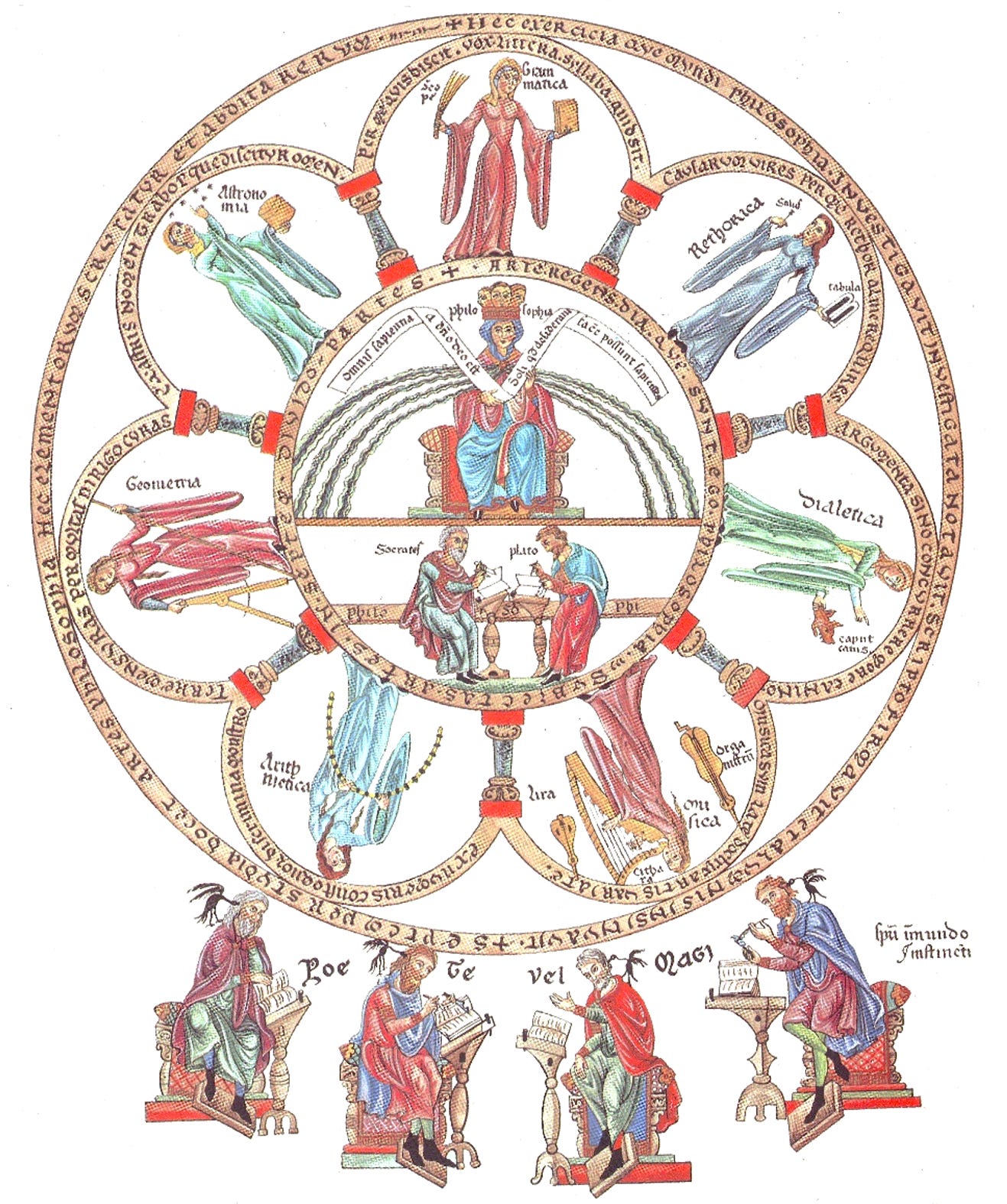
Figure 1.69: “Philosophy and the Seven Liberal Arts,” by Herrad of Landsberg, circa 1180. Clockwise from the top, the three subjects of the trivium: Grammar, Rhetoric, and Dialectic. Continuing, the four subjects of the Quadrivium: Music, Arithmetic, Geometry, and Astronomy. In the center, Lady Philosophy with the wise teachers, Socrates and Plato below her. Outside the circle, are “poets” and “wizards” whose work, Herrad warned was impure and valueless [[ix], [x]].
It is difficult for us now to appreciate the revolution in education exemplified by Cassiodorus. Throughout antiquity, education was oral. Times were changing, however, as the old order passed away, as imperial authority in the West collapsed, and as Europe fragmented into successor kingdoms. Strained economies meant less public education, and fewer aristocrats with the resources to hire private teachers. “Following the collapse of the taxation system that had formerly paid for the Roman civil administration, and the consequent loss or radical downsizing of the bureaucratic cadres, there was no longer any call for the services of the grammarians and rhetoricians who had drilled Roman schoolboys in the skills that made them eligible for a civil career” [[xi]]. A student might not have a local teacher available to answer questions and explain difficult texts. Cassiodorus took up the call to be the “Antiquarius Domini,” the “Book-Producer of the Lord” [[xii], [xiii]], creating the self-study guides for the coming generations of do-it-yourself scholars.
Cassiodrous in his Institutions made the Trivium and Quadrivium the foundation of education [[xiv]], adding the mathematical sciences of the Quadrivium to what had been the traditional education based on the Trivium [[xv]]. “Mathematics… includes four scientific disciplines,” he explained, “that is, arithmetic, geometry, music and astronomy” [[xvi], [xvii]]. “Our holy Fathers properly persuaded men of a scholarly disposition to read these sciences since they do much to turn our appetite from carnal things and make us desire what with the Lord’s aid we can see with the heart alone” [[xviii]].
More modern scholarship has cast doubt on the uniqueness of Cassiodorus’ example and the influence of his Vivarium in copying and preserving classical literature. “How large a part was actually played by Vivarium in the transmission of manuscripts to the Middle Ages is hard to say” [[xix]]. What is certain, however, is that the monastic movement played a central role in keeping education alive through the collapse and restarting education as times improved in the Carolingian Renaissance of the ninth century.
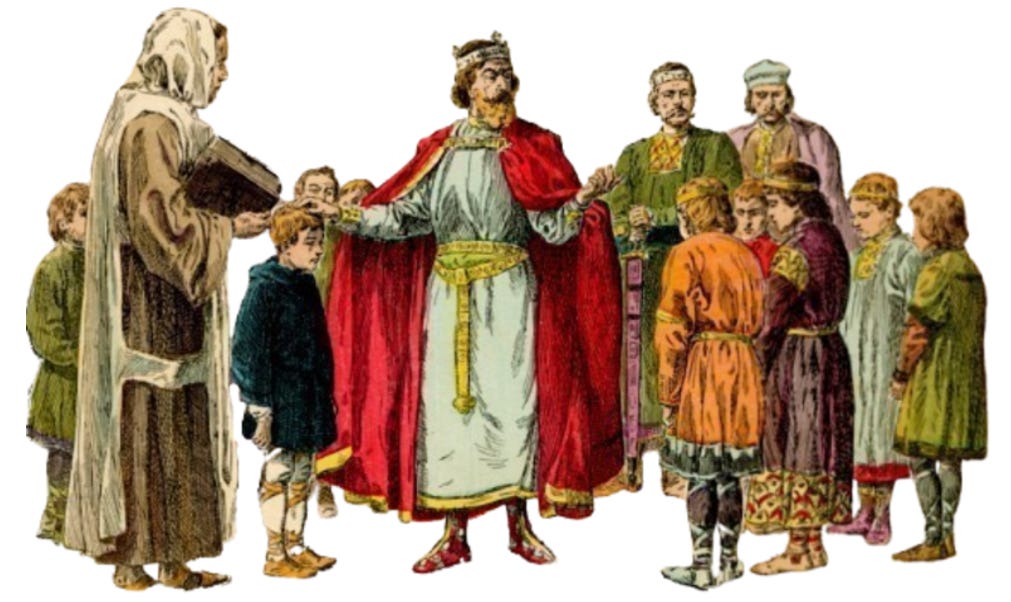
Figure 1.70: Charlemagne (748–814) visiting a school from an early twentieth century French schoolbook [[xx]].
That so much was preserved in spite of the gradual collapse of Roman political organisation and social structure under the impact, first, of Goths, Vandals and Franks, and then, in the 9th century, of Norsemen, was due to the appearance of monasteries with their attendant schools which began in Western Europe after the foundation of Monte Cassino by St. Benedict in 529. The existence of such centres made possible the temporary revivals of learning in Ireland in the 6th and 7th centuries, in Northumbria in the time of Bede (672/3–735), and in Charlemagne’s empire in the 9th century. Charlemagne invited Alcuin (c. 735–804) from Northumbria to become his minister of education, and one of Alcuin’s essential reforms was to establish schools associated with the more important cathedrals [[xxi]].
Charles Martel (688–741) turned back the Moslem invasion at the Battle of Poitiers in 732. His grandson, Charlemagne (748–814), inherited and expanded the dynasty’s holdings to include France, Germany, and Northern Italy. Pope Leo III (750–816) crowned him Holy Roman Emperor on Christmas Day in 800. A big empire required educated administrators to manage it. Despite his own limited literacy, Charlemagne launched an ambitious educational reform by ordering schools at cathedrals throughout his realm under the leadership of the learned Northumbrian monk Alcuin of York [[xxii], [xxiii], [xxiv]]. The cathedral schools of Charlemagne were “an evolutionary step on the path to the formation of the university” [[xxv], [xxvi], [xxvii]].
For instance, the University of Paris evolved from the cathedral school of Notre Dame in the 12th century [[xxviii]]. Peter Abelard (1079–1142) was a French philosopher, theologian, and celebrated teacher whose mastery of logic attracted students from across Europe to the schools of Paris. His dialectical method of examining and reconciling competing authorities became a cornerstone of scholastic education and helped lay the intellectual foundations of the medieval university system [[xxix]].
In the twelfth century the impulse of men below the ecclesiastical and feudal hierarchies was to seek security and strength by forming associations for mutual aid and to create in doing so modes and regulations of self-government. In essence the universities were like a craft-gild, an association for the protection and regulation of their craft of learning, and at long last they monopolized their name [[xxx]].
The guild could be an association of students, as in Bologna, or of scholars, as in Paris [[xxxi]]. These associations eventually became corporations, legal entities with distinct rights and privileges, and a degree of autonomy. Pope Gregory IX (1145–1241) in 1231 issued a statue defining the rights of scholars and students [[xxxii]], the “Magna Charta” of the University of Paris [[xxxiii]].
Similarly, the School of Salerno, famous by the tenth century, is often considered Europe’s earliest university-level institution. Drawing on Greek, Latin, Arabic, and Jewish medical traditions, it became the leading medical school of medieval Europe, and in 1231, Frederick II (1194–1250) made its examinations a prerequisite for medical practice in his realm [[xxxiv]].
Unlike in Byzantium or in the Islamic world where institutions of learning were tightly controlled by religious and political leaders, the medieval university became an independent and co-equal institutional power [[xxxv]]. The Sacerdotium, the Imperium (or Regnum), and the Studium (i.e. Priesthood, Kingship, and Scholarship) were the three pillars of medieval cultural power encompassing spiritual, temporal, and intellectual authority [[xxxvi], [xxxvii]]. The power of the Studium made manifest in the universities would survive the downfall of the monasteries from which they emerged… for a while.
That’s all for now. Remember always to keep calm, and make physics great again.
See you next week,
Hans
P.S. Pick up your copy of Fields & Energy Book I: Fundamentals and Origins of Electromagnetism, if you haven’t already:
Next time: II 1.7.2.7 Monasticism: Dissolution and Downfall: How Great Institutions Lose Their Legitimacy
Enjoyed the article, but maybe not quite enough to spring for a paid subscription?
Then click on the button below to buy me a coffee. Thanks!

Full Table of Contents [click here]
You may follow me online in other places as well:
Telegram: 𝔸𝕖𝕥𝕙𝕖𝕣𝕔𝕫𝕒𝕣’𝕤 𝔸𝕖𝕥𝕙𝕖𝕣𝕤𝕥𝕣𝕖𝕒𝕞
Gab: @aetherczar
Twitter: @aetherczar
Amazon: Hans G. Schantz
[[i]] Cassiodori Senatoris Institutiones, R.A.B. Mynors, trans., Oxford: At the Clarendon Press, 1935, p. 151. “…Varro, peritissimus Latinorum,...” See: https://archive.org/details/bwb_P8-AHU-396/page/150/mode/2up
[[ii]] Pliny The Elder (AD 23/24–79), Natural History, Book VII, 114, Translated by Harris Rackham (1868–1944). “In the library founded at Rome [c. 39 BC] by Asinius Pollio [Gaius Asinius Pollio (c. 75 BC–AD 4)], the earliest library in the world [in Rome, not earliest in the world] established out of the spoils of war, the only statue of a living person erected was that of Marcus Varro, the bestowal by a leading orator and citizen of this crowning honour on one only out of the multitude of men of genius then existing constituting no less a distinction, in my own opinion, than when Pompey the Great [Gnaeus Pompeius Magnus (106–48 BC)] gave to that same Varro a naval crown for his conduct in the war with the pirates.” See: https://www.attalus.org/pliny/hn7b.html.
[[iii]] Cassiodorus, Institutions of Divine and Secular Learning and On the Soul, Translated with notes by James W. Halporn, and an introduction by Mark Vessey, Liverpool: Liverpool University Press, 2004, p. 188. See: https://amzn.to/4aaMqDX.
[[iv]] Cassiodori Senatoris Institutiones, R.A.B. Mynors, trans., Oxford: At the Clarendon Press, 1935, pp. 91-92. “…quarto de mathematica, quae quattuor complectitur sciplines disciplinas, id est, arithmeticam, geometricam, musicam et astronomicam.” See: https://archive.org/details/bwb_P8-AHU-396/page/92/mode/2up
[[v]] Crombie, A.C., Augustine to Galileo, vol. I, Cambridge, Massachusetts: Harvard University Press, 1961, p. 13. https://archive.org/details/bwb_KV-166-220/page/12/mode/2up
[[vi]] Falk, Seb, The Light Ages: The Surprising Story of Medieval Science, New York: W.W. Norton & Company, 2020, pp. 82-83. See: https://amzn.to/4o5pefW
[[vii]] Crombie, A.C., Augustine to Galileo, vol. I, Cambridge, Massachusetts: Harvard University Press, 1961, p. 10. https://archive.org/details/bwb_KV-166-220/page/10/mode/2up
[[viii]] Cassiodori Senatoris Institutiones, R.A.B. Mynors, trans., Oxford: At the Clarendon Press, 1935, p. 109. “Dialecticam vero et rethoricam Varro in novem Disciplinarum libris tali similitudine definivit: ‘Dialectica et rethorica est quod in manu hominis pugnus astrictus et palma distensa,’ (illa brevi oratione argumenta concludens, ista facundiae campos copioso sermone discurrens, ) illa verba contrahens, ista distendens. dialectica siquidem ad disserendas res acutior, rethorica ad illa quae nititur docenda facundior.” See: https://archive.org/details/bwb_P8-AHU-396/page/108/mode/2up
[[ix]] Falk, Seb, The Light Ages: The Surprising Story of Medieval Science, New York: W.W. Norton & Company, 2020, p. 83. See: https://amzn.to/4o5pefW
[[x]] Herrad of Landsberg (c. 1130–1195), “Philosophy and the Seven Liberal Arts,” as illustrated in Hortus deliciarum, c. 1180. From an 1818 copy of the 1180 original wich was destroyed in the Franco-Prussian War, 1870. See: https://commons.wikimedia.org/wiki/File:Hortus_Deliciarum,_Die_Philosophie_mit_den_sieben_freien_K%C3%BCnsten.JPG
[[xi]] Cassiodorus, Institutions of Divine and Secular Learning and On the Soul, Translated with notes by James W. Halporn, and an introduction by Mark Vessey, Liverpool: Liverpool University Press, 2004, p. 99. See: https://amzn.to/4aaMqDX.
[[xii]] Brown, Peter, The Rise of Western Christendom, Triumph and Diversity, 2nd ed., Malden, MA: Blackwell Publishing, 2003, p. 197. See: https://amzn.to/4a8lqVF
[[xiii]] Reynolds, L.D. and N.G.Wilson, Scribes and Scholars: A Guide to Transmission of Greek & Latin Literature, 2nd ed., Oxford: Clarendon Press, 1974, p. 72. See: https://archive.org/details/bwb_S0-BKW-016/page/72/mode/2up
[[xiv]] Grant, Edward, God & Reason in the Middle Ages, Cambridge University Press, 2004, p. 84. See: https://amzn.to/3Pc20rv.
[[xv]] Cassiodori Senatoris Institutiones, R.A.B. Mynors, trans., Oxford: At the Clarendon Press, 1935, p. 93. “…quarto de mathematica, quae quattuor complectitur sciplines disciplinas, id est, arithmeticam, geometricam, musicam et astronomicam.” See: https://archive.org/details/bwb_P8-AHU-396/page/92/mode/2up
[[xvi]] Cassiodori Senatoris Institutiones, R.A.B. Mynors, trans., Oxford: At the Clarendon Press, 1935, pp. 91-92. “…quarto de mathematica, quae quattuor complectitur sciplines disciplinas, id est, arithmeticam, geometricam, musicam et astronomicam.” See: https://archive.org/details/bwb_P8-AHU-396/page/92/mode/2up
[[xvii]] Cassiodorus, Institutions of Divine and Secular Learning and On the Soul, Translated with notes by James W. Halporn, and an introduction by Mark Vessey, Liverpool: Liverpool University Press, 2004, p. 208. See: https://amzn.to/4aaMqDX.
[[xviii]] Cassiodorus, Institutions of Divine and Secular Learning and On the Soul, Translated with notes by James W. Halporn, and an introduction by Mark Vessey, Liverpool: Liverpool University Press, 2004, p. 208. See: https://amzn.to/4aaMqDX.
[[xix]] Cassiodorus, Institutions of Divine and Secular Learning and On the Soul, Translated with notes by James W. Halporn, and an introduction by Mark Vessey, Liverpool: Liverpool University Press, 2004, p. 82, and more generally, pp. 80-97. See: https://amzn.to/4aaMqDX.
[[xx]] Charlemagne visitant une école. Lithographie en couleurs par E. Crété d’après une illustration de H. Grobet, Histoire de France, Paris, Émile Guérin, 1902. See: https://commons.wikimedia.org/wiki/File:H._Grobet_-_Charlemagne_visitant_une_%C3%A9cole.jpg
[[xxi]] Crombie, A.C., Augustine to Galileo, vol. I, Cambridge, Massachusetts: Harvard University Press, 1961, p. 13. https://archive.org/details/bwb_KV-166-220/page/12/mode/2up
[[xxii]] Hannam, James, The Genesis of Science: How the Christian Middle Ages Launched the Scientific Revolution, Washington: Regnery, 2011, pp. 13-15. See: https://amzn.to/4b8YbLD
[[xxiii]] Previté-Orton, Charles William (1877-1947), Cambridge Medieval History, vol. 1, Switzerland: Castalia Library, 2024, pp. 326-327. See: https://archive.org/details/shortercambridge0000prev/page/326/mode/2up
[[xxiv]] Innis, Harold A. (1894–1952), The Bias of Communications, Victoria, BC: Rare Treasures, originally published 1951, p. 21. See: https://amzn.to/4vGgkIS
[[xxv]] Grant, Edward, God & Reason in the Middle Ages, Cambridge University Press, 2004, p. 29. See: https://amzn.to/3Pc20rv.
[[xxvi]] Rashdall, Hastings, 1858-1924, The universities of Europe in the middle ages, Oxford : The Clarendon press, 1895, p. 29. See: https://archive.org/details/universitiesofeu01rash_0/page/28/mode/2up .
[[xxvii]] Previté-Orton, Charles William (1877-1947), Cambridge Medieval History, vol. 1, Switzerland: Castalia Library, 2024, pp. 621-623. See: https://archive.org/details/shortercambridge0000prev/page/622/mode/2up
[[xxviii]] Haskins, Charles Homer, The Rise of Universities, New York: Henry Holt and Company, 1923, p. 19. See: https://archive.org/details/in.ernet.dli.2015.77813/page/18/mode/2up
[[xxix]] Rashdall, Hastings, (1858-1924), The universities of Europe in the middle ages, Oxford : The Clarendon press, 1895, pp. 41-43. See: https://archive.org/details/universitiesofeu01rash_0/page/42/mode/2up
[[xxx]] Previté-Orton, Charles William (1877-1947), Cambridge Medieval History, vol. 1, Switzerland: Castalia Library, 2024, p. 621-622. See: https://archive.org/details/shortercambridge0000prev/page/620/mode/2up
[[xxxi]] Rashdall, Hastings, (1858-1924), The universities of Europe in the middle ages, Oxford : The Clarendon press, 1895, pp. 17-18. See: https://archive.org/details/universitiesofeu01rash_0/page/16/mode/2up
[[xxxii]] Gregory IX (1145–1241), Parens Scientiarum, 1231. See: https://la.wikisource.org/wiki/Parens_scientiarum
See also: https://websites.uta.edu/hunnicut/reading-list/readings-western-civilization/statutes-of-gregory-ix-for-the-university-of-paris-1231/
[[xxxiii]] Rashdall, Hastings, (1858-1924), The universities of Europe in the middle ages, Oxford : The Clarendon press, 1895, pp. 338-339. See: https://archive.org/details/universitiesofeu01rash_0/page/338/mode/2up
[[xxxiv]] Previté-Orton, Charles William (1877-1947), Cambridge Medieval History, vol. 1, Switzerland: Castalia Library, 2024, pp. 622-623. See: https://archive.org/details/shortercambridge0000prev/page/622/mode/2up
[[xxxv]] Reynolds, L.D. and N.G.Wilson, Scribes and Scholars: A Guide to Transmission of Greek & Latin Literature, 2nd ed., Oxford: Clarendon Press, 1974, p. 64. See: “Other scholarly work was done by the monk Nicephorus Blemmydes (c. 1197-c. 1272), who wrote on many topics, including logic, physics, and geography, and made a journey to parts of the old empire now under Latin control in search of books that could not be found in Asia Minor. This is one of the few short periods in which literary studies flourished outside the capital.” See: https://archive.org/details/bwb_S0-BKW-016/page/64/mode/2up
[[xxxvi]] Jordan of Osnabrück (fl. c. 1270–1280), Chronica, in Simon Schardius (1535–1573) (ed.), De Jurisdictione, Autoritate, et Praeeminentia Imperiali, Basel, 1566, p. 307.
“His siquidem tribus, scilicet Sacerdotio Imperio et Studio, tanquam tribus_ uirtutibus uidelicet naturali uitali et scientiali, catholica ecclesia spiritualiter mirificatur, augmentatur et regitur. His itaque tribus, tanquam fundamento, pariete | et tecto, eadem ecclesia tanquam materialiter _ proficit.’”
“By these three, namely, Priesthood, Empire and Study, as by three virtues, namely, natural, vital and scientific, the Catholic Church is spiritually wondrous, increased and governed. And so by these three, as by foundation, wall and roof, the same Church, as by materially, profits.’”
As quoted by Rashdall, Hastings, (1858-1924), The universities of Europe in the middle ages, Oxford : The Clarendon press, 1895, p. 29. See: https://archive.org/details/universitiesofeu01rash_0/page/4/mode/2up
[[xxxvii]] Previté-Orton, Charles William (1877-1947), Cambridge Medieval History, vol. 1, Switzerland: Castalia Library, 2024, p. 626. See: https://archive.org/details/shortercambridge0000prev/page/626/mode/2up
Comments
Nothing yet. Say the first thing.
Sign in to join the conversation.