
In 529, when Benedict of Nursia (c. 480–547) founded the Abbey of Monte Cassino on the site of an abandoned Temple of Apollo on a mountain top southeast of Rome, Christian monasticism already had a long tradition.
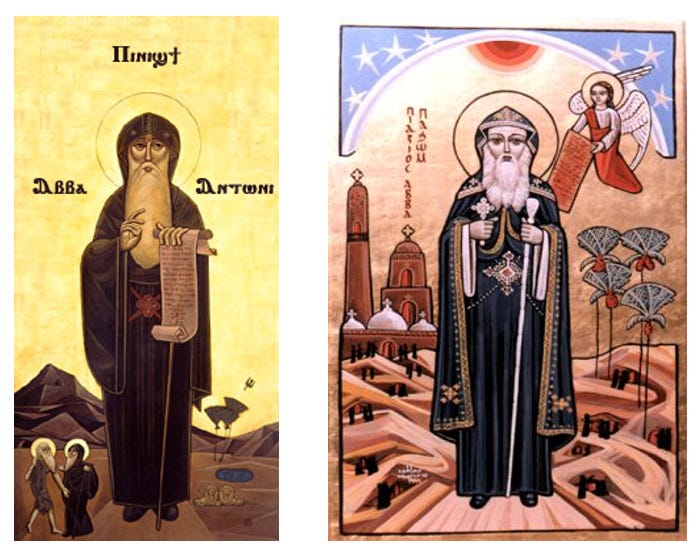
In the third and fourth centuries, Christians withdrew into the deserts of Egypt, Palestine, and Syria in pursuit of prayer, self-discipline, and spiritual perfection [[i], [ii]]. Anthony the Great (c. 251–356), often regarded as the father of Christian monasticism, withdrew into the Egyptian desert to pursue a life of prayer, ascetic discipline, and spiritual struggle, becoming the model for generations of hermits and monks throughout Christendom [[iii]]. Mary of Egypt (c. 344–421), one of the most celebrated desert ascetics, abandoned a life of promiscuity and vice after a dramatic conversion in Jerusalem and spent nearly half a century in solitary repentance and prayer beyond the Jordan, becoming an enduring symbol of spiritual transformation and holiness [[iv]].
Where Anthony proscribed solitude punctuated by communal worship on Saturdays and Sundays, his contemporary, Pachomius (c. 292–348) organized ascetics into communal settlements governed by common rules [[v]]. Anthony pioneered the “eremitic” tradition of solitary desert asceticism, while Pachomius developed “cenobitic” monasticism, organizing monks into communities governed by a common rule.
UPDATE. I was just studying libraries for a later section, and came across this gem from Clark, John Willis (1833–1910), The Care of Books, 1909, pp. 64-65: “The Rule of S. Pachomius (A.D. 292-345), whose monastery was at Tabennisi near Denderah in Upper Egypt, provides that the books of the House are to be kept in a cupboard (fenestra) in the thickness of the wall. Any brother who wanted a book might have one for a week, at the end of which he was bound to return it. No brother might leave a book open when he went to church or to meals. In the evening the officer called “the Second,” that is, the second in command, was to take charge of the books, count them, and lock them up.”
Basil the Great (c. 330–379) further developed the communal model, arguing that Christian virtues such as charity, humility, and service are best cultivated within a disciplined community. The Lord in humility and charity washed the feet of his disciples. “Whom, therefore, will you wash… if you live alone?” [[vi]]. Basil thereby helped establish the form of monastic life that would dominate both the Byzantine East and, indirectly, the West.
Augustine of Hippo (354–430) recounts how an acquaintance told him the story of two imperial officials who encountered Athanasius of Alexandria’s (c. 296–373) Life of Anthony and abandoned their worldly careers to pursue the ascetic life [[vii]]. Augustine presents this as a catalyst leading to his conversion.
John Cassian (c. 360–435), drawing on firsthand experience among the Egyptian Desert Fathers, transmitted the ideals of Eastern asceticism to the Latin West through his Institutes and Conferences, works that profoundly influenced Benedictine monasticism [[x]]. They “cut themselves off…” he explained, “from the life of this world, and were called monks… [T]hey are called cenobites from their common fellowship, and their cells and dwelling places are called cenobia” [[xi]]. “This vast work, then,” Cassian’s translator explains, “is about obtaining purity of heart through the exercise of discretion, all for the sake of preparing oneself for the kingdom of heaven” [[xii], [xiii]].
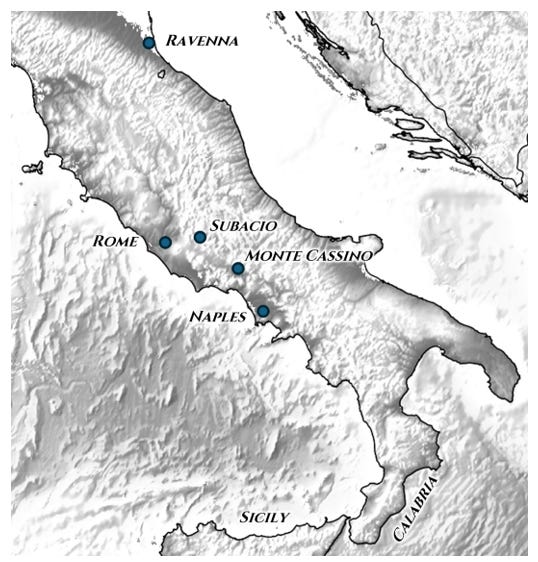
In the sixth century, shepherds in the Apennines near the village of Subiaco encountered a hermit clothed in animal skins and living in a cave, whom they at first mistook for a beast. As word of his wisdom spread, visitors came seeking spiritual counsel, and eventually a community of monks asked him to become their abbot. After founding a number of small monastic settlements near Subiaco, Benedict of Nursia (c. 480–547) finally settled atop Monte Cassino overlooking the old Rome–Naples highway. There in 529, he founded the community that would become the cradle of Western monasticism [[xiv]].
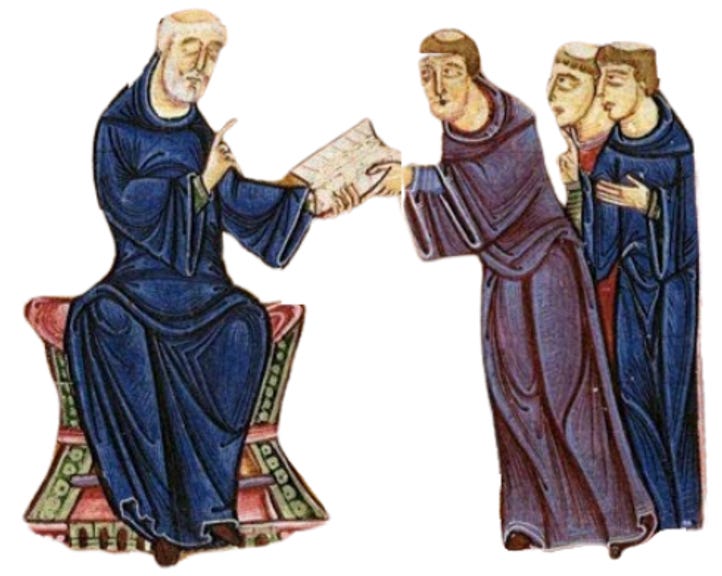
Drawing on the asceticism of St. Anthony and the Desert Fathers, the communal discipline of St. Pachomius, the theological vision of St. Basil, and the spiritual wisdom of St. Cassian, in 516 Benedict fashioned a moderate yet disciplined and durable rule that transformed monasticism from a movement of ascetics into one of the most successful institutions of medieval civilization [[xvi]]. “He wrote a Rule for monks, a work outstanding in good judgment and clearly expressed” [[xvii]], declared Pope Gregory I (c. 504–604).
That discipline was austere, but not excessively or emulously ascetic. Chastity, poverty, and obedience were as usual the three vows. The black dress of tunic and cowl was simple, flesh food was forbidden, the life was busy secluded and hard, but its conditions and its clothing were not so unlike those of the Italian peasant as to be fiercely ascetic… [[xviii]]
By integrating prayer, productive work, and study into a common rule of life, Benedict created an institution that simultaneously served God, formed character, preserved knowledge, and cultivated habits of discipline and organization.
Roughly speaking, the monk’s time was to be divided into three daily portions after allowing eight hours for sleep. First of all, and their essential duty, was the Opus Dei, the daily common services chanted in choir, taking some four and a half hours altogether. Second came manual work in field or cloister, an integral part of St Benedict’s ideal, which occupied six or seven hours more. Last was reading of Scripture and the Fathers, to which were allotted three to five hours. It was a simple, busy life without ulterior ambitions. To make his monks good men practising the Christian virtues in obedience and humility was the aim of St Benedict [[xix]].
Benedict did not found monasteries to preserve science and civilization. He founded them for the glory of God, “a school for the Lord’s service,” in the words of the prologue to his Rule [[xx], [xxi]]. Yet the means he prescribed proved remarkably effective at cultivating, transmitting, and applying knowledge across generations.
Monks spent hours each day reading and reciting Scripture, studying the Church Fathers, copying texts, and reflecting on what they read. Before they could be ordained, “each new entrant into the monastery was required to learn Benedict’s Rule and the complete psalter of 150 psalms” [[xxii]]. To support this practice, monasteries accumulated libraries and produced manuscripts. In preserving Christian texts, they often preserved classical works as well.
Monks made their devotions and chanted the hours at precise times of the day.
The first topic Benedict had covered after introducing the core monkish qualities of obedience and humility was the regular routine of the liturgy, and so the first thing novices had to learn — after the rule itself — were the patterns of the daily offices. From Nocturns and Lauds through the numbered hours of Prime, Terce, Sext and Nones (with additional masses), to Vespers and Compline, each had its canon of antiphons, psalms, prayers, readings, and responses. All were carefully performed and precisely timed [[xxiii]].
They pursued astronomy and timekeeping with religious devotion. “The use of the stars to regulate the times of prayers goes back to the earliest monastic instruction books” [[xxiv]]. That same devotion led monastics to be among the pioneers of mechanical clocks in the thirteenth century [[xxv], [xxvi]]. Before that, wealthier monasteries might use water clocks which we know from a twelfth century account of a clock being used to put out a fire [[xxvii]].
Monks vowed to remain with their communities. Unlike wandering ascetics, monasteries could build libraries, maintain archives, accumulate practical knowledge, and pass experience from one generation to the next.
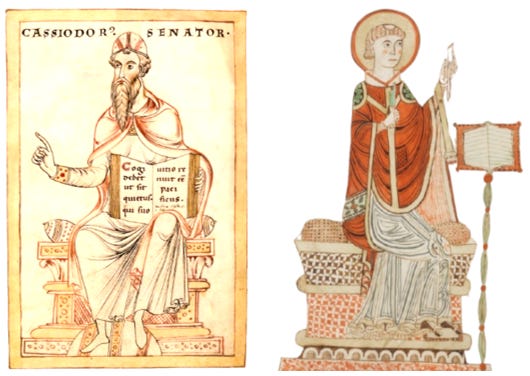
Government patronage helped. A contemporary of Benedict, and a former “Quaestor” or statesman under Theodoric the Great (454–526), King of the Ostrogths and of Italy and much of the former Western Roman Empire at the time (475–526) played a critical role. Cassiodorus (c. 485–c. 585) attempted to found a Christian University in Rome c. 535. That effort failed. When he retired during the Gothic Wars in 544, he founded the monastery of Vivarium on his estate in Calabria in Southern Italy, where he assembled a major library and encouraged the systematic study and copying of manuscripts [[xxviii], [xxix]].
Apart from setting aside a period each day for reading—a spiritual rather than intellectual operation—the Benedictine Rule had nothing to say about intellectual pursuits, and the copying of books had no explicit part in the monastic ideal; but, in saying nothing, it left the way open for liberal influences when the time was ripe, and reading could in any case not be carried on without books [[xxxiv]]
While Scripture and the Church Fathers remained the primary focus, Cassiodorus argued that classical learning could serve Christian ends and should be preserved alongside sacred texts [[xxxii]]. “The Institutiones of Cassiodorus, the best known and most revered of his literary works, may truly be called one of the main foundation stones of Mediaeval Latin culture…” [[xxxiii]]. It is unlikely all the Latin classics would have reached us were it not for his efforts. Through his writings, library, and example, Cassiodorus helped establish the Benedictine tradition of scholarship that played a crucial role in transmitting both Christian and classical learning through the turmoil of the early Middle Ages [[xxxv], [xxxvi], [xxxvii]].
On the distant frontiers of Christian Europe, the Venerable Bede (673–735) could draw on the extensive resources of his seventh-century Northumbrian monastery to compile the first English history and to write many learned treatises on Scripture, poetry, and astronomical calculation [[xxxviii], [xxxix], [xl]]. His successor, Alcuin of York (735–804) praised the Northumbrian libraries [[xli]] which started him on his path to become a counsellor to Charlemagne (748–814) [[xlii]]. Monasticism made knowledge institutional, rather than merely personal, distributed instead of centralized, and enduring rather than transient.
That’s all for now. Remember always to keep calm, and make physics great again.
See you next week,
Hans
P.S. Pick up your copy of Fields & Energy Book I: Fundamentals and Origins of Electromagnetism, if you haven’t already:
Next time: II 1.7.2.5 Monasticism: Pray & Work; Guardians of Agriculture and Technology
Enjoyed the article, but maybe not quite enough to spring for a paid subscription?
Then click on the button below to buy me a coffee. Thanks!

Full Table of Contents [click here]
You may follow me online in other places as well:
Telegram: 𝔸𝕖𝕥𝕙𝕖𝕣𝕔𝕫𝕒𝕣’𝕤 𝔸𝕖𝕥𝕙𝕖𝕣𝕤𝕥𝕣𝕖𝕒𝕞
Gab: @aetherczar
Twitter: @aetherczar
Amazon: Hans G. Schantz
[[i]] Wortley, John, An Introduction to the Desert Fathers, Cambridge: Cambridge University Press, 2019. See: https://amzn.to/43JkBif
[[ii]] Wortley, John, An Introduction to the Desert Fathers, Fifteen Eighty Four: Academic perspectives from Cambridge University Press, 16 April, 2019. See: https://cambridgeblog.org/2019/04/an-introduction-to-the-desert-fathers/
[[iii]] Athanasius I of Alexandria (c. 296–373), The Life of Antony and the Letter to Marcellinus, Translated by Robert C. Gregg, New York: Paulist Press, 1980. See: https://www.newadvent.org/fathers/2811.htm Written shortly after the death of Saint Anthony the Great (c. 251–356) by Athanasius of Alexandria, it became a bestseller of the ancient Christian world, inspiring ascetic movements throughout both the Greek East and Latin West. Note that the Saint’s Greek name is Ἀντώνιος (Antonios) which can be rendered either Antony or Anthony in English.
[[iv]] Sophronius (c. 560–638), The Life of Our Venerable Mother Mary of Egypt, See: https://stmaryofegypt.org/files/library/life.htm
[[v]] Previté-Orton, Charles William (1877-1947), Cambridge Medieval History, vol. 1, Switzerland: Castalia Library, 2024, pp. 72-73.
[[vi]] Basil the Great (c. 330–379), Ascetical Works, trans. Sister M. Monica Wagner, Fathers of the Church vol. 9, Washington, DC: Catholic University of America Press, 1950, p. 252. Basil went on to declare: “This kind of life has as its aim the glory of God according to the command of our Lord Jesus Christ, who said: ‘So let your light shine before men that they may see your good works and glorify your Father who is in heaven.’ It maintains also the practice characteristic of the saints, of whom it is recorded in the Acts: ‘And all they that believed were together and had all things common,’ and again: ‘And the multitude of believers had but one heart and one soul; neither did anyone say that aught of the things which he possessed was his own, but all things were common unto them.’” See: https://archive.org/details/writings0009basi/page/252/mode/2up
[[vii]] Augustine of Hippo (354–430), Confessions, Book VIII, Ch. 6-12. See: https://www.newadvent.org/fathers/110108.htm
[[viii]] Coptic icon of Anthony the Great (251–357). See: https://commons.wikimedia.org/wiki/File:StAnthony.jpg
[[ix]] Icon of Saint Pachomius (c. 292-348), also known as Abba Pachomius and Pakhom. See: https://commons.wikimedia.org/wiki/File:StPakhom.jpg
[[x]] Stewart, Columba, Cassian the Monk, New York: Oxford Press, 1998. See: https://archive.org/details/cassianmonk0000stew
[[xi]] Cassian, John (c. 360–435), The Conferences, Translated by Boniface Ramsey, Ancient Christian Writers 57. New York: Newman Press, 1997, p. 638. See: https://archive.org/details/johncassianconfe0000cass/page/638/mode/2up
[[xii]] de Vogué, Adalbert, “Understanding Cassian: A Survey of the Conferences,” Cistercian Studies Quarterly vol. 19, 1984, pp. 101-121, as cited in Cassian, John (c. 360–435), The Conferences, Translated by Boniface Ramsey, Ancient Christian Writers 57. New York: Newman Press, 1997, p. 12.
“…[T]here appears to exist a complex and refined interrelationship among almost all the different conferences. Not only do they follow one another in logical order, picking up previously introduced themes and elaborating on them. In addition, in his view, both the odd-numbered and the even-numbered conferences develop certain common ideas and constitute two parallel series. The odd-numbered conferences are occupied in some form or other with the goal of the monk, purity of heart, whereas the even-numbered ones deal with discretion and with making one’s way carefully between opposing vices” See: https://archive.org/details/johncassianconfe0000cass/page/12/mode/2up
[[xiii]] Cassian, John (c. 360–435), The Conferences, Translated by Boniface Ramsey, Ancient Christian Writers 57. New York: Newman Press, 1997, p. 20. See: https://archive.org/details/johncassianconfe0000cass/page/20/mode/2up
[[xiv]] Rennie, Kriston R., The Destruction and Recovery of Monte Cassino, 529-1964, Amsterdam University Press, 2021, pp. 5–15. See: https://dokumen.pub/qdownload/the-destruction-and-recovery-of-monte-cassino-529-1964-9789048552122.html. Rennie credits Benedict’s twin (?) sister, St. Scholastica (480–547) as co-founder. His sister Scholastica appears to have led a nearby community of religious women that later became associated with the Benedictine tradition, but there is no surviving evidence she was directly involved in the founding of Monte Cassino.
[[xv]] St. Benedict (c. 480–547) delivering his Rule to St. Maurus and other monks of his order, France, Monastery of St. Gilles, Nimes, 1129. See: https://upload.wikimedia.org/wikipedia/commons/f/fc/St._Benedict_delivering_his_rule_to_the_monks_of_his_order.jpg
[[xvi]] Benedict, Saint, Abbot of Monte Cassino (c. 480–547), The rule of S. Benet. Latin and Anglo-Saxon interlinear version, Logeman, H. (Henri), 1862-1936, ed., London: Early English Text Society, by N. Trübner and Co., 1888, p. xv. See: https://archive.org/details/rulesbenetlatin00logegoog/page/n22/mode/2up. Dating the rule from 516 suggests it was written in Benedict’s Subiaco years. While the lived experience came from Subiaco; the final synthesis was probably produced at Monte Cassino after 529. That pattern would fit remarkably well with the character of the Rule, which reads less like a founding manifesto and more like the distilled wisdom of an experienced abbot reflecting on decades of monastic leadership.
[[xvii]] Gregory I, Pope, (c. 540-604), The dialogues of Gregory the Great. Book two: Saint Benedict, Indianapolis: Bobbs-Merrill, 1967, p. 46. Chapter XXXVI: I should like to tell many other stories about this venerable abbot, Peter. But I am purposely omitting some incidents because I am hurrying along to tell about the achievements of other saints. However, I want you to realize that in addition to the many miracles which made him famous, he also distinguished himself by his teaching. He wrote a Rule for monks, a work outstanding in good judgment and clearly expressed. Whoever may wish to have a fuller understanding of his character and his life can find all the acts of his administration in this Book of the Rule. For that saint was incapable of teaching a way of life that he did not practice.
See: https://archive.org/details/dialoguesofgrego00greg/page/n71/mode/2up
[[xviii]] Previté-Orton, Charles William (1877-1947), Cambridge Medieval History, vol. 1, Switzerland: Castalia Library, 2024, p. 285. See: https://archive.org/details/shortercambridge0000prev/page/284/mode/2up
[[xix]] Previté-Orton, Charles William (1877-1947), Cambridge Medieval History, vol. 1, Switzerland: Castalia Library, 2024, p. 285. See: https://archive.org/details/shortercambridge0000prev/page/284/mode/2up
[[xx]] Benedict, Saint, Abbot of Monte Cassino (c. 480–547), The rule of S. Benet. Latin and Anglo-Saxon interlinear version, Logeman, H. (Henri), 1862-1936, ed., London: Early English Text Society, by N. Trübner and Co., 1888, p. 6. In the prologue, Benedict discusses constructing a dominici scola servitii, a school for the service of God. See: https://archive.org/details/rulesbenetlatin00logegoog/page/n78/mode/2up?q=+dominici
[[xxi]] Benedict, Saint, Abbot of Monte Cassino (c. 480–547), The Rule of Saint Benedict, Translated and with an Introduction by Cardinal Gasquet, London: Chatto & Windus, 1925, p. 6. See: https://archive.org/details/ruleofsaintbened0000bene/page/6/mode/2up
[[xxii]] Falk, Seb, The Light Ages: The Surprising Story of Medieval Science, New York: W.W. Norton & Company, 2020, p. 65. See: https://amzn.to/4o5pefW
[[xxiii]] Falk, Seb, The Light Ages: The Surprising Story of Medieval Science, New York: W.W. Norton & Company, 2020, p. 45. See: https://amzn.to/4o5pefW
[[xxiv]] Falk, Seb, The Light Ages: The Surprising Story of Medieval Science, New York: W.W. Norton & Company, 2020, p. 47. See: https://amzn.to/4o5pefW
[[xxv]] Falk, Seb, The Light Ages: The Surprising Story of Medieval Science, New York: W.W. Norton & Company, 2020, p. 55. See: https://amzn.to/4o5pefW
[[xxvi]] Crombie, A.C., Augustine to Galileo, vol. I, Cambridge, Massachusetts: Harvard University Press, 1961, p. 211.
[[xxvii]] Falk, Seb, The Light Ages: The Surprising Story of Medieval Science, New York: W.W. Norton & Company, 2020, p. 47, 49. See: https://amzn.to/4o5pefW
[[xxviii]] Reynolds, L.D. and N.G.Wilson, Scribes and Scholars: A Guide to Transmission of Greek & Latin Literature, 2nd ed., Oxford: Clarendon Press, 1974, p. 72. See: https://archive.org/details/bwb_S0-BKW-016/page/72/mode/2up
[[xxix]] Rand, E. K., “The New Cassiodorus,” Speculum (in Italian). XIII (4), October 1938, 433–447. doi:10.2307/2849664. JSTOR 2849664. See: https://www.journals.uchicago.edu/doi/pdf/10.2307/2849664
[[xxx]] Frontispiece showing Flavius Magnus Aurelius Cassiodorus (seated opposite Theodoric), fol. 2r of Leiden ms. vul. 46 (Gesta Theodorici), Manuscript on vellum. 186 ff., 220 x 125 mm. Fulda, dated 1176/7. See: https://commons.wikimedia.org/wiki/File:Gesta_Theodorici_-_Flavius_Magnus_Aurelius_Cassiodorus_(c_485_-_c_580).jpg
[[xxxi]] Venerable Bede in an illustrated manuscript, writing his Ecclesiastical History of the English People. Omiliae lectionum sancti evangelii Venerabilis Bedae presbiteri numero quinquaginta; Parchment; 135 ff. 28 x 20.4 cm Engelberg, 1143-1178 See: https://www.e-codices.unifr.ch/de/bke/0047/1v; https://commons.wikimedia.org/wiki/File:E-codices_bke-0047_001v_medium_(cropped).jpg
[[xxxii]] Previté-Orton, Charles William (1877-1947), Cambridge Medieval History, vol. 1, Switzerland: Castalia Library, 2024, p. 286, 288. See: https://archive.org/details/shortercambridge0000prev/page/286/mode/2up
[[xxxiii]] Ennis, Sister Mary Gratia, The Vocabulary of the Institutiones of Cassiodorus, Washington, DC The Catholic University of America Press, 1939, p. v. She adds “Though primarily intended by Cassiodorus for the guidance of the monks of his monastery of Vivarium, the two books of the Jnstitutiones either together or (more frequently) separately—since each satisfied a different need—soon came to be used throughout the West as a standard manual. Already in the early seventh century Isidore of Seville incorporated large sections of the Institutiones into his Etymologiae; Alcuin employed it in the late eighth century; in the early ninth century Rabanus Maurus incorporated large portions of Book II into his De institutione clericorum; in the middle of the century Aurelian of Réomé used the section on music and late in the same century Remigius of Auxerre used the portion on rhetoric. From the ninth century to the end of the Middle Ages, either through citations or from catalogues of mediaeval Latin manuscripts, we know that the Institutiones circulated and were studied as few other mediaeval works.” See: https://archive.org/details/vocabularyofinst0000sist/page/n5/mode/2up
[[xxxiv]] Reynolds, L.D. and N.G.Wilson, Scribes and Scholars: A Guide to Transmission of Greek & Latin Literature, 2nd ed., Oxford: Clarendon Press, 1974, p. 72. See: https://archive.org/details/bwb_S0-BKW-016/page/72/mode/2up
[[xxxv]] Reynolds, L.D. and N.G. Wilson, Scribes and Scholars: A Guide to Transmission of Greek & Latin Literature, 2nd ed., Oxford: Clarendon Press, 1974, p. 72-74. See: https://archive.org/details/bwb_S0-BKW-016/page/72/mode/2up
[[xxxvi]] Vukoviü, Marijana, The Library of Vivarium: Cassiodorus and the Classics, MA Thesis in Medieval Studies, Central European University, Budapest, May 2007. See: https://www.academia.edu/448008/THE_LIBRARY_OF_VIVARIUM_CASSIODORUS_AND_THE_CLASSICS
[[xxxvii]] Brown, Peter, The Rise of Western Christendom, Triumph and Diversity, 2nd ed., Malden, MA: Blackwell Publishing, 2003, pp. 196-197. See: https://amzn.to/4a8lqVF
[[xxxviii]] Crombie, A.C., Augustine to Galileo, vol. I, Cambridge, Massachusetts: Harvard University Press, 1961, p. 13, 176.
[[xxxix]] Previté-Orton, Charles William (1877-1947), Cambridge Medieval History, vol. 1, Switzerland: Castalia Library, 2024, p. 178. See: https://archive.org/details/shortercambridge0000prev/page/178/mode/2up
[[xl]] Laisterner, M.L.W. “The Library of the Venerable Bede,” collected in Bede: His Life, Times, and Writings, Essays in Commemoration of the Twelfth Centenary of his Death, A. Hamilton Thompson, ed. Oxford: At the Clarendon Press, 1935, pp. 237–266. Offers a list of the works in Bede’s library. See: https://archive.org/details/bedehislifetimes0000lord/page/236/mode/2up
[[xli]] Reynolds, L.D. and N.G.Wilson, Scribes and Scholars: A Guide to Transmission of Greek & Latin Literature, 2nd ed., Oxford: Clarendon Press, 1974, p. 79. See: https://archive.org/details/bwb_S0-BKW-016/page/78/mode/2up
[[xlii]] Previté-Orton, Charles William (1877-1947), Cambridge Medieval History, vol. 1, Switzerland: Castalia Library, 2024, p. 318. See: https://archive.org/details/shortercambridge0000prev/page/318/mode/2up
Comments
Nothing yet. Say the first thing.
Sign in to join the conversation.