
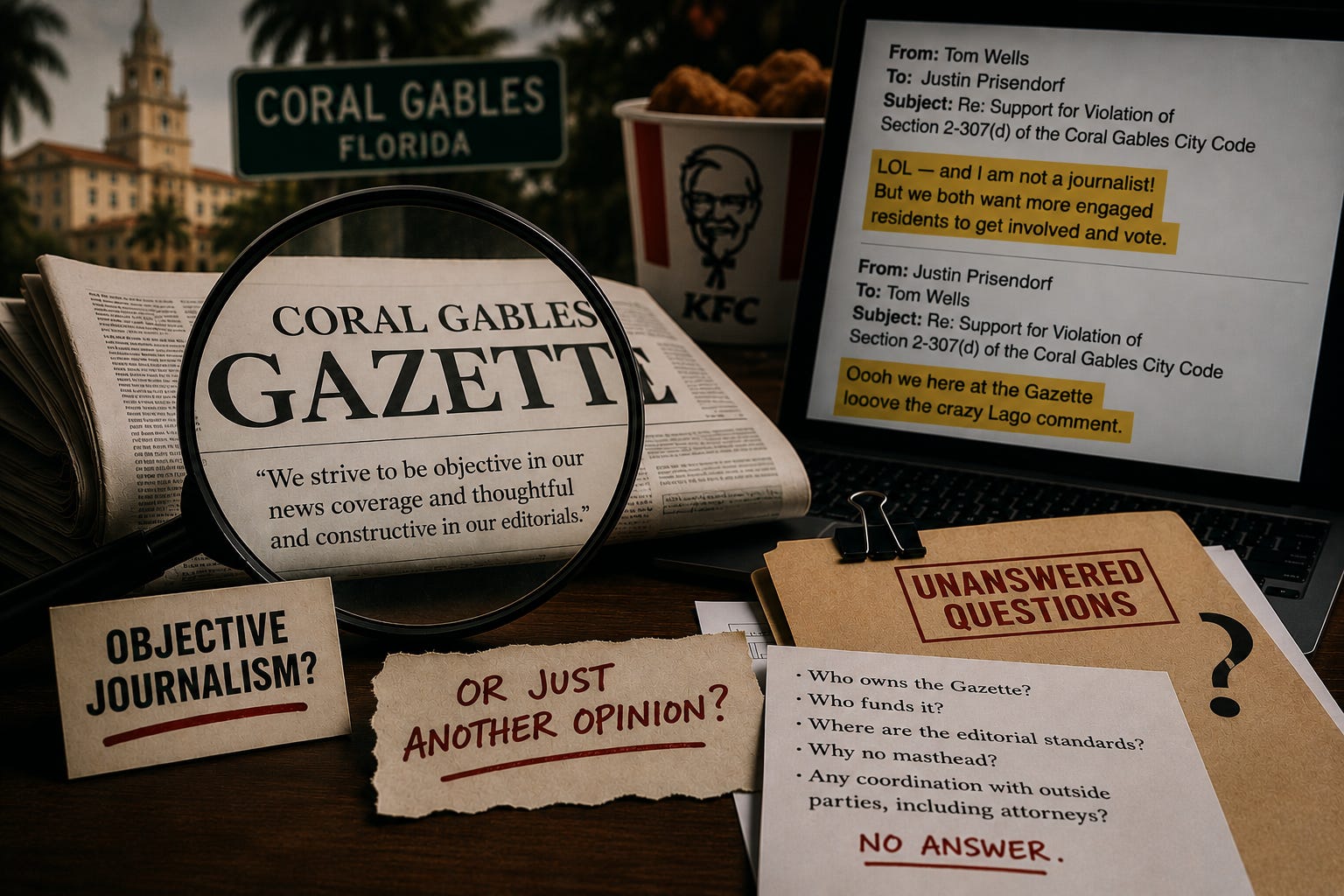
Note: This is another long one. Very Aesop of me. Once again, I’ll provide a brief summary in the hopes that it’ll get you reading. 😉
Summary:
I don’t claim to be objective. I’ve always disclosed my perspective and never hidden behind the false pretense of neutrality.
The Gables Gazette publicly claims to “strive to be objective.” This article examines whether its private conduct reflects that public promise.
A text exchange with former Gazette contributor Sebastian de Marmol raises questions about transparency and whether a narrative had already been established before I was ever contacted for comment.
A subsequent phone call with publisher Justin Prisendorf revealed a philosophy that appeared to condition fairness on whether someone “gets what they give”—a standard fundamentally different from the impartiality journalism claims to uphold.
Emails between Tom Wells and Justin Prisendorf paint a revealing picture of how a prospective article developed behind the scenes and what actually captured the publisher’s attention.
Additional correspondence between Mayor Vince Lago and Prisendorf raises unanswered questions about ownership, funding, editorial standards, and transparency—questions that were never answered despite repeated opportunities.
Throughout this piece, I distinguish between being subjective and pretending to be objective. Every writer has a perspective. The difference is whether they’re honest enough to admit it.
The central argument is simple: credibility isn’t built by claiming objectivity. It’s built through transparency, consistency, and a willingness to be scrutinized by the same standards applied to everyone else.
I recently shared a brief interaction with a resident that inspired me to write this piece. The resident approached me and joyfully asked if I was the Nicolas Cabrera associated with… you guessed it… Aesop’s Gables. After confirming I was indeed the contributor she suspected me to be, she proceeded to compliment my writing. I was grateful for the show of love, but surprised by what came next. Although she enjoys my writing, she stated she “wishes I were more objective.” I laughed, she laughed, George Merrick laughed. I also laughed when I read this:
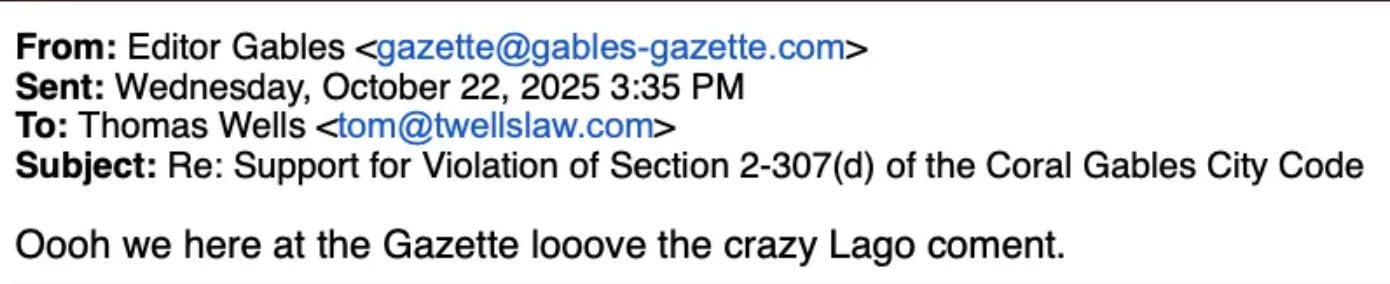
Did I read that right? Did YOU read that right? What you see there folks is nothing but a scandal. But before I get ahead of myself, let me give you some background.
See, I’ve never tried to hide behind the false pretense of objectivity. I own my views and I own what I write. For those of you who have been along for the ride since the early days of my contributions to Aesop’s Gables, you’ll recall I shared this disclaimer at the start of the second episode of Politics in Paradise:
There is no false pretense of objectivity here. In fact, I kindly told the lovely resident that if anyone ever tells you they’re objective, they’re lying. Especially in journalism. Nobody is truly objective. I’m certainly not. The honest admit it while the dishonest market it. That’s where the Gables Gazette comes into play.
Our city has always had its fair share of disagreements. That’s healthy. It’s the backbone of an efficient and effective local government and a flourishing democracy. What’s less healthy is when the outcome of a story appears to be pre-determined, well before reporting begins. Especially when the people shaping that story are not who they claim to be. Back in August of 2025, Justin Prisendorf — owner and publisher of the Gables Gazette — posted a response to an email circulated by the Coral Gables First PAC. In the post, the only one signed by Prisendorf by name, he stated the following:
“…the Gazette exists to inform, to engage, and to serve the people of Coral Gables. We focus on the issues that matter to residents and report with fairness, consistency, and care.
We strive to be objective in our news coverage and thoughtful and constructive in our editorials. The work of journalism is continuous: we aim to improve with every story, always focused on the people we serve.”
I actually agree with Prisendorf about the intent of local journalism: that it should exist to inform, engage, and serve the community. But we part ways at his claim that the Gazette strives to be objective. If someone, like Prisendorf, markets themselves as objective, we should be asking what they’re trying to convince us of. In this case, he’s trying to convince you of the credibility of the Gazette, despite the fact that he lives thousands of miles away and has no true vested interest in Coral Gables….

Prisendorf markets himself as a voice for the community without establishing his connection to it. He’s no longer a resident, but seeks to be a participant and an influencer of the narrative without properly situating himself among the people of Coral Gables. Credibility comes from disclosure, not from declaration. Even more so, transparency is the currency of credibility, and the Gazette is severely lacking in that field. Which is why my one and only written interaction with a former Gazette “contributor” was so striking.
Back in October of 2025, then Gazette contributor, Sebastian de Marmol, reached out to me via text following a string of accusations made by former Commission candidate Tom Wells against me during the public comments section at a city commission meeting. This is less about Wells than it is about de Marmol. Transparency begins with telling readers who is asking the questions. So I asked de Marmol to show me his credentials. Here’s the outcome of that brief text conversation:
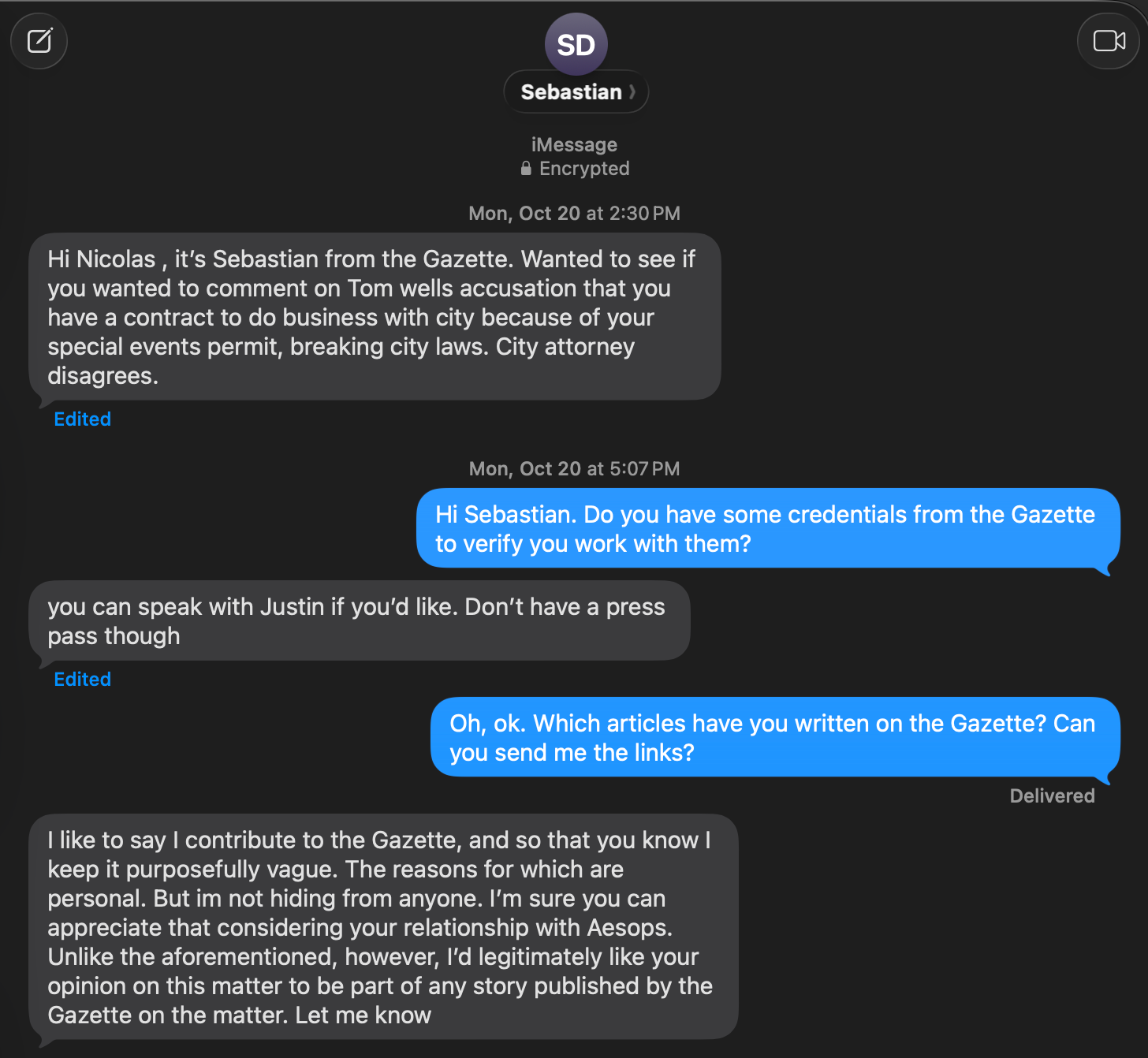
The reporting began with the conclusion. de Marmol doesn’t state that “we are looking into a claim” or that “we are reviewing allegations.” He starts by adopting the allegation as the premise and establishes the narrative direction before reporting. He didn’t ask me for context; he simply asked me to respond. His message was not investigative; it was confirmatory. This is how stories are written when the outcome is assumed at the outset. No discovery, just reinforcement.
The process is flawed. Then he deflects. In a single exchange with de Marmol, all credibility breaks down. To understand that, I broke his message apart piece by piece:
He admits he has no press credentials.
He defers legitimacy to the publisher, Prisendorf (“you can speak with Justin).
He refuses transparency (“I keep it purposefully vague”).
He attempts to neutralize my concern (“I’m sure you can appreciate that considering your relationship with Aesops”).
He frames my role incorrectly (“I’d legitimately like your opinion”).
This is not accidental. It is a pattern. I asked for basic verification, especially considering I did not have his number saved at the time and could not truly verify who I was communicating with. Instead, de Marmol deflected, the natural course of action when all other efforts are non-existent or exhausted. Journalism is not purposefully vague about who is asking questions. It is specific, it is attributable, and it is accountable. de Marmol — and by extension, the Gazette — was neither of the three. The only thing clear about this exchange was the lack of clarity around who was asking the questions, so I picked up the phone and I did what de Marmol recommended: I called Justin Prisendorf.
The conversation itself wasn’t remarkable. I didn’t walk away with a different impression and I gained no confidence in the process. If anything, the conversation simply confirmed what was already evident. One statement, however, stayed with me because it revealed something far more significant than the rest of the discussion.
In response to my involvement in local politics, Prisendorf asked if it was fair to say I get what I give. Put another way; You criticize people publicly, therefore you shouldn’t expect different treatment when they criticize you publicly. If Prisendorf had been speaking as an individual, not the publisher of the Gazette, it would be a perfectly ordinary opinion. In fact, I wrote about how elected officials should treat voters back in my May op-ed before I became an official contributor to Aesop’s. There is a standard our elected officials should follow, and it’s based on how they should treat their staunchest critics.
Prisendorf’s question is contrary to that standard. The issue here isn’t whether I should expect universal affection from the elected officials I hold accountable. Rather the issue is that the publisher claiming to “strive to be objective” framed fairness as something conditioned on the subject’s conduct. Journalism isn’t supposed to decide whether someone deserves fairness. Its obligation is to apply the same standards regardless of whether it likes the subject or dislikes them. Based on Prisendorf’s objective standard, my opinion should not matter. Wells’ opinion should not matter. Only the facts should. The moment fairness and objectivity become conditional upon whether someone “gets what they give”, journalism stops being journalism and becomes reciprocity.
What I did not know was the existence of a thread of emails that came into my possession months later, by and between Justin Prisendorf and Tom Wells. I came into possession of these emails because someone made a mistake. A consequential mistake that has become the centerpiece of this entire post. The emails provided significant insight into how the story developed. I will not disclose the source because I don’t need to. The substance of these emails stands on its own because they illustrate the sharp contrast between the public standard Prisendorf portrays in his August 7th, 2025 post and the private behavior between himself and a former candidate. Here is the email timeline:
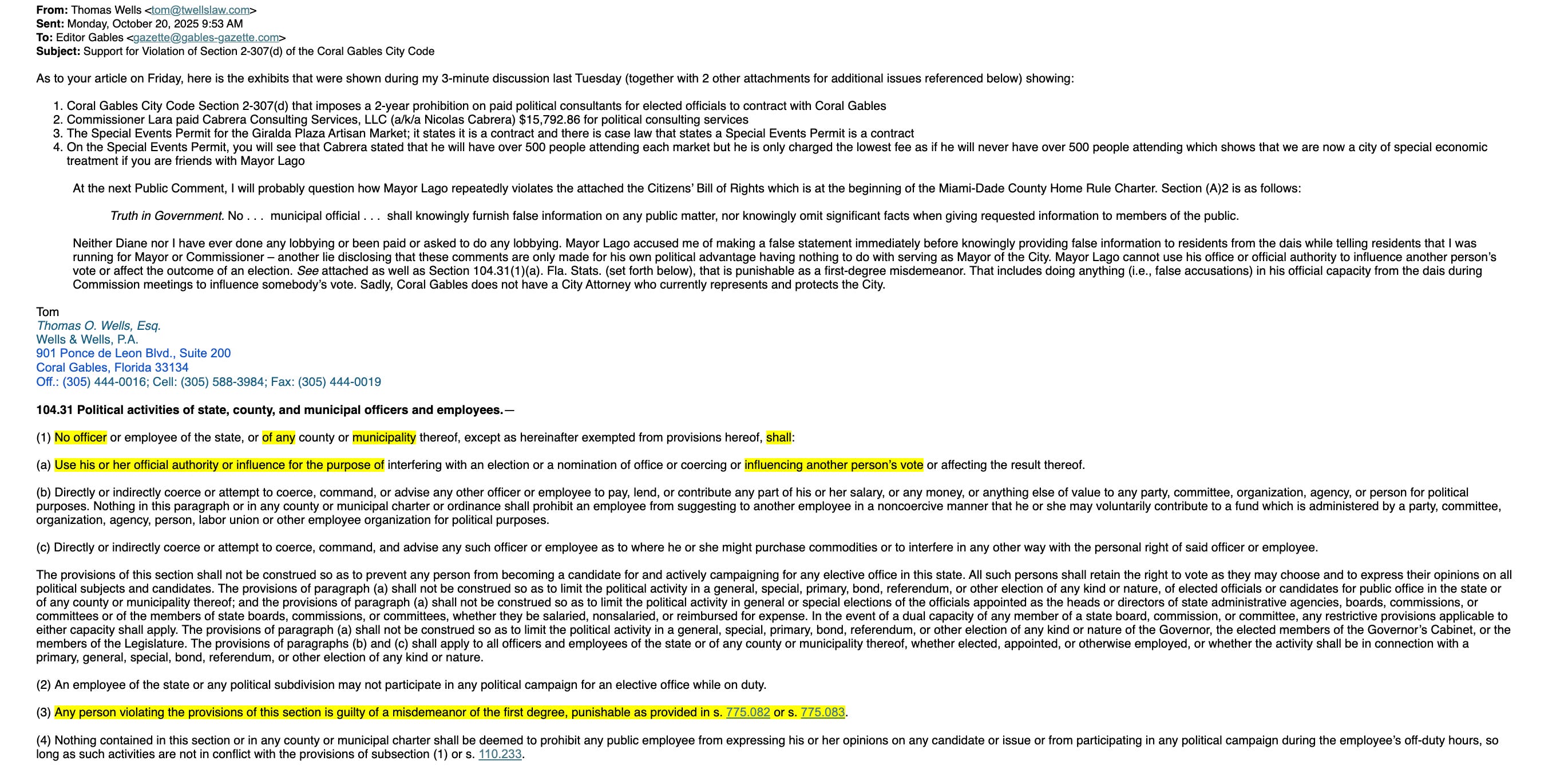
Wells sends the initial email — at least according to the thread in my possession — to Prisendorf on Monday, October 20th, 2025. This email is immediately following Wells’ public comments made at the October 14th, 2025 commission meeting, in which he publicly accuses me of illegal and unethical conduct, displays the Ethics Code, mischaracterizes my special events permit as a “contract,” alleges improper financial benefits, and announces his intent to file an ethics complaint that afternoon. Note the time stamp below:
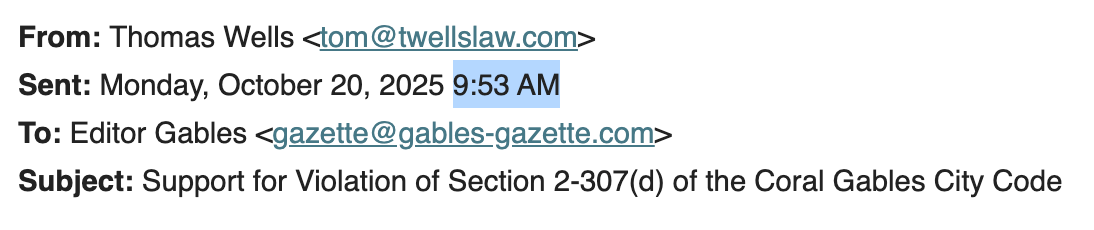
Wells sent that email at 9:53 AM on October 20th, 2025. de Marmol didn’t text me till 2:30 PM that same day. Almost five hours passed before I heard from anyone at the Gazette. Between the time Wells first contacted Prisendorf to when de Marmol contacted me, the allegations had already been assembled, transmitted to the publisher, and transformed into outreach for a prospective article. What struck me wasn’t that someone sought comment before publication, as responsible journalism should. What struck me was the structure of that first contact. By the time anyone asked for my “opinion”, Wells already knew an article was coming. The framework of the story appeared to have been established with the narrative presented in Wells’ emails and the subsequent outreach from the Gazette.
What follows in the email thread is even more eye-opening.
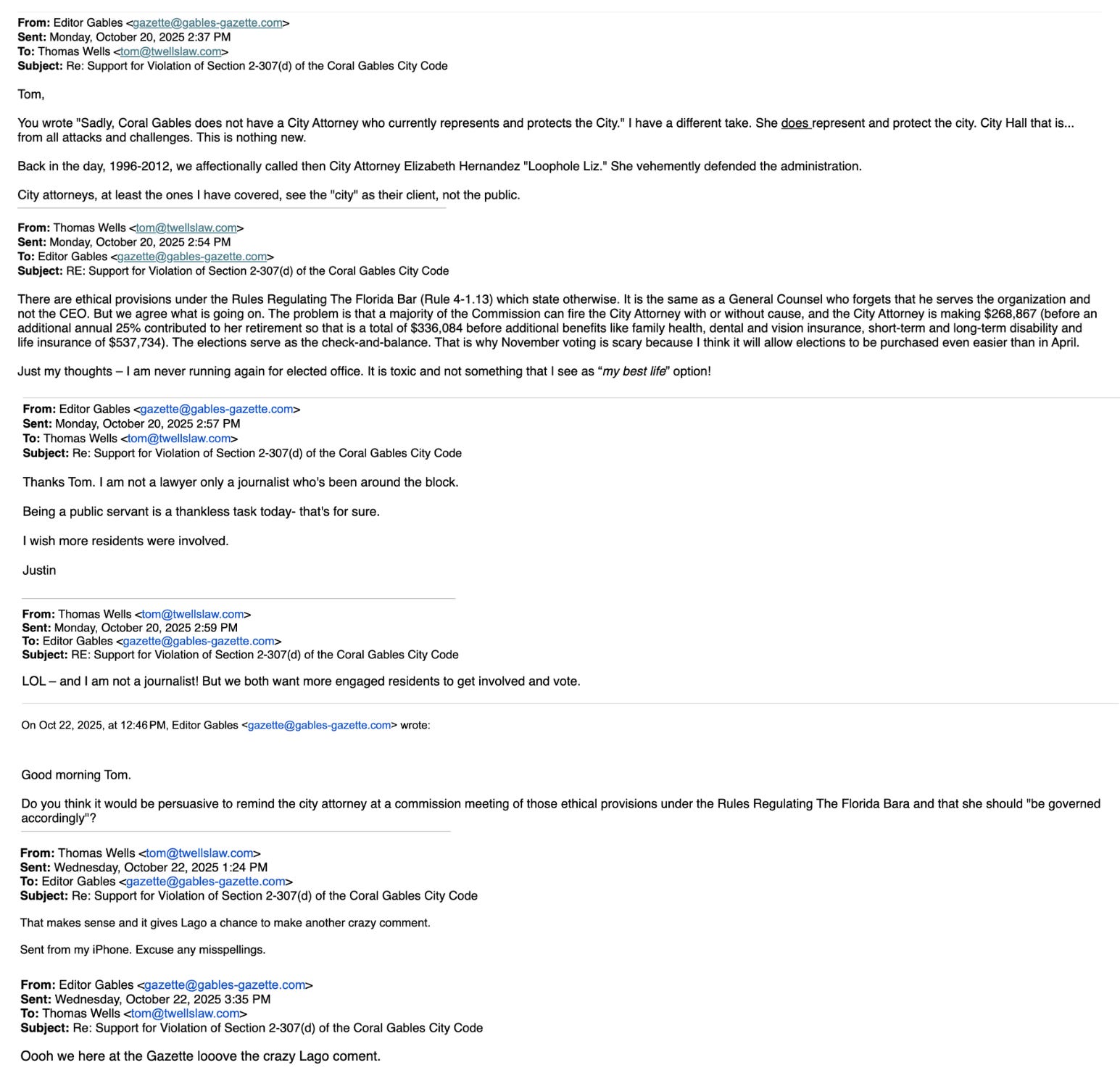
What began as a discussion of Wells’ legal theory gradually shifts into an exchange as to whether a story could be produced. But note what really caught Prisendorf’s attention. He barely engaged with Wells regarding the legal theory but perked up at this statement from Wells:
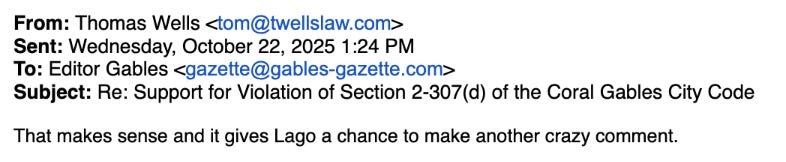
His follow up:
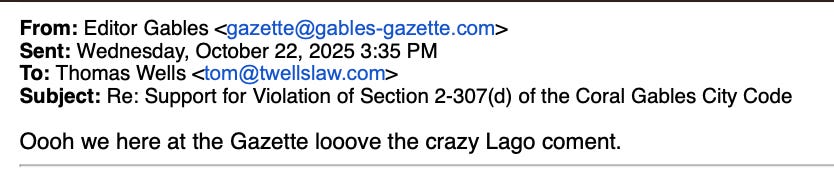
This is the most revealing sentence in the entire exchange, not because it is evidence of bias itself, but because it tells us what really caught Prisendorf’s attention. It wasn’t the legal question, it wasn’t whether the allegation was true, and it wasn’t whether Wells had evidence. It was “the crazy Lago comment”. Note Prisendorf’s enthusiasm at the prospect of Lago giving him the fuel for a future editorial generated around colorful political conflict. Publicly, Justin writes: “We strive to be objective in our news coverage and thoughtful and constructive in our editorials.” Privately, in a discussion with a political ally and source, he says: “Oooh we here at the Gazette looove the crazy Lago comment.” One is a mission statement, the other is a contrasting editorial reaction. It paints an obvious picture: Prisendorf is comfortable moving between the roles of publisher, conversational participant, and editorial decision-maker. The latter are done in secret while the first is how he wants to be perceived. Is this an acceptable standard of “objective” reporting?
Now this is where Mayor Lago belongs in the story. In March of this year, Prisendorf emailed Lago in anticipation of an article to be posted on the Gazette about the April special election.
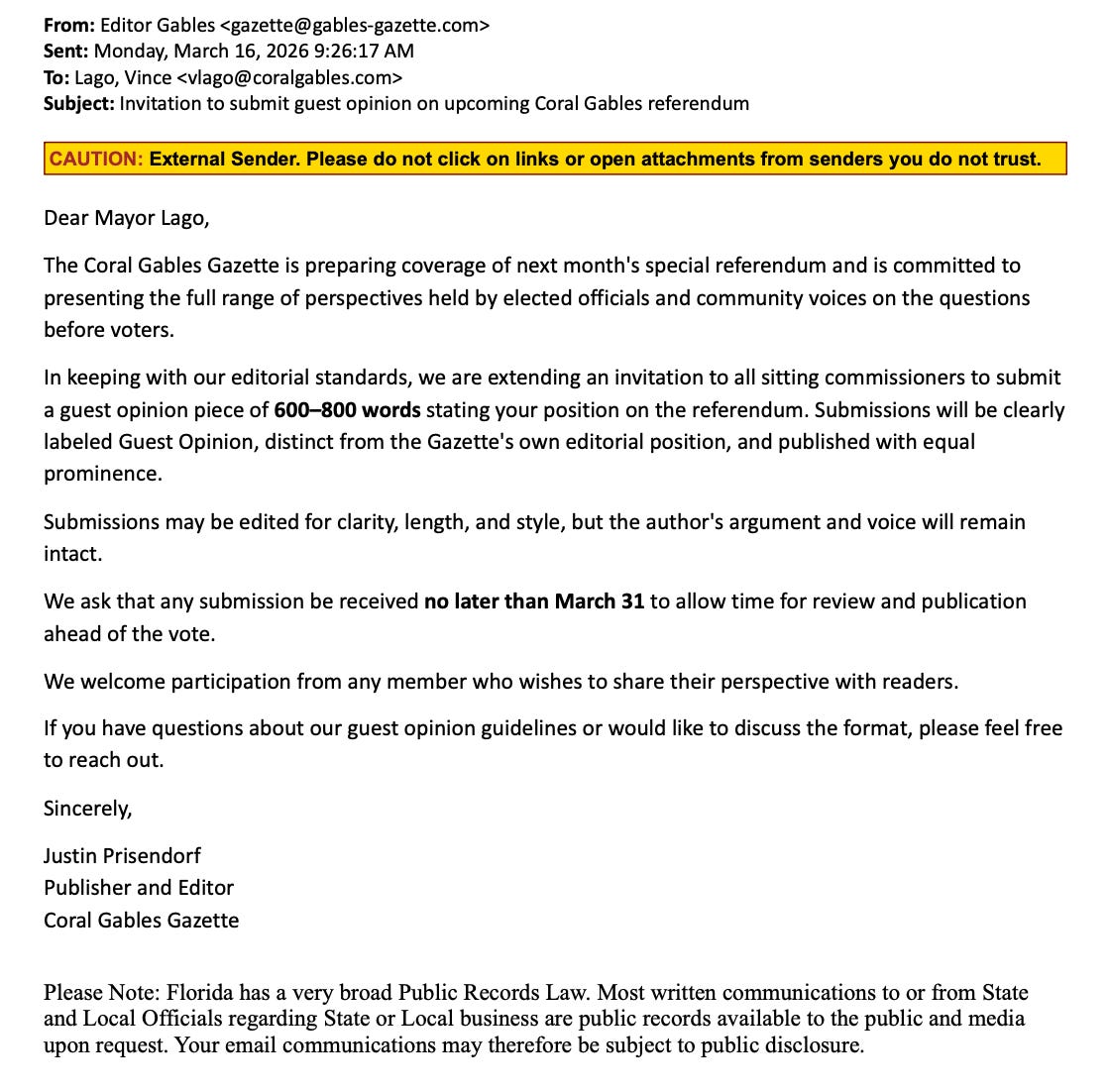
As a follow up to this email, Lago sent the email below:
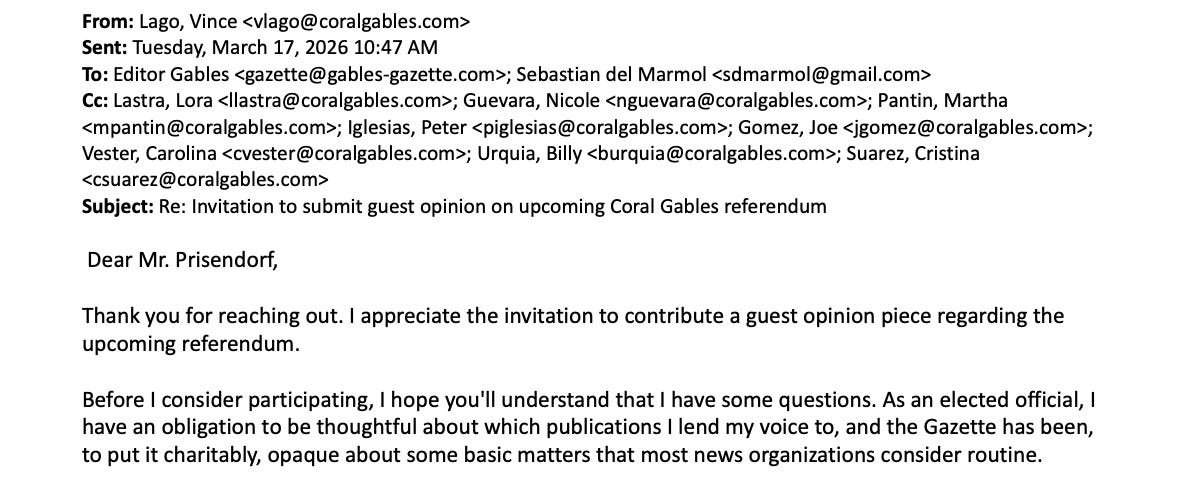
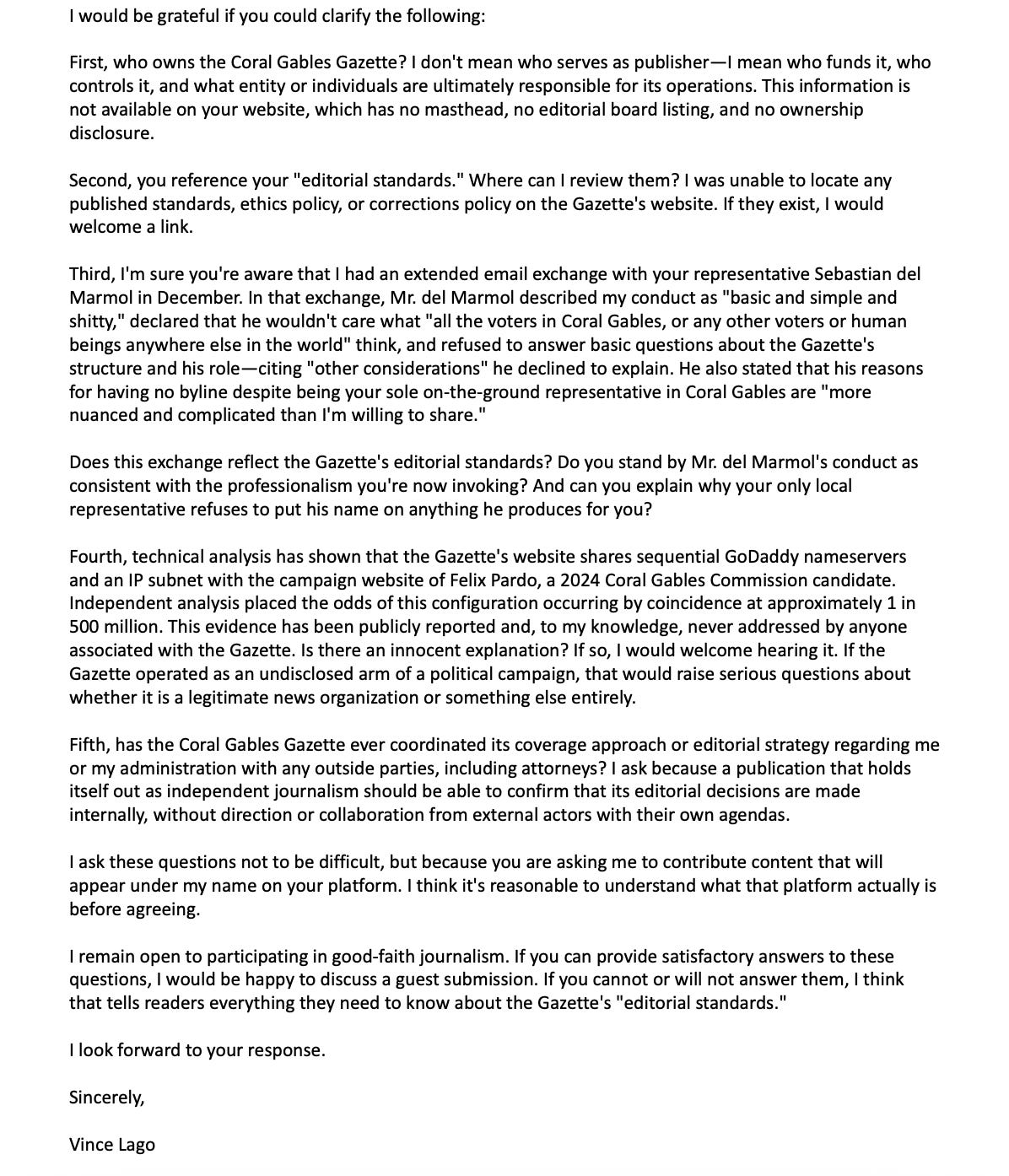
Lago isn’t accusing Prisendorf of anything in his response. He’s asking simple questions:
Who owns the Gazette?
Who funds it?
Where are the editorial standards?
These are valid questions considering the credibility of the Gazette following Aesop’s reporting about the creation of the site back in this post. Oh, and this post. The email speaks for itself. So does Prisendorf’s response:
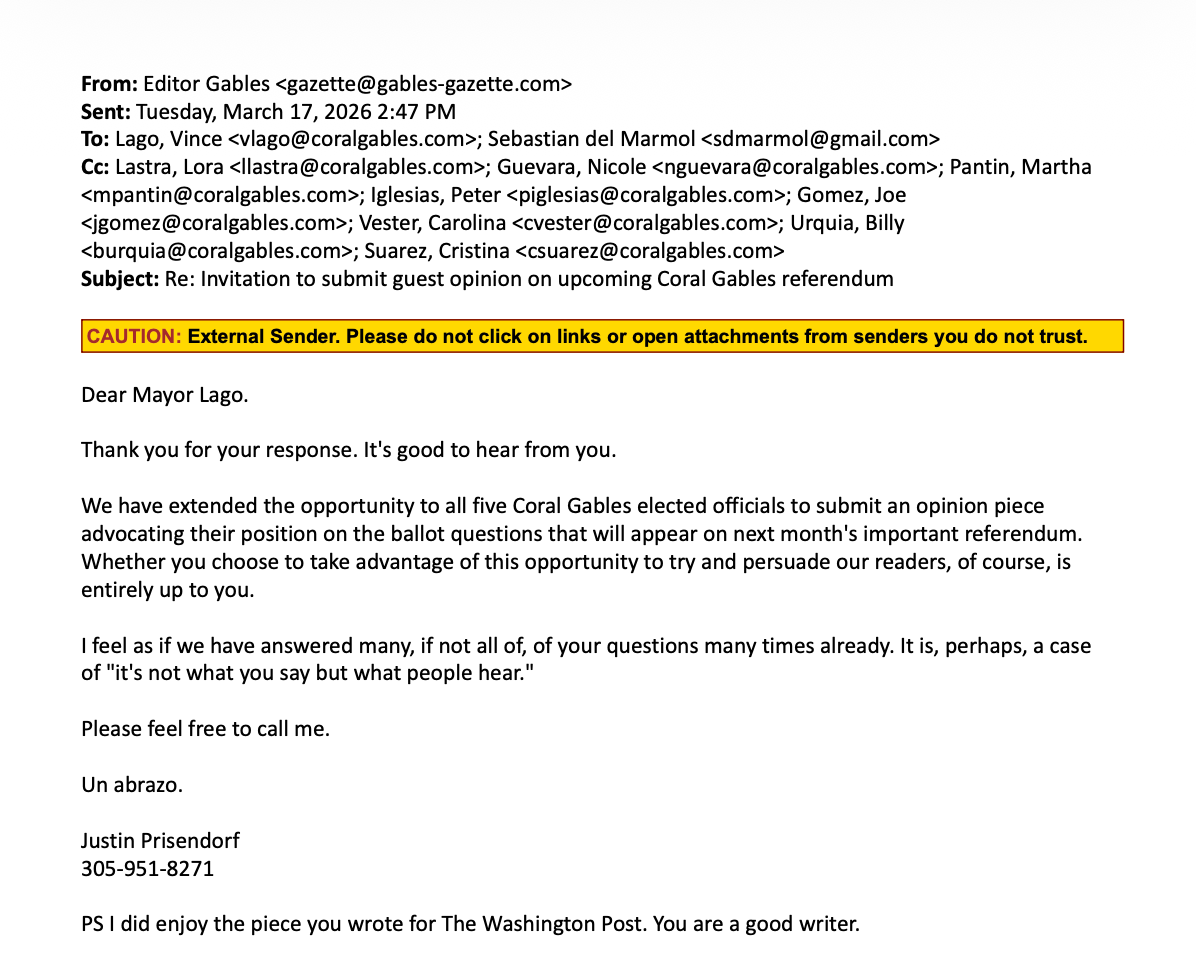
No answers to Lago’s questions are provided. So he asks again:
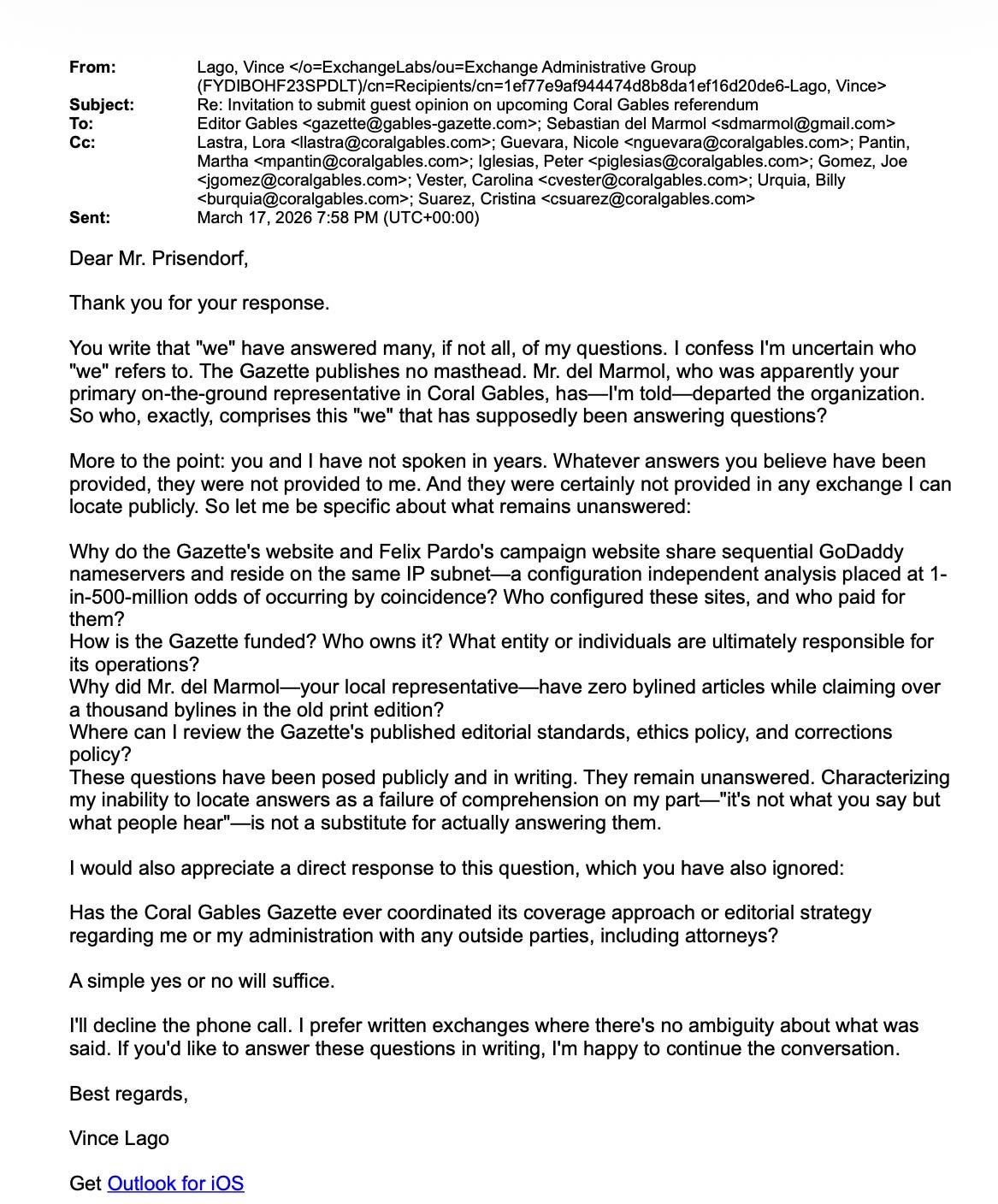
This was the perfect opportunity for Prisendorf to build credibility. Whether you agree with Lago or not is irrelevant, so take him out of the picture. There are a thousand other residents who could have asked these questions, imagine it was any one of them. These questions are straightforward and any publication claiming to “serve the people of Coral Gables” would be prepared to answer them regardless of who is asking. Lago narrowed the issue down and doesn’t ask for an essay response. All he wanted was a simple yes or no.
The silence matters more than the question. Prisendorf has published a public mission statement, based upon striving for objectivity. Those are ambitious commitments, but transparency runs in both directions. If a publication asks elected officials difficult questions, readers can reasonably expect that publication to answer reasonable questions about itself. Lago’s email presented an opportunity to do exactly that and it was met with silence. Trust in journalism is not built solely by asking difficult questions, it’s also built by answering them. If someone tells you they’re objective — like Prisendorf has — they’re asking you to trust them. If they truly are objective, they will welcome scrutiny of their own methods. You know how the old idiom goes… Actions speak louder than words.
Interestingly enough, the “article” Wells referred to in his initial email was never published. Prisendorf and I never spoke again and to my understanding, de Marmol is no longer involved in the Gazette. Although de Marmol is no longer associated with the Gazette, his departure did not mark a change in the publication’s approach, which brings me back to transparency. If you ever see this individual at a city function, just know she’s collecting intel on their behalf:
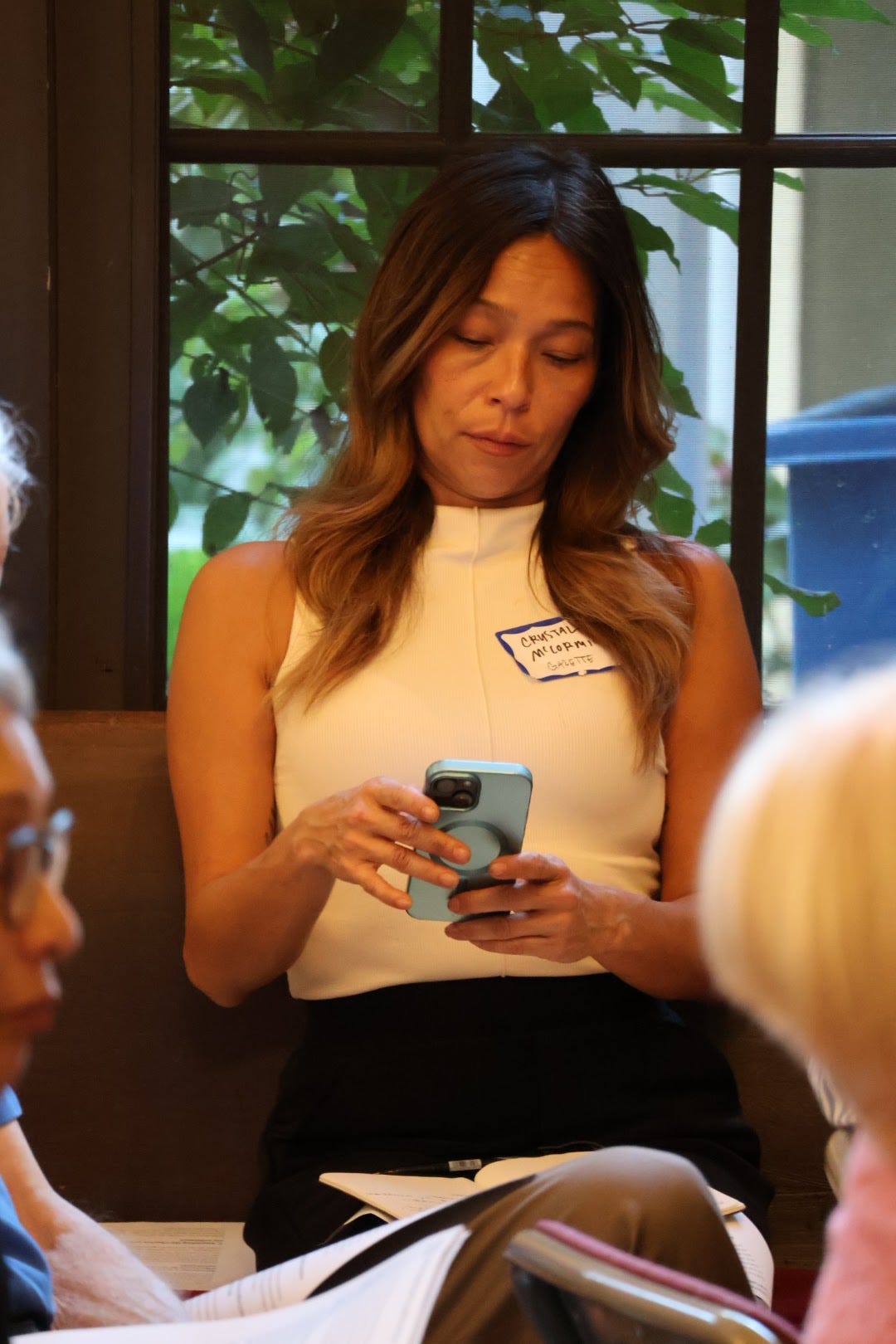
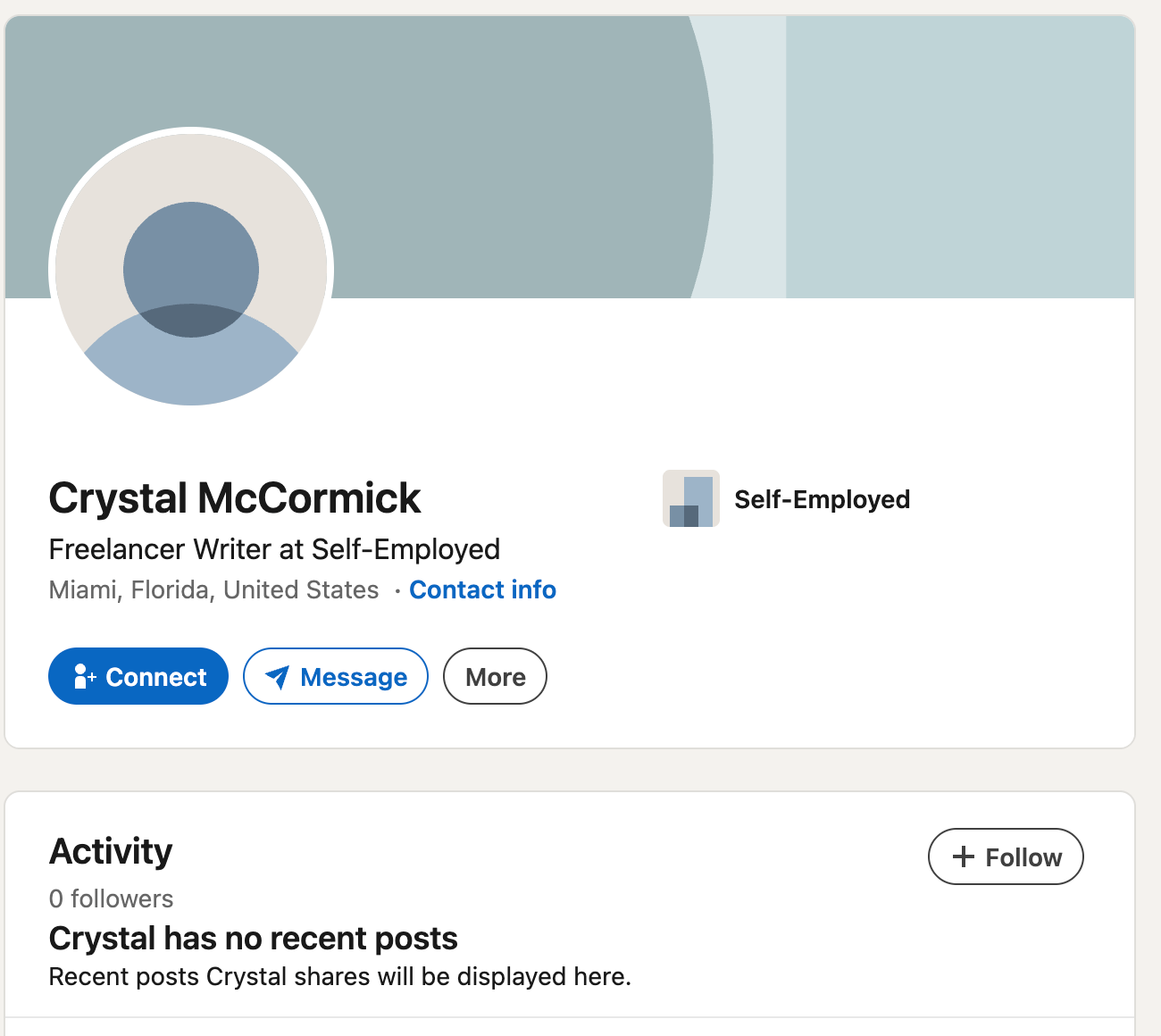
Her name is Crystal McCormik and she is the newest “contributor” to the Gazette, as evidenced by her name tag. Still, her name doesn’t appear on any byline, only “Gazette Staff”. Her LinkedIn profile says she is a freelance writer, but provides no other details.
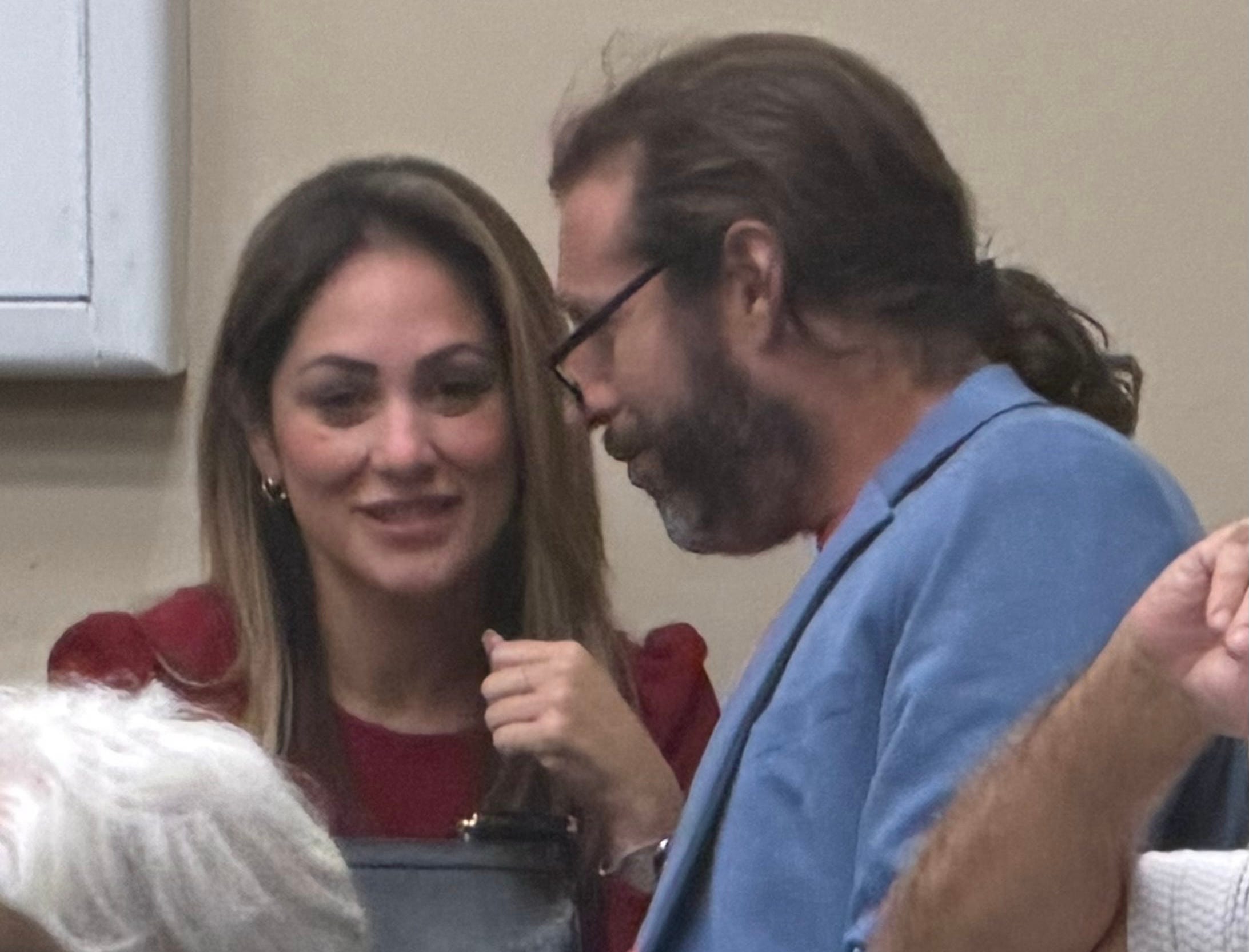
Meanwhile, de Marmol’s time at the Gazette has come to a quiet close, and we won’t be seeing him getting too cozy with any elected again:
This post isn’t about Wells. It’s about the Gazette and Prisendorf’s false pretenses. Which is why I won’t elaborate on what transpired between Wells and myself following his public comments in October of last year. I’ll just remind readers that Wells knew I was involved in candidate Richard Lara’s race for more than six months by the time he decided to run for Commissioner himself in December of 2024. In my view, his actions toward me appear to have been politically motivated and it’s purely coincidental this email exchange involves me. No further commentary on the matter is necessary.
We may think the current political climate is an isolated incident, but Commissioners of yesteryear had disagreements, too. We just don’t remember them because social media and the internet didn’t have the influence of today. The original print rendition of the Gazette was just as polarizing and just as subjective as it is today. But print doesn’t last as long as digital, so it’s easy to forget. But the digital age affords us with a permanent time capsule that captures and preserves records. And from what the record has shown, subjectivity is the lifeblood of the Gazette.
Aesop taught that appearances often deceive. The fox wore humility. The crow mistook flattery for truth. The moral of the fables was never to trust what you’re told, but rather to always watch what they do. Prisendorf tells readers the Gazette is objective but I watch what they do. You should, too.
Comments
Nothing yet. Say the first thing.
Sign in to join the conversation.