
Coral Gables posted one of its best pension years in a decade, and the analysis of it files the good news under caution: markets move the number, assumptions can shift it, judge it over years and not one result. Every one of those warnings is true. Every one is also beside the point, because none of them explains why the number improved. The city did not get lucky. It made a choice, and kept making it for ten years, and that is the part the caveats talk around.
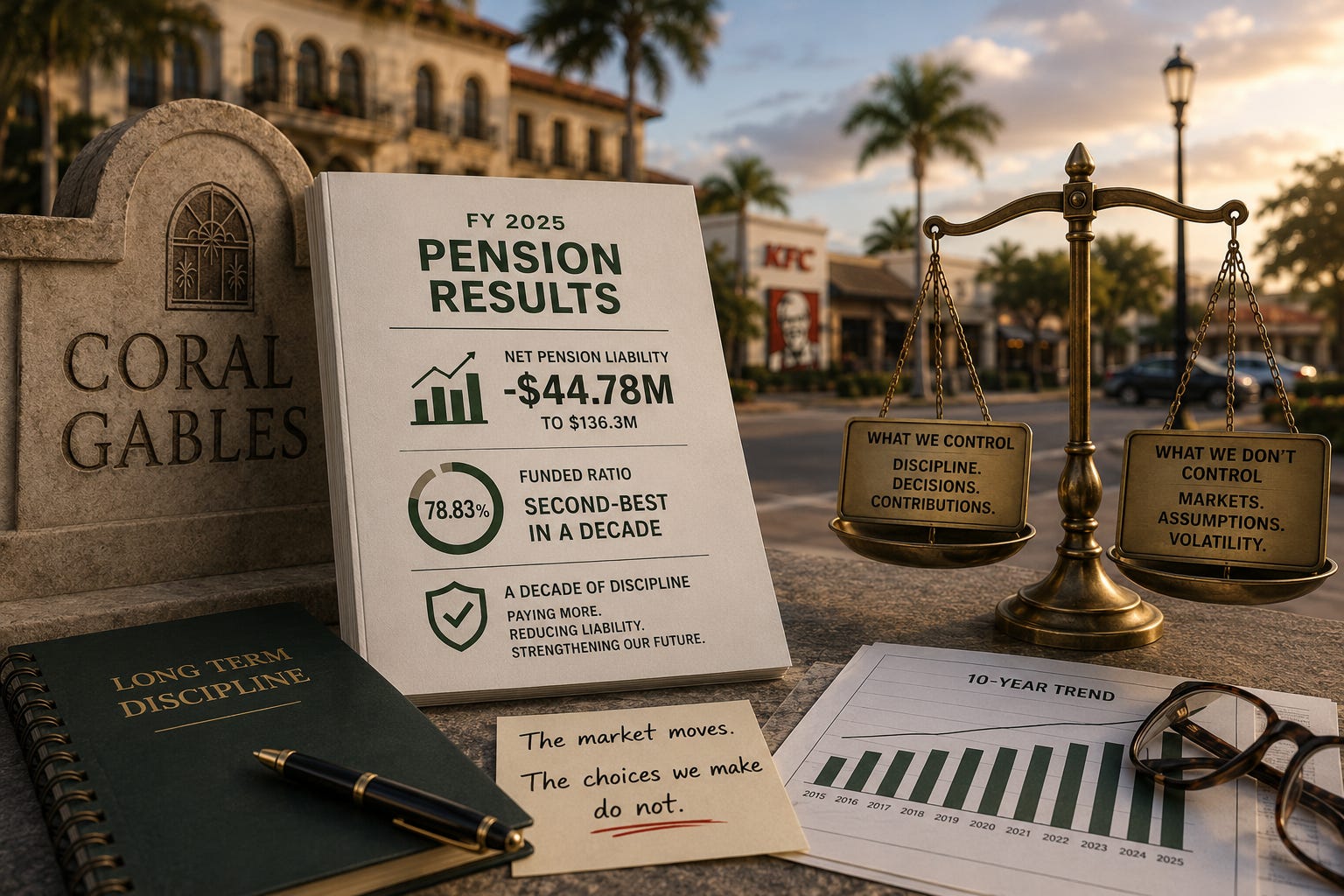
Here is the result. The net pension liability fell by $44.78 million in fiscal 2025, to $136.3 million, and the funded ratio rose to 78.83 percent, its second-best mark in a decade. In 2015 the commission adopted a policy of paying more than the actuary requires toward the unfunded liability, and it has kept paying it, $55.35 million above the required amount since 2016. Measured against payroll, the liability has fallen from 622 percent that year to 288 percent now. That is not a market’s mood. It is a decision, made once and honored for a decade, the kind of unglamorous discipline that never makes a headline and always makes a difference.
Take the central caution seriously, then size it correctly. A pension number does ride the market, and a discount-rate assumption can swing the reported liability by tens of millions. But that is true of every public pension fund in America. It is a fact about pensions, not a fact about Coral Gables, and dressing a universal caveat as a special hazard of this city’s finances is how you mute a strong result without ever denying it. The market cut both ways, lifting the number this year and dropping it in 2023, while the funded position climbed through both, because the contribution is the part that does not swing.
Which is the context the analysis leaves out. It asks whether the city keeps separating what it controls from what it does not, a fair question aimed at the wrong target, because the discipline is not an institutional reflex. It is a contested political choice, kept alive by the majority that votes for it every year and opposed by the members who would rather spend it. The real risk to that funded ratio is not Wall Street, which no city governs. It is the dais, which this one does. Dr. Castro, by Aesop’s account, voted to grant an eight percent retiree cost-of-living increase that would have added roughly $27 million to the very liability this policy has spent ten years paying down. The market you cannot legislate. A commission that would trade the discipline away, you elect.
So judge it over years, as the analysis asks. Over years, the city chose to pay its pension down faster than required and held the line through good markets and bad. The number will rise and fall from here. The discipline underneath it holds or breaks on a vote. That is the story.
Comments
Nothing yet. Say the first thing.
Sign in to join the conversation.