
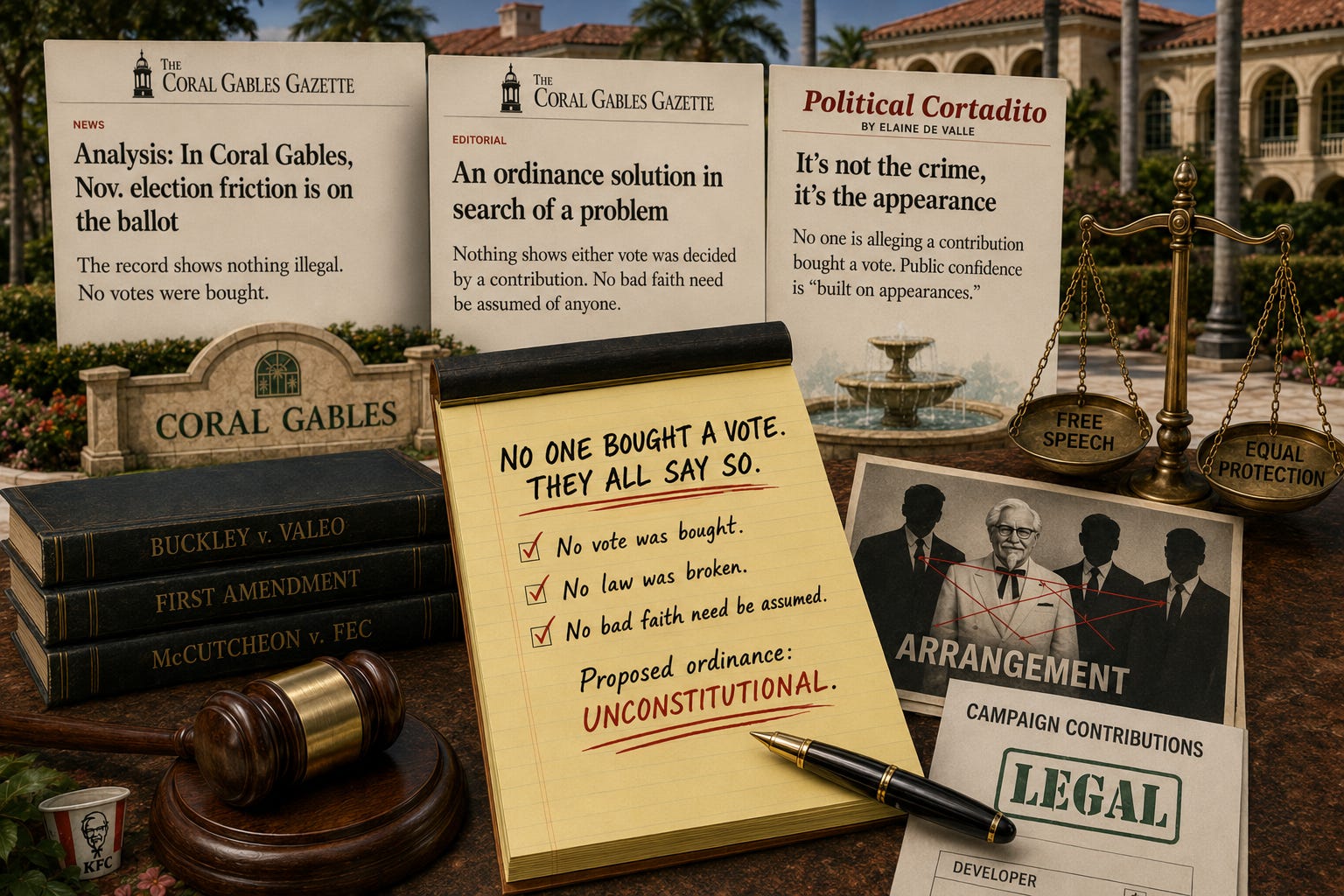
Three blogs published the same story. Two share a masthead, a “news” report and its companion editorial, and the third is Elaine de Valle’s Political Cortadito, which arrived the next morning to say the loud part. One subject, three tellings, and if you strip the adjectives from all of them you are left with a single sentence each one concedes somewhere in its own body: no one bought anyone’s vote.
That is not my characterization. It is theirs. The news report allows that the record shows nothing illegal. The editorial goes further, granting that nothing shows either vote was decided by a contribution and that no bad faith need be assumed of anyone. Political Cortadito, after a thousand words announcing that its author does not believe in coincidence, states plainly that no one is alleging a contribution bought a vote, then reaches for the line that does the real work: public confidence, it explains, is “built on appearances.” There is the whole machine, in three words. Concede you cannot show the thing, then announce that showing it was never the point.
So set the appearances aside and ask what is actually being alleged, because the answer, by the unanimous admission of the people alleging it, is nothing. A committee raised money, lawfully, from people who share its politics, and a commission then voted on development the way it has voted on development for years. Everything past that is arrangement: a composite image of three men’s faces, a calendar with two dates circled, a headline built around the word “surge.” Take the arrangement away and there is no story, which is exactly why the story cannot be told without it.
But a narrative that concedes its own emptiness needs somewhere to go, and this one goes to a proposed ordinance. Dr. Castro’s measure would bar campaign contributions from real estate developers, and the three blogs have made it the purpose the reporting was missing. So let us take the ordinance seriously, which none of them did, because taking it seriously is fatal to it.
A campaign contribution is protected political activity, and government may narrow it only when the restriction is closely drawn to a sufficiently important interest. The Supreme Court has recognized exactly one interest that clears that bar: preventing quid pro quo corruption, or its appearance. Not the reduction of influence, not the leveling of the field, not the public’s general unease about who funds whom. The trading of votes for money, and nothing else. From Buckley v. Valeo through McCutcheon v. FEC, that has been the whole of it. Which leaves Dr. Castro’s ordinance nowhere to stand, because the corruption that is its only permissible justification is the very thing its champions have, in print, conceded did not happen. They made the case for the ban and dismantled its foundation in the same breath.
It gets worse from there. When the Court first allowed contribution limits, part of what saved them was that they fell on everyone alike, whatever a person’s occupation. This ordinance does the reverse, singling out one lawful profession and silencing it by name, which is speaker discrimination of the plainest kind, and a flat ban on a class is the most suspect instrument in the whole field. The Court has struck down even a ban on contributions by minors for failing this test. A ban on an entire industry of adults will not do better. The one narrow place such bans have held is government contractors, paid from the public treasury on deals they are actively bidding, and a developer seeking a zoning change is not that. The contractor’s rationale does not transfer to a private citizen asking for a discretionary vote.
There is, in any case, a lawful way to do what the ordinance claims to want. Disclosure, and recusal where a real conflict exists, is constitutional, ordinary, and already the tool of choice everywhere it matters. The blogs reached past it for a ban, which tells you the aim was never a rule that could actually hold. So does the drafting. It reaches developers but not the architects, land-use lawyers, lobbyists, and expediters around every project, a hole the paper’s own editorial concedes, and by its sponsor’s own account it would not apply to the current election. A measure that spares most of the influence it names, exempts its authors, and takes effect only after the votes that prompted it is a press release with a section number.
One last tell sits in the comment sections. The same small roster carries all three posts across both sites, among them the mayor’s own November opponent, thanking the paper and leaving a phone number, and a former candidate writing in as a concerned resident. A groundswell is made of strangers. This is a campaign applauding its own coverage, on schedule, in an election year.
So here is the whole of it, in the words of the people who published it. No vote was bought. No law was broken. No bad faith need be assumed. And the fix they are selling for this absence of wrongdoing is a ban the First Amendment does not permit. That is not reporting that found a problem. It is three blogs building one, and reaching for an unconstitutional cure to keep it alive.
Comments
Nothing yet. Say the first thing.
Sign in to join the conversation.