
When we point clients to the EIA’s latest forecast for a global oil surplus of roughly 5 MMBbl/d in 2027, the response is often disbelief or skepticism. Given the continued disruption to Gulf production and Strait of Hormuz traffic, how does the agency arrive at a surplus of that magnitude? Whether or not the forecast ultimately proves correct, it reflects a specific set of assumptions. Here is how the EIA gets there.
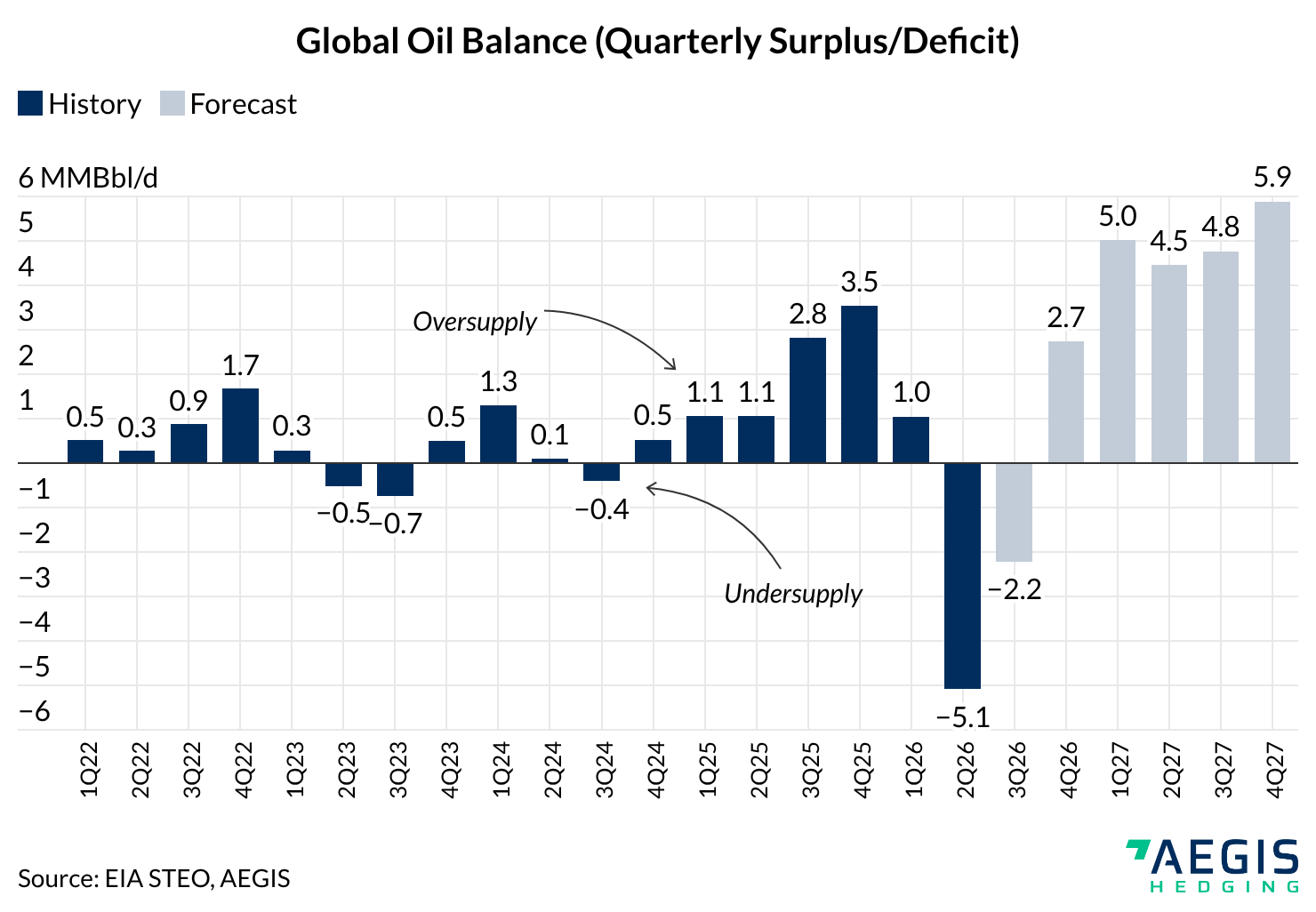
The July Short-Term Energy Outlook (STEO) shows global inventories drawing by 5.1 MMBbl/d in 2Q26 and another 2.2 MMBbl/d in 3Q26. The balance then swings to a 2.7 MMBbl/d build in 4Q26 before averaging a 5 MMBbl/d surplus in 2027.
What assumptions underpin the EIA’s 2027 balance?
Strait of Hormuz traffic normalizes, and most conflict-related Gulf production shut-ins return.
The July STEO assumes US SPR injections averaging 0.28 MMBbl/d in 2027, creating an additional government bid for crude. Those barrels would increase government rather than commercial inventories, potentially tightening market availability and supporting prices even as total global stocks rise.
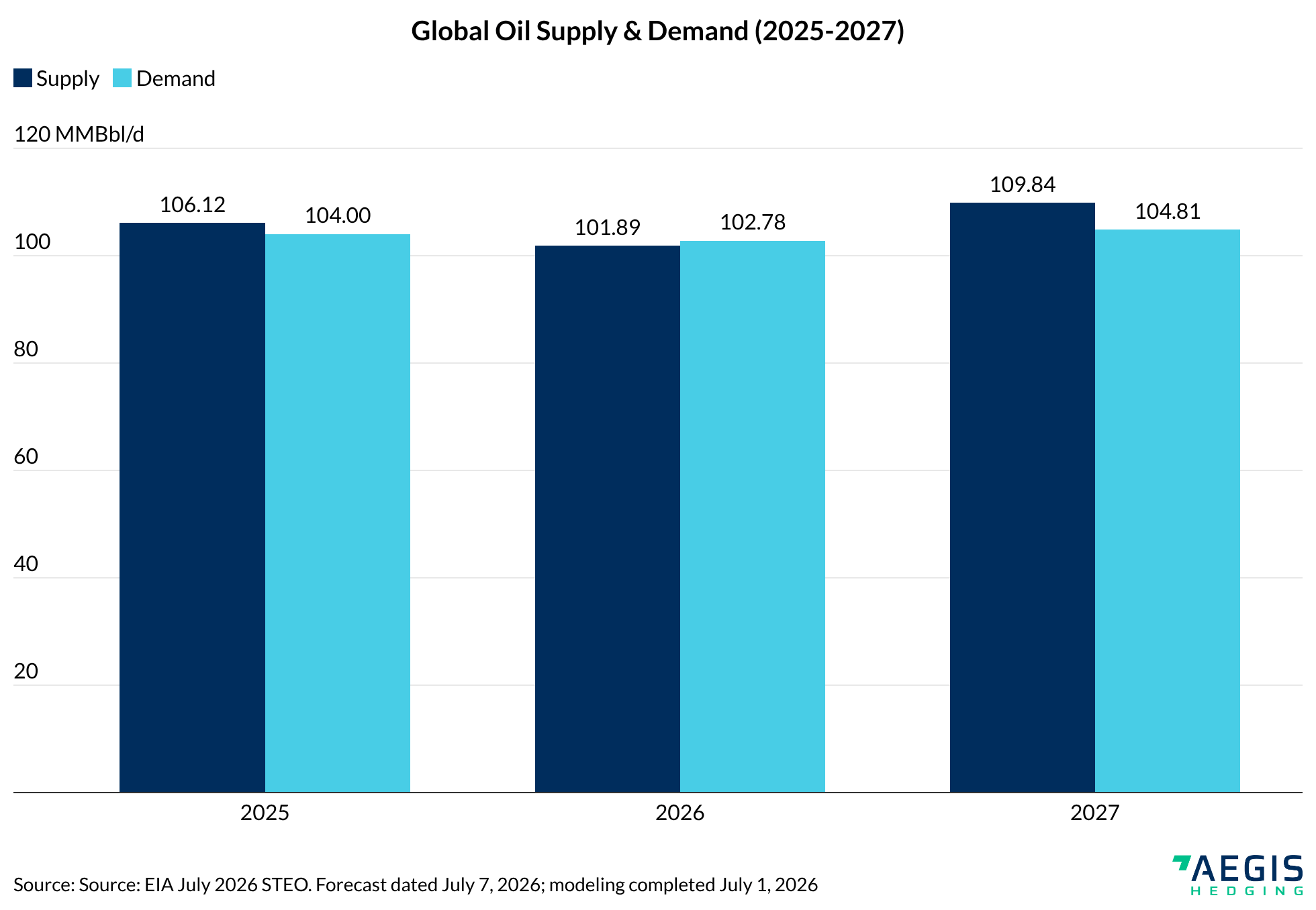
The annual supply and demand figures side by side make the imbalance easier to see. Global supply falls to 101.89 MMBbl/d in 2026 before rebounding nearly 8 MMBbl/d to 109.84 MMBbl/d in 2027. Demand recovers by only about 2 MMBbl/d, rising from 102.78 MMBbl/d to 104.81 MMBbl/d. Put differently, supply is projected to increase nearly four times as much as demand in 2027.
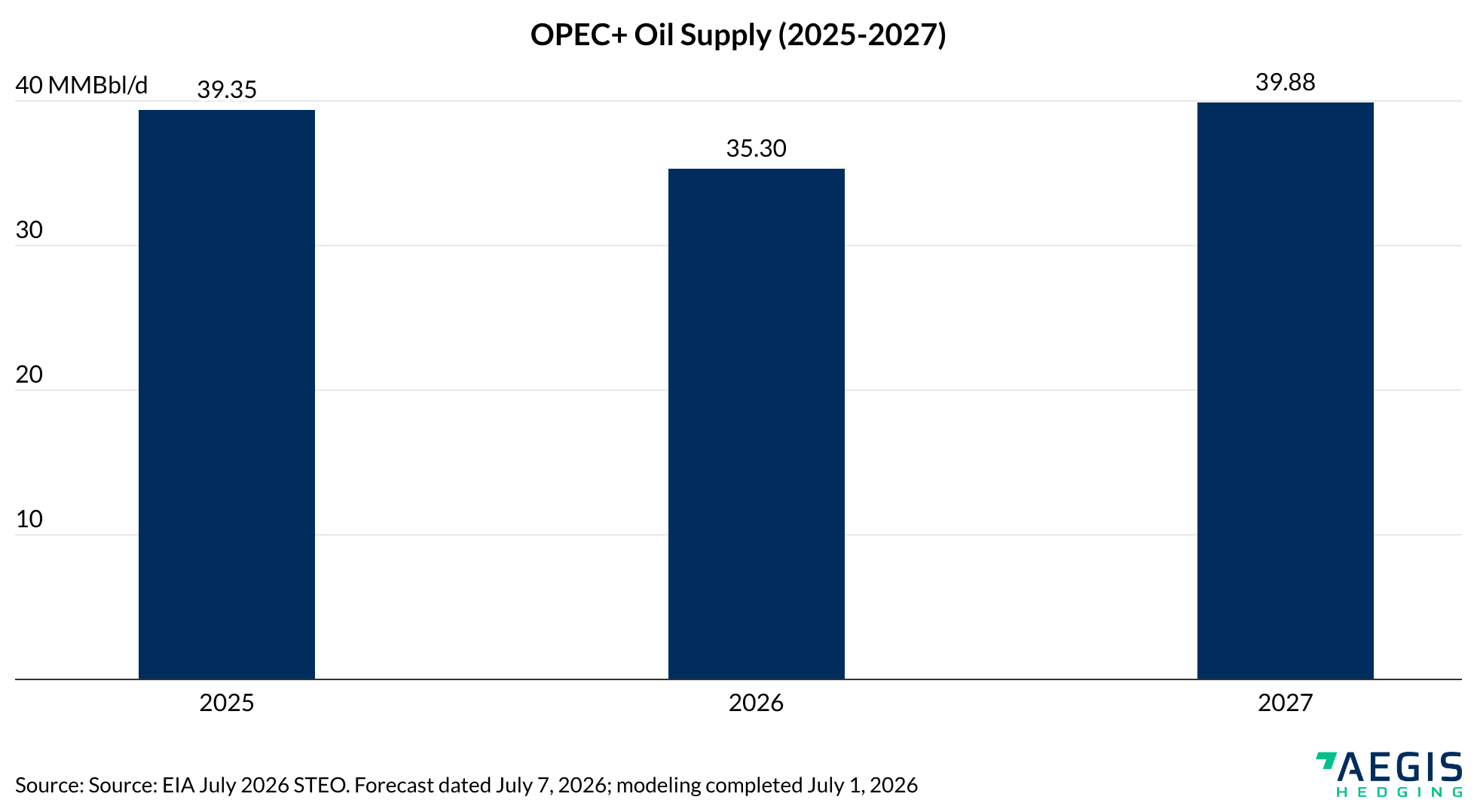
The projected surplus begins with the return of OPEC+ barrels that were shut in during 2026. Output falls from 39.35 MMBbl/d in 2025 to 35.30 MMBbl/d in 2026 as Gulf producers shut in barrels, then rebounds to 39.88 MMBbl/d in 2027. That represents a 4.58 MMBbl/d increase from 2026, but only 0.53 MMBbl/d of growth from 2025. OPEC+ production recovery is part of the story, but the larger source of new supply lies outside the group.
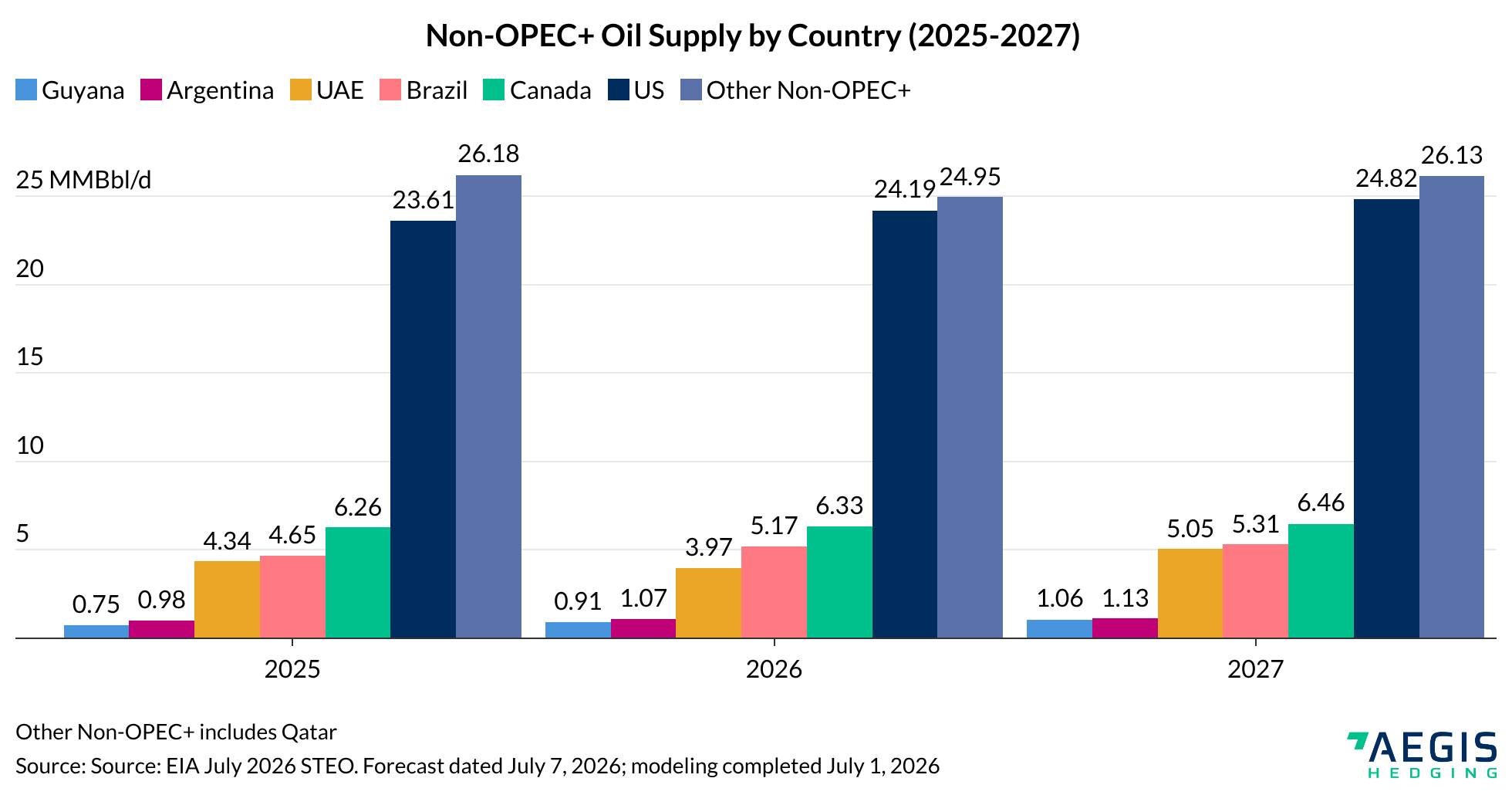
The larger source of incremental supply comes from non-OPEC+ producers. As the chart above shows, non-OPEC+ supply rises by 3.36 MMBbl/d between 2026 and 2027. The UAE increases from 3.97 MMBbl/d to 5.05 MMBbl/d after leaving OPEC, while the US, Canada, Brazil, Argentina and Guyana each add production. Other non-OPEC+ producers also add barrels, including Qatar as Hormuz flows normalize. No single country creates the glut. Instead, the projected surplus results from production gains across many countries.
The July STEO was completed on July 1, before hostilities resumed and the MoU collapsed. The next outlook may therefore push back the assumed normalization of Hormuz flows and revise the projected global balances to reflect the renewed geopolitical disruption. Still, the July forecast illustrates what could happen if Gulf production recovers, non-OPEC+ supply continues growing and demand rebounds only modestly. Ultimately, the projected glut hinges on whether supply returns as quickly as the EIA assumes.
Commodity Interest Trading involves risk and, therefore, is not appropriate for all persons. Past performance is not necessarily indicative of future results. Neither this trading advisor nor any of its trading principals offer a trading program to clients, nor do they propose guiding or directing a commodity interest account for any client based on any such trading program. The “Hedging Advisory Firm of the Year” and “OTC Trading Platform of the Year” awards were presented to AEGIS CTA, LLC and AEGIS SEF, LLC (d/b/a AEGIS Markets), respectively, by Energy Risk, a publication owned by Infopro Digital. These awards are part of the Energy Risk Awards program, which recognizes excellence in commodity trading, risk management, and related services. Award recipients are selected based on editorial judgment, industry nominations, and a review of company performance, innovation, and client feedback. The “Top Workplaces” award was presented to AEGIS by the Houston Chronicle based on anonymous employee survey results conducted by Energage. Rankings are determined by comparing employee feedback against benchmarks for workplace culture and employee satisfaction.
Statements describing AEGIS as the leading revenue intelligence platform and/or a global leader in hedging technology and solutions (and similar claims) reflect AEGIS’ opinion. These views are based on a combination of industry awards and recognition, the company’s unique technology capabilities, and internal market analysis.
No posts
Comments
Nothing yet. Say the first thing.
Sign in to join the conversation.