
That was the pitch.
Less manual work. Faster creative. Smarter targeting. Better performance. More time for strategy.
Wonderful.
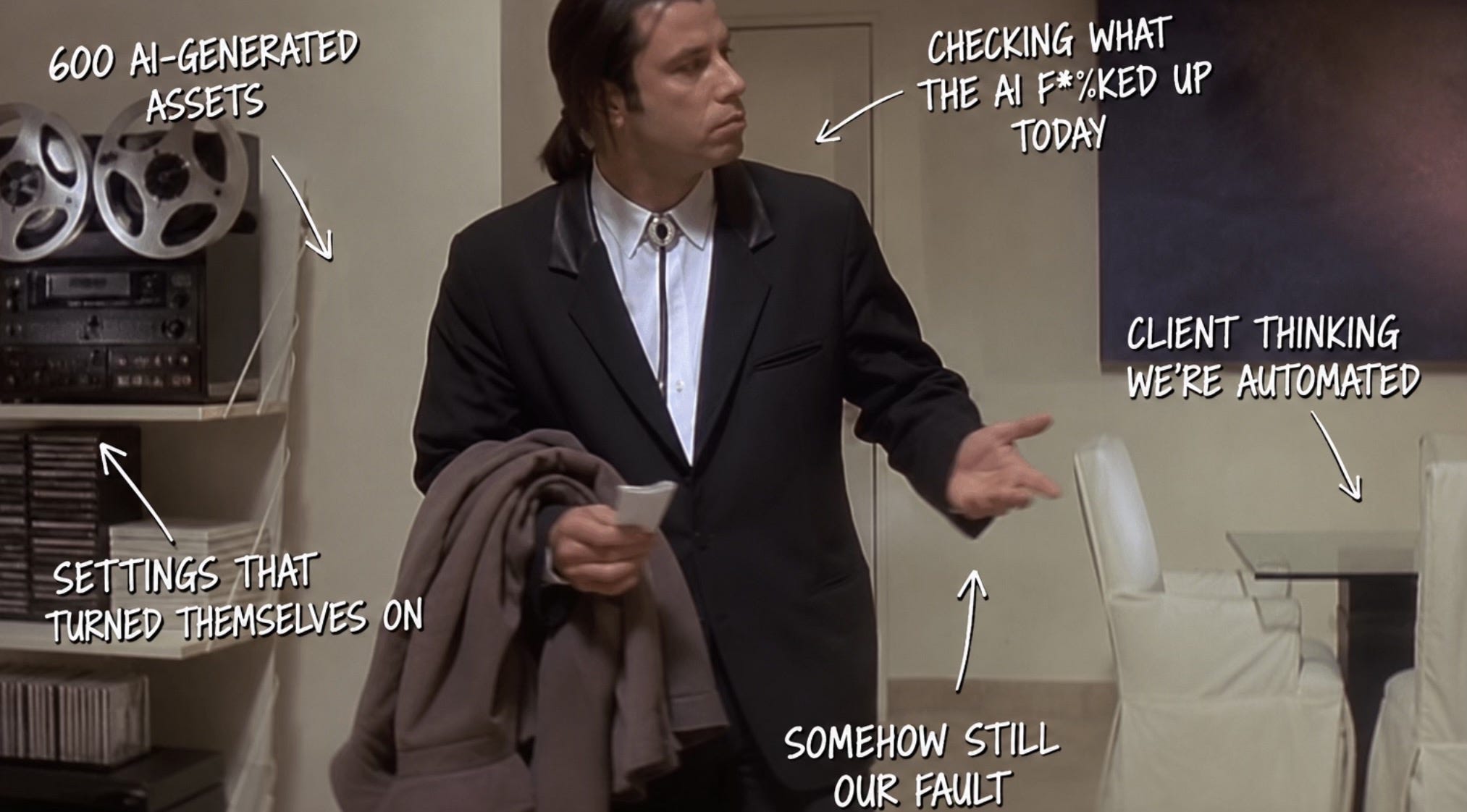
What we actually got was 600 automatically generated assets, settings nobody remembers turning on and a new daily responsibility:
Checking whether Meta gave someone an extra arm and Google spent the client’s budget advertising something the client does not even sell.
Very efficient.
Meta’s AI ad tools can now modify images, rewrite copy, resize creative, animate products and generate endless variations of an ad.
That sounds great until the product changes color, the background looks insane or the person in the ad suddenly has a hand that belongs in a medical journal.
Then who gets to explain it to the client?
Not Meta.
The digital media buyer.
The same person who was told all of this automation would save time is now responsible for reviewing everything the platform created while supposedly saving them time.
Congratulations.
You are now the unpaid QA department for Big Tech.
This is the part that always gets left out of the exciting AI announcements.
AI has not automated advertising.
It has automated production.
There is a difference.
The platforms can generate more headlines, images, videos, audience combinations and campaign variations than any human team could reasonably create.
Cool.
Can they guarantee any of it is accurate?
No.
Can they guarantee it is on-brand?
No.
Can they guarantee the product still looks like the actual product?
Also no.
Can they guarantee the generated claim will not make legal lose its mind?
Absolutely not.
That part is still our job.
We still have to catch the product that changed colors.
The image that no longer resembles what the company sells.
The headline nobody approved.
The crop that removed the actual product.
The setting that quietly expanded the audience.
The traffic coming from 700 miles outside the service area.
The search terms for something the client has never offered in its life.
AI makes the mistake in three seconds.
A human gets to spend the next three hours figuring out where it came from, how much it spent and how to keep it from happening again.
That is not automation.
That is delegation without accountability.
Google has introduced disclosures that can show whether an ad was created or edited with AI.
Which sounds very responsible.
Very transparent.
Very “we take user trust seriously.”
Until you realize the platforms are essentially labeling the mess after handing media peeps the mop.
The label does not stop an ad from being wrong.
It does not confirm that the advertiser knowingly approved every AI-generated variation.
It does not tell anyone exactly what was changed.
It does not explain whether the product, person or offer shown in the final ad still resembles reality.
It just tells everyone that AI was involved.
Great.
So when something looks bizarre, misleading or completely detached from what the advertiser approved, at least we know which buzzword to blame.
That is not transparency.
It is an alibi.
The advertising industry keeps measuring AI efficiency by how quickly it can produce things.
That is the wrong measurement.
The real question is how long it takes a qualified human to review everything the AI produced.
Generating 100 creative variations in five minutes sounds impressive.
But if someone has to spend three hours checking them, fixing them, documenting the problems and explaining the worst ones to a client, did we actually save time?
Or did we just move the work somewhere less visible?
Production time went down.
Review time went up.
Risk went up.
The number of things that can go wrong went way up.
And somehow the platforms still get to write case studies about efficiency.
Meanwhile, advertisers are clicking through six different menus trying to figure out whether a feature was intentionally selected, automatically recommended, quietly opted into or added during the latest interface update nobody asked for.
Again, very efficient.
The platforms have spent years convincing advertisers that more is always better.
More assets.
More variations.
More audiences.
More automation.
More signals.
More learning.
More everything.
But more creative is not automatically better creative.
Sometimes it is just more crap to review.
A good campaign does not need 600 mediocre variations.
It needs a clear offer, accurate targeting, a decent landing page and creative that does not look like it escaped from an AI fever dream.
The machine can produce endless combinations.
That does not mean the combinations are good.
It just means they are endless.
This is usually where someone posts:
“AI won’t replace humans. Humans who use AI will replace humans who don’t.”
Groundbreaking.
Put it on a beige carousel and add a photo of someone staring thoughtfully out a window.
The point is not that humans are still important.
The point is that the platforms want more control over how campaigns run while shifting more risk back to advertisers.
They want to generate the creative.
Expand the targeting.
Interpret the intent.
Choose the placements.
Adjust the bids.
Rewrite the assets.
And when something goes wrong, they would also like the advertiser to accept full responsibility.
That is a hell of a business model.
The platform gets the automation.
The advertiser gets the liability.
The client gets the explanation.
I use AI.
I am not anti-automation.
There are plenty of things AI can do faster and, in some cases, better.
But the idea that these tools have eliminated advertising work is complete bullshit.
They changed the work.
Instead of manually creating every variation, we review machine-generated variations.
Instead of selecting every setting, we check whether the platform selected it for us.
Instead of only monitoring campaign performance, we now monitor the automation that is supposedly monitoring campaign performance.
The babysitting did not disappear.
There are just more children now.
And every single one of them has access to the client’s credit card.
Comments
Nothing yet. Say the first thing.
Sign in to join the conversation.