
Editor’s note: This essay follows a presentation I gave to the Climate Psychology Alliance on neurodivergence and collapse awareness. It builds on two earlier essays; Why Some People See Collapse Earlier Than Others and If Collapse Is Inevitable, Why Does Seeing Early Matter?
This essay extends that argument into advocacy: what support, roles and forms of participation might neurodivergent people need as the systems around us become less reliable? The presentation I gave to the Climate Psychology Alliance is available to view here.
1. Introduction
Some days I feel so tired.
I think part of that tiredness comes from being masked twice.
There is a particular kind of exhaustion that belongs to people who are carrying two performances: the performance of neurotypical functioning, and the performance of believing in a future we no longer find credible.
I call this double masking.
Internally, many of us stopped believing the shared story some time ago, but the meetings, pensions, and career plans continued.
This essay asks how we support neurodivergent people when schools, workplaces, services and institutions can no longer be assumed to remain stable.
In my earlier essay, Why Some People See Collapse Earlier Than Others, I propose that collapse awareness may be linked to neurodivergent pattern-seeking. Civilisational decline is not perceived through one piece of evidence, but through the convergence of many: energy constraints, ecological degradation, climate instability, debt, institutional strain and the repeated failure of mitigation narratives. [1]
Thanks for reading A Grand Unified Theory of Doom! Subscribe for free to receive new posts and support my work.
A strongly systemising mind may be more likely to connect these data into a single model. Autistic traits, and some ADHD traits, such as systemising, sustained attention, reduced conformity and a preference for internally consistent explanations may make the dominant cultural story harder to maintain once enough anomalies accumulate.
Collapse awareness, in this framing, is the recognition of a failing system.
In the following essay, If Collapse Is Inevitable, Why Does Seeing Early Matter, I explore what adaptive value early recognition might have if collapse cannot be prevented. The answer was behavioural rather than predictive. A person who no longer expects the dominant system to recover may begin to redirect effort towards lower dependency, practical skills, land, care, repair, community and ecological alignment. [2]
At population level, cognitive variation may matter because different minds respond to instability at different thresholds. Traits that create difficulty inside stable, conformity-based systems may have different value when the shared model begins to fail. Early seeing matters because it can change conduct before consensus changes.
My research so far, and lived experience as a neurodivergent human, has brought me to the following question;
If we accept that global industrial civilisation is collapsing due to ecological overshoot, what does neurodivergent advocacy look like in a declining society?
I recently delivered a presentation asking this question to colleagues in the Climate Psychology Alliance (CPA). The CPA brings together therapists, researchers, artists and others exploring the psychological and emotional dimensions of the climate and ecological crisis.
In the plenary session, there were comments about young neurodivergent activists, moral intensity, suicidal ideation, and the need for support networks able to bear what some young people are already seeing. There were comments about masking, neurodivergent women without children, the double empathy problem, crisis response, and places such as Sudan, where collapse is not a future psychological orientation but a present material condition.
Neurodivergent women without children raise a distinct question around masking, collapse awareness, reproductive expectation, and refusal of the usual future story. It deserves its own essay, and I plan to return to it properly after listening further to women in that position.
I had been presenting a model of neurodivergent collapse awareness as altered contradiction-processing. The same world enters different minds differently, depending on neurotype. Climate data, institutional failure, ecological degradation, cost-of-living pressure, political inertia, net zero targets sitting beside fossil expansion, and the language of economic growth placed over declining material conditions.
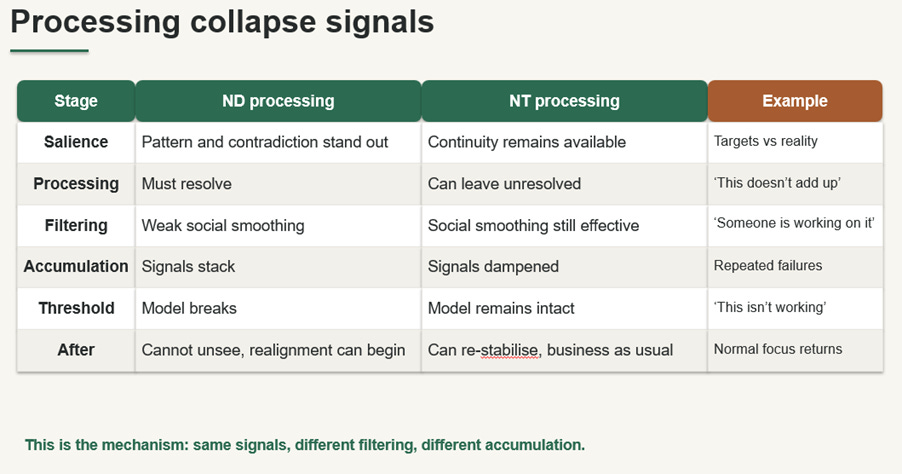
Fig. 1: Processing Collapse Signals. A working model of neurodivergent and neurotypical processing of collapse-related contradiction. Source: Adrian Lambert. Seeing Patterns, Finding Meaning presentation. CPA (2026)
Some people can hold these as separate facts. Some people can’t. Some people can allow the dominant story to keep functioning despite the evidence accumulating around it. For others, the contradiction itself becomes the thing they cannot let go.
Most neurodivergent advocacy has been developed within a society that assumes continuity. It assumes education, workplaces, health systems, professional pathways, and public services will continue, and the general future will remain close enough to the present for inclusion to be the central aim of support for neurodivergent people.
Contemporary advocacy in this space asks for reasonable adjustments, sensory adaptations, flexible working, diagnosis, medication, communication adjustments, employment rights, reduced stigma, and access to services. All of that still matters greatly.
It is also built around the assumption that the surrounding system remains worth adapting to.
That assumption is becoming harder to accept.
Advocacy, in this context, has to move beyond inclusion in existing systems towards adaptive participation: creating roles, relationships and forms of support that allow neurodivergent people to help communities perceive, respond and reorganise as those systems become less reliable.
Before looking more closely at adaptive participation, we should be honest about how incomplete the existing settlement still is.
2. Advocacy inside a system that assumes continuity
The existing advocacy frame is still barely established.
Autistic people remain profoundly excluded from employment, with the Buckland Review reporting that only around three in ten autistic people are in work, compared with around half of disabled people and around eight in ten non-disabled people.[3]
That statistic alone should stop any move towards romanticising neurodivergence as an adaptive advantage. For many people, the present system has been a place of exhaustion, poverty, administrative failure, social misunderstanding, and dependence on support that often arrives late or not at all.
The existing advocacy settlement therefore still has work to do. Schools still need to understand sensory overload. Employers still need to stop treating neurodivergent people as unreliable versions of neurotypical workers.
Mental health services still need to adapt therapy, not just offer the same model through a slightly more patient tone. ADHD medication pathways need to be accessible before people lose jobs, relationships and confidence. Autistic adults need support that recognises burnout, masking, social exhaustion and the cumulative cost of being misread.
Advocacy that is built around access to existing institutions becomes unstable when those institutions are themselves becoming unstable.
If the school system is overwhelmed, if workplaces become more precarious, if health services are rationed through waiting lists, if local authorities retreat to statutory minimums, and if climate and ecological disruption begin to shape everyday life more directly, then advocacy cannot only mean getting neurodivergent people through the door of the existing order.
So, what do neurodivergent people need when the order they are being included into is degrading? And what might communities need from neurodivergent people when shared assumptions begin to fail?
That question moves advocacy away from a purely supportive frame. Support still matters, and some people will need more of it, not less, as conditions worsen. But neurodivergent people should not be understood only as vulnerable individuals to be looked after. Some neurodivergent perception may be socially useful. Some of it may carry information the wider culture does not yet know how to receive.
In short, advocacy has to move from inclusion to participation in adaptation.
One way of thinking about what neurodivergent people might contribute, rather than simply need, is the canary metaphor.
3. The canary problem
The canary metaphor came up in the plenary, and it is worth staying with because it is useful and dangerous in roughly equal measure.
A canary in a mine is more sensitive than miners to a change in atmosphere. Its distress means something because the environment has changed before the miners can detect it. The canary’s vulnerability is also its function.
There may be something here for neurodivergent collapse awareness. Some neurodivergent people seem to register incoherence before the wider culture can metabolise it. The gap between narrative and evidence becomes harder to ignore. The social reassurance that keeps others aligned with mainstream narratives carries less weight.
The phrase “someone is working on it” may comfort one person and intensify the unease of another, because the person can see that the evidence is still moving in the opposite direction.
I’m not suggesting that this experience is the same for all neurodivergent people. There are plenty of neurodivergent people who are not collapse-aware, plenty who are uninterested, plenty who are overwhelmed by more immediate concerns, and plenty whose pattern recognition takes them into unhelpful or even destructive places.
Further, this isn’t an argument that neurotypical people are blind. Many neurotypical people have done extraordinary work in climate science, ecology, systems thinking, activism, mutual aid and political resistance.
My point is that some cognitive styles may be less able to filter out contradiction.
Some people may be less reassured by consensus. Some may experience the social system degrading as an active pressure rather than background noise. In periods of stability, that can look like difficulty, pessimism, social friction or maladjustment. In periods of destabilisation, the same traits may function as early warning.
A society entering overshoot and collapse should be careful about dismissing the people who cannot stay aligned with stories of progress and stability.
The canary is an individual. But the question might also be asked at the level of the collective.
4. Neurodivergence as collective signal
Another interesting suggestion in the discussion was that neurodivergence might be thought about at a collective level. This matters because clinical and educational systems usually encounter neurodivergence through the individual: diagnosis, impairment, intervention, risk, reasonable adjustments, medication, therapy, and support plans.
The individual scale is not the whole picture.
At a collective level, cognitive variation widens the perceptual range of a group or population. Different people notice different forms of danger and possibility. Some are tuned to social threat. Some to sensory disruption and injustice. Some to pattern and contradiction. Some to the gap between what a system says about itself and what it actually does.
This is useful in any society but becomes more important when conditions change. A stable society rewards people who can preserve cohesion, accept contradiction, follow social scripts, and maintain faith in shared institutions.
Growth societies especially need this. Large-scale coordination requires trust in the dominant cultural story. It requires people to keep showing up, keep investing, keep consuming, keep planning, and keep reaching for the stars.
A society in overshoot has a different problem. [4] Its dominant stories are also part of the machinery of overshoot. Growth. Innovation. Progress. More jobs. More infrastructure. More energy demand disguised as transition. More complexity to solve the problems created by complexity. [5]
In that context, the inability to tolerate incoherent narratives may become part of the species adaptive range. The person who says “this does not add up” may be rejected socially before they find a role for themselves that fits.
This is where trait adaptiveness becomes context dependent. A trait that causes friction inside a stable institution may become valuable when the institution itself is failing. A person who struggles with performative consensus may be harder to deal with in normal times. They may also be harder to fool when normality becomes a performance.
Before going further, the argument needs to be held against its own potential for self-serving distortion.
5. Humility
The argument here needs humility, otherwise it becomes another identity myth.
There is a temptation to turn neurodivergent collapse awareness into a heroic story. We saw it earlier than the others. We were the sensitive ones. We were the honest ones. That story has emotional appeal, especially for people who have spent much of their lives feeling out of place and then discover that the discomfort was being perceptive rather than defect.
Some neurodivergent people may be good in crisis. Some ADHD people respond well when urgency supplies activation. Some autistic people may be good at building meaningful systems from first principles when inherited systems fail. Some may respond to practical necessity better than to performative bureaucracy. Some may be less captured by social prestige or institutional reassurance.
I was one of the lucky ones. I found work and a career in a field that suited how my mind already worked. Systems, patterns, contradiction, organisational failure; these were often the job.
Others will suffer terribly. Some already are. Autistic unemployment, poverty, poor access to services, diagnostic delay, suicide risk, social isolation, exploitation, insecure housing, mental illness, and burnout are not erased by saying that neurodivergent traits may have adaptive value under certain conditions.
Adaptive value is not evenly distributed. It depends on support, class, housing, gender, race, health, community, skills, timing, and luck.
This matters because collapse will not arrive as a fair test of cognitive style. It will intensify existing inequalities. People with money, land, housing, family support and social capital will have more room to convert perception into adaptation. People already living at the edge may have no such opportunity.
If neurodivergent people are canaries, many have been lying on the floor of the cage for years. The advocacy question should focus on how to change the conditions under which heightened sensitivity becomes injury.
The stakes of getting this wrong are perhaps most visible in the situation of young neurodivergent activists - whose experience was among the most important contributions to the plenary discussion.
6. Young activists and unsupported intensity
The comments about young neurodivergent activists were among the most important in the session.
There is a particular kind of young person who sees too much, too early, with too little around them to help them bear it. Some are autistic, ADHD or otherwise neurodivergent. Some are morally intense, and some think in systems. Some see hypocrisy clearly, and some struggle to accept adult reassurance when the adults appear to be maintaining the very systems that are destroying their future.
Some are pulled into activism because it is the only real form of integrity.
This can be powerful. It can also be dangerous.
A young person who sees ecological breakdown may be carrying a level of reality that their family, school, peer group and wider culture have not even considered. If they also struggle with uncertainty, ambiguity, social belonging, executive function, sensory overload or emotional regulation, the result can be a heavy burden.
The problem goes much further than concern about climate change - they may be living after the future story has failed, while everyone around them continues with business as usual.
That is a very lonely place.
Activism can give meaning, structure and community. It can also intensify the load. The young person may be surrounded by adults who either minimise the crisis or praise them for caring while continuing to protect the system that generates the harm.
They may be told they are inspiring, resilient, brave, dramatic, anxious, naïve, and too young to understand, often by the same culture that refused to act at the scale required.
Young neurodivergent activists do not need adults clapping while they burn out. They need adults who can tell the truth without collapsing themselves. They also need spaces where uncertainty can be tolerated.
Not everything is binary, but some binaries are imposed by reality.
Living systems survive or they do not. Emissions rise or they fall. Habitats remain viable or they do not. A young person needs help distinguishing false complexity from real complexity.
The double empathy problem matters here. Damian Milton’s work moved the frame from autistic social deficit to mutual misunderstanding between differently disposed people.[6]
In collapse-aware settings, this can be very practical. Neurotypical adults may hear neurodivergent climate distress as catastrophising. Neurodivergent young people may hear adult reassurance as denial. The adult thinks they are regulating the child. The child experiences this as evidence that the adult cannot see.
A support model that cannot understand this gap will deepen it.
Underlying much of this is a dynamic that extends well beyond young people - a phenomenon which advocacy has not yet formally recognised.
7. Double masking
Masking is a term already familiar in neurodivergent advocacy. Neurodivergent masking is the learned suppression or modification of natural ways of thinking, communicating, moving, responding and relating in order to survive social, educational or professional environments.
Masking can be useful and necessary. It can also be exhausting.
Collapse awareness adds another layer.
Some people are masking twice. They are masking neurodivergence, and they are masking the fact that the shared future no longer feels believable.
They may continue with work plans, school expectations, career narratives, pension assumptions and the everyday rituals of continuity. They may still love the people around them. They may still be competent. They may still laugh, meet deadlines, go to concerts, cook dinner, attend meetings and make polite conversation.
But internally they have left the future story.
You are in a meeting about service transformation while knowing the public services are degrading. You are asked about five-year plans when you no longer believe in the assumptions behind five-year planning. You listen to people talk about growth, opportunity and innovation while thinking about energy, food, debt, climate, soil, war and the inability of complex systems to simplify voluntarily.
Collapse masking is the performance of belief in a world-model you have already left behind.
It affects how you participate. The person is translating themselves into a shared reality that no longer feels true. For neurodivergent people who already mask heavily, this second layer, or double masking, will increase the burden.
At some point the question arises: why spend so much energy fitting into a structure that is itself losing credibility?
This is one of the places where advocacy has to become a lot more honest. If the answer to neurodivergent distress is always better masking, better employability, better resilience, and better adaptation to institutional demands, then advocacy becomes a tool of the collapsing system. It helps people remain functional in environments that may be making them ill.
This cannot end well.
8. Epistemic injury
There is also an injury in being told to mistrust the perception that allowed you to see clearly.
Many neurodivergent people have long histories of perceptual invalidation. The light is not too bright. The room is not too loud. The social rule is obvious. The task is simple. Your reaction is too intense. Why can’t you be normal?
You are the problem.
Collapse awareness can recreate this pattern. The person notices a mismatch between the dominant story and the evidence, but the response often moves towards them: their mood, their certainty, their intensity, their mental health. The thing they are pointing at is left largely untouched.
Sometimes those responses may be caring, and even partly true. There is such a thing as obsession. There is such a thing as despair becoming self-reinforcing. There is such a thing as social media doom loops damaging a person’s capacity to live.
But there is also a harm in being asked to treat perception as pathology because it disrupts the dominant group’s need for continuity.
That harm is epistemic. The person is pressured to distrust the very faculties that helped them detect the pattern of collapse in the first place: pattern recognition, low tolerance of incoherence, reduced reliance on social consensus, moral intensity, and refusal of false reassurance.
The world becomes unstable, and then the person is told that their instability lies in noticing.
This matters for therapeutic practice. If support approaches collapse-aware distress as a faulty conclusion, it may reproduce the injury. The person may feel that they are being returned to the false story for the comfort of the listener.
Reassurance only works when the source of reassurance remains credible.
For some people, that credibility is long gone.
9. Collapse is already present
Another comment during the plenary session pulled the room towards places where collapse is already happening. Sudan was mentioned.
This matters, because any discussion of collapse awareness in relatively stable Western settings risks becoming too introspective if it forgets that collapse is already material reality elsewhere. War, displacement, hunger, state failure, destroyed infrastructure, currency breakdown, failed health systems, ecological degradation and aid dependency are a part of daily life for many.
In Sudan, war has produced the world’s largest displacement crisis, with UNHCR reporting in April 2026 that around 14 million people had been forced to flee since the conflict began, including 9 million displaced inside Sudan and 4.4 million across borders.[7] OCHA describes Sudan as the world’s largest internal displacement crisis, with civilians bearing the brunt of violence and more than 9 million people displaced internally.[8]
That should discipline the Western collapse imagination.
For some of us, collapse first appears as pattern recognition. A sense that the future is narrowing. An inability to believe institutional narratives. A growing distance from the cultural script. For many others, collapse is the loss of home, food, safety, medicine, family, school, land and state protection.
Neurodivergent advocacy in collapsing societies cannot only be about helping relatively secure people prepare psychologically for future contraction. It also has to ask what support means when services have already failed, diagnosis is unavailable, medication supply is insecure, communication differences are dangerous, and survival itself dominates attention.
The unevenness of collapse should produce humility. It should also make the advocacy question more concrete; what forms of support survive when institutions do not? What kinds of community can include people whose needs are complex when the formal systems around them have weakened? What happens to neurodivergent people in war, displacement, famine, state failure and forced migration?
Those questions are where climate and collapse psychology eventually has to go.
That context disciplines what advocacy can mean, and points toward a change that goes beyond inclusion into something that might be called adaptive participation.
10. From inclusion to adaptive participation
Inclusion assumes the systems neurodivergent people are being included into will continue to exist in a recognisable form.
That assumption is becoming harder to sustain.
Rights, diagnosis, accommodations, adapted therapy; all of that still matters, and in many places remains barely established. But inclusion cannot be the ceiling when the institutions offering it are themselves degrading.
Neurodivergent advocacy still has to ask how people enter existing systems. It also has to ask what they contribute when those systems begin to fail.
A society under strain needs its perceptual range widened. It needs people who can notice early signs of failure, name contradictions others are still filtering out, and begin adapting before consensus gives permission.
Much of that contribution will not be aligned with systems that measure value through productivity and professional output. Some of it will happen in gardens, repair spaces, and informal networks rather than workplaces.
The old economy was never a reliable measure of human usefulness. A declining society may finally make that obvious.
11. What support looks like under strain
Support under strain requires honesty, where someone can sit with you and not try to move you back into the socially acceptable version of the future.
Support built on managed reassurance will fail the people who need it most, because they are perceptive enough to exit the consensus trance. Truthful companionship means staying with someone in an accurate account of their situation without steering them back toward hope.
That asks the supporter to have done their own reckoning first.
From there, the work is helping a person bring their perception, their values, and their daily life into closer alignment. That process is both psychological and practical, and it will be slow, partial, and accompanied by grief even when it is also clearly right.
Collapse awareness can become dangerously abstract. A mind living inside civilisational analysis can lose its grounding without registering the loss. Returning to the physical and the local, to soil, seasons, and useful work at human scale may be what makes life meaningful again.
Housing, income, access to medication, safe relationships: under contraction these become more important at the same moment they are harder to secure. Psychological support that ignores the material dimension will reach its limits quickly.
Neurodivergent people need spaces where less masking is required, where a person does not have to deplete their available energy appearing fine before they can access any help at all.
A person who has left the dominant story needs somewhere real to land, not a better technique for pretending they have not.
12. Adaptive withdrawal
One of the most difficult distinctions support has to make is between withdrawal as deterioration and withdrawal as adaptation, because from the outside they can look identical.
Clinical systems are trained to read withdrawal as risk. That reading matters and should not be discarded. A person can also leave a career that no longer feels meaningful, or an institution whose functioning depends on collective pretence about the future.
The old system may call this maladaptation, when it may be the most rational move available under contraction.
These readings are not mutually exclusive. A person can be adapting and depressed. They can withdraw adaptively and become isolated at the same time. The withdrawal can be right in its direction and still damaging in its execution. Support cannot simply validate either assessment in advance.
Not all leaving is loss.
Some people are not giving up on life. They are giving up on a future that was never coming. The work of support is learning to tell the difference.
13: Conclusion: Advocacy after the future story breaks
The sequence I keep returning to is this.
Early seeing leads to realignment. Realignment leads to ecological engagement. Ecological engagement leads to new roles.
Collapse awareness can become despair, obsession, burnout, isolation or paralysis. Seeing early is not a virtue in itself.
The important thing is what transformation the perception leads to.
If it is embedded in loneliness, it may destroy the person. If it is embedded in community, practice, honest companionship, land, repair, care and useful work, it may become adaptive.
That is where neurodivergent advocacy in collapse has to go.
It must keep fighting for support in existing systems while also preparing for those systems to become less reliable. It must defend neurodivergent people from exclusion while also recognising that some of the excluded may carry forms of perception that communities need. It must protect vulnerable people without reducing them to vulnerability. It must value difference without turning it into an identity war.
The future will not need everyone to be optimistic. It will not need everyone to be socially compliant. It will not need everyone to maintain belief in failing narratives.
It will need people who can notice, repair, grow, warn, care, adapt and tell the truth without being destroyed by it.
I do not think this will be easy. Many institutions would rather have compliant neurodivergent people than perceptive ones. Many families would rather have reassuring answers than honest ones. Many services are built to function in complete ignorance of what that function is serving.
Neurodivergent advocacy in a collapsing society has to extend beyond supporting inclusion in the world as it was. It has to become part of building the forms of life that remain possible as that world begins to fail.
Author note: If you have a neurodivergent person in your life, or if you know someone who works with neurodivergent people, or who can impact policy in this area, please consider sharing this essay with them.
My work will always remain free to access. If this essay resonated with you, or was helpful in some way, please like, share, and subscribe. That is how this work travels.
References
[1] Why Some People See Collapse Earlier Than Others. Adrian Lambert. Substack (2025)
[2] If Collapse is Inevitable, Why Does Seeing Early Matter? Adrian Lambert. Substack (2026)
[3] The Buckland Review of Autism Employment. UK Government (2024).
[4] Overshoot: The Ecological Basis of Revolutionary Change. Catton, W. R. (1980). Overshoot: The Ecological Basis of Revolutionary Change. University of Illinois Press.
[5] The Collapse of Complex Societies. Tainter, J. A. (1988). The Collapse of Complex Societies. Cambridge University Press.
[6] On the Ontological Status of Autism: the ‘double empathy problem’. Milton, Damian (2012), Disability & Society.
[7] UN Refugee Agency United Kingdom. UNHCR. Sudan Crisis (2026)
[8] United Nations Office for the Coordination of Humanitarian Affairs. OCHA. Sudan (2026)
Thanks for reading A Grand Unified Theory of Doom! Subscribe for free to receive new posts and support my work.
Comments
Nothing yet. Say the first thing.
Sign in to join the conversation.