
Editor’s note: This essay uses game theory to explain collapse: not as one event, one failed leader, or one isolated crisis, but as the outcome of households, firms, governments and states making rational choices inside a system under tightening physical limits. Each move makes sense in isolation. Together, they drive collapse.
Introduction: Follow the Signs
The cost of living is rising, and the world feels less stable. People are moving, delaying major decisions, and having fewer children. In the West, healthy life expectancy is declining. Globally, the “rules-based order” is increasingly sidelined in favour of conflict.¹
Game theory helps explain why these pressures are becoming more difficult to contain. It examines how actors behave when their outcomes depend on the choices of others and asks what becomes rational under a given set of circumstances.²
Applied to industrial civilisation - a competitive system operating under tightening physical limits - the answer is not reassuring:
Rational behaviour by individual actors can collectively produce outcomes that no actor wants.²
Households take on debt because the alternative is a fall in living standards. Businesses chase growth to stay competitive. States increase military spending because rivals are doing the same. Each move makes sense to the actor. The combined result is destructive for society and the environment.³
Collapse does not require villains or failures of leadership. It emerges from ordinary strategic behaviour inside an overextended system whose conditions have changed.⁴
Three predictions follow.
The cost of living continues to rise, governments struggle to bring it back down, and poverty becomes entrenched.
Competition between countries over resources intensifies, and more of it turns into conflict.
Over time, the global system contracts, leading to less stability, less consumption, less complexity, and eventually fewer people.
These predictions are linked. Rising costs put pressure on households and states. States respond by trying to protect their position. As more actors do this at the same time, cooperation weakens. The system becomes more competitive, less stable, and harder to maintain at its current scale.²
History is always messier than theory, but the same underlying structure keeps producing recognisable outcomes. Once the incentives are understood, the pattern becomes easier to see.
Prediction One: The Cost of Living Keeps Rising, and Governments Cannot Bring It Back Down
Industrial civilisation was built on cheap, abundant energy.⁴
Fossil fuels made mechanised agriculture, global trade, mass housing, and modern healthcare possible, and in doing so created a political expectation that has persisted ever since: that living standards will keep rising, and that governments will protect them when they come under threat.⁴
Energy is the capacity to do work across the entire economy. When it becomes more expensive, costs spread through every sector that depends on it. Food, housing, transport, healthcare, public services: all become harder to sustain. Even when headline inflation falls, the accumulated price rise does not reverse.⁵
The baseline has shifted.
During the Covid pandemic, governments borrowed and spent to prevent economic collapse. During the energy crisis, they capped bills and subsidised households. In both cases, immediate pressure was reduced by moving costs onto public balance sheets and future taxpayers.⁶
These interventions can prevent acute hardship at the time, but they cannot make the system cheaper to run in the long term. The cost moves from households to public debt, from the present to the future, from one generation to another.⁶
The bill is deferred, not reduced.
The first prediction is that the real cost of maintaining a normal life keeps rising, and that governments become progressively less able to close the gap between what people expect and what the system can deliver.⁵
Policy can only slow this process and decide who bears more of the burden.
Prediction Two: Competition Between States Intensifies, and More of It Turns Into Conflict
The same pressure that squeezes households also squeezes states. Governments face rising demands for services, security, climate adaptation, and support for ageing populations, while the fiscal and political room to meet them shrinks.⁶
When growth was expanding the available surplus, these demands could be managed. When surplus tightens, they compete directly with one another. Defence against welfare. Energy security against emissions targets. Pensions against investment.⁷
Robert Axelrod showed that cooperation between actors can emerge when they expect to interact repeatedly, recognise each other as stable players, and can reward or punish behaviour over time. These conditions erode under stress. When the future is uncertain, immediate advantage becomes more valuable.³
When rivals seem less predictable, restraint feels more dangerous. A state that holds back on military spending while others increase theirs accepts strategic risk. A state that cooperates on energy while rivals secure independent supply chains may find itself exposed. When deterrence logic takes hold, each move generates the conditions that justify the next one.²
The recent U.S. attack on Iran illustrates this in real time: a strike framed as deterrence has widened the conflict, hardened Iranian and regional responses, disrupted energy routes, and made each side’s next move more dangerous to avoid.⁸
Global military spending has risen for ten consecutive years and reached record levels in 2024 - the aggregate signal of states preparing for a more competitive world. The competition extends beyond weapons: to energy access, critical minerals, semiconductors, trade routes, and data infrastructure.⁹
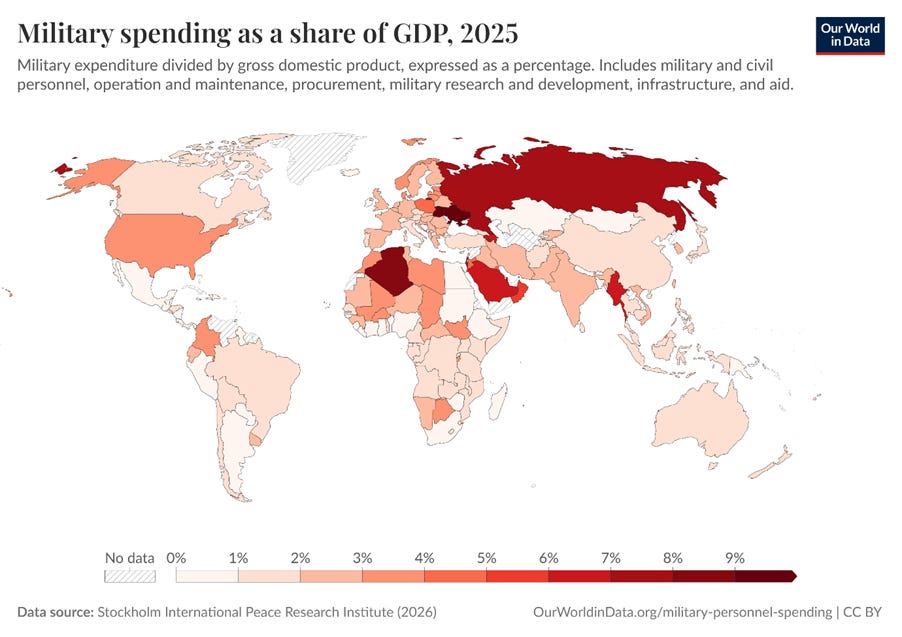
Fig 1: Military spending as a share of GDP, 2025. (Source: Stockholm International Peace Research Institute. 2026)
Every move can be framed as defensive. Together, they make the shared environment more hostile.
Wars have their own histories, causes, and contingencies. Material stress raises the underlying probability of conflict by raising the stakes of competition, reducing tolerance for compromise, and shortening the political time horizon of leaders already under domestic pressure.¹⁰
The second prediction is that this pressure keeps intensifying, and that more of it, over time, tips into open conflict.
Prediction Three: The System Contracts
Industrial civilisation operates at a scale that fossil fuels made possible; not just for energy, but for the food systems, healthcare, sanitation, construction, and state capacity that support over eight billion people.⁴
William Catton called this “phantom carrying capacity”: the Earth appears able to support far more human life than it actually can on a durable basis, because we are drawing down finite stocks of energy and resources accumulated over hundreds of millions of years. That draw-down has limits.¹¹
Nowhere is that draw-down more consequential than in the global food system.
Approximately 4 billion humans are dependent on food that is derived from fertiliser produced using fossil fuels. As energy depletion and a destabilised climate bite together, billions will find themselves without the calories necessary for survival.¹²
As these pressures compound with others, population contraction becomes a realistic long-term outcome.¹³
More than half of all countries now have fertility rates below replacement level. People decide whether to have children inside real material conditions; housing costs, job security, confidence about the future. When those conditions deteriorate, birth rates fall. When places can no longer support a tolerable life, people leave. Falling fertility and rising migration are the demographic expression of a system under strain.¹³
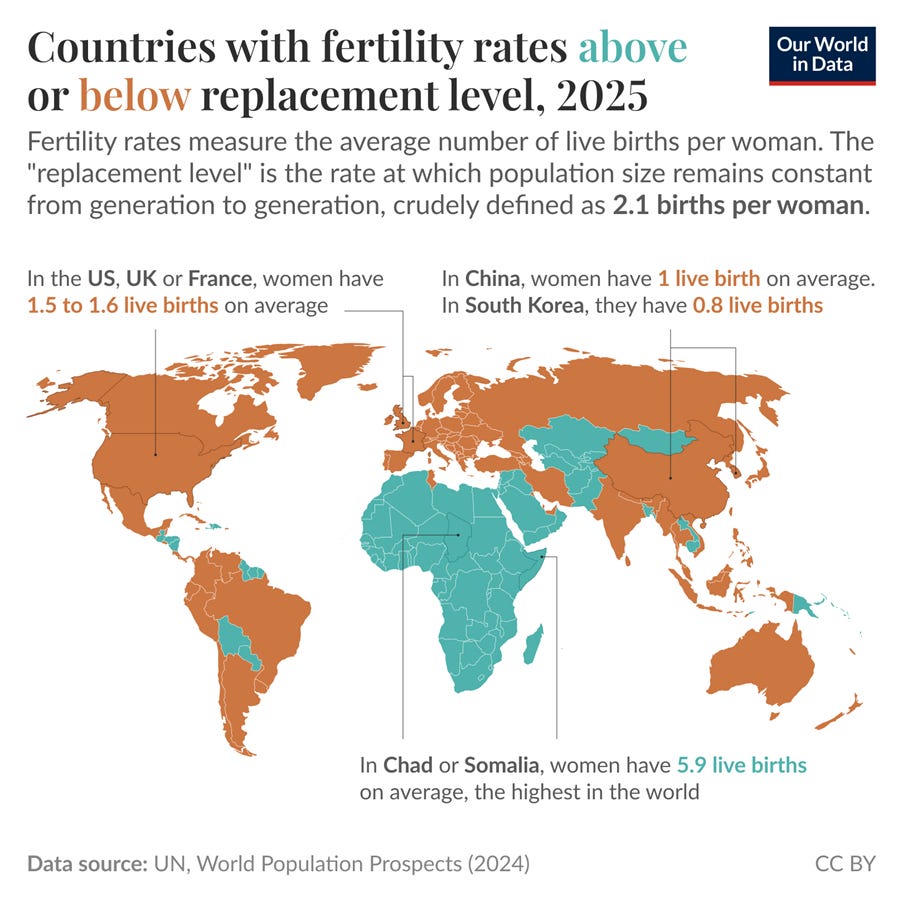
Fig 2: Countries with fertility rates above or below replacement level, 2025. (Source: UN, World Population Prospects. 2024)
Contraction arrives as degraded quality of life before outright failure. Healthcare systems that still exist but are harder to access. Transport networks that still run but less reliably. States that still govern but with diminishing legitimacy.
Joseph Tainter showed that societies under stress respond by adding complexity; more bureaucracy, more infrastructure, more technical management. This works until the cost of maintaining that complexity exceeds the benefit it provides.⁷
At that point, simplification begins, whether through choice, failure, or loss of capacity.⁷
The present moment fits this pattern closely. Every major challenge (climate adaptation, energy transition, healthcare, financial stability) requires adding another layer of costly complexity to a system already struggling to maintain what it has.⁷
The third prediction is that the system gradually becomes unable to sustain its current scale: less consumption, less reliability, less institutional capacity, and eventually fewer people.
Some places will contract early and sharply. Others will hold on longer by drawing resources from elsewhere. Inequality will widen.
A system cannot maintain a scale that its material base no longer supports.
The Prisoner’s Dilemma: Why the Game Cannot Stop
All three predictions share the same underlying structure, and game theory has a name for it: the prisoner’s dilemma.²
Two actors would both benefit from cooperation. But if one cooperates and the other defects, the cooperating actor loses. So, both defect, and both end up worse off than if they had cooperated. The individually rational move produces the collectively worse outcome.²
Civilisation is not a two-player game, but the structure is the same.
Every major state has an interest in a stable climate, a rules-based order, and sustainable resource use. Each also has an immediate interest in energy security, industrial competitiveness, and strategic advantage.²
A country that decarbonises faster than rivals may incur costs without equivalent benefit. A country that restrains military spending while rivals expand accepts strategic risk. A country that conserves resources while rivals extract gains nothing. Each continues, and the collective outcome worsens.²
Modern economies require growth to remain stable.⁷
Debt assumes future income. Pension systems assume future workers. Political legitimacy depends on improving or at least stable living standards. Without growth these structures become unstable, but growth requires energy and material throughput that the Earth can no longer absorb without consequence.⁴
Each actor is constrained by the choices available to it.
Population patterns register that stress through fertility decline, migration, ill health, and conflict. Decisions accumulate in degraded ecosystems, falling biodiversity, and a changing atmosphere.¹⁴
What Collapse Actually Looks Like
Collapse is often imagined as sudden; a dramatic rupture, a clear before and after.
Acute breaks do happen: wars, financial crises, supply chain failures. The wider process is slower and unevenly distributed.⁷
Systems become more expensive to maintain, less reliable, and more dependent on intervention before they fail. A collapsing system often still functions, more or less. Shops stay open. Elections happen. Hospitals treat patients. The surface looks calm while the cost of maintaining it rises underneath.⁷
The more accurate picture is a ratchet. A shock hits. Governments intervene. Stability partly returns, but at a lower baseline. The next shock hits sooner, or harder. The system does not return to its previous baseline; it adapts downward.
Conditions that would once have been considered unacceptable become normal; higher rents, longer hospital waits, more military tension, food banks as a permanent fixture.
Adaptation to decline can mask decline, for a while. Expectations fall while political rhetoric becomes more detached from reality.
As the system weakens, actors become more defensive, more willing to take risks, more focused on short-term position. A declining state may gamble rather than concede. A political movement losing legitimacy may find enemies more useful than solutions. Authoritarian regimes inevitably rise.¹⁰
A competitive descent is more unstable than a cooperative one would be, and nothing in the current system reliably produces cooperation at the scale required.³
What it produces instead is a series of locally rational moves that collectively accelerate the descent.
What Remains
At the global scale, the incentive structure will not change in time to alter our trajectory.
Too many institutions depend on growth. Too many political promises depend on future surplus. Too many actors are punished for restraint.
At smaller scales, different incentive structures are possible. Communities with local food production, practical skills, strong relationships, and mutual trust are less exposed than those entirely dependent on global supply chains.¹⁵
Reducing dependency is the one move available that changes the terms of the game.
Permaculture offers one framework for this: designing human systems that can function within ecological limits rather than against them. The less a household or community depends on long supply chains, centralised energy, and debt-fuelled consumption, the fewer moves it is forced to make inside the collapsing game.¹⁵
States remain necessary, and their failure causes enormous harm. But they are caught in the same game, unable to tell populations that the future is contraction without undermining the legitimacy they need to govern. The gap between the public story (growth, innovation, managed transition) and the material reality (constraint, overshoot, decline) will widen.
Work that holds its value regardless of how that gap resolves - restoring ecosystems, caring for people, building trust, reducing dependency, telling the truth - is worth doing now.
The Narrowing of Moves
As conditions tighten, the number of viable moves available to each actor falls.
Households try to stay solvent. Firms try to stay profitable. Governments try to stay legitimate. States try to stay secure. Each move makes sense. Together, they drive collapse.
The system rewards behaviours that preserve local advantage while eroding the conditions that support the whole. The absurdity of some responses is already visible: building energy-intensive cooling systems to survive rising heat; increasing military spending in a world that needs cooperation; extracting more to fund a transition away from extraction.
These are rational responses to the incentives in front of each actor.
The actors are not playing badly, but the game itself has become destructive. Once a system reaches a certain scale, with certain dependencies, under tightening constraints, the number of viable moves falls until collapse becomes the aggregate outcome of individually rational behaviour.
Everyone is playing correctly. And that is enough.
My writing will always remain free to access. Please consider liking and sharing - that’s how this work travels. You’re very welcome to subscribe if you want to follow where these ideas go next.
References
Health Foundation. Healthy Life Expectancy in the UK. 2026; Stockholm International Peace Research Institute. Trends in World Military Expenditure, 2024. SIPRI, 2025.
Dixit, Avinash K., and Nalebuff, Barry J. The Art of Strategy: A Game Theorist’s Guide to Success. W. W. Norton, 2008.
Axelrod, Robert. The Evolution of Cooperation. Basic Books, 1984.
Smil, Vaclav. Energy and Civilization: A History. MIT Press, 2017.
International Energy Agency. World Energy Outlook 2024: Security, Affordability and Sustainability. IEA, 2024; Food and Agriculture Organization of the United Nations. FAO Food Price Index. FAO, 2026.
Office for Budget Responsibility. Fiscal risks and sustainability; UK Government energy support scheme documentation.
Tainter, Joseph. The Collapse of Complex Societies. Cambridge University Press, 1988.
House of Commons Library. Israel/US-Iran conflict 2026: Reopening the Strait of Hormuz. 2026.
Stockholm International Peace Research Institute. Trends in World Military Expenditure, 2024. SIPRI, 2025.
Homer-Dixon, Thomas. Environment, Scarcity, and Violence. Princeton University Press, 1999.
Catton, William R. Overshoot: The Ecological Basis of Revolutionary Change. University of Illinois Press, 1980.
Ritchie, Hannah. “How many people does synthetic fertilizer feed?” Our World in Data, 2017; Our World in Data. Fertilizers.
United Nations Department of Economic and Social Affairs, Population Division. World Population Prospects 2024: Summary of Results. United Nations, 2024; United Nations. World Fertility 2024.
IPBES. Global Assessment Report on Biodiversity and Ecosystem Services. 2019; IPCC. AR6 Synthesis Report: Climate Change 2023. 2023.
Holmgren, David. Permaculture: Principles and Pathways Beyond Sustainability. Holmgren Design Services, 2002.
No posts
Comments
Nothing yet. Say the first thing.
Sign in to join the conversation.