
Chapter 1: The City Is Not an Escape from Ecology
We do not think of ourselves as livestock - not the way we think of pigs, sheep or cows. But perhaps we should, and the place to start is where most of us live.
Cities are the ecological equivalent of intensive livestock systems for Homo sapiens.
That may sound extreme, because modern culture has trained us to see cities as evidence of human advancement. The city is where humanity supposedly became civilised. It is where we conduct and celebrate culture, politics, finance, medicine and technology, and tell ourselves that we have risen above the constraints of land, soil, weather and food.
That interpretation mistakes abstraction for ecological transcendence.
Humans do not escape ecology by building cities. Through cities, we reorganise ecological dependence into forms that are invisible to us in our daily lives.
Ignorance by design.
A feedlot concentrates animals in a simplified artificial environment. Their food is produced elsewhere. Their waste becomes a technical problem. Their movement is constrained. Their bodies are reorganised around production and output.
The modern city concentrates human bodies at high density, imports energy and biomass from elsewhere, converts those flows into economic activity and waste, and presents the arrangement as civilisation.
Feedlots and cities perform the same function for different species.
Cities concentrate us. They feed us from distant landscapes. They manage our waste through hidden infrastructure. They direct movement through property, transport systems and economic activity. They reorganise life around work, rent, debt and institutional compliance.
A feedlot is more than just a pen - it is a whole arrangement of inputs and outputs; land, feed, water, waste, movement, stress and consumer products.
A city can be read the same way. It concentrates mammals inside an artificial habitat and makes them dependent on flows from elsewhere.
City dwelling humans are mammals living inside an intensive production system.
This framing moves attention away from the city as a symbol of progress and toward the city as a biological arrangement. It allows us to ask what the city system requires, what it produces, what behaviours it selects for, and what happens to the organisms inside it. It allows us to consider alternatives.
The city is not humanity’s escape from nature.
It is nature rearranged into a high-throughput human enclosure.
Chapter 2: Cities, Overshoot and the Problem of Human Habitat
The city-as-feedlot frame sits within a well-established body of ecological thought about overshoot, energy and human settlement.
William Catton’s analysis demonstrates that civilisation supports human populations at densities and consumption levels that local ecosystems could never sustain by themselves. Fossil fuels, global trade and industrial agriculture allow carrying capacity to be imported from elsewhere and borrowed from the future. The city is a clear expression of that process: a dense human settlement sustained by landscapes it does not inhabit.[1]
This is also the argument made in ecological economics by Professor William Rees. His work on ecological footprints and appropriated carrying capacity shows that cities appear spatially compact only because their real ecological footprint is displaced beyond their boundaries. The land actually required to sustain urban consumption is not contained within the city, but is appropriated through trade, energy systems and the wider flow of ‘ecological goods and services’.[2]
The visible enclosure is never the whole system. A feedlot is a pen, but also the land growing the feed, the water, the transport, the waste system, the veterinary inputs and the economic structure around it. A city should be read in the same way. The mapped city is only the visible surface of a larger ecological apparatus.
Howard Odum’s work explains this metabolically. Odum states that cities are not autonomous human achievements but are concentration points for energy and material flows. A city draws in food, fuel, water, minerals, labour and information, then degrades those inputs into waste heat, pollution, sewage and further demand.[3]
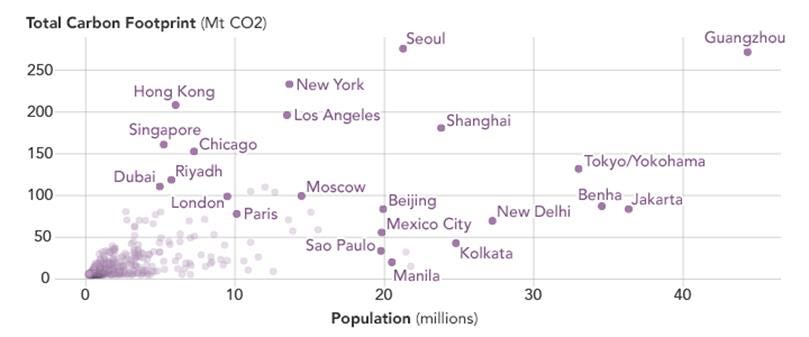
Fig 1: Carbon Footprint of Cities. (Source: NASA) 2019
Abel Wolman made this point directly in his classic paper, The Metabolism of Cities. Writing in Scientific American in 1965, Wolman framed the city through its inputs and outputs: water, food, fuel, waste and pollution.[4]
This paper made the biological language of cities legitimate. The city is not just a place where people live, it is a metabolic entity.
This is where the usual story of the city really breaks down. The city presents itself as the place where humanity becomes less dependent on nature. In material terms, it is where dependence becomes most extreme.
Mumford and Shepard’s analysis demonstrates that the city is both an energy system and a human habitat.
Shepard argues that human psychological maturity is biologically tethered to an immersion in the natural world. By separating ourselves from our hunter-gatherer past, modern society has stunted human emotional development.
Mumford’s central idea in The City in History is that modern, unchecked cities risk destroying human culture unless urban design prioritises human psychological and social needs over technological and economic expansion.
Cities shape attention, behaviour, social life and the perceived boundaries of normality. Humans living inside highly artificial environments can come to experience ecological displacement as ordinary life.[5][6]
The city produces a version of the human animal adapted to the enclosure. It trains us to treat distance from the ecological basis of our existence as normal, even sophisticated. That is what makes the feedlot comparison useful; it asks what kind of human being the city selects for.
As a counterpoint, economists like Edward Glaeser have argued that dense cities are ecologically efficient compared to the alternative, i.e. that a household in a compact apartment with shared infrastructure and short commutes uses less energy and land per person than the same household spread across suburban or rural sprawl.[7]
Per-capita footprint is often genuinely lower in dense cities than in dispersed, car-dependent settlement patterns.
But efficiency and dependency are different axes. A feedlot is also extremely efficient (that is the entire point of a feedlot). Efficiency is how you maximise throughput per unit of input, but it says nothing about the experience of the animals inside the system.
A city can be more efficient than sprawl and still be a more total, more fragile form of dependency than either. The efficiency argument tells us cities are a comparatively good way of running a high-throughput civilisation. However, it is not an argument that high-throughput civilisation, run efficiently or otherwise, is something we can or should keep doing.
The existing literature gives us much of the picture. It gives us ecological overshoot, metabolism, technological organisation and habitat mismatch.
The cities-as-feedlot paradigm allows us to take this even further.
The feedlot comparison reframes the city as an intensive human containment system. A structure that concentrates bodies, imports carrying capacity, manages waste, selects for certain behaviours, and turns living organisms into output within a larger economic metabolism.
The key point here is that cities can be analysed as a production ecology for domesticated humans.
With this perspective, the modern city is an ecological system that has become so abstracted and displaced that its inhabitants mistake total dependence for freedom.
Chapter 3: Phantom Carrying Capacity Made Concrete
A feedlot animal is sustained by a landscape it does not inhabit.
So is the urban human.
The city does not feed itself. It eats elsewhere, so to speak.
Food arrives through industrial agriculture, fossil fuels, fertiliser, refrigeration and logistics. Energy arrives through grids, pipelines, refineries and geopolitical arrangements. Materials arrive from extraction zones most urban people will never see.
The city dwelling human experiences these flows as services. Food appears in shops, water from taps, power from plug sockets, heat from boilers, and waste disappears into pipes and bins.
This is phantom carrying capacity made concrete.
The city gives the appearance of abundance because the ecological basis of that abundance has been pushed out of view. Food, water, heat and waste become consumer interfaces. The soil, catchment, fuel system and disposal site are somewhere else, which is precisely the point.
The mapped city (the one on the map, with a postcode and a skyline) is only the visible surface of this arrangement. The real city also includes the oilfield, the mine, the industrial farm, the cargo ship, the warehouse, the landfill, the sewage outfall and the atmospheric sink.
London is not only London. London is the land, energy, labour, food, water and waste assimilation required to keep London functioning. The real city extends across the biosphere, and most of what sustains it is, by design, somewhere a Londoner will never go and never have to think about.
The result is a disturbing form of dependency that we mistake for independence.
But then the power goes off. The plumbing stops working, the card machine fails, or the supermarket shelves empty, and the illusion starts to collapse. What felt like freedom was really access to a functioning but fragile system.
You can live in a city, be highly educated, professionally successful and socially respected while having almost no direct relationship with the material systems keeping you alive.
That is the expected outcome of an intensive system.
A feedlot animal does not need to understand the grain system. The urban human does not need to understand the supply chain. The system understands on their behalf.
Until the systems break down.
Chapter 4: Throughput Misrecognised as Wealth
Modern societies believe that cities produce wealth.
From an ecological perspective, cities produce throughput.
They pull in energy, matter, labour and our time and attention, and convert them into activity. Some of that activity is counted as economic value. Some is treated as waste. Some activity becomes illness, stress, pollution or institutional dysfunction.
These are outputs of the same metabolism.
You wake in a housing unit, eat imported calories, travel through a managed corridor to work, perform specialised labour, return home, pay bills, rest, sleep, and repeat.
Inside the dominant cultural story, this is ordinary life.
Within the city-as-feedlot framework, it is a production cycle.
The system converts human attention into work. It converts land into rent, dependence into consumption, and insecurity into labour discipline.
A feedlot has an owner and an output. The owner is whoever profits from the throughput; the output is the animal itself, fattened and sold on. The human feedlot has no single farmer in the way a cattle operation does, there is no one person signing the cheques - but it does have beneficiaries and it does have an output.
The beneficiaries are diffuse: landlords, lenders, employers, shareholders, the state, anyone positioned to extract value from a population that must work, borrow, rent and consume in order to remain inside the system at all.
The output is labour, rent, debt service, tax revenue and consumption, extracted continuously across a lifetime rather than realised once at slaughter. The human feedlot is like a market of overlapping owners, each drawing throughput from the same enclosed population.
No single architect is required for a system to behave like one.
Human reproduction is part of the same throughput logic - what the late George Carlin described as ‘pumping out a unit.’ The city does not only process the humans already inside it. It requires new humans to enter the cycle after them. Pension systems need new contributors, and landlords need new tenants. Labour markets need new entrants once the old ones retire, sicken or die.
Children are culturally sentimentalised, but systemically they are future workers, consumers, tenants, borrowers and taxpayers - the next intake for the same beneficiaries described above.
The human feedlot uses bodies, extracts from them continuously, and then requires their replacement.
The more the human depends on the system, the more the system describes them as independent.
You may appear autonomous because you earn money, make purchasing choices, and possess recognised credentials. But remove electricity, supermarkets, digital payments, wage income, transport, heating and sewage infrastructure, and that autonomy disappears very quickly.
Intensive systems increase output by reducing direct ecological engagement and encouraging specialism. This is one of the main ways complex societies raise throughput: people become better at narrower functions while becoming less able to meet their own needs directly.
This has obvious benefits within a functioning complex society. It also creates dependency. Under conditions of expansion, that dependency is experienced as progress.
Under conditions of contraction, it becomes exposure.
Chapter 5: The Behaviour Selected by the Enclosure
Every habitat selects for behaviour.
The modern city rewards people who can be punctual, abstract, compliant, competitive and tolerant of noise. It rewards people who can sit indoors under artificial light for long periods and sell their attention for money.
The city also rewards fluency in social signals. Money, credentials, and job titles become the symbolic environment through which life is managed.
The city is a symbolic habitat built on material flows it hides from view.
Within this habitat, you can become highly functional while losing the ability to meet basic needs outside the system. You can eat every day without knowing how food is grown. You can claim to be resilient while depending entirely on just-in-time logistics.
This is habitat selection.
The city selects for people who can function inside the enclosure, through reward, punishment and adaptation: those who can tolerate abstraction, crowding, noise, bureaucracy and wage dependency are more likely to succeed within it.
Complex societies are more fragile than they look, precisely because of this specialisation. Joseph Tainter’s analysis of societal collapse argues that complex societies invest in problem-solving structures that yield diminishing returns over time, leaving them less able to absorb shocks even as they appear, on the surface, more sophisticated.[8]
A population finely adapted to one stable arrangement of energy and institutions is not the same as a population that can adapt quickly when that arrangement changes.
Collapse changes the selection environment.
As energy, ecological and institutional conditions deteriorate, the traits rewarded by high-throughput civilisation lose some of their adaptive value. People will become more concerned with food, heat, water, repair, care, land, and community.
Viewed this way, collapse is a context shift. It alters which competencies matter.
The tragedy for industrial humans is that many have spent their lives adapting successfully to a habitat that is already breaking down.
Chapter 6: Pathology as Habitat Feedback
When animals are confined in simplified artificial environments, pathology follows.
That is what happens when organisms are separated from the conditions that shaped them, placed under chronic stress, restricted in movement, and made dependent on managed inputs.
In intensively housed fattening bulls, stereotypic behaviours such as object manipulation and repetitive oral behaviours are widely observed and are generally treated as indicators of restricted welfare. These behaviours emerge from the conditions of housing, feeding and confinement. The animal is responding to the enclosure.[9]
A bull’s tongue-playing and a human’s doomscrolling are not the same behaviour, but they sit in the same explanatory category: both are read by researchers as a confined animal’s response to an environment that does not meet its behavioural needs, rather than as a fault internal to the individual animal. I’m not suggesting a literal equivalence of symptoms, but the same logic of diagnosis.
Humans are animals. Modern culture avoids this fact because accepting it would collapse much of its self-image.
Urban life produces characteristic forms of distress. Loneliness in crowds, sensory overload, status anxiety, and attention fragmentation.
These conditions are usually treated as individual problems, and sometimes that is appropriate - individuals have different histories, bodies and vulnerabilities.
But an ecological analysis has to ask what kind of habitat repeatedly produces the same patterns of suffering.
There is now a mainstream research base pointing in the same direction. Bratman and colleagues note that urbanisation is associated with increased levels of mental illness. They tested whether nature experience might affect rumination, a known risk factor for depression and other mental health problems.
In their study, participants who walked for 90 minutes in a natural setting showed reduced self-reported rumination and reduced activity in a brain region associated with mental illness risk, while those who walked in an urban setting did not show the same effect.[10]
This supports the broader habitat argument. Reduced contact with the living world is now treated as a plausible pathway through which urbanised environments affect psychological wellbeing.
If a captive animal develops abnormal behaviour, the enclosure becomes part of the diagnosis.
Modern humans rarely extend that logic to themselves.
Instead, our system offers optimisation. There are productivity tools for overwhelm, wellness apps for stress, gyms for bodies immobilised by sedentary work, therapy for distress created by economic precarity, and mindfulness for lives structured by distraction and contradiction.
These responses leave the habitat intact, placing the problem on the individual.
Late-stage industrial civilisation increasingly frames system-generated distress as personal maladaptation. You are anxious, burned out, lonely, and failing to cope.
Japan’s long-running rise in solitary deaths among the elderly and the isolated is one of the starker public-health expressions of this; a society highly functional by every conventional economic measure, in which growing numbers of people die alone and undiscovered for days or weeks at a time.[11]
Within the city-as-feedlot framework, we can see that the organism may be responding to the enclosure.
Chapter 7: Beauty Does Not Cancel Metabolism
Cities contain real beauty.
They contain friendship, art, medicine, music, libraries, refuge, anonymity and possibility. They can give people freedom from the suffocation of small communities. They can gather the displaced, the strange, the ambitious and the brilliant.
Industrial civilisation has always been able to produce beauty from extraction. This is one of the reasons it is so difficult to reject. The same system that destroys forests can build hospitals. The same system that burns fossil fuels can produce music, science, sanitation and extraordinary human connection.
Let’s use a Metallica concert at the O2 stadium in London as an example. Thousands of people travel through fossil-fuelled transport systems into a building made from concrete, steel, glass, plastics and copper, powered by an electrical grid, amplified through mined metals and petrochemical equipment, to experience something genuinely wonderful together. The power of the experience is real. So is the extraction that made it possible.
A collapse-aware analysis has to hold both the good and the harm.
The city can be culturally generative and ecologically parasitic at the same time. It can liberate individuals while increasing systemic dependency. It can create forms of human flourishing while destroying the conditions that make human life durable.
Complex systems often contain positive local outcomes within larger destructive trajectories.
What is important here is what cities require, what they conceal, and ultimately, what they become when the flows sustaining them contract.
Chapter 8: Less Intensive Human Habitats
The answer is not ‘everyone should live on a farm’.
The countryside is not necessarily ecological, and much of it has already been reorganised by industrial logic. Rural life can be lonely, hierarchical, economically precarious and ecologically damaging.
A field of pesticide-treated monocrop may look green from the road, but ecologically it can be closer to a factory than a living landscape.
Another important concern is intensity of production. We cannot feed 8.2 billion humans without industrial agriculture, and so we are fated with a human population correction as the flows that support industrial agriculture disappear.
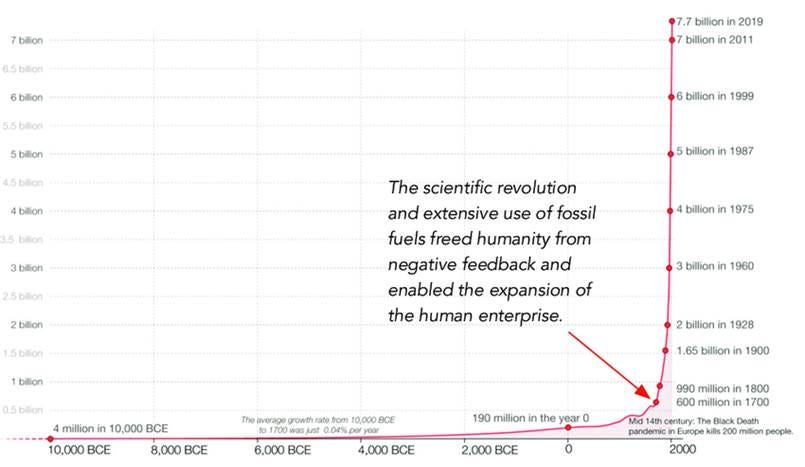
Fig 2: Human population over the past 12,000 years (Source: Researchgate)
Putting that aside for a moment, what would a less intensive human habitat actually look like, in practice, rather than in principle?
It would reduce throughput and increase direct ecological relationship. It would bring food, water, waste, energy, repair, shelter and care back within perception.
That might mean a street where enough households grow some real fraction of their own vegetables that a bad harvest is noticed rather than invisible. A town with a working relationship to a mill, a woodlot or a local energy source, so that ‘where does this come from’ has an answer a person could walk to.
A neighbourhood where skills like food preservation, basic repair, water capture and care for the old and the sick are distributed across many households rather than outsourced to apps, tradespeople and institutions that may not always be functional.
None of this requires abandoning cities.
It requires cities, towns and households to hold back some of the competence and material relationship that intensification has spent the last century removing.
It would not require every person to become a farmer. But it would require more humans to become participants again in the material basis of life.
Food would not simply appear. Waste would not simply vanish. Energy would not be treated as magic. Shelter would not function primarily as a financial asset. Work would not consume the best hours of human attention in exchange for permission to survive.
A less intensive habitat would restore ecological participation.
None of this is a substitute for the structural change a throughput system this large actually requires. A street that grows some of its own vegetables does not dismantle a global supply chain, and no amount of household-level competence rolls back the beneficiaries described in Chapter 4. But it is the kind of practice a person can start now, while the larger argument about systems and ownership is still being had.
Collapse is already a process of systems becoming less able to maintain their promises. The more intensive the habitat, the more vulnerable it becomes to disruption.
The more dependent the human, the less resilient they are when the system starts to fail. Less dependence now is greater resilience later.
Chapter 9: The Feedlot at the End of the Fossil-Fuel Age
The modern city is one of the great achievements of fossil energy.
It is also one of humanity’s great illusions.
It taught us to confuse supply chains with abundance, wage labour with independence, consumption with freedom, and ecological blindness with progress.
For a while, the illusion has worked.
The energy was dense enough, and the food systems expanded. The pipes carried the waste away, and the shops stayed full. The lights came on, and the institutions retained enough legitimacy for most people in wealthy countries to believe this was normal.
But normal was never really normal.
It was a temporary arrangement of energy created by fossil fuels, extraction, debt, empire and technology.
This is the version of the city the feedlot comparison fits most precisely: the high-throughput, fossil-fuelled city of the last century, sustained by container ships, synthetic fertiliser, electrical grids, global supply chains and distant waste sinks.
The pre-industrial city, fed largely from its own region, was never this exposed. The city of the last century is.
Now the flows are under pressure.
Climate instability is disrupting food systems.[12] Global cooperation is breaking down as resources become scarcer. Energy is becoming more contested. Infrastructure is ageing. Housing is failing as a social settlement. Public services are fraying. People are anxious, angry and tired.
The enclosure still functions, more or less. But the animals are restless.
Collapse-aware or not, we are all implicated. Most of us depend on the systems we can see failing. There is no clean outside position.
Cities are not proof that humans escaped ecology. They are dense human feedlots made possible by vast external subsidies of energy, land, labour and time.
They are intensive livestock systems for a species clever enough to build its own enclosure and blind enough to call it freedom.
The city is not humanity’s escape from nature.
It is the feedlot at the end of the fossil-fuel age.
References
[1] Catton, W. R. (1980). Overshoot: The Ecological Basis of Revolutionary Change. University of Illinois Press.
[2] Rees, W. E. (1992). Ecological footprints and appropriated carrying capacity: what urban economics leaves out. Environment and Urbanization.
[3] Odum, H. T. (1971). Environment, Power, and Society. Wiley-Interscience.
[4] Wolman, A. (1965). The metabolism of cities. Scientific American, 213(3), 178–193.
[5] Mumford, L. (1961). The City in History: Its Origins, Its Transformations, and Its Prospects. Harcourt, Brace & World.
[6] Shepard, P. (1982). Nature and Madness. Sierra Club Books.
[7] Glaeser, E. (2011). Triumph of the City: How Our Greatest Invention Makes Us Richer, Smarter, Greener, Healthier, and Happier. Penguin Press.
[8] Tainter, J. A. (1988). The Collapse of Complex Societies. Cambridge University Press.
[9] Schneider, L., Kemper, N. and Spindler, B. (2020). Stereotypic Behavior in Fattening Bulls. Animals.
[10] Bratman, G. N., Hamilton, J. P., Hahn, K. S., Daily, G. C., & Gross, J. J. (2015). Nature experience reduces rumination and subgenual prefrontal cortex activation. Proceedings of the National Academy of Sciences.
[11] Japan Times (2026, April 17). Solitary deaths in Japan.
[12] IPCC (2023). Climate Change 2023: Synthesis Report. Contribution of Working Groups I, II and III to the Sixth Assessment Report of the Intergovernmental Panel on Climate Change. IPCC, Geneva, Switzerland.
No posts
Comments
Nothing yet. Say the first thing.
Sign in to join the conversation.