
Hey Friend!
There Are Two Crypto Markets Now…
April 2026 told two completely different stories at once.
If you held IBIT, the Bitcoin ETF, in your brokerage, you watched your position drift higher and read headlines about institutional flows recovering. If you held rsETH (KelpDAOs restaked Ethereum) in a wallet, you watched 18% of the entire supply get minted out of thin air, dumped into Aave as collateral, and some hackers just walked out the door with $292 million of real ETH.
Same asset class on the surface. Different planets underneath.
Let’s look at what actually happened in this episode…
️ ⚡ On today's Episode:
📈 Market Update – April split crypto into two different markets: spot Bitcoin ETFs pulled in ~$2B, their strongest month since October 2025, while onchain finance suffered its worst hack month ever with ~$651M stolen across 40+ exploits.
🐂 Alpha Insights – 6% of aggregated CEX perp volume, oil + equity markets overtaking crypto flow, HIP-4 prediction markets live, and HYPE ripping to $43.73. Plus: CARDS trades near a $39M market cap against ~$45M annualized revenue, but September unlocks could flip the setup fast.

The current state of the market.
Weekly Crypto Bubbles
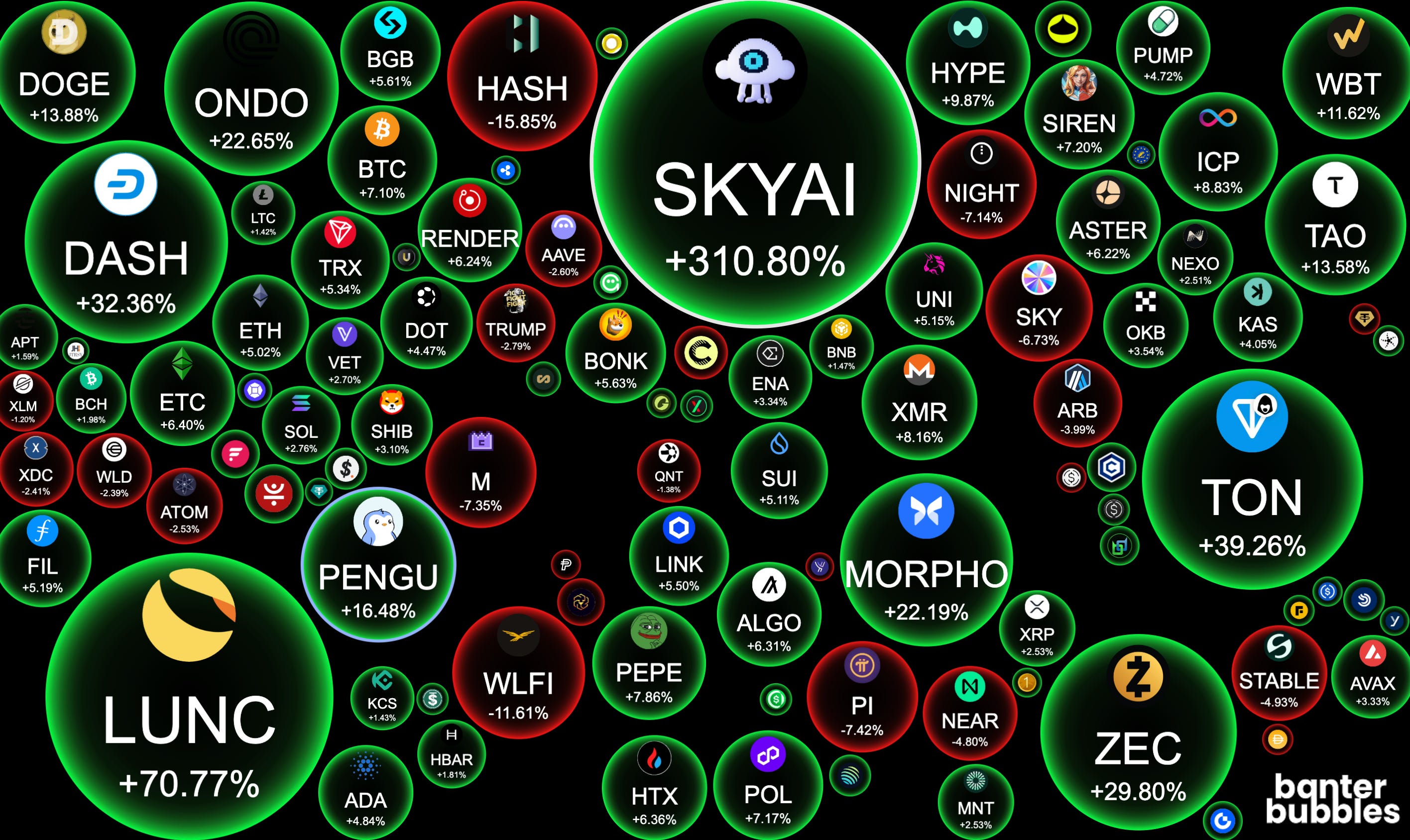
→ A nix mix of green but the real question is: Will all of us soon play Telegram games again because there’s nothing else to do in crypto? I hope not!
Market Evaluation
The ETF crowd is back
Spot Bitcoin ETFs took in roughly $2 billion in net inflows in April.
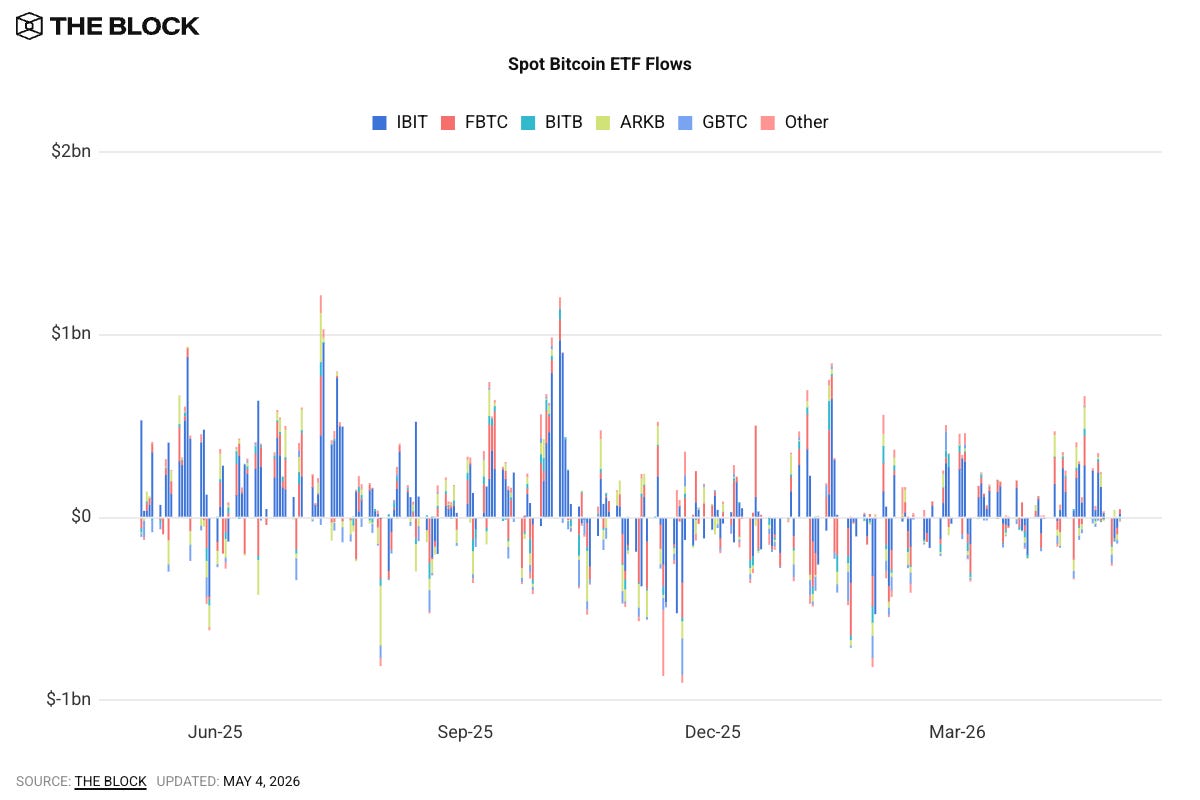
Spot Bitcoin ETFs took in roughly $2 billion in April. Strongest month since October 2025. Year-to-date flows are now positive at about $1.5 billion, a real reversal after a sluggish first quarter. IBIT keeps seeing the majority of those flows, which surprises nobody who knows about BlackRock’s distribution machine work.
This is the part of the market that wealthy non-crypto-natives can actually access. It sits inside a brokerage account. It settles like an equity. It reports on a 1099. It inherits like every other security they own.
It’s also the part of the market that’s stabilizing.
The onchain market got taken apart
April was the most-hacked month in crypto’s history by number of incidents. Roughly $651 million stolen across 40+ separate exploits. More than one a day.
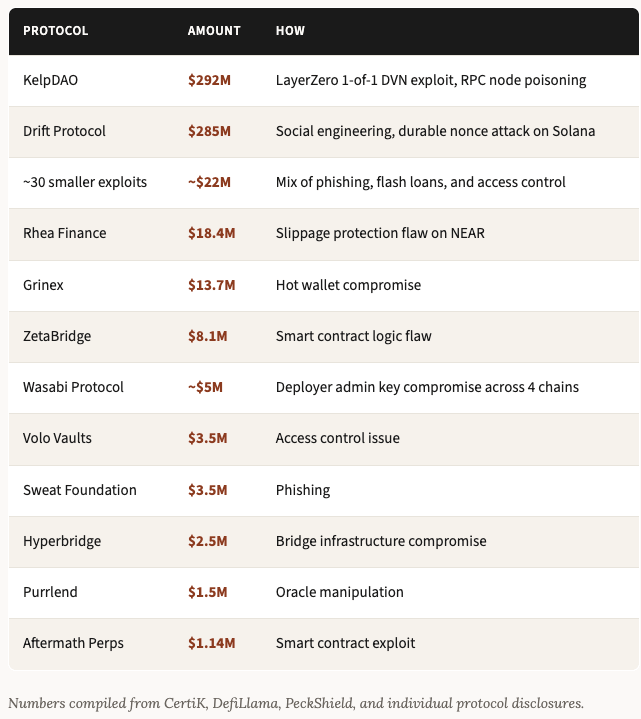
Two attacks did most of the damage.
Drift Protocol on Solana lost $285 million in twelve minutes after its security council got socially engineered for six months by attackers posing as a quant fund. The attackers deposited $1 million of their own funds first, just to look credible. Then they used a Solana feature called durable nonces to get council members to pre-sign transactions. Basically signing blank checks. On April 1, the checks cleared.
KelpDAO on Ethereum lost $292 million because their LayerZero bridge ran a 1-of-1 verifier setup. LayerZero’s own integration checklist explicitly recommended multiple verifiers. KelpDAO went with the default. Attackers manipulated the single verifier, minted 116,500 unbacked rsETH (about 18% of the entire supply), put it into Aave as collateral, and borrowed real ETH against it.
The fallout went well past the protocols themselves. Aave saw $8.4 billion in deposit outflows in 48 hours.
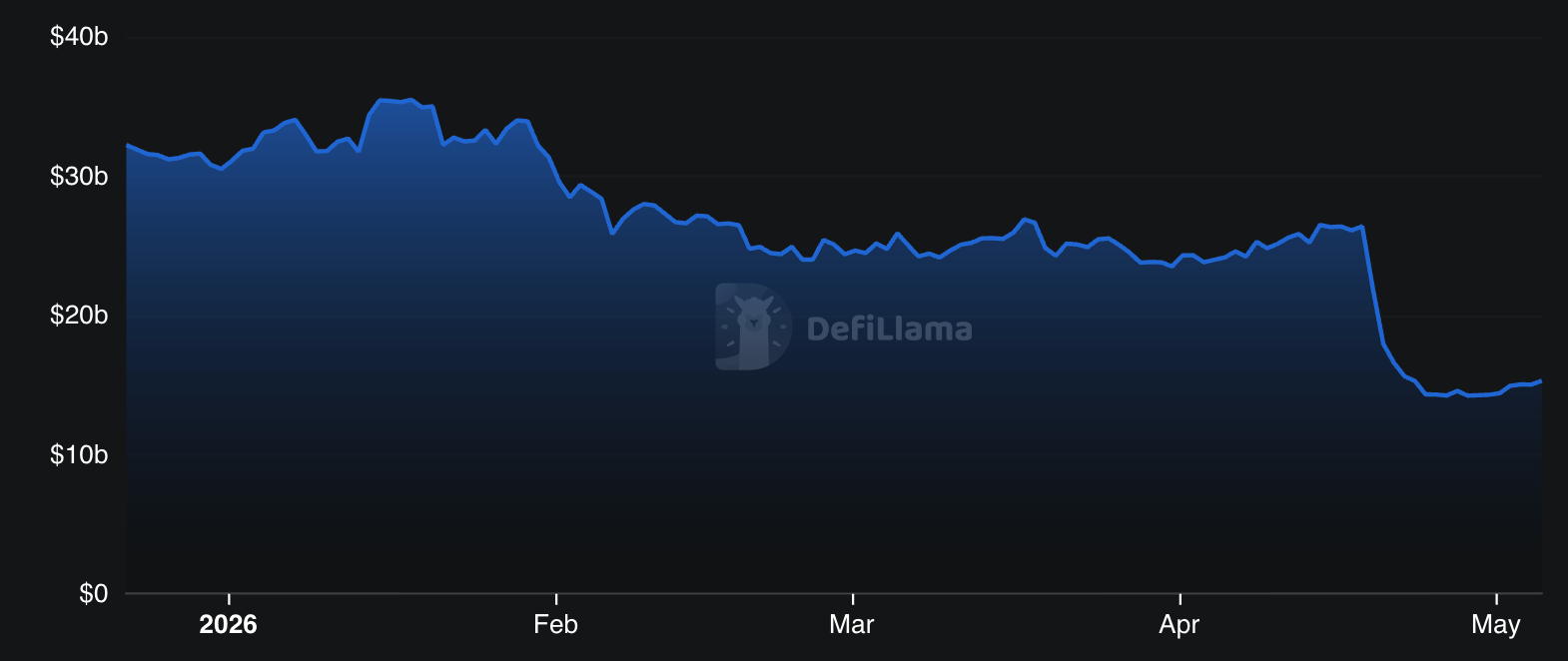
DeFi TVL dropped by over $13 billion across the board. Morpho, Spark, Lido, Beefy froze operations. Trust in onchain finance is the lowest it’s been since the the Terra / Luna crash.
Two markets, one name
These are two different markets that happen to share an asset category called crypto.
The institutional market: Custodied at qualified custodians, accessed through a brokerage, distributed through platforms with fiduciary obligations, dominated by a small number of products. Its bid is recovering. Its volatility is bounded by how fast a wirehouse updates a model portfolio.
The onchain market: Self-custodied or sitting in protocol contracts, accessed through wallets, distributed through frontends with no fiduciary anything, fragmented across hundreds of protocols.
The first market just had its best month in six. The second market just had its worst month on record.
If you’re holding both and treating them as one position, you’re running a portfolio you don’t understand.
The decision that’s actually in front of you
Most of the conversations on my calendar this month start the same way. You’ve been waiting. You’ve watched the cycle. You’ve read the threads. You’re starting to feel late.
The question you’ll usually ask is: “Should I get into crypto?”
After April, the more useful question is: “Which crypto am I getting into?”
The answers diverge sharply.
An ETF allocation is an exposure decision. How much. What percentage. What role in the broader portfolio. It looks like every other security decision you’ve ever made.
An onchain allocation is an operational decision. What custody. What protocols. What counterparties. What threat model. It looks like running a small private bank for yourself, except the threats include nation-state actors who spend six months earning your trust before draining you in twelve minutes.
Those two decisions don’t share a framework. Treating them as one means importing the risk profile of one market into the position size you sized for the other. That’s the version of “getting into crypto” that ends badly. And it ends badly in a way that’s specific to people who entered through hype instead of structure.
The signal April sent
The institutional market is consolidating. The onchain market is in a security inflection that’s about to get worse before it gets better. AI-assisted vulnerability discovery is going to redraw the threat surface for every smart contract running today, and most protocols aren’t ready.
That doesn’t mean ignore onchain. Some of the most interesting infrastructure of this cycle lives there. Hyperliquid is eating TradFi rails. Real onchain credit is a thing and RWAs are ever growing. Prediction markets like Polymarket and Kalshi show true product-market-fit. There’s a frontier there.
But the bar for being there just went up. Position sizing, custody, protocol selection, exit plans, all of it needs to be deliberate.
The two markets are diverging. Decide which one you’re in for any given dollar. Don’t let the price chart fool you into thinking they’re the same trade.
That’s the call.
Thanks for reading Adrian DeFi! Subscribe for free to always receive the best DeFi investment opportunities.

Good opportunities I discovered.
Update on HYPE as the House of All Finance:
Hyperliquid kinda stopped being a crypto exchange in April.
Their April monthly volume cleared 6% of aggregated centralized exchange perpetual volume. New record. The interesting part isn’t the share. It’s the mix.
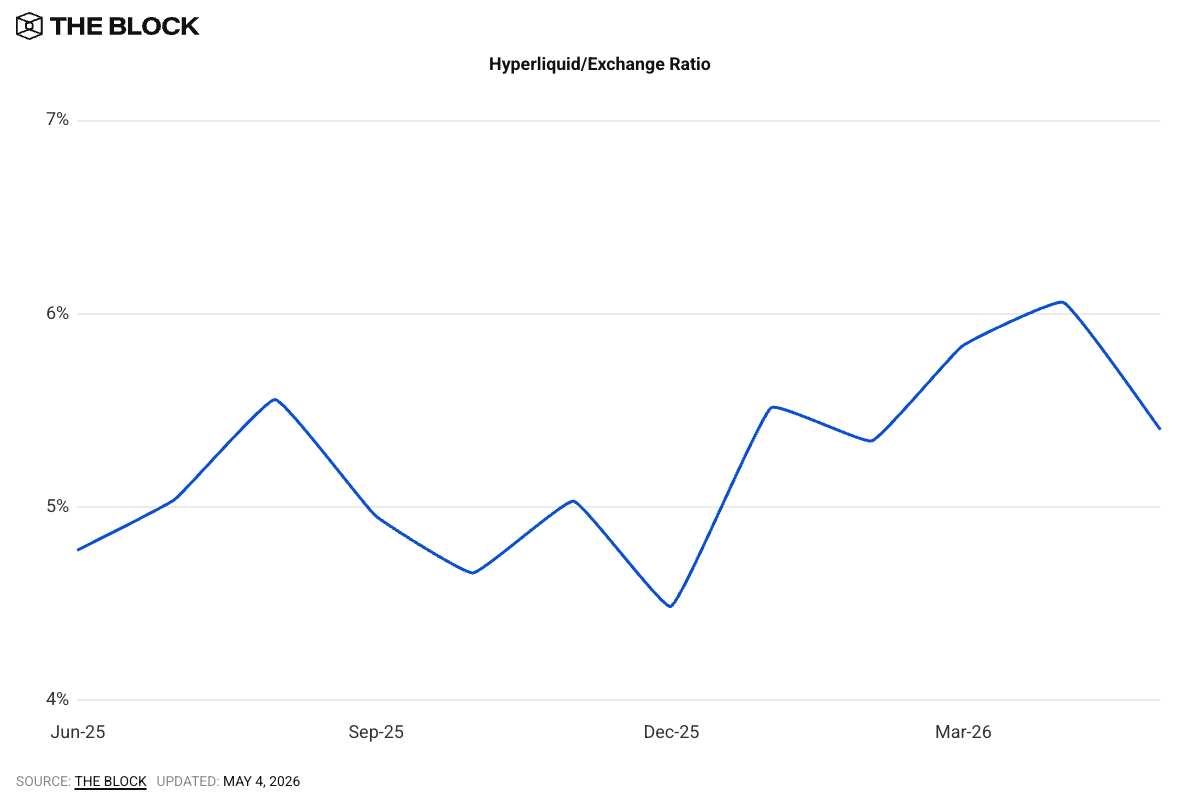
Over the past week, crude oil alone made up over 30% of HIP-3 volume. Equity indices and single-name stocks were another 30%. Crypto perps are now a minority on what’s still labeled a “crypto exchange.”
The 6% understates the structural shift. Most crypto exchanges (Binance excepted) don’t list commodity or equity perps in any comparable size. Hyperliquid isn’t sharing a market with them. It’s building its own semi decentralized niche.
Then on May 2, Hyperliquid launched a new feature called HIP-4. The short version: Prediction markets, built directly into the same exchange you’d use to trade Bitcoin or oil.
The mechanics are clean. You buy a YES or NO share on a question. Something like, “Will Bitcoin close above $80K tomorrow?” You pay less than $1 for it. If you’re right, the share pays $1. If you’re wrong, it pays $0. No borrowing, no leverage, no risk of getting liquidated. The most you can lose is what you put in.
The first market they launched is a daily yes/no on Bitcoin’s price. In the first few days: $8 million in trading volume across more than 4,000 traders.
That’s the surface story. The structural one is more interesting.
Until now, the dominant prediction markets (Polymarket and Kalshi, where people bet on elections, sports, and macro events) were standalone venues. To bet on the next Fed decision, you’d move money over to Polymarket, trade, move it back. Fees on the way in, fees on the way out, capital sitting idle the whole time.
Hyperliquid just collapsed that. The same account you use for Bitcoin trades is the same account you use for “Will the Fed cut rates in June?” No transfers. No idle capital. No extra fees. The menu of questions will expand fast. Elections, sports, and macroeconomic markets are all on the roadmap for the coming months.
This is the most direct threat Polymarket and Kalshi have ever faced. And the bigger picture: Hyperliquid isn’t trying to beat them at prediction markets. It’s trying to absorb everything.
In one Hyperliquid account, you can now trade crypto, oil and gold (commodities), the S&P 500 and individual stocks (equities), and prediction markets. One login. One pool of money. The “house of all finance” they are building is actually becoming reality.
Their HYPE token, popped to $43.73 since then.
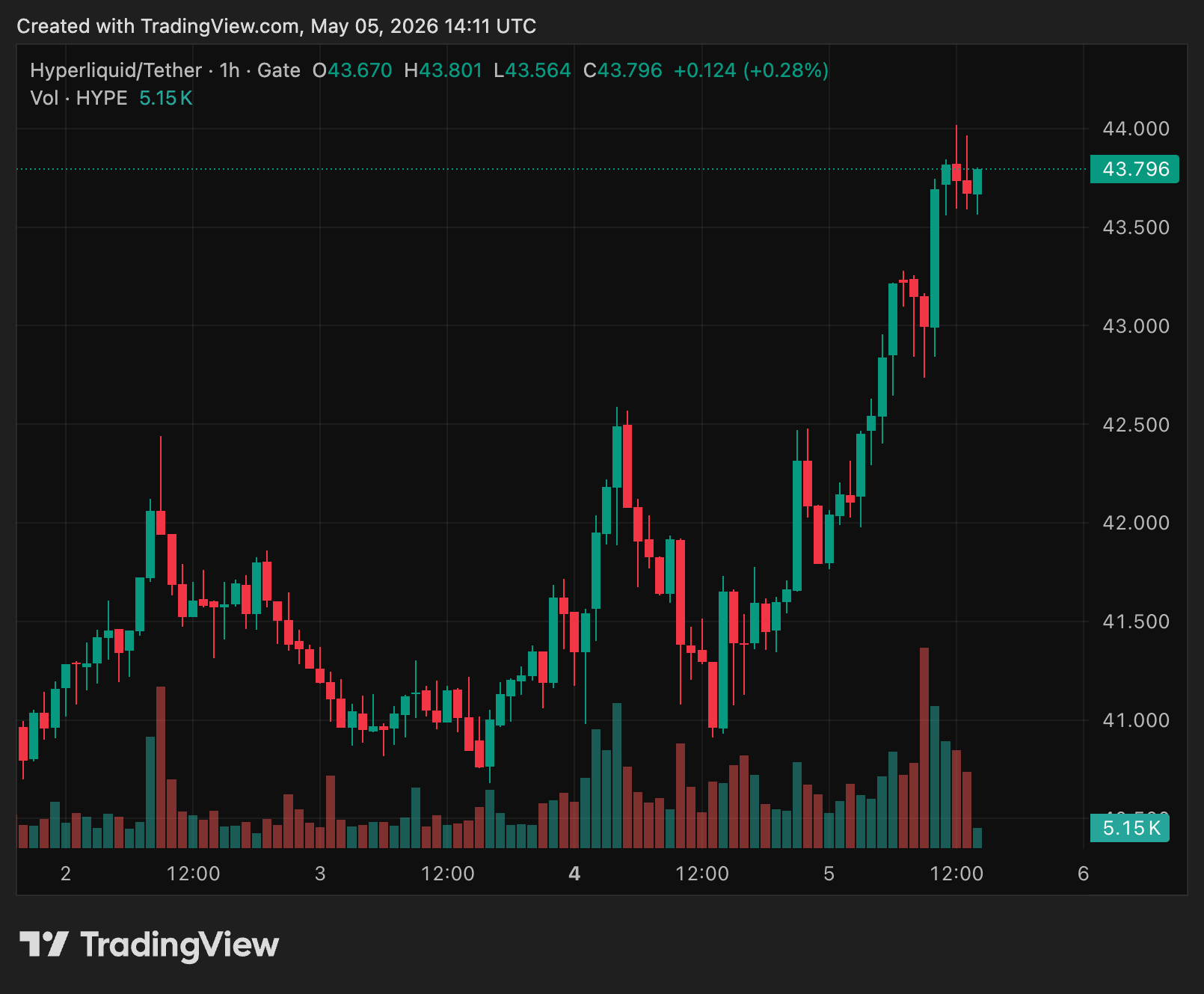
Anchor on what just happened. A single venue (running entirely on blockchain) can now handle oil futures, S&P 500 contracts, Bitcoin trading, and prediction markets, all from one account. That’s five different industries, each with its own dominant players. All of them are now competing with the same upstart at the same time.
Worth watching closely. Especially if you’re starting to think about crypto less as something to bet on, and more as the financial plumbing that other industries are moving onto. In case we see a bigger setback on HYPE I would want to accumulate aggressively.
If you want a straight to the point newsletter full of calls, new projects, airdrop farms, memecoin and DeFi moonshots, then Hix0n’s Confidential is the place for you. I can really recommend his take (if you’re comfortable with high risk).

Alpha on CARDS (an old position you should know about):
I was quite surprised when I discovered a speculative position this week in a trading app that I had opened a few months ago. Sharing the thesis and what I’m watching.
The position. CARDS entered at ~$0.07.
The thesis in one line. Collector Crypt is the dominant platform for tokenized trading cards. Annualized revenue is roughly $45M against a ~$39M market cap, and the team is using revenue to buy back tokens.
That asymmetry doesn’t usually persist. Revenue running hotter than market cap with an active buyback creates an impressive flywheel: Dollars in, supply out. The longer it runs, the harder it is for the price to hold here.
Near-term catalyst. TCG expansion. They started with Pokemon, then added One Piece and Azuki. Magic: The Gathering is the obvious next domino, and MTG is currently the best-selling TCG in the world. Listing it lands directly in a meta with buyers.
Why just a small position. Still a speculative bet and I don’t want to go risk on with substantial capital. More of an undercovered protocol in a niche meta. Launched in September, bottomed a few months ago, just starting to find its base.
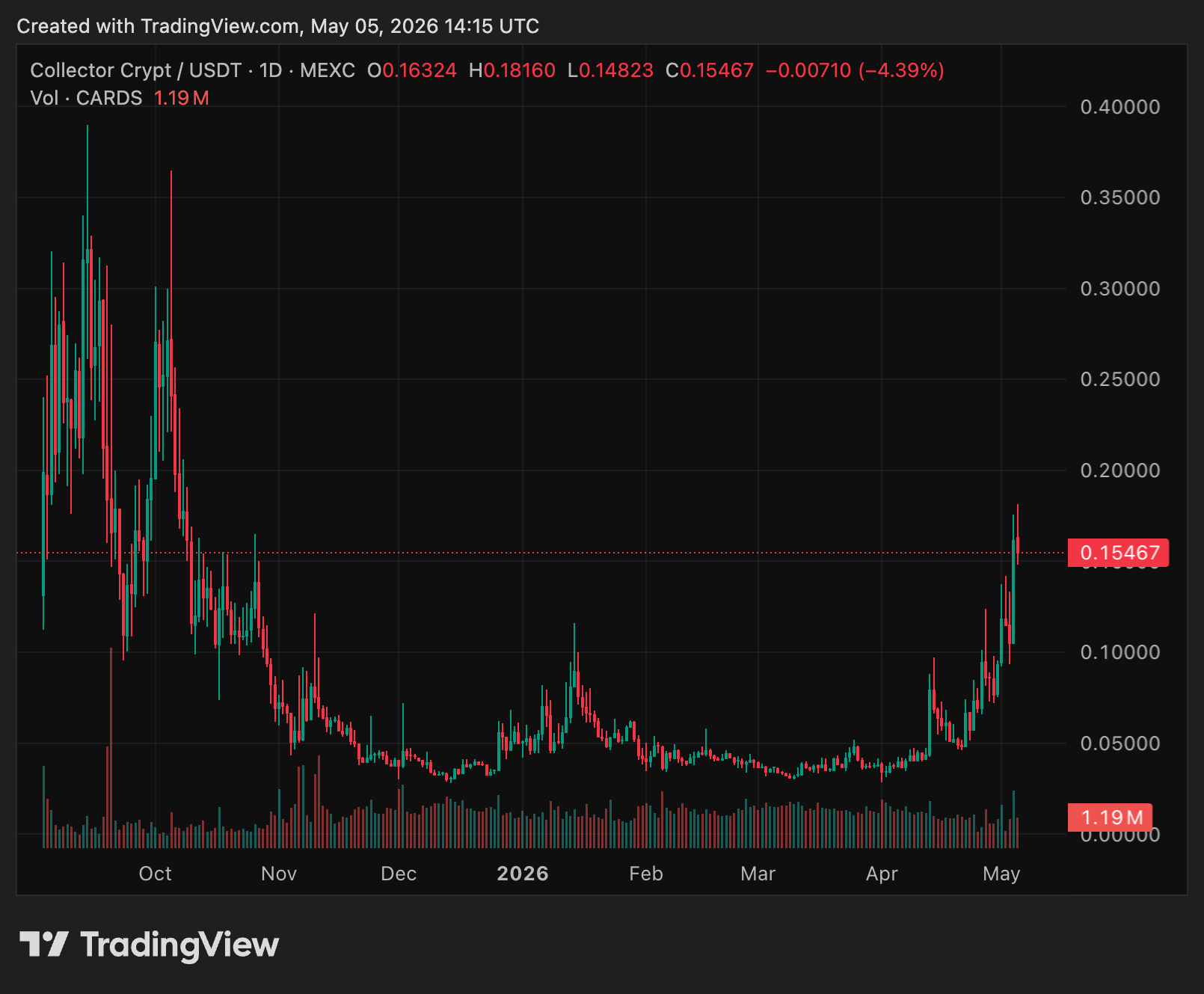
The risk isn’t fundamentals. It’s unlock pressure over the next few months. I’m watching the unlock schedule closely as there is a huge team allocation coming to market.
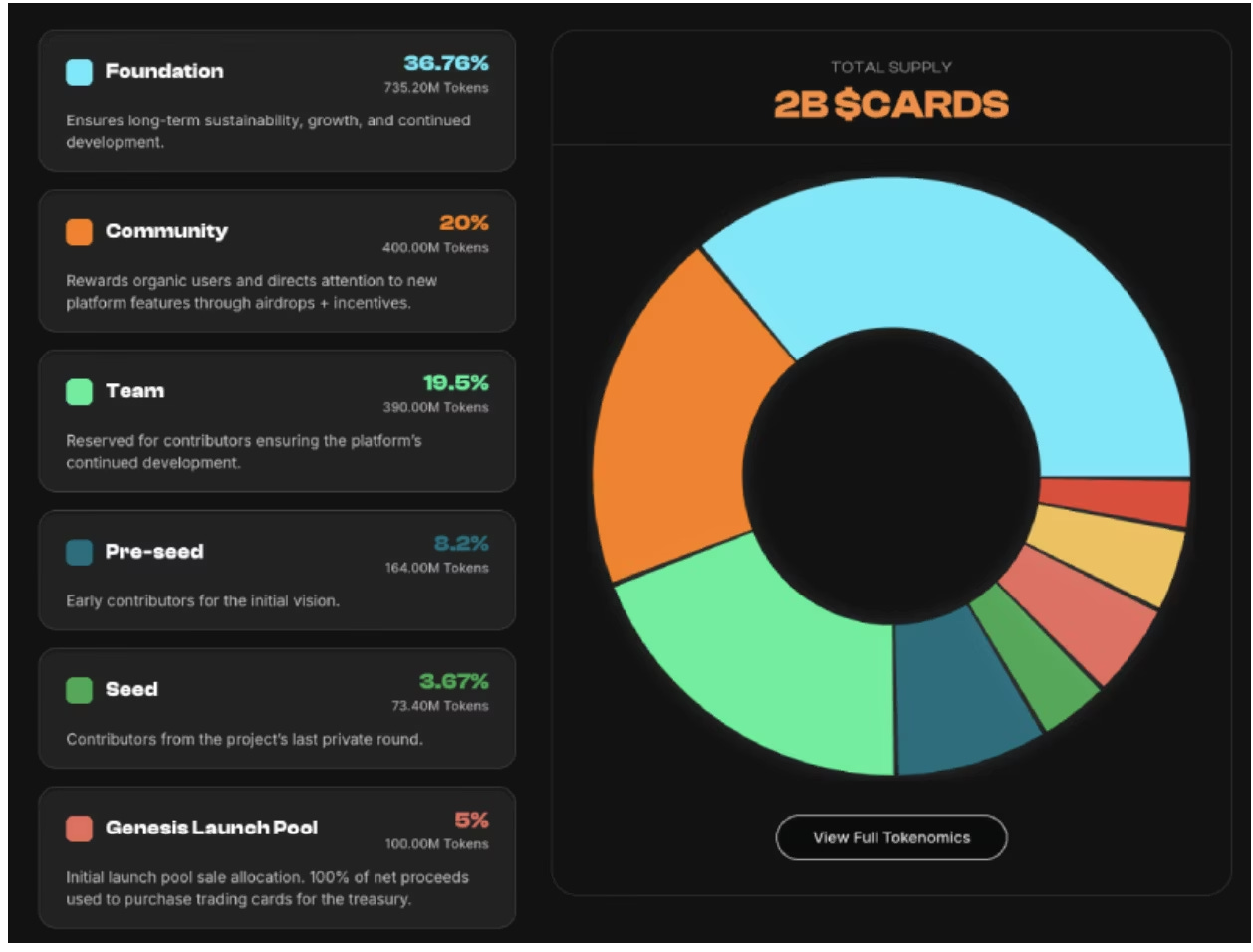
Major unlocks start in September.
• Current circulating: ~257M $CARDS
• Current monthly vesting: ~14.2M
• September circulating: ~300M
• Monthly vesting from September: ~44.6M
• Annualized inflation rate: ~178%
At current price, that’s ~$7M of $CARDS hitting the market every month.
What I’m not doing. This isn’t a long-term core position. It’s a tactical add into a setup with revenue cover and a clean catalyst path. If MTG ships and revenue keeps compounding, sizing up is on the table. Before unlocks meet weak demand, I want to cut.
That’s it for today’s episode, thank you for being here!
Till next time, stay safe!
Comments
Nothing yet. Say the first thing.
Sign in to join the conversation.