
Hey Friend!
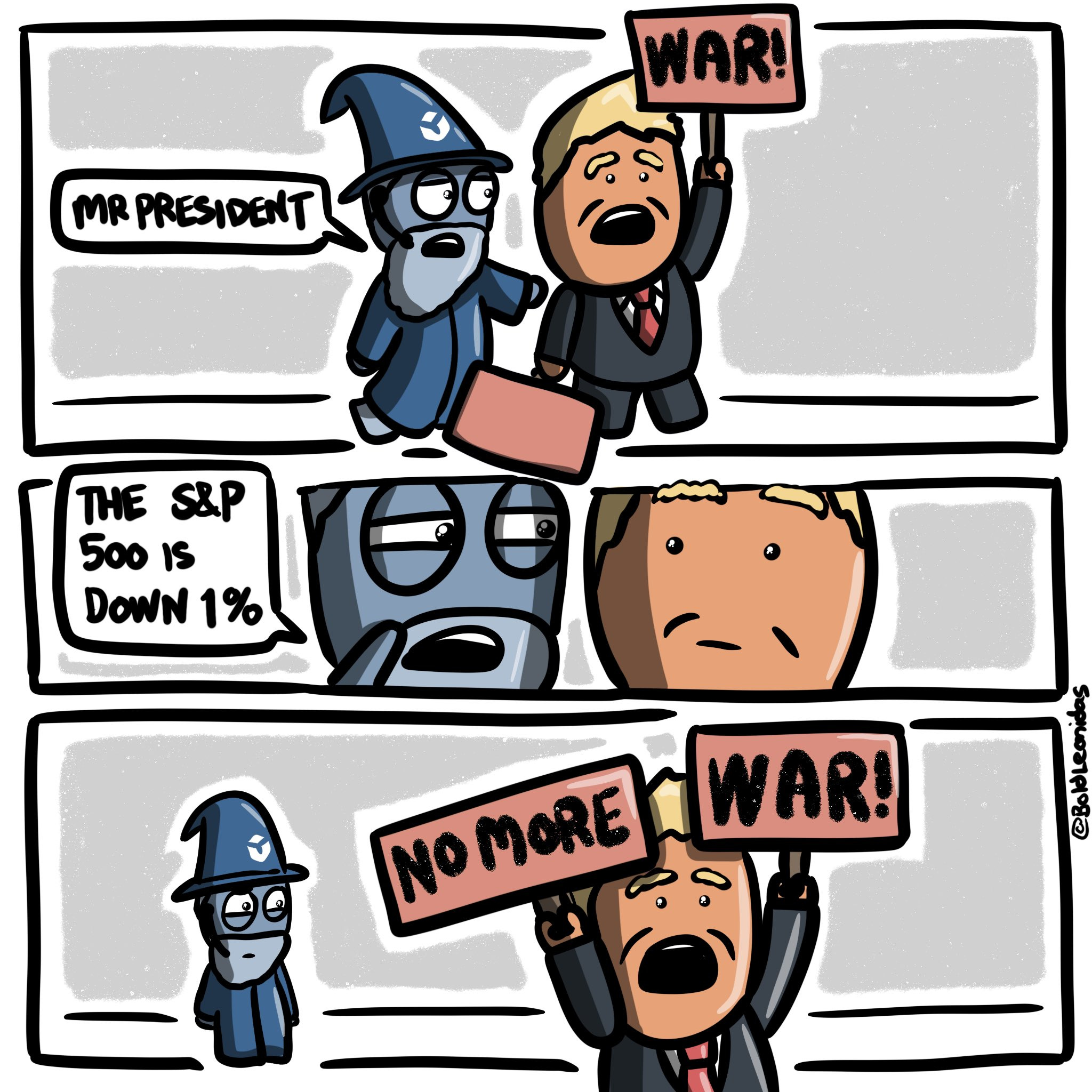
This market still feels like it is trading with one eye on the chart and the other on a war map.
One minute Bitcoin is getting shoved toward 70k on Hormuz panic, the next it is back above 74k because the market realized the headline was ugly, not apocalyptic.
Underneath that noise, the bigger picture is getting more interesting. Macro still looks tense, the Fed still has no easy way out, and oil is back making trouble. But Bitcoin long-term holders are accumulating again, ETF demand keeps catching supply, and tokenized assets are printing new highs.
Messy surface. Stronger foundation.
Let’s get into the broader picture and how to set up for the coming weeks:
📈 Market Update – Bitcoin got punched by geopolitical panic, then ripped back above 74k as escalation fears cooled. Macro still looks messy with sticky 3.3% inflation, elevated yields, and limited Fed flexibility, but ETF demand keeps absorbing supply. Onchain remains mixed short term, while long-term holder accumulation and rising tokenized asset growth point to stronger structural demand underneath.
🐂 Alpha Insights – Aave v4 upgrades the protocol meaningfully, but weaker contributor depth, tougher competition, and execution risk make the token less attractive.

The current state of the market.
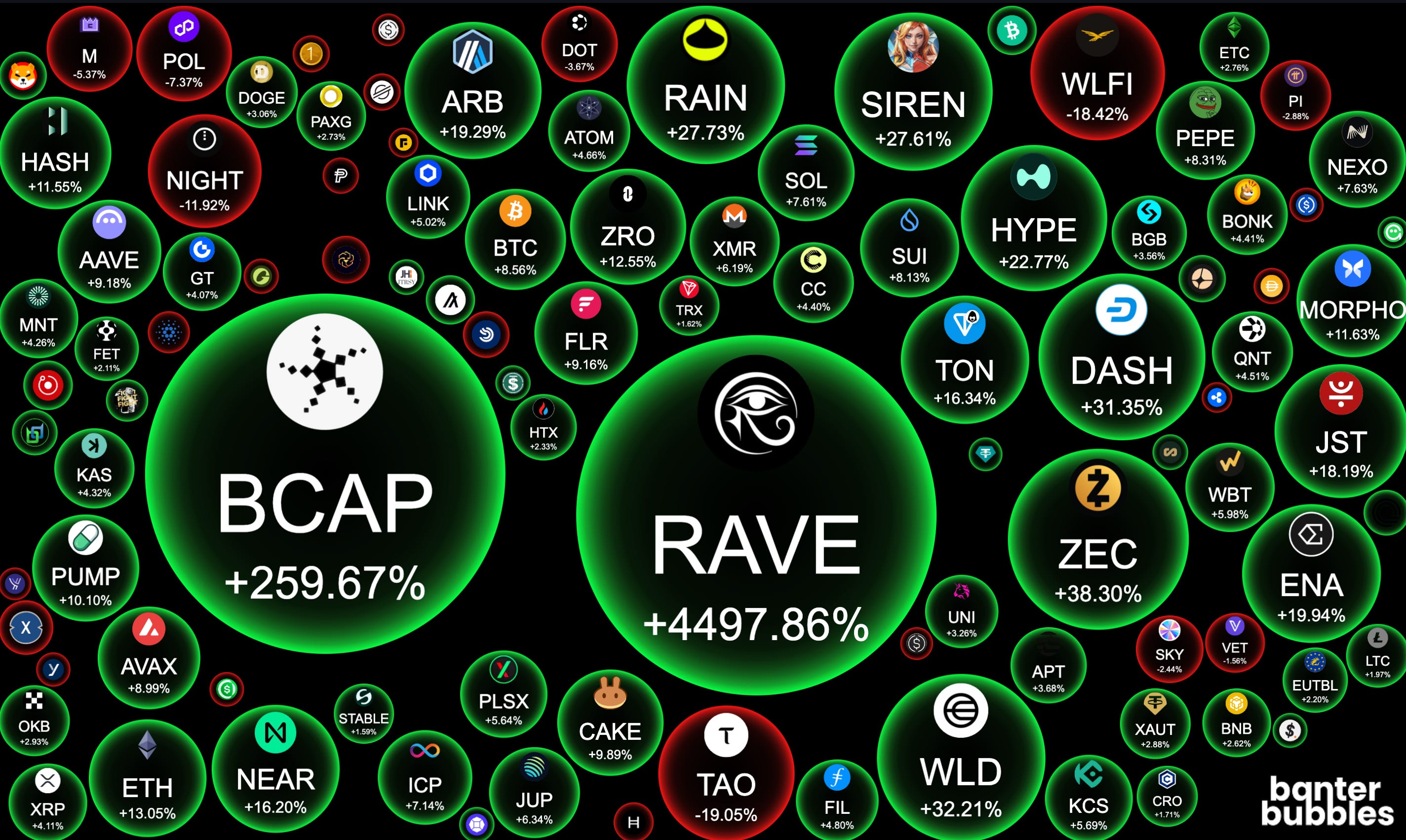
→ The power of Binance Alpha scam pumps like RAVE are immense but luckily we also see privacy (DASH, ZEC) and HYPE performing, so the market is not only pricing speculation but also some fundamentals.
The market got punched by a war headline, then ripped the other way.
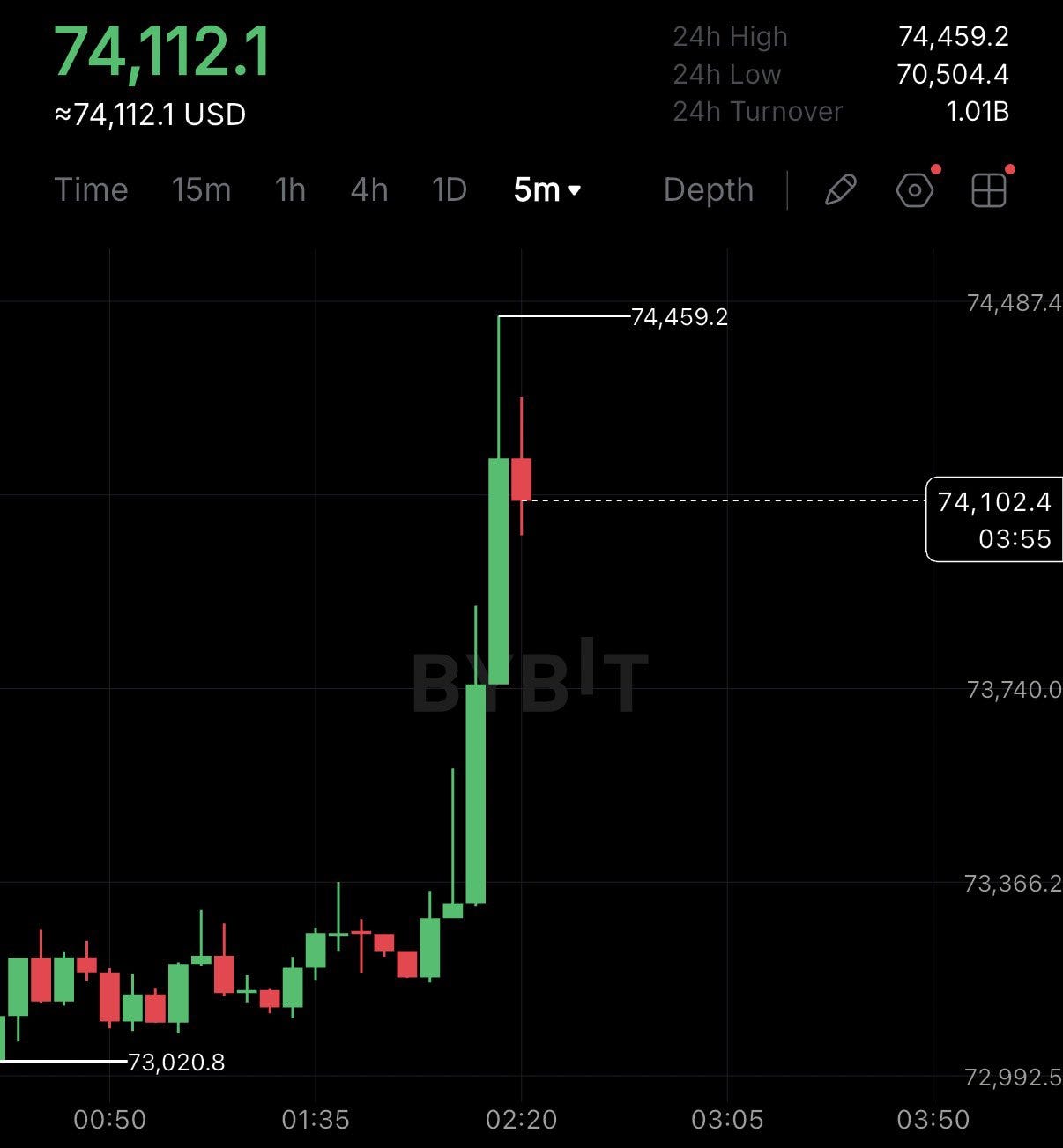
Bitcoin dropped into the 70.7k area on April 14, then snapped back above 74k as panic faded and crowded shorts got run over. This was not a clean trend move. It was a relief rally in a market that had been leaning too hard the wrong way.
The first hit was geopolitics.
After the US-Iran talks collapsed, blockade headlines around the Strait of Hormuz sent oil higher and risk assets lower. Bitcoin followed. Then came the detail that changed the mood: the blockade appeared aimed at Iranian-bound vessels, while broader transit stayed open. That took the market from “full escalation” to “contained shock,” and risk flipped higher.
→ Not peace. Just less chaos than feared.
Then the squeeze kicked in.
A heavy cluster of shorts sat between 72,000 and 73,500 USD. Once BTC broke through, liquidations did the rest. Around 166 million USD in BTC shorts got wiped, helping send price from roughly 70.7k to nearly 75k in about 12 hours.
The broader setup helped too.
US equities closed green despite the oil spike, tech led the bounce, the dollar softened, and the VIX eased a touch. Crypto just became the fastest expression of that relief.
Zooming out, the setup still looks like a coiled spring. Macro remains tense, inflation is running hot at 3.3%, yields are elevated, and the Fed still has limited room to cut. But spot Bitcoin ETF demand keeps absorbing supply in the background.
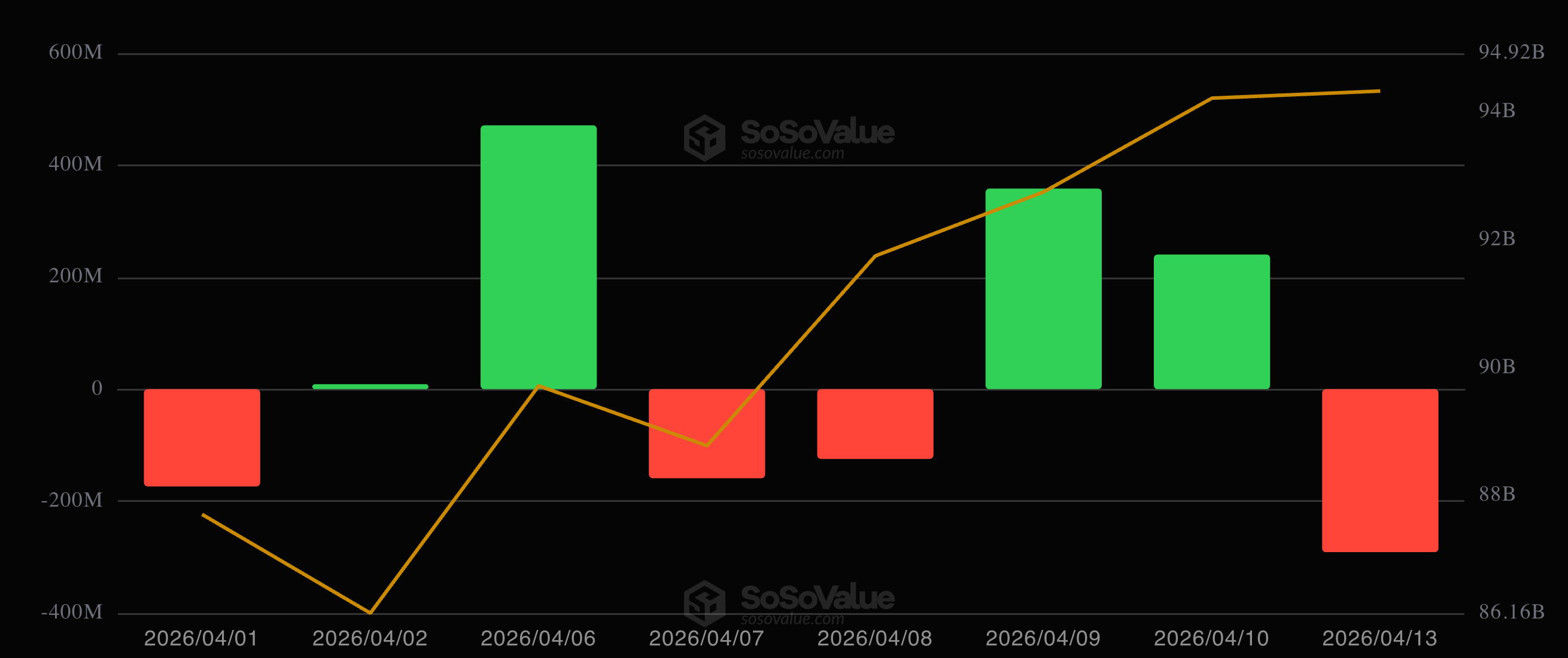
→ Macro is messy, but Bitcoin still has a real structural bid underneath it.
The on-chain read is still mixed short term, but the medium-term structure is getting more constructive.
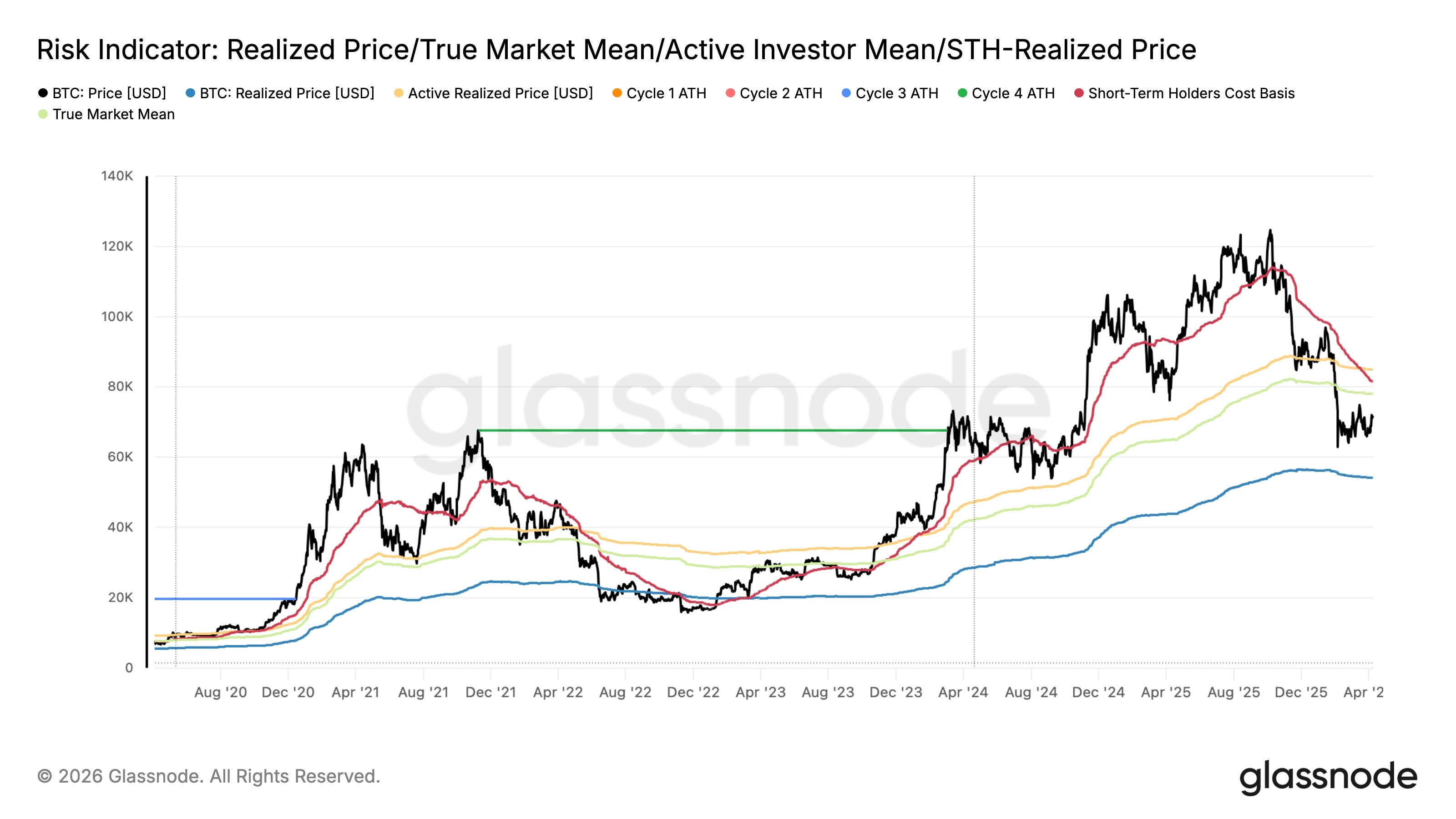
Start with the realized price. This is the network’s aggregate cost basis, based on the price at which coins last moved onchain rather than the current market price. In plain English: it tells you where the average Bitcoin in the network was effectively last bought.
Why it matters is simple.
If BTC trades above realized price, the average holder sits in profit. If it trades below, the market is underwater on aggregate. That usually changes behavior fast, especially for newer participants with weaker hands.
The key nuance here is that older holders and newer buyers are living in very different worlds. Long-term holders still have a much lower cost basis, while more recent buyers entered at materially higher prices. So when the market drops, pressure tends to build first among short-term holders, not the old guard.
→ The deeper cost basis of older holders is one reason this cycle still has stronger hands underneath it.
The Pi Cycle Top Indicator is not flashing a full-blown cycle-bottom signal yet either.
Historically, Bitcoin cycle bottoms tend to form when the Pi Cycle Oscillator pushes above 2.0. Right now it sits around 1.54, which means the market has not yet reached the kind of washed-out condition that typically marks a proper macro low. In other words, this correction may feel painful, but from a cycle perspective it still does not look like full capitulation.
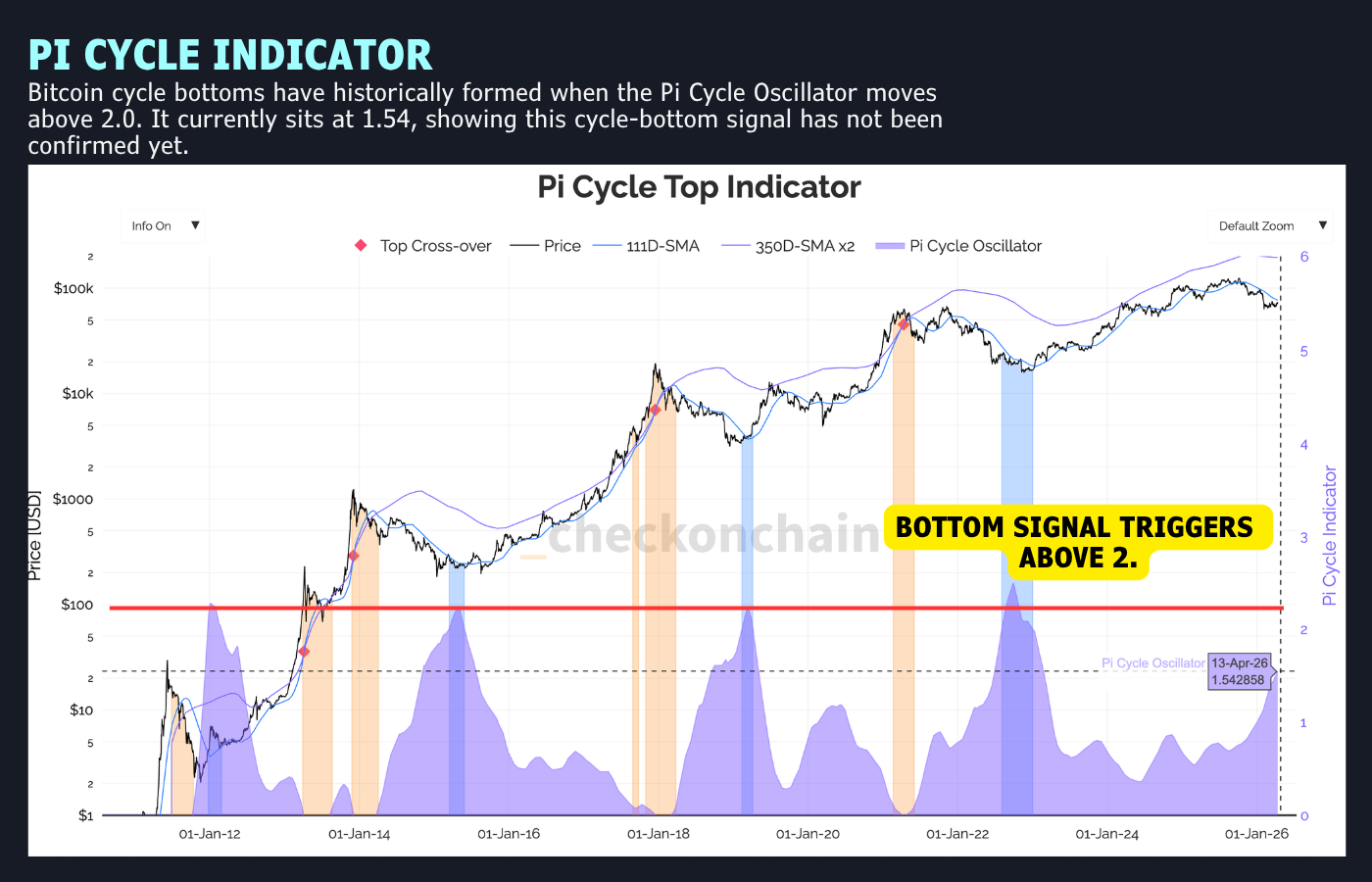
→ Bearish takeaway: if the indicator is right again, Bitcoin may still need one more deeper flush before the market can seriously claim a final bottom is in.
What makes this setup uncomfortable is the gap between sentiment and structure. Traders are already hunting for a clean “bottom is in” narrative, but the Pi Cycle read suggests the market has not fully exhausted downside pressure yet. That does not mean price has to collapse tomorrow. It does mean any bounce from here should still be treated as suspect until the broader cycle reset looks more complete.
Another useful signal: Long-Term Holder Supply Change has turned positive again.
After bottoming near -674,000 BTC in late November, the metric has now flipped back above zero, with roughly +308,000 BTC being added net to long-term holder supply. That is a meaningful shift. It tells you coins are moving back into stronger hands and staying there long enough to age into long-term status.
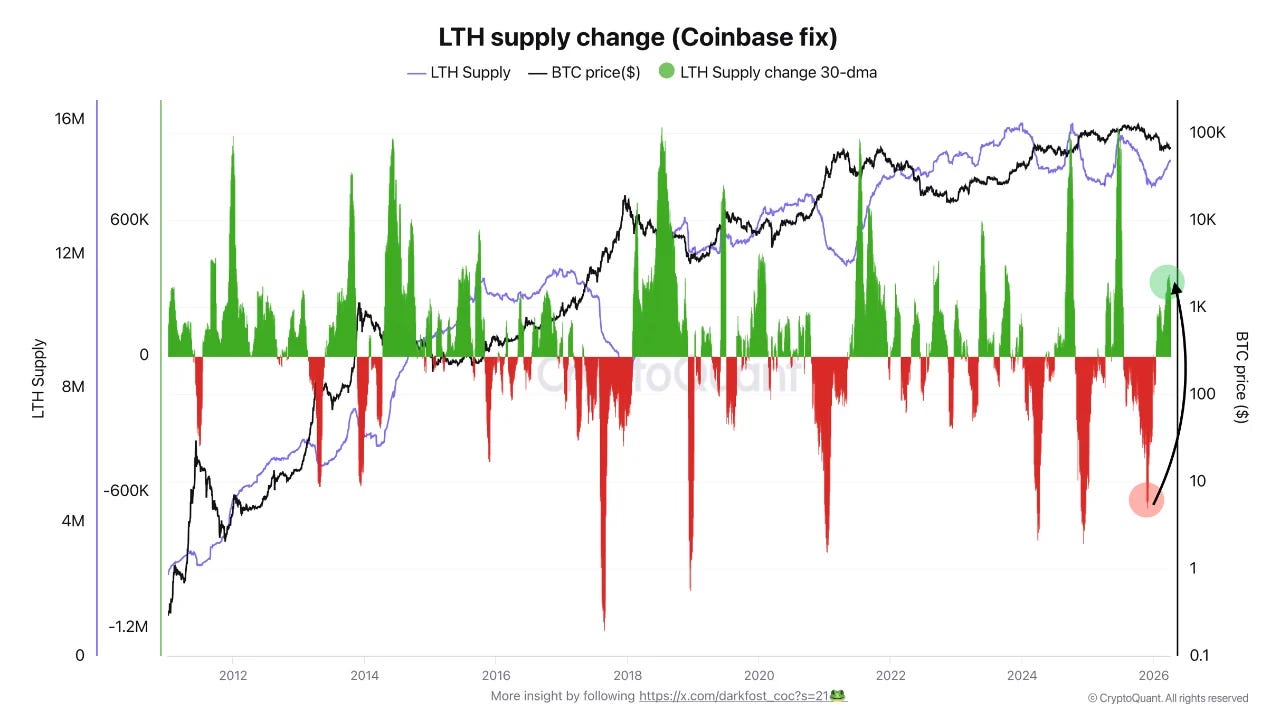
Historically, that kind of transition tends to matter. Not because it guarantees immediate upside, but because it often marks the point where distribution slows down and accumulation starts rebuilding.
Then there is the less noisy story most people ignore when price action gets bad: tokenized assets keep making new highs even while crypto is still digesting its correction.
Since the October 2025 Bitcoin top, BTC has corrected around 52%. Meanwhile, the infrastructure layer kept expanding:
Stablecoin market cap: 300.5 billion USD, up 33.6%
Tokenized funds: 31.3 billion USD, up 146.6%
Tokenized commodities: 5.2 billion USD, up 310.2%
Tokenized stocks: 932 million USD, up 5,135%
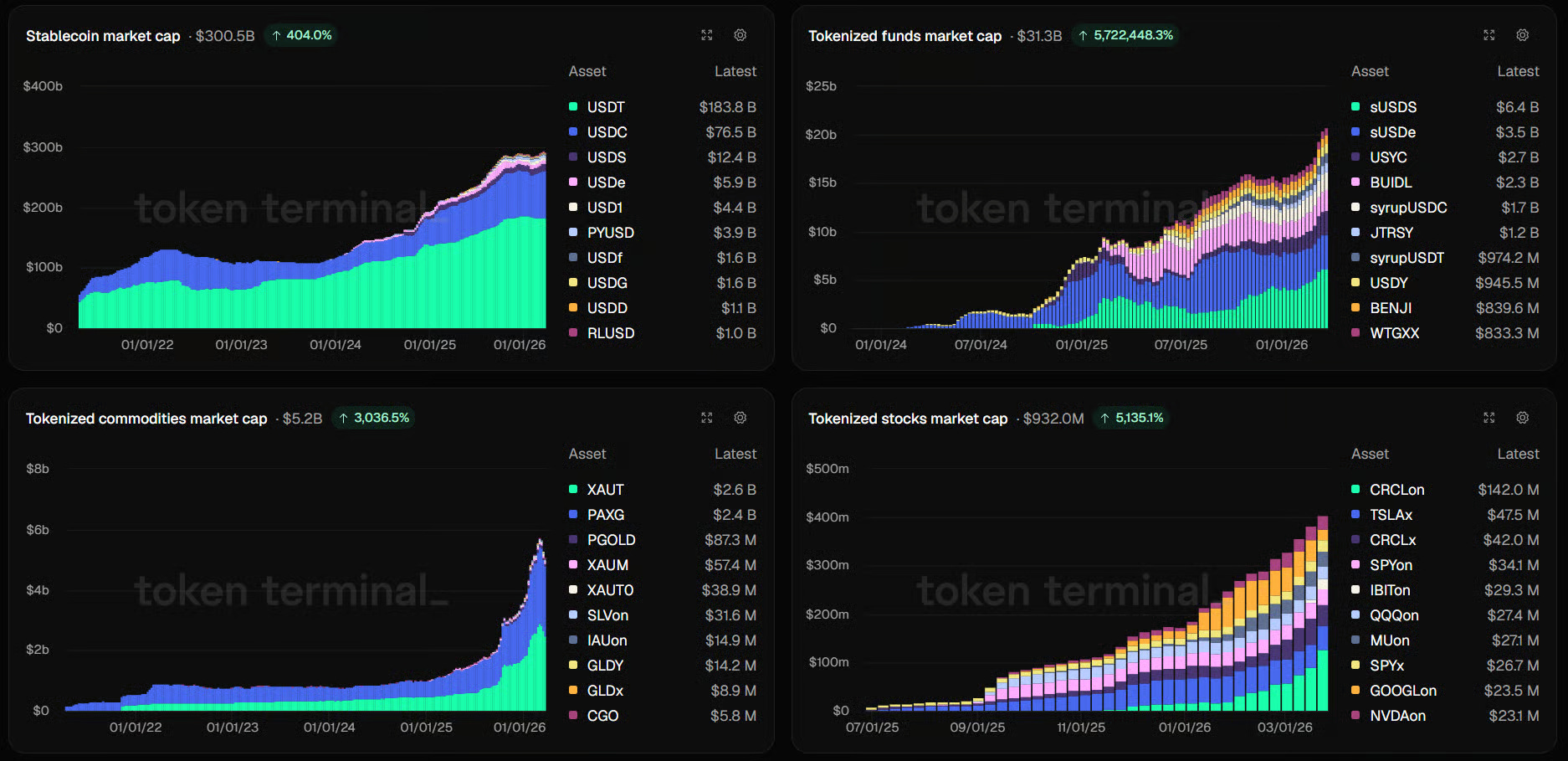
That is the part worth paying attention to.
Speculation cools off, narratives rotate, leverage gets flushed, but the rails keep getting built. Stablecoins grow. Funds move on-chain. Commodities and equities keep getting tokenized. The casino gets quieter for a bit, but the city underneath it keeps expanding.
→ This is the ‘boring’ adoption we want to see for long term success of blockchains.

Good opportunities I discovered.
Aave v4 is a real product upgrade. I still sold the pump.
The reason is simple: I think v4 improves the protocol more than it improves the token and recent developments weakened the Aave contributors substantially.
Aave v3 runs as a set of separate lending markets.
Each market has its own liquidity pool, which means every new product, market, or setup needs to attract liquidity again from scratch. That creates fragmentation.
v4 moves to a Hub & Spoke model.
The easiest way to think about it is one central liquidity engine in the middle, with more specialized markets built around it. That should make capital more efficient and make it easier for Aave to support new lending setups without rebuilding the whole structure each time.
So from a product perspective, this is clearly a step forward.
v4 also improves how risk gets priced.
In v3, two users borrowing the same asset would usually pay roughly the same base rate. In v4, pricing can depend more on the quality of the collateral behind the loan.
That makes more sense.
A borrower posting stronger collateral should not be priced the same as someone borrowing against a riskier asset. It is a more realistic model and, in theory, a healthier one for lenders too.
Liquidations also become more refined.
Instead of the old, more blunt forced-selling dynamic, v4 is designed to handle liquidations in a cleaner and more targeted way.
So again: the system got better.
My issue is the setup around the product.
Over a short period, Aave lost or is losing several of the most important independent teams around the protocol:
BGD was deeply involved in the code and upgrades.
ACI was one of the main governance operators in the DAO.
Chaos Labs handled a major part of the risk management.
That matters a lot.
Because v4 is not a small update or cosmetic refresh. It is a more ambitious system with more moving parts, more complexity, and more need for strong coordination behind the scenes.
Launching a more demanding architecture while the contributor bench gets weaker is not the kind of setup I want to bet on after a pump.
That is the part I think the market brushed aside.
The pump priced in the narrative:
new version, better architecture, bullish upgrade
But it did not price in the harder question:
Who is actually going to execute this at the level needed?
A better design on paper does not automatically become a better investment case for the token, especially when the operating layer around the protocol looks less stable.
The second issue is positioning.
DeFi has changed.
The next wave of lending growth is not just ETH and stablecoins. It is increasingly about:
tokenized real-world assets
structured yield products
principal tokens
more specialized collateral types
more modular risk configuration
That is exactly why Aave is moving in this direction with v4.
But to me, that looks more like adaptation than leadership.
Aave is responding to where the market is going. It is not obvious to me that they are the ones defining that next phase.
This is where Morpho becomes important.
Morpho already has stronger momentum in modular lending and more mindshare around where the sector is heading, especially on the institutional side.
So while v4 is clearly progress for Aave, it does not feel like Aave has suddenly opened a huge lead again.
It feels more like they are trying to close a gap.
And that matters for the token.
Because if the market starts to see Aave as the mature incumbent trying to catch up structurally, then the upside multiple gets harder to justify.
This is the key point.
Aave can still be:
large
relevant
widely integrated
revenue-generating
important to DeFi
And the token can still underperform.
Those are not contradictions.
A strong protocol does not automatically equal the best investment in the sector, especially when the story shifts from leadership to defense.
When I look at AAVE after the pump, I see:
a better product,
but also a weaker operating setup,
higher execution risk,
and tougher competition.
That is not something I want to chase.
So I sold.
Not because v4 is bad.
Not because Aave is dead.
Not because the protocol stops mattering.
I sold because I think v4 improves the protocol more than it improves the token.
If you want a straight to the point newsletter full of calls, new projects, airdrop farms, memecoin and DeFi moonshots, then Hix0n’s Confidential is the place for you. I can really recommend his take (if you’re comfortable with high risk).
That’s it for today’s episode, thank you for being here!
Till next time, stay safe!
No posts
Comments
Nothing yet. Say the first thing.
Sign in to join the conversation.