
I waited for the rental car in front of Hotel Europe amidst a group of Japanese businessmen in black suites. They were taking a smoking break from some tech conference held in the hotel’s conference room. As I stepped into the black Škoda Octavia we exchanged smiles through a thick cloud of cigarette smoke. I picked up my aunt in front of her apartment building just before ten o’clock. Yesterday, my uncle swore he would under no circumstances accompany me and his wife to Rudo. I’m done with damned Rudo, he said. Please convince your uncle son, he knows those treacherous roads like the back of his hand, my aunt said. But uncle said no, no, no, never, leave me alone.
I needed to use aunt and uncle’s bathroom before hitting the road. I’m coming with you, uncle said to me in their apartment, as aunt waited for us in the car. Oh, why the change of heart, I asked. Your aunt expressed all kinds of fears last night, she’s nervous you’ll mess up with the directions, she worries the Serbs will poison her in Rudo, so I’m coming with you. Great, I said, confused as to the psychology of uncle’s change of heart.
When uncle got in the car, aunt, seated in the back, cracked a big smile. What did you do to convince him up there? I beat the shit out of him, I said. Popped him twice right in the kidney. C’mon, aunt retorted. Yeah, c’mon, enough of this shit, let’s go, uncle said. Aunt had brought red roses in a cheap plastic bag. She placed the roses behind the driver seat. She had brought another plastic bag, which contained a plastic bottle unevenly cut in half (a vase for the roses, I presumed) and three bottles of water. That bag she placed next to her on the middle seat.
And off we went. For around half a kilometer, then aunt commanded me to pull over at the neighborhood bakery. She stepped out, but because of swollen legs and all kinds of other health issues (she insisted she was doing fine), she walked the few steps to the entrance with great difficulty.
Between you and me, the woman refuses to see doctors. Myself, pfft, I’ll go to the dentist, the doctor, the surgeon, like I’m going for a coffee, like it’s nothing. I’ve had four surgeries, two for the heart, one for the back, one for my knee, one for my colon, well maybe it’s five. You know, I’ve tried to convince your father to pull out the black remnants of his so-called teeth and do implants, it’s pretty cheap in Sarajevo. Your father waved me off, told me his teeth are just fine. I don’t know how your father chews honestly, though I’ve seen him somehow manage to spear a small piece of pršuta with one of those black tooth shards of his with remarkable accuracy.
Aunt returned from the baker a few minutes later with a small paper bag. Got us sausage rolls. She put that bag inside the bag with the water bottles. Oh, I just got goosebumps, like someone else is here, listening to everything we’re saying, watching us. Yeah said uncle, now that you mention it I feel like someone’s been sitting next to you the whole time. I nodded my head in silence and looked into the rear view mirror, where I saw my eyes looking at us.
I drove the Octavia on Michael Schumacher Street. Uncle said Šumi came to visit a lot during the war, gave a lot of money to kids, there’s a mural of him close by, poor guy, with the coma and all. I heard he was cheap as hell, I said, as if Schumacher was already dead.
***
Yesterday I went to a local bookstore and bought Ivo Andrić’s Turske priče. I wanted to read “Ruđanski begovi” again, as if the story would be a key to better understand the place of my ancestors and perhaps my place in this world.
I asked the staff, a short woman with an air of kind nonchalance and inner strength beaming through her eyes, what are people here reading nowadays, what’s good? She said there’s Štukan’s Blank, check out a short story collection by Ahmed Burić, Hemon if you haven’t read him. Lana Bašta…? I asked. No, the woman said with her piercing eyes, before I could finish saying the writer’s last name. Is there like a new Danilo Kiš, or maybe someone that writes like Borges? No one writes like that here anymore, if anywhere, she said. Literature now, it’s basically like how we’re talking in this moment. Huh I thought, and I also thought: is she a genius or just opinionated?
I bought two copies of Turske priče. One I later gave to uncle and aunt as a gift, because when we spoke at the cafe in Baščaršija right after I had arrived to Sarajevo from Brussels, they said they liked to read good stories. Uncle mentioned reading the Qur’an. Listen, the first time I read, it sounded nonsensical, the second time I felt something stir in the words, and the third time I sensed layers upon layers of truth, each time it opens new doors. After the coffee, on our walk by the Gazi Husrevbeg mosque, we talked about prayer. Something draws me to it, to go there, to pray there, even though I don’t know the rituals or words in Arabic, aunt said, hooking her arm to mine for walking support. I think it’s the intention, like what’s inside your heart, that’s most important in prayer, I said.
***
Andrić called Rudo “the white town of the beys.” The beys were the town’s Muslim elite, essentially a landholding class. Among my Rudoan ancestors I count a few beys, an Osmanbeg great-grandfather for sure, but that’s not part of Andrić’s story.
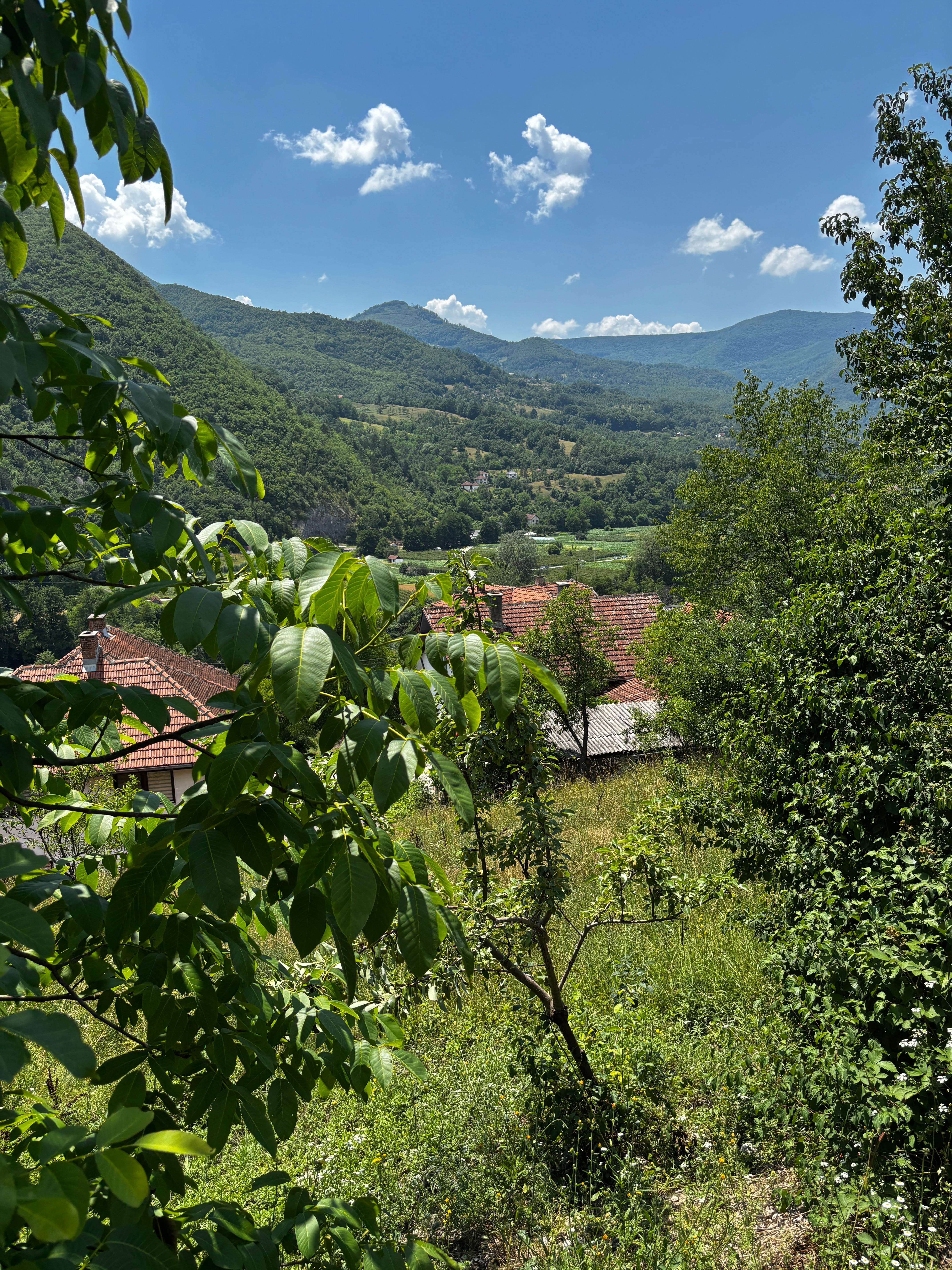
Andrić describes the town something like this. Rudo is dotted with lovely white stone houses and has a beautiful white stone mosque, built from the designs of a great Ottoman architect. Orchards and fruit trees abound in its plots and lush courtyards. The fruit trees make it seem as if the houses are clothed in green cotton. The Lim river with its stone beach offers heavenly reprieve during the hot summer months.
The rest of story goes something like this. It was a day at the end of August in 1878. The beys convened a council to discuss what to do now that the Austrian army had occupied Višegrad and was sure to pass Rudo on its march toward Pljevlja. My father is from Pljevlja, but that’s not part of Andrić’s story either.
The beys had to decide whether to fight or surrender. Andrić ventures a psychological generalization. The beys wanted to surrender while avoid being perceived as cowards by the townsfolk. This hidden desire of theirs, therefore, was utterly obscured in what they said, and revealed clearly only in what they didn’t say. The following duplicitous speech issued from the mouth of Huseinbeg Perlez, the oldest bey, and therefore the one with most authority. Yes, Huseinbeg said, it’s our duty to defend the true faith from the occupiers, but it’s also true that we’re not permitted to die needlessly, to die in service of the enemy’s plans. Since there’s not enough of us in Rudo anyway, if we fight, the ranks of our faithful will surely be decimated by the world’s most powerful army, far superior to our, let’s face it, few puny rifles and men more suited to spiritual matters, land cultivation, and such.
Ibrahimbeg Hamzagić, who came from one of the oldest families in Rudo, dissented from the apparent consensus view, as expressed between the lines of Huseinbeg’s sentences. Ibrahimbeg’s weird loner brother Alibeg, of a “dark mind,” in conflict with his brother, was there too. The truth is, Ibrahimbeg said, the Austrian army can’t go around Rudo and Rudo can’t get out of the Austrian army’s way. Fate has conspired for the Austrian army and Rudo to meet and exercise their wills on each other. Such is fate. We must fight, win or lose.
The other beys thought Ibrahimbeg a crazy suicidal fuck. The final decision was postponed.
The Austrian Feldjägers arrived in their green uniforms not long after the council was held. Seeing no evident resistance upon entering the quiet town, and awed by its beauty, they relaxed and drank from the town water fountain. Ibrahimbeg emerged from some hideout with his pathetic rifle, shot at the Jägers, missed, and got himself killed by Austrian bullets. Alibeg then sprang out from somewhere on higher ground. He too shot at the Austrians, even managed to kill a few, but met the same fate as his brother, with whom he hadn’t spoken in a long time. Thinking there was resistance in tiny Rudo after all, the Jägers retreated to call for reinforcements. When they came back with more troops, every house in Rudo had raised the white flag. The imperial army marched right through town.
***
Romanija, uncle said as we passed through, is full of road bandits pretending to be cops, that’s just one reason why this is a bad idea, why I didn’t want to come.
Not far past Romania, uncle pointed out the Red Rocks (Crvene stjene). They were ancient Illyrian hill forts and burial mounds. Below the rocks ran the medieval “Emperor’s Road,” connecting Sarajevo to Constantinople. The red moniker was coined during World War II, when the Partisan commander Slaviša “Čiča” Vajner set up his headquarters there to launch the region’s first uprisings against Nazi and Fascist occupation forces.
The tunnels past Rogatica, each more terrifying than the other, cut through hard and jagged stone beneath lush labyrinthine mountains, each more beautiful than the other. Before entering a tunnel in the German-run Czech machinery, all I saw was a black hole, because though there were lights in there, they didn’t work. Parts of the tunnels were finished and other parts were left as exposed rock, some of it sprinkled here and there on the road, like oversized bread crumbs.
We drove through the darkness of the longest tunnel. This happened here during the war, uncle and aunt said. Bosniak forces trapped and killed a bunch of Chetniks. A doctor and her nurse were sent out from Rudo to help retrieve the bodies and tend to the wounded soldiers trapped in the tunnel. So much everyone agrees on.
The Bosnian Serbs say this happened next: the Bosniak forces told the two medics to surrender, but they refused, so the Bosniaks threw a grenade into the tunnel, which blew them the two women to smithereens.
The Bosniaks say: the two women tried to throw a grenade at the Bosniak soldiers, but messed up and ended up accidentally killing themselves.
Yet another Bosnian Serb version says: the two women blew themselves up with a hand grenade to avoid being captured.
The doctor, Jovana, delivered me, aunt said. We knew the nurse too. They raised a statue of the doctor and the nurse in Rudo after the war. I’ve seen it, it’s actually okay, not too nationalistic or anything.
How the hell could anyone know what really happened, uncle said.
Serbian flags hung from houses and municipal buildings with increasing frequency the deeper we drove into Republika Srpska. Each flag we passed added fuel to aunt’s sizeable anger tank. She cussed out the Serbs and the Chetniks in byzantine expletives. You know your mother said don’t drink or eat anything in Rudo, they’ll poison us. That’s nonsense uncle said. I doubt they’d poison us, I said.
It was a beautiful sunny day. The temperature outside was 29 Celsius.
***
We drove past the point where the Drina and Lim rivers join, from where the Lim begins to follow its own course, its own fate. The Drina’s green and the Lim’s yellow, when they meet you get that indescribable color of the Lim, aunt said with longing in her voice.
The Lim guided us all the way to Rudo.
We defied the laws of our own reality, venturing through black holes, snaking along mountain forests shimmering like emeralds in the late morning sun.
***
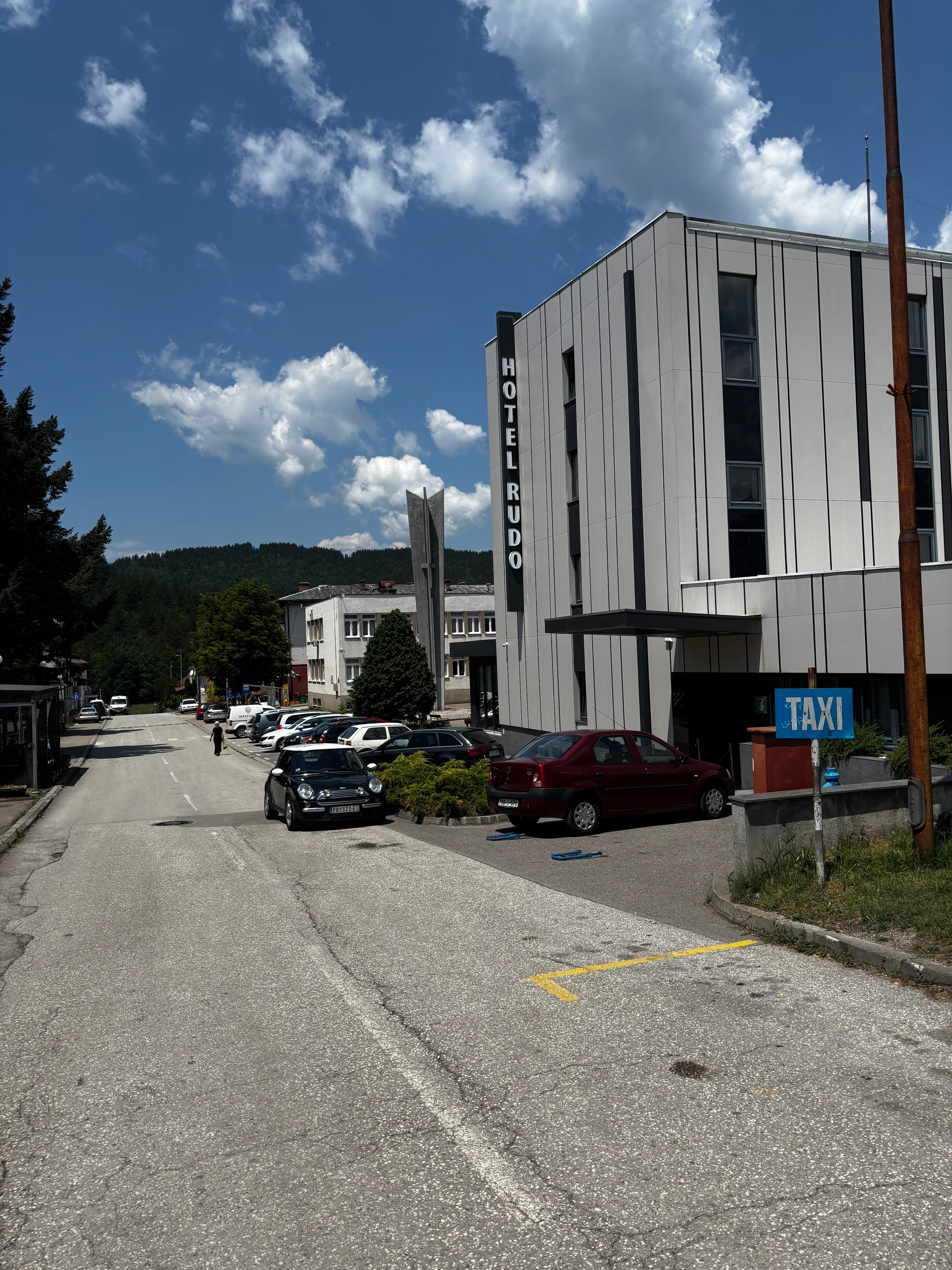
We rolled into town shortly after noon. The Škoda climbed up the street past the hospital to the main square. I parked by Hotel Rudo. I saw a few elderly men in tank tops and big bellies sitting on plastic chairs in the cafe across from the hotel.
Let’s get a coffee in the hotel bar uncle said. I took out my camera from the trunk. Maybe best not to use that here, just use the phone, he said. No, fuck that, I said, I’m using it.
The hotel bar was empty save for a few waiters, who were sitting and looking at their phones by the cash register. The bar was very clean and had green leather chairs and sofas. They were comfortable. We sat down looking out the window that faces the square and the tall Partisan monument. The waiter took our order of what they called domaća kafa.
Uncle tapped his index finger on the armrest. Your father and I would come here a lot, sometimes with your mother and aunt, but more often just us and your brother when he was four, five. It was all very different then. So much more life, a lot of people, people had fun. We loved coming here. Your brother made sure I didn’t flirt with the waitresses. Uncle, he’d say, aunt is home waiting. I’d say, hey your father’s over there, talk to him, bother him! When we lived in Paris in the 70s, working our asses off, and your cousin was living here with your grandmother most of the year, your father took care of her as if she were his own child. Your cousin still loves your father deeply. You don’t forget that, when someone does that for your child. Tears welled up in aunt’s eyes. We sipped on our coffees.
Listen, the day my mother died, uncle said, your father came home to your apartment, he was dead drunk. Your mother told him hey my brother-in-law’s mother died, you have to go to the funeral. Wouldn’t you know it, your father sobered up in that very moment! There was no direct bus or anything, and the funeral was far away. So he went around town asking everyone he knew if they could help him, and somehow, three rides and many hours later, he showed up at my doorstep. You never forget something like that either.
***
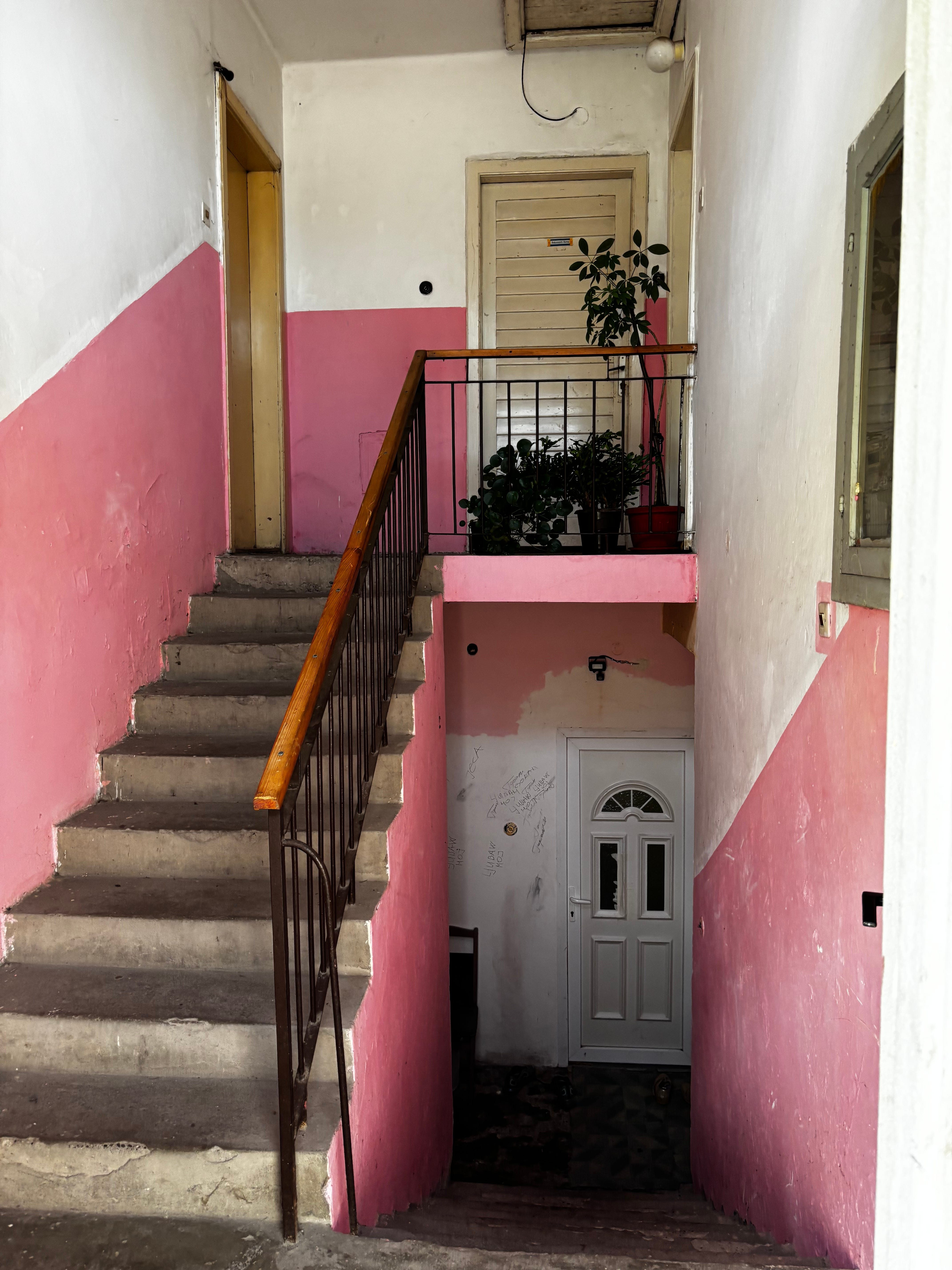
Across the street from the hotel, there was a passageway, its worn walls painted pink. The paint was so bleached by the sun that it made the wall look like an overexposed photo. You recognize it? aunt asked me. Through that passageway, that’s your old apartment.
I took my camera, walked across the street and through the passageway. As soon as I saw the building, also in pink, also bleached by the sun, I remembered. Remembering felt like waking up a leg that had fallen asleep.
I took photos of the exterior, of the mountains beyond the apartment building, of the passageway, of the stairwell, of the steps that go down to the street which used to have a small grocery store, clothing store, ćevabdžinica, but which now only had a betting parlor the windows of which were painted bright red. The photos too felt numb. I didn’t have a reason for taking them. I didn’t have a plan for them.
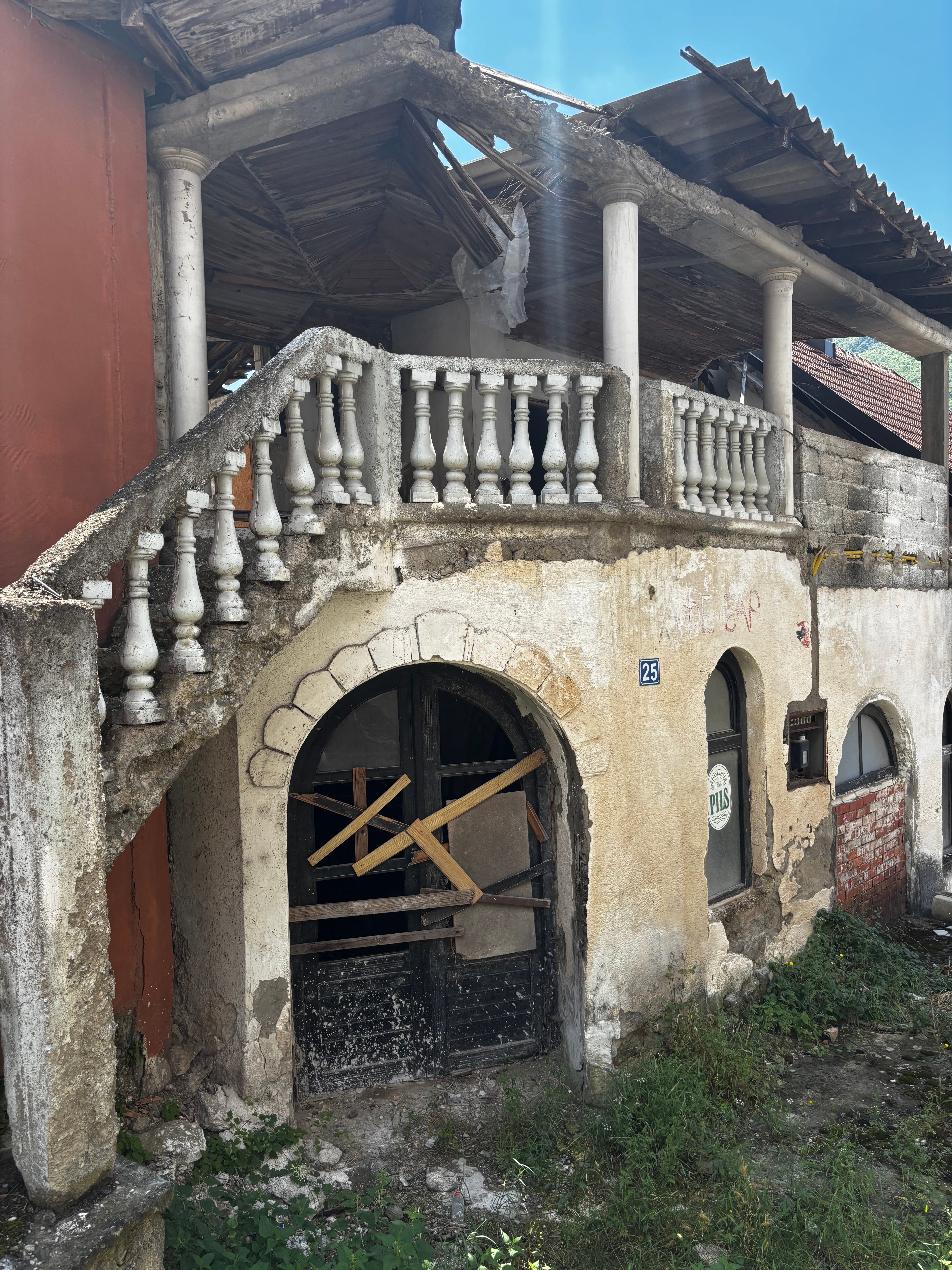
I crossed the street and took steps that led further down to the mosque. One of the buildings, a beautiful old stone house with a veranda, was abandoned. Through its collapsed roof the blue sky reclaimed its dominion.
The white stone mosque was well-maintained. From the courtyard I surveyed the valley and the mountains. Then I walked back up the stairs, across the street, up the stairs again, past our old apartment, through the passageway, and back to the hotel.
If all this seems rushed, it’s because it was. I felt rushed by aunt. She didn’t want to stay there long.
In 1983, when your mom told us she was pregnant with you on one of our visits, we were shocked to hear your father had left her after some big fight. He’d gone to Pljevlja. She told us she’d like to get back together with him, and asked me to go get him. I drove to Pljevlja, and asked around for your father. I ended up meeting your father’s uncle, a giant man with a thick black mustache, a real Montenegrin. The giant said, you and me we’re going to drink a few beers, then I’ll decide if I’ll tell you where he is. I guess he judged my intentions to be good, so he told me where your father was. When I found him, he was dead drunk. I asked him, so do I take care of your kids now? There’s a second coming. He didn’t know. He said let’s drive back to Rudo right now. But I sobered him up first.
***
From the hotel, we drove to my grandmother’s house. The front yard was so overgrown with nettles, grass, and weeds that we barely pushed open the green gate. There was a hazelnut tree and a walnut tree in the front yard. Both were planted after the war, after the family had reclaimed the house from its Chetnik occupiers.
The door to the first floor wasn’t locked. It was kept shut by a blue rubber band. My aunt and uncle paid someone they knew in Rudo to keep the house locked and the front and back yards neat. They cursed out this person.
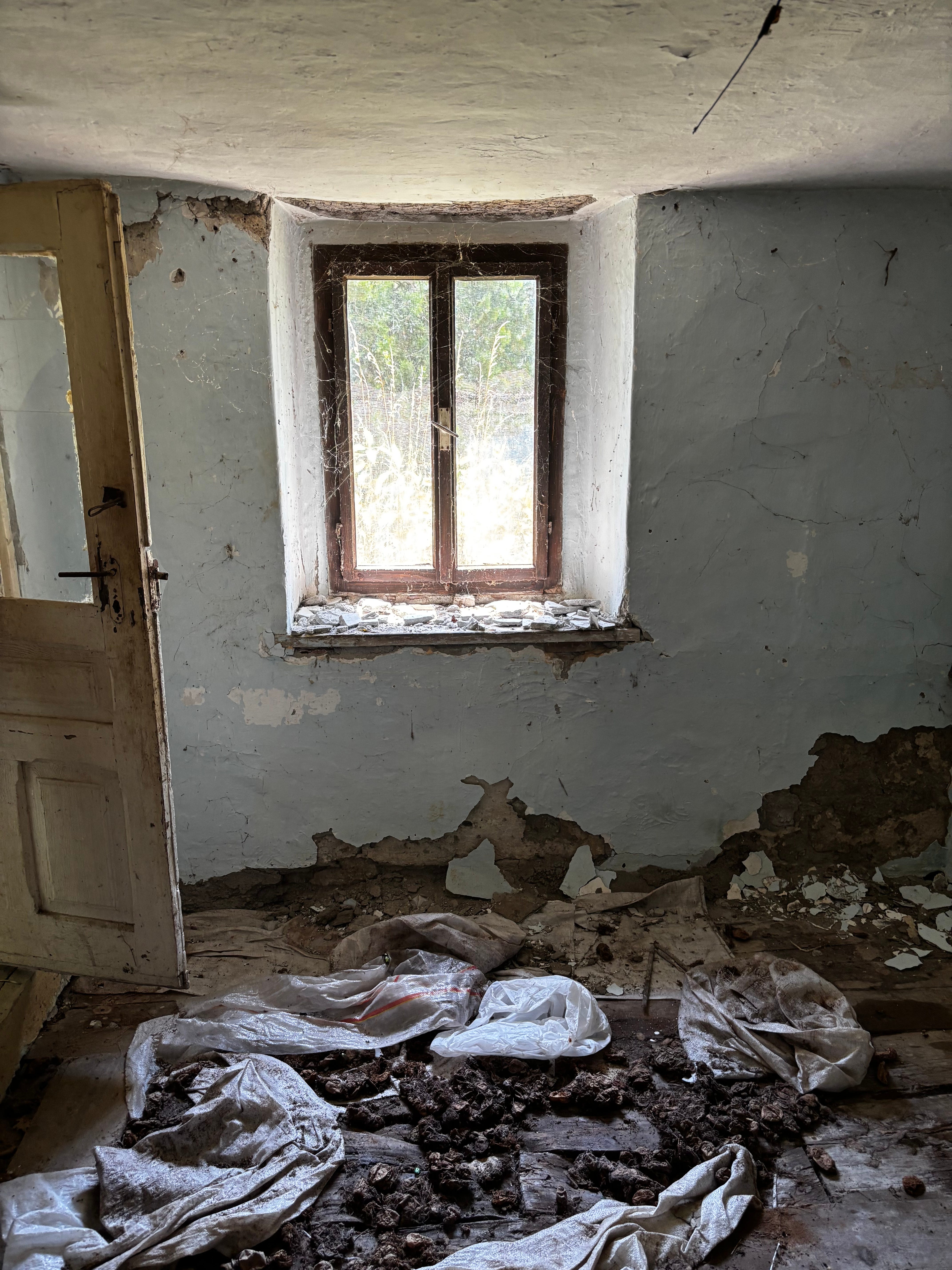
Here they used to be a kitchen, living room and bathroom, aunt said. There were empty glass jars on the deep window sills. There was a dirty thick plastic cover on the floor in what used to be the kitchen. On it were some fruits that had been left to dry. On a door someone had written MILE (a Serbian first name) and MINIRANO (mined).
My foot fell through a floorboard as I listened to aunt. Careful son, the floors have rotted, they’re unsafe, she said.
This is where you and your grandma would sit, chat, drink white coffees. She loved having you around. Do you remember?
Something in me remembered, something deposited in the collapsing floor, the peeling paint, the cobwebs spread across the room like galaxies, the black mold on the walls, the crumbling stone walls, the chimney leaning like the Tower of Pisa. It all seemed so small.
***
We walked around the house and up the slope with some difficulty on account of the overgrowth. Aunt said that’s where your grandfather died, as we passed by the window of a bedroom on the second floor. He lied there in a coma for a week, your mom changed his transfusions.
In the back yard here is where we grew all kinds of things, the soil is so fertile. We’d plant in the summer and we’d have food until winter. Eggplant, tomatoes, leeks, peppers, green onions, potatoes, plums, berries, everything. I put my hand on the soil. It felt like wet clay.
The door to the second floor was closed and locked, but aunt and uncle had trouble unlocking it. Is it the right key you brought he said, yes she said. Then uncle got it to open.
This was your apartment for a few years, this where they brought you after you were born, aunt said, as walked through the door, beneath the cobwebs.
In one of the bedrooms I noticed something that looked like a pancake-shaped fur rug, but something about it seemed off. It was too raggedy, too lumpy, its color pattern of green and brown kind of impossibly mashed together. I hunched over to take a closer look. I saw the tiny paw. And I thought I saw the faintest hint of a little head.
I think it’s a dead kitten, I said. Oh my God, poor little thing, aunt said. I need to get it out. She scooped up the mangled remains with a piece of carton that was resting against the wall. Lifting the cat’s corpse exposed startled worms underneath. They squirmed, as if trying to evade being caught. Ew, ew, aunt said, crushing the worms with her foot. Don’t do that I said, it’s just part of life. She did it anyway.
The roof had collapsed in several rooms. Blackened wires and chords hung from the ceilings like mummified arteries. I tried turning on the light switches, why I don’t know.
In the back yard, the land was being cultivated by I don’t know who. Green onions and green salad shot up like weeds.
What do we do with the house? Do you want to buy it and build something nice on it? aunt said. No, I said. Yeah, of course you don’t, she said. Who wants to live here. I should have given it to that widower after the war. I should have sold it for the 15,000 marks that one woman offered. Demolishing it will cost a fortune, uncle said. But that’s what we should do.
My other uncle, aunt’s brother, told my aunt right before he died that his last wish was to keep the house in the family. Uncle and I said that was a big thing to ask, too big. We said we think it’d be okay to sell the house. But the burden of her dead brother’s last wish didn’t seem to lessen.
***
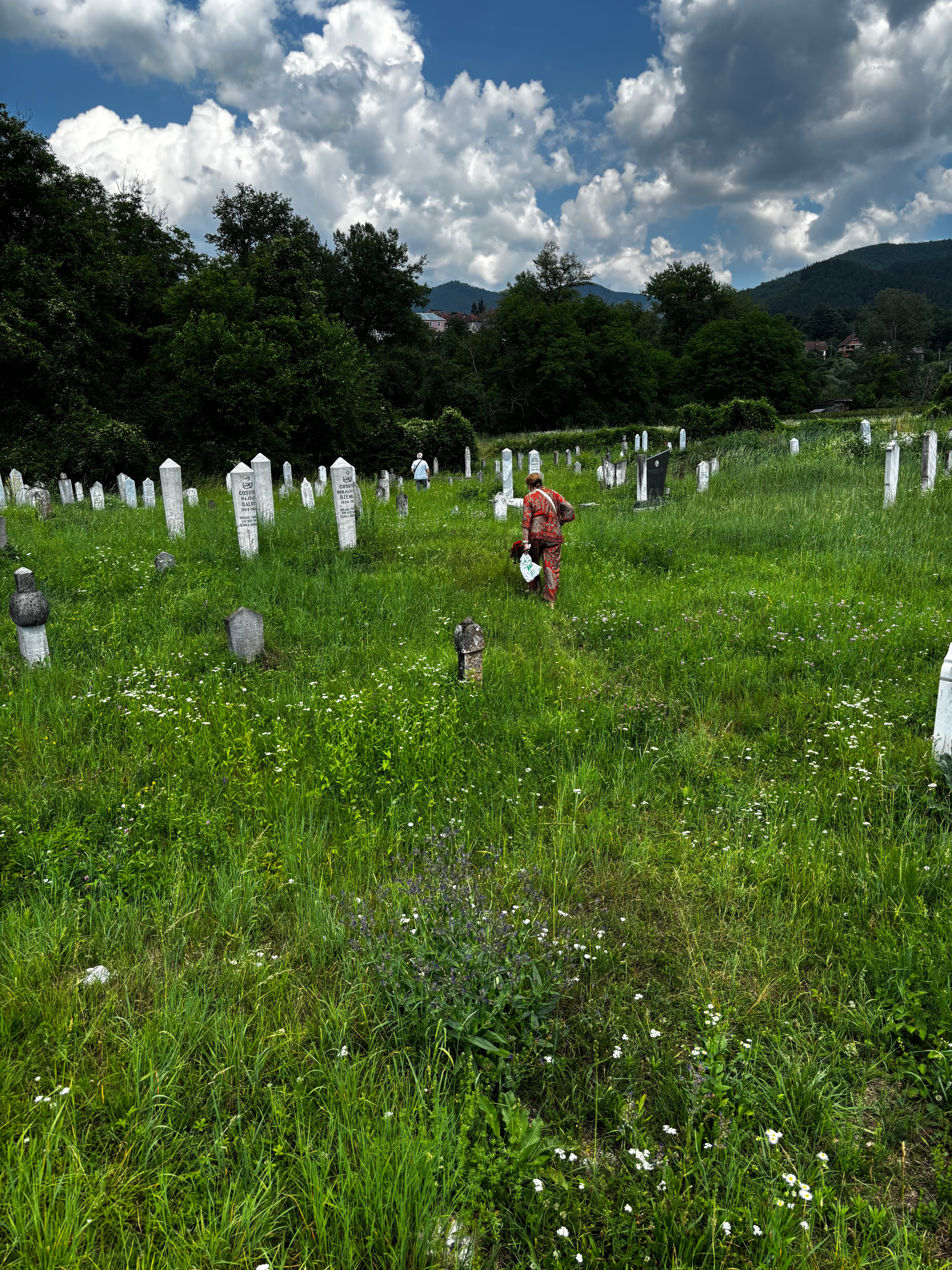
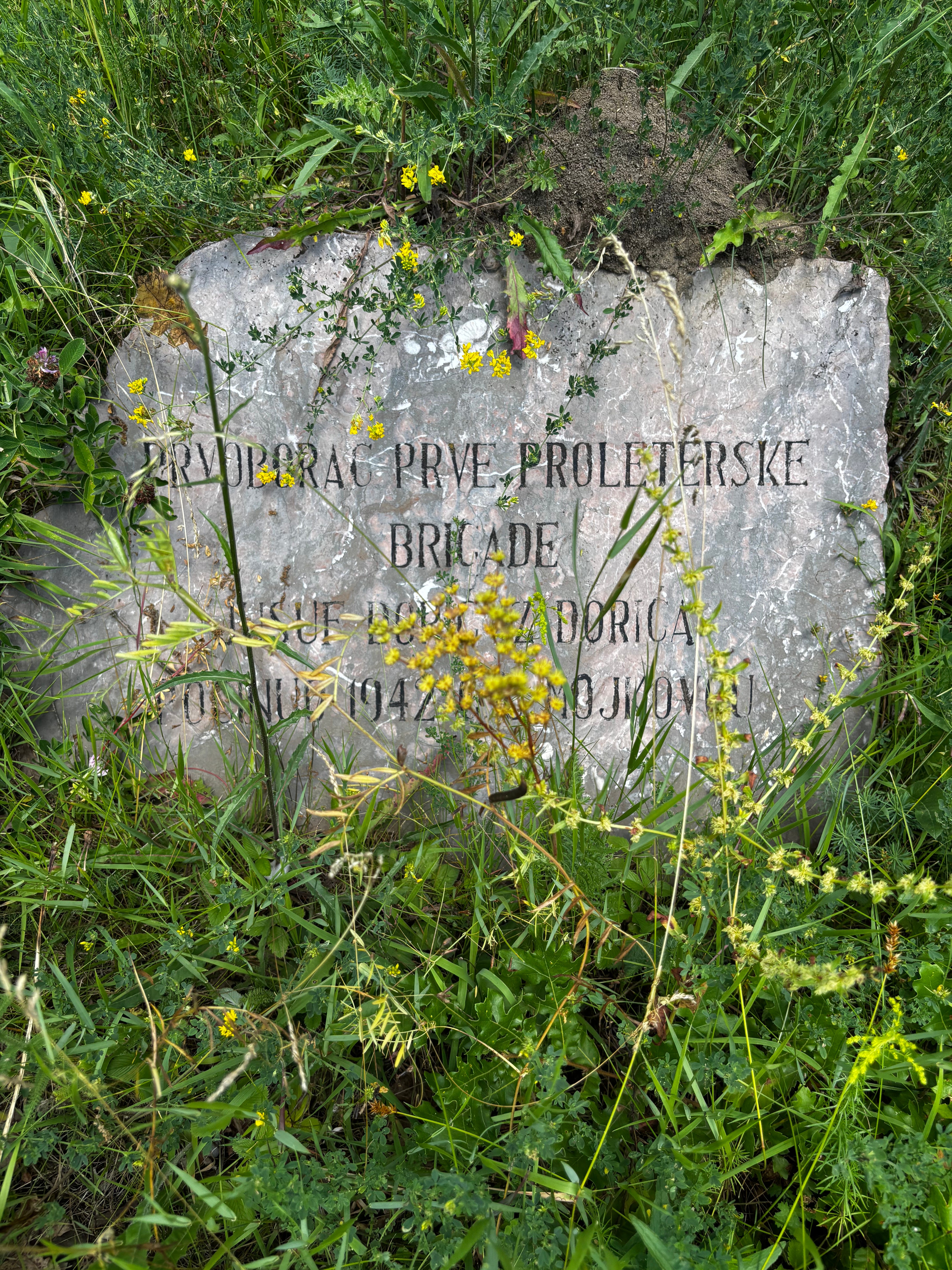
We stopped by the Partisan cemetery on our way out of town. I had a feeling one of my ancestors, Jusuf Dorić, was buried there. And he was. The cemetery wasn’t being maintained. Dorić’s tombstone, like those of his fallen comrades, would soon be reclaimed by the land. This too had its own beauty to it.
We drove over the iron bridge, over wooden planks that really should be solid concrete, and then along the river, until we arrived to the Muslim cemetery.
Hey babo, here I am with your son-in-law and your grandson, aunt said, as she placed the halved plastic bottle full of roses behind the tombstone. She said a prayer.
I remembered when my other uncle brought me here when I was boy. The tombstone has a green star, now worn and not so green. In my memory it was freshly painted. The stone was so white it seemed to send out light. I remembered seeing a blotch of hardened green paint sagging from the tip of the star like chewing gum. I remembered how my uncle flicked the blotch off with his finger, tenderly, and smiled at me. That memory carries a heavy weight, why I don’t know.
Your great-grandparents, my grandparents, lived in a village close to here, aunt said. In 1941, the Chetniks slit their throat as they were walking home one day. Your grandfather was twenty years old, with four siblings. He named your mother after his mother.
***
On our way back to Sarajevo through the labyrinth of mountains and black holes, my mother in Sweden called my aunt. The reception was bad. Aunt couldn’t hear a word what my mother said.
***
I dreamed I was sitting around a table with my wife and some other people I didn’t know. Someone brought a white pizza box and placed it in front of us. I opened it. Inside I saw what looked like a liver but that I knew to be a heart. The heart was beating. It looked out of place. It looked afraid. This shouldn’t be eaten, I thought. I had the feeling it was a chicken’s heart even though it was is as big as what I imagined to be human liver. I closed the lid. I tried to focus on what my wife was saying. But I could hear the heart thumping from inside the box. The box started to bounce to the heartbeat. I opened it again and looked at the beating heart. Nobody else around the table took notice. The first thing that came to mind when I woke up: there’s a heart that’s outside your body. I went to pick up the rental car in front of Hotel Europe.
Comments
Nothing yet. Say the first thing.
Sign in to join the conversation.