
The town where I was born is called Rudo. Tired and worn-out, it sits on the Lim River valley, nestled between brooding pine-forested mountains in the Dinaric Alps. I haven’t been back since we fled in 1992. That was 34 years ago.
I sometimes think I imagined living there. The absence is more pronounced than the memories, but since life abhors voids, the absence carves out contours, like water seeping imperceptibly into the soil, then into the rock, an architect carving out subterranean cities, replete with cathedrals of rock, chambers, passageways, and total darkness, and total silence. Imagine when you stumble over this world within the world with a light?
I’ve increasingly been imagining Rudo as a setting for my stories. I don’t know, it feels like the soul of the place said “I’ll be right back, don’t worry” to the river and the mountains, lifted from the valley, traveled thousands of miles in the blink of a pigeon’s eye, found me, seeped into me, and built all kinds of beautiful, terrifying things in the dark silence of the soul we seem to share.
Maybe that’s why I’ve been feeling an irrepressible urge to go there.
So I’m going, with my aunt, next week.
Rudo lies in Republika Srpska, the Bosnian Serb-dominated entity of Bosnia and Herzegovina. Bosnia and Herzegovina is essentially a Western protectorate, and an apartheid state. There’s even a viceroy. But he’s not called a viceroy. He’s called the “High Representative for Bosnia and Herzegovina.” The High Representative for Bosnia and Herzegovina has these powers, which are called the “Bonn powers.” He can do all kinds of things with laws and rules with those powers. He must feel very powerful, I imagine.
Rudo is the birthplace of the First Proletarian Brigade of the Yugoslav Partisans. One of my ancestors, Jusuf Dorić, joined the Partisans, fought in countless battles (the first brigade, I read somewhere, fought a battle every two or three days, for years), and was declared a hero after the war.
He was estranged from my grandmother’s side of the family, or so my mother tells me. Still, I can’t help but want to know more about him, to insert him in my own story. I found him mentioned in a book called Prva Proleterska Brigada–Sećanja Boraca: Knjiga II. Among other things, the following (euphemized no doubt) can be gleaned about Jusuf Dorić from the book:
That winter, when Hamid joined the Partisan column together with his schoolmate Jusuf Dorić, armed battalions of Serbian and Montenegrin fighters were buzzing festively through the streets of Rudo under the five-pointed star. In those very days, on a snowy field near Rudo, the battalions of the 1st Proletarian were lined up to form the first brigade of the Yugoslav revolution. After the German-Chetnik punitive expeditions against the ‘Užice Republic,’ after Kadinjača and Zlatibor, after the failed attack of the Montenegrin Partisans on Pljevlja, Rudo became a respite in our struggle—and a new milestone in it, given everything it brought to the future actions of what was no longer merely Partisans, but the steadily growing and tirelessly offensive People’s Liberation Army.
A shit ton of Partisans were killed during the war. The Yugoslav state made special cemeteries for these fallen soldiers. They made one in Rudo, where Jusuf Dorić lies buried, I presume, but I’m not sure. I know that they don’t take care of that cemetery anymore. I’ll check it out on my visit.
The Yugoslav authorities erected a bronze statue of Jusuf Dorić in town in the 1960s. The Serbs tore it down in 1992. Yes, the same year they forced my family to flee. Well, to be more precise, they cut off the head in 1992, but the pedestal and chest they left alone for ten years, at which point they tore those down too and threw them in the garbage heap of their glorious history. They also ripped off all the street names and threw the forbidden words into the wasteland of their glorious history.
And that’s how they built a glorious new Rudo.
Rudo has the most dangerous bridge in all of Bosnia and Herzegovina. It’s swallowed cars, and people. But, unlike the communist sites of collective memory, they’re not tearing the bridge down. They put these wooden planks over the messed-up parts, because they said there’s no public money to rebuild the bridge properly. Then the planks broke. Then they put down more planks to fix the broken planks. They’re pretty cheap, these planks, so they can just keep putting on more planks on top of the broken ones, or replace them if need be.
So there it stands in the new history, the green iron bridge over the Lim, refusing to do what it was meant to do: bridge people, let people gaze down into the river and let their souls dip its toes in the water, let lovers sit together in the night to look at the moonlight dancing in the river, bring people to and from work, bring people to and from loved ones, and so on. Seems to me that all that, too, had to go into the landfill of their glorious history. There’s some cyclical infinity of decay going on here. I see before me the wasteland of glory, of victory, of ethno-nationalist purity.
I don’t know how to insert Jusuf Dorić into my story, but you may have guessed that. It’s mostly because I don’t know what my story is, and I have no urge to construct stories, as strange as that may sound. Reflecting on his fate, and the fate of his decapitated bust, and of the bridge’s fate, and the town’s fate, led me to produce this thought, which I’ll emphasize by increasing the font size and putting it in bold:
And once this thought came, its sibling thought appeared:
I have this picture which my cousin took on her smartphone. It’s of my grandmother’s house. Let your eyes wander down and you’ll see it. Do you see the window on the right, next to the door? Look inside. That’s the living room. I used to sit there with my grandmother. We’d bicker over some bjela kafa.
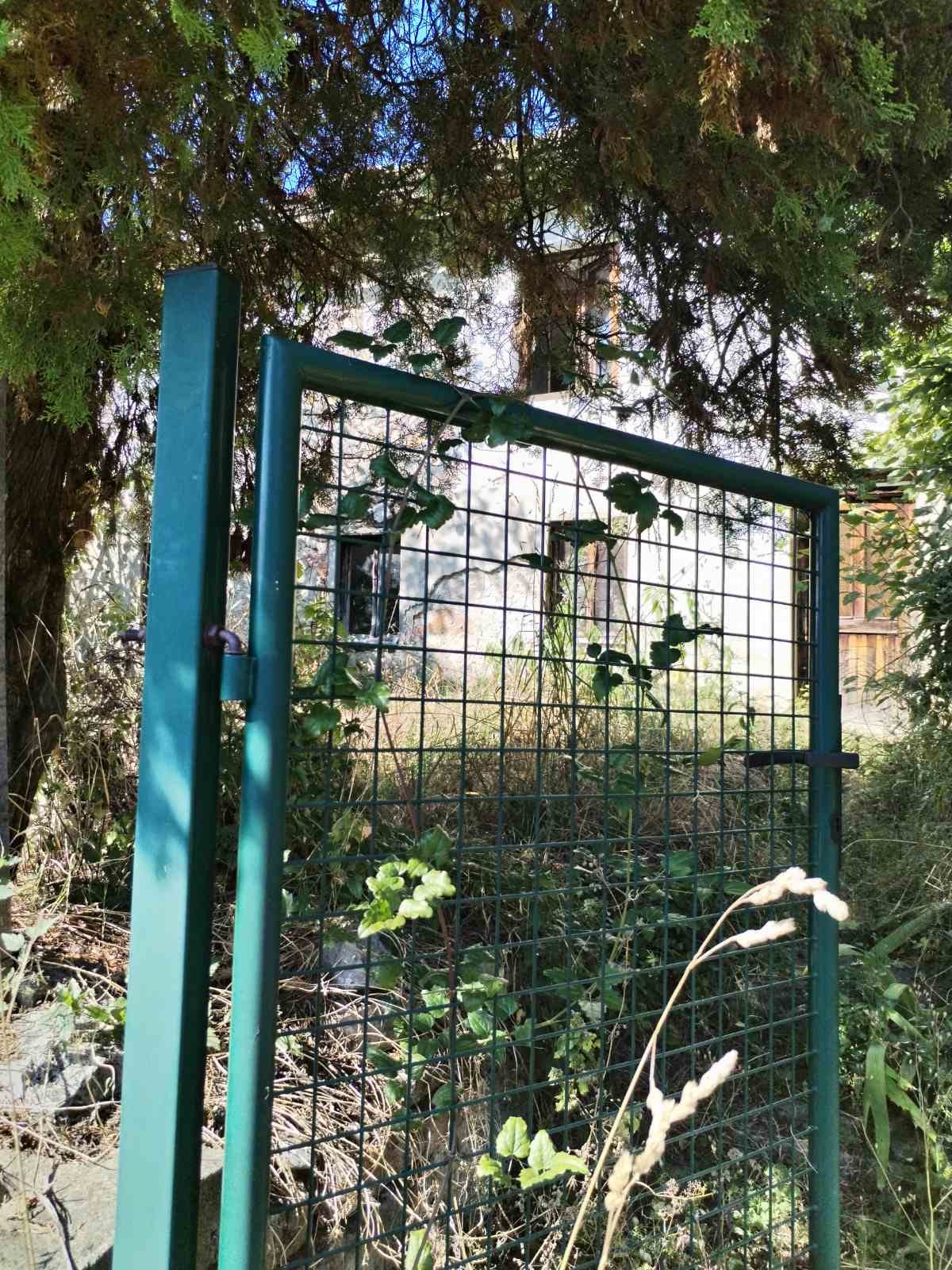
My aunt doesn’t know what to do with the house. Maybe the town, and our ancestors, will let us know when I sink my hands into the earth and pour back whatever it is the town poured into me. I don’t know. I’ll be sure to let you know how it went.
Comments
Nothing yet. Say the first thing.
Sign in to join the conversation.