
Juan Rulfo published a little over 300 pages in his life I read somewhere. Around half of however many words goes into around 300 pages he put into Pedro Páramo, which is widely considered to be one of the greatest Latin American novels of the twentieth century. Borges saw it as one of the greatest novels of all time. I came across Pedro Páramo I don’t remember how, and I don’t know if it’s the best of anything.
It’s like a dream wearing the mask of a narrative. The dream takes the first step, the narrative the second, but since each step is infinitely divisible, the narrative never catches up to the dream. It’s like a space where self and others, past and present, entrapment and freedom, living and dead, guilt and redemption, aren’t aware of their distinctiveness, of their separation. These elemental forces of human existence thus juxtaposed (in a Mexican landscape which seems to cool like the wind, rush like the river, desiccate like the desert, destroy like a storm, burn like the sun, in every word, every sentence) can’t but share a story.
It’s about Juan Preciado, the son, who goes to a desolate town to search for the father, Pedro Páramo, only to find him in stories told by ghosts. The father, the voices of the dead tell the son, was a tyrant, his life cast in tragedy. But what reality can the living find in truths uttered by the dead?
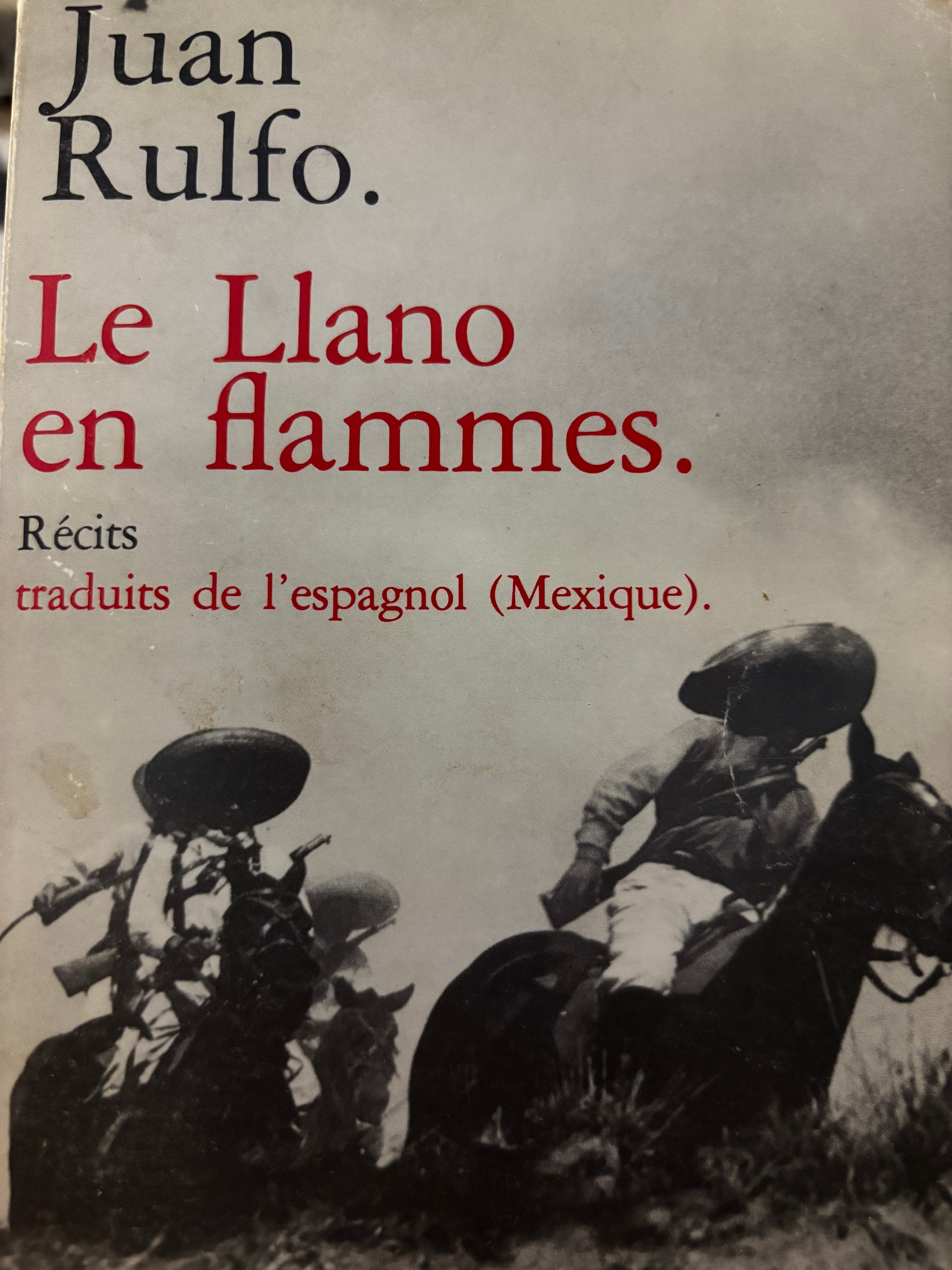
But Pedro Páramo isn’t my book tip. No. The book that occasioned the writing of this juxtaposition of thoughts is Rulfo’s first publication: the collection of stories entitled The Burning Plains (Le Llano en llamas). I found it recently (in French translation) in a secondhand bookstore in the French village St Antonin Noble de Val. I wasn’t looking for it.
The bookstore was nestled, rather inconspicuously, between two expensive clothing shops on a windy cobblestone street. The bookstore had a lot of books about French Marxism. I also bought a copy of stories by Marquis de Sade. The clerk said as I handed him the book: “ooh, never heard of this Rulfo character, much to discover, yes, much to discover. Four euros please.”
On the way to the village, as we descended downward on the snaking road, we passed the French army base in Caylus. I read somewhere that Indochinese colonial soldiers who had rebelled against French rule were interned here after World War II. I read somewhere else that during World War II, following the “great success” of a similar plan during World War I, “Plan Mandel” (named after the Minister of the Colonies) shipped over 300,000 colonial workers to France to help the war effort by working in various industries across the countries. The 90,000 or so Vietnamese within this reserve army of labor, I read in a third place, the French would describe as dangerous cannibals, cat and dog eaters, potential thieves, hypocrites, innocent children. Most were repatriated after the war, but thousands weren’t. Among those thousands, some organized themselves to support the liberation struggle of Vietnam. Last time we visited the area we saw the latest Rafale fighter jets fly overhead. We heard them break the sound barrier.
There’s a story in The Burning Plains called “L’homme.” It’s about a murderer who’s killed a bunch of people. The story’s told as if space, time, and self are illusions. The story’s told as if freedom, evil, guilt, judgment, are inviolable ghostly laws of human nature. He didn’t have to kill them all the murderer keeps saying as he treks a rugged Mexican landscape, follows a river banked by coniferous trees, talks to himself, sees and hears dead people whose voices split the story into a hall of mirrors. As he walks away from the scene of the crime, the murderer walks towards it but not quite in a circle, not quite in memory, the present rather a confluence between his past and future. He has to keep looking back to listen, as if for the first time, as if for the last time, to what he and the others are telling him from the moment of the act where he showed the entirety of his worth as a man. That one act, that one event, the epicenter, the Big Bang, the sun, a wildfire: there’s no looking at it directly, there’s no knowing it directly. There are screams. There are children. There are other sounds. There are traces. There’s darkness in the house, in the dead of the night. There’s a faint light flickering outside the house as he approaches. Our murderer encounters a shepherd who rescues him from the river, feeds him, befriends him. The shepherd gets to tell the story, addressing his speech to the authorities. Yes, I rescued him, I fed him, and so on. Had I known what he’d done, I would have killed him, I swear. You think I’m his accomplice, you accuse me of hiding him? Yes, yes, I can see how it looks. But how could I have known what he’d done, I who am cut off from the world here on this lonely faraway mountain with nobody but my sheep as company? No, I would have killed him myself had I known, I swear. Alas, who are we to believe? The murderer, the shepherd, the authorities, the ghosts speaking to God knows who? As for the murderer who’d found out exactly who he was, we’re told all that was left for him to know was where he was, and that only for the briefest of moments, before that too was denied him.
We actually stayed in Vaour and drove the fifteen minutes to St Antonin Noble de Val to check out the Sunday market. Shortly after we arrived to Vaour, we saw a white Peugeot 206 stranded helplessly in a ditch. An old villager, we later learned, had driven drunk at nine in the morning. “I see no reason in playing it safe.” I know this because the family we visited in Vaour know the old man.
The family said this: there’s an older man who lives in the woods. He’s a recluse hoarder. This is his life: he walks around from house to house, enters when no one’s at home, takes things, all kinds of things, but gives them back if you ask for it. He came over to M.’s mother’s house one day, when M. was house-sitting. He presented himself with some cloth in his hands. He said: “Your mother must sow me new clothing, it doesn’t befit a man to engage with such womanly activity.” M. said fuck off, or something to that effect. The old man didn’t speak with her for two months.
I asked M.’s husband why alcoholism is rampant in Vaour. He said something like: there’s not much here by way of work, opportunity, and entertainment. It’s all farms around here, not much of a tax base. There’s a tiny store open two days a week, selling the bare essentials. A food truck comes in once a week, marking the biggest happening, social event, and networking opportunity of the week. There’s a crew of volunteer fire fighters who kind of know what they’re doing if the fire’s small.
Wildfires were raging not too far from Vaour when we arrived. One of the volunteer firemen, fancying himself competent, drove to the perimeter of one of the wildfires, presented himself in flip flops to the professional firefighters and said he was ready for duty. You’re ready to go back home they said.
The night before we left for Vaour, we woke up around midnight to the smell of smoke outside. We were reminded of Oakland seven years ago, when the horizon turned sepia, when the sky crackled like a camp fire, when the air suffocated. Earlier in the evening, as we bathed in the setting sun’s cascading light over the parched mountains, as we prepared to say goodbye to each other the next day, we noticed the birds had gone quiet.
Comments
Nothing yet. Say the first thing.
Sign in to join the conversation.